
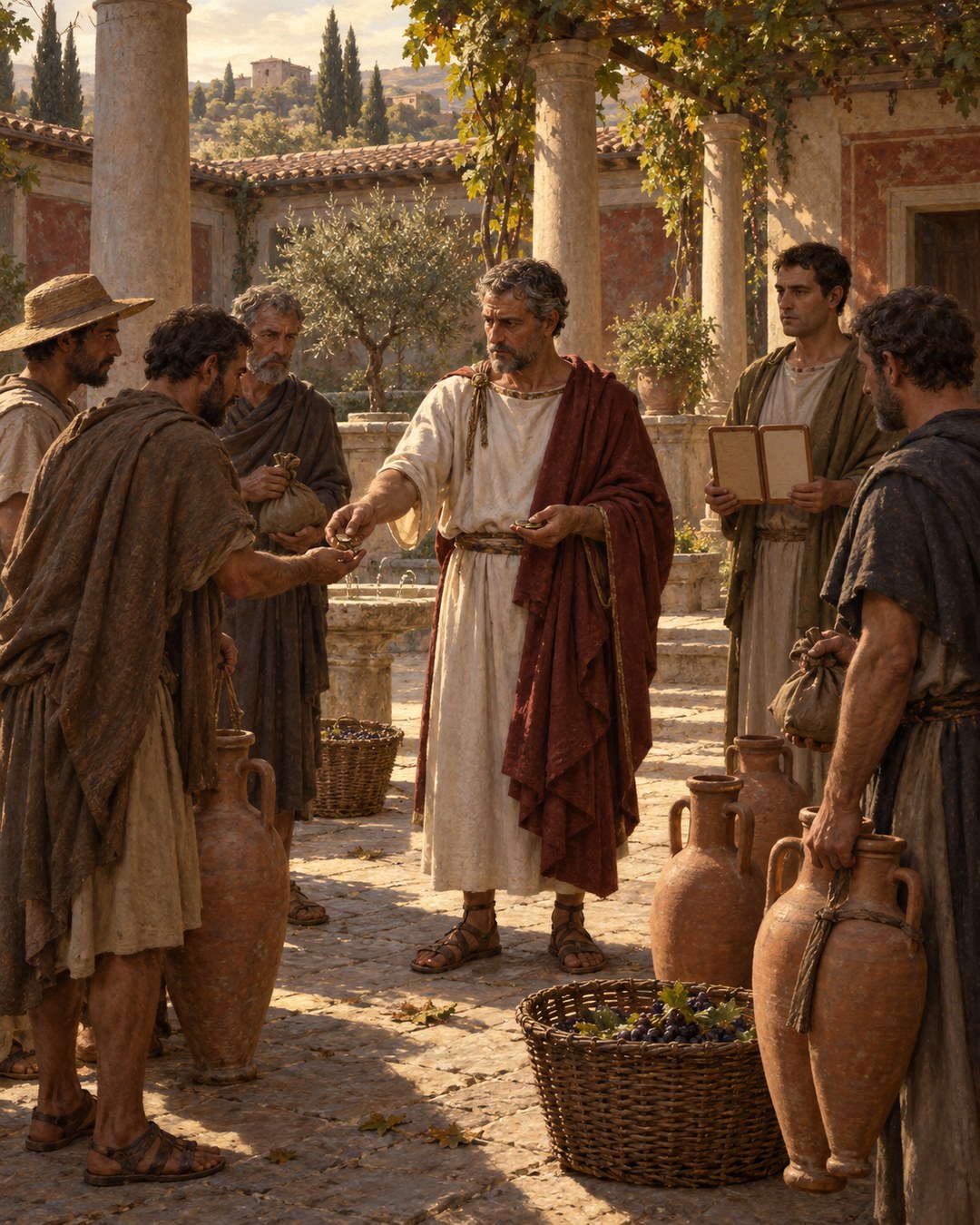
The wine had already been sold when expectation turned against the buyers.
Dealers had competed for Pliny the Younger’s vintage because current prices looked attractive and later prices looked better. Then the market refused to cooperate.
Pliny answered with three concessions, each measuring a different part of the relationship.
Competitive Bidding Put the Risk on the Buyers
Pliny opens his letter to Calvisius with a reversal. Other men visited their estates and returned richer. He came back poorer. The expense was voluntary, but it arose from a sale whose original terms had not been careless.
He had sold the vintage to dealers bidding against one another. Their competition reflected two judgments: what wine seemed to be worth when they bargained and what they expected it to be worth later. A dealer buying a crop in advance was not simply taking amphorae off an owner’s hands. He was making a forecast.
The forecast failed. Pliny does not say that he had lied about the grapes, concealed damage or broken a delivery promise. The buyers’ expectations were disappointed. On a narrow reading of the bargain, that disappointment belonged to them.
Roman wine sales could assign risk with careful rules. The three-day test attached to another Roman wine sale concerned whether the product itself remained sound. Pliny’s problem was different. His vintage had become a worse commercial bet than dealers expected.
That distinction explains why he calls what followed remission rather than correction. He was not repairing a false quantity or replacing spoiled goods under an agreed test. He chose to release buyers from part of the price after their own market judgment went wrong.
Doing nothing would have protected the immediate contract. It might also have left dealers unable or unwilling to return. Cancelling everything would have transferred the whole loss to the estate. Pliny instead divided relief into layers.
One-Eighth Made the First Concession Universal
The simplest response would have been to reduce every bill by the same proportion. Pliny did begin there. He remitted one eighth of the price to each buyer, quoting poetry to make the universal gift sound almost festive.
This first layer recognized a common event. Every dealer had purchased from the same vintage under disappointed expectations. A proportional concession allowed a small purchase and a large one to receive relief on the same basic rule.
One eighth also left the sale standing. Buyers still owed most of what they had promised, and Pliny still received most of the negotiated price. The concession shared pain without pretending that no bargain had existed.
Proportion mattered more than an equal handful of coins. A fixed cash gift would loom large beside a modest order and barely touch a major one. Returning the same fraction preserved the scale of each purchase.
Yet Pliny thought a universal fraction was not enough. Strict equality would ignore how much each buyer had exposed to the failed expectation and how each had behaved after agreeing to buy.
His language joins generosity to classification. Justice did not mean flattening differences. It meant identifying which differences were relevant to the loss and to the future relationship.
Large Orders Crossed a Second Threshold
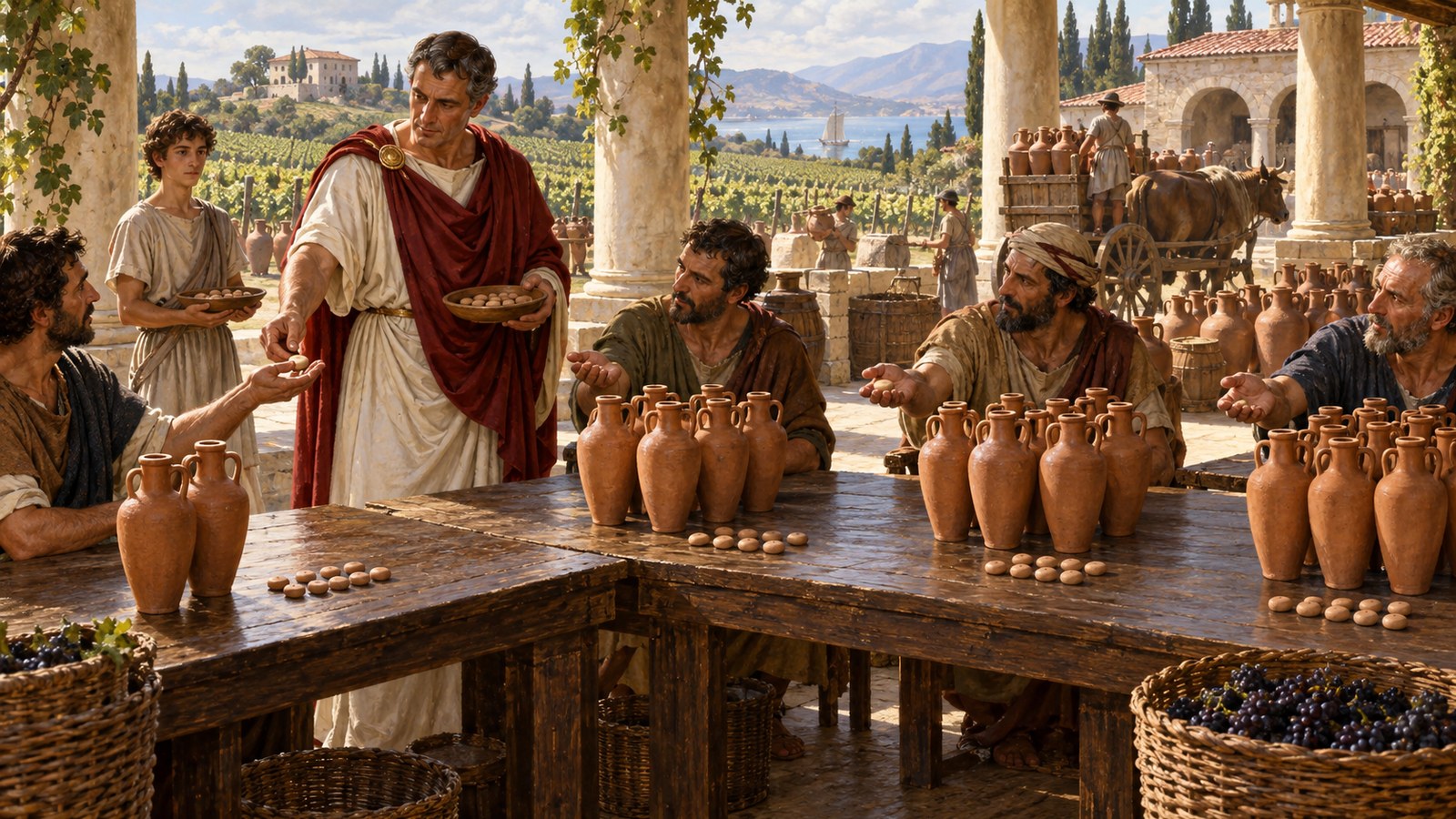
The next concession went to the largest buyers. Pliny reasoned that they had benefited him more when the vintage was sold and had now sustained the greater loss.
He set a threshold at 10,000 sesterces. A purchase above that line received additional relief on the excess, on top of the one-eighth reduction already granted to everyone. The calculation was cumbersome enough that Pliny paused to explain it again.
The structure separated ordinary participation from exceptional exposure. The first layer said that every buyer mattered. The second said that committing far more capital created an additional claim.
This was not a reward for social rank. The letter grades purchases, not ancestry. A dealer reached the second tier by buying enough of the crop to cross the monetary threshold.
The larger dealer had also solved a larger problem for the estate at the moment of sale. Moving a substantial share of a vintage reduced storage, marketing and price risk for the owner. Pliny remembered that earlier benefit when the same buyer faced a larger disappointment.
That memory kept the calculation connected to the actual crop. A large order meant more jars, transport and resale exposure, not merely a larger figure on a tablet. When expected prices failed, the buyer could be left holding a heavier physical stock and a larger financing burden. Pliny’s second tier recognized that concentration of risk without erasing the dealer’s responsibility for bidding.
His recent account of candidates forced into Italian land purchases also follows money created by a rule. Here no emperor compelled demand. Pliny used thresholds to decide how much of a private bargain he would voluntarily surrender.
Money Already Paid Earned the Third Remission
Size still did not capture everything. Some buyers had paid a considerable part of what they owed. Others had paid only a fraction. Others had paid nothing.
Pliny refused to place them on one level. The distinction concerned performance, not merely intention. A promise to pay gave the estate a claim; money delivered had already removed uncertainty and supplied usable cash.
He therefore granted a further remission tied to sums paid over. A dealer who had transferred cash before the market disappointment received recognition unavailable to someone who had kept all his money while waiting.
This third layer changed the meaning of relief. It did not only compensate loss. It rewarded conduct that made the original transaction more dependable.
The rule also avoided a perverse result. If nonpayment received the same generosity as prompt payment, future buyers could learn that delay carried no relationship cost. By distinguishing the paid-up dealer, Pliny protected the value of reliability.
He says so directly. The remission acknowledged honorable behavior in the old deal and offered an inducement for the next one. Buyers should return, purchase again and pay ready money.
Ready money mattered to an estate whose costs continued whether dealers prospered or not. Laborers, vessels, storage and transport could not all wait on a reseller’s later success. Prompt payment converted a negotiated price into resources the owner could use, which made the paid buyer’s conduct commercially different from an identical order still resting on credit.
Generosity thus operated forward and backward at once. It judged what men had already done and tried to shape what they would do when another vintage came to market.
The Estate Bought Reputation with Foregone Revenue
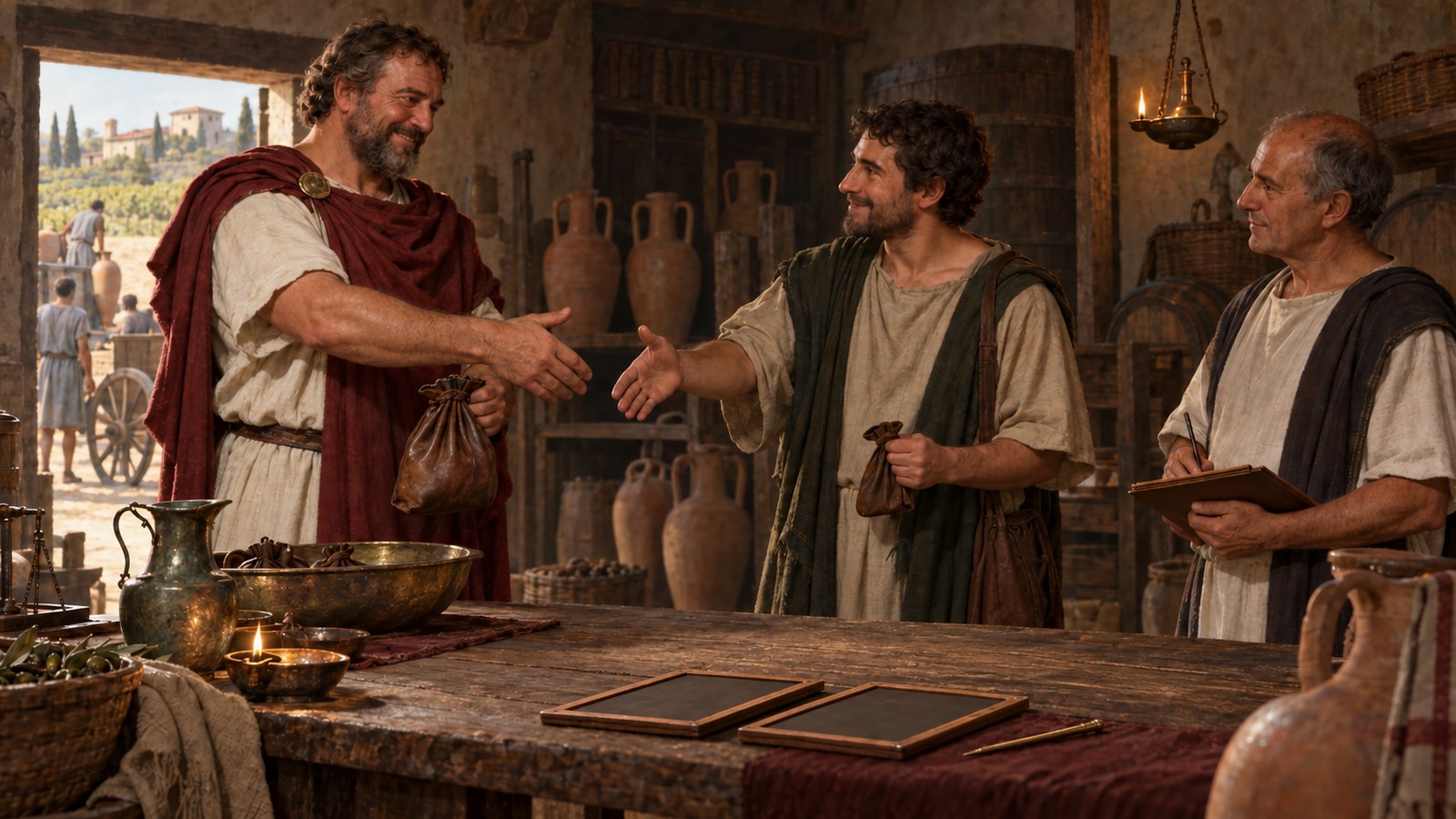
Pliny admitted that the method cost him considerably. The opening joke about returning poorer was not empty modesty. Every fraction remitted reduced revenue that the contract had promised him.
What he purchased was not simply gratitude. The district discussed and approved the novelty of his method. Public judgment turned a private set of revised accounts into a statement about how his estate did business.
The most reliable buyers left more attached to him because they discovered that he did not honor good and bad conduct equally. Classification made the concession legible. People could see why one buyer received more than another.
That legibility reduced the danger that discretion would look like favoritism. The universal eighth established a common floor. The large-order addition followed exposure. The paid-money addition followed performance.
The system was not a modern insurance contract, and the letter gives no evidence that every buyer considered the result perfect. It preserves Pliny’s own account, written to a friend, with all the self-presentation that implies.
Even so, the arithmetic reveals a durable commercial insight. A merchant relationship contains more than one number. Purchase size, payment history and willingness to return can matter alongside the legal price.
Pliny kept the bargain, surrendered part of its proceeds and made the surrender discriminate between kinds of commitment. The bad vintage cost him money. The three refunds tried to ensure that the cost also bought the next sale.
Sources
Pliny the Younger, Letters, book 8, letter 2.