
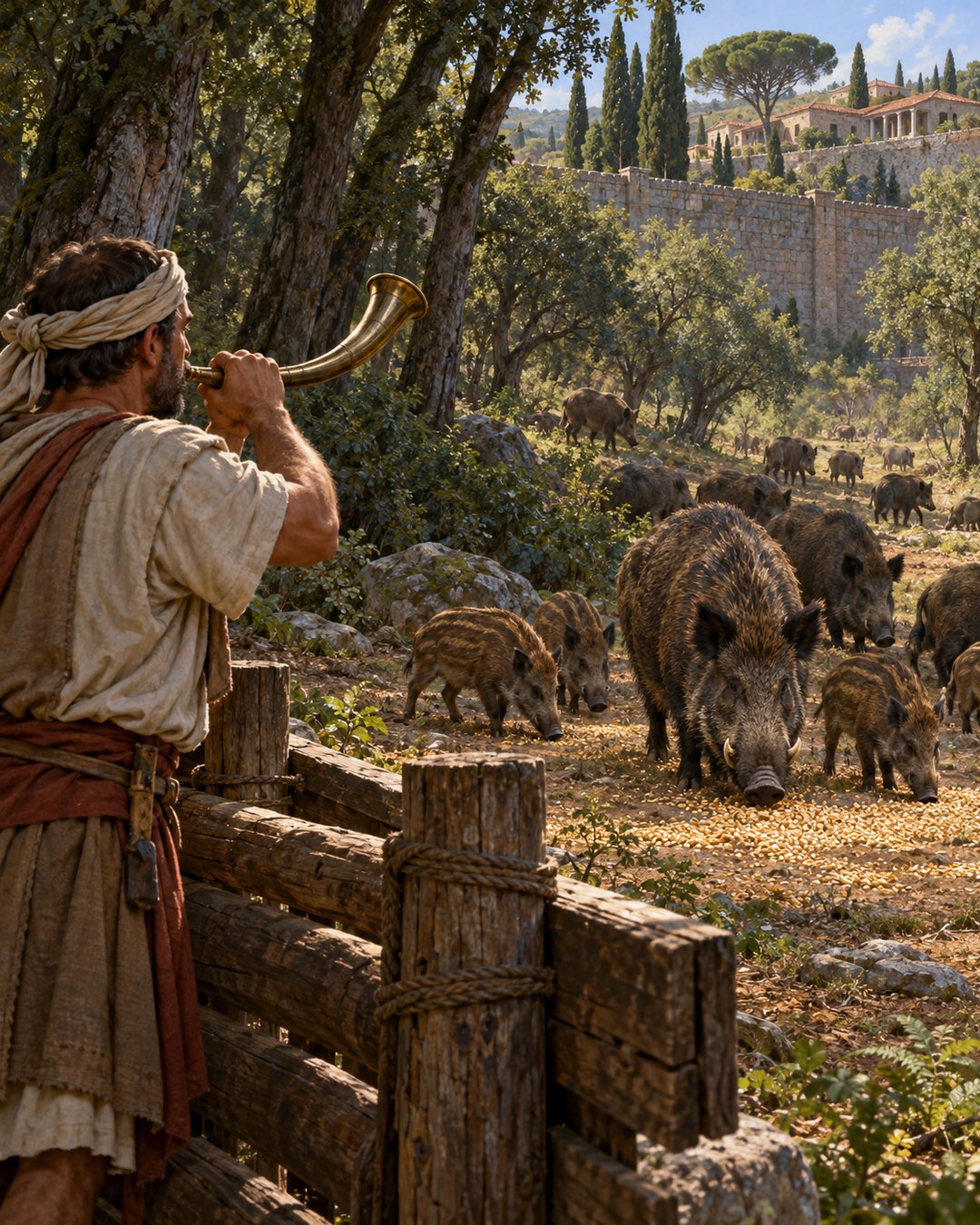
A trumpet sounded in the woods, and wild boars came to dinner. They did not charge a battlefield or enter an arena. They gathered at a feeding place inside a high-walled preserve, where scattered food had taught them to associate one human signal with a reliable meal.
Varro describes the enclosure as part pleasure, part profit, and part agricultural management. Several jugera of wooded ground gave the animals cover. Walls kept the herd within a property. Breeding increased the stock, feeding made it visible, and sale turned the apparent wilderness into income.
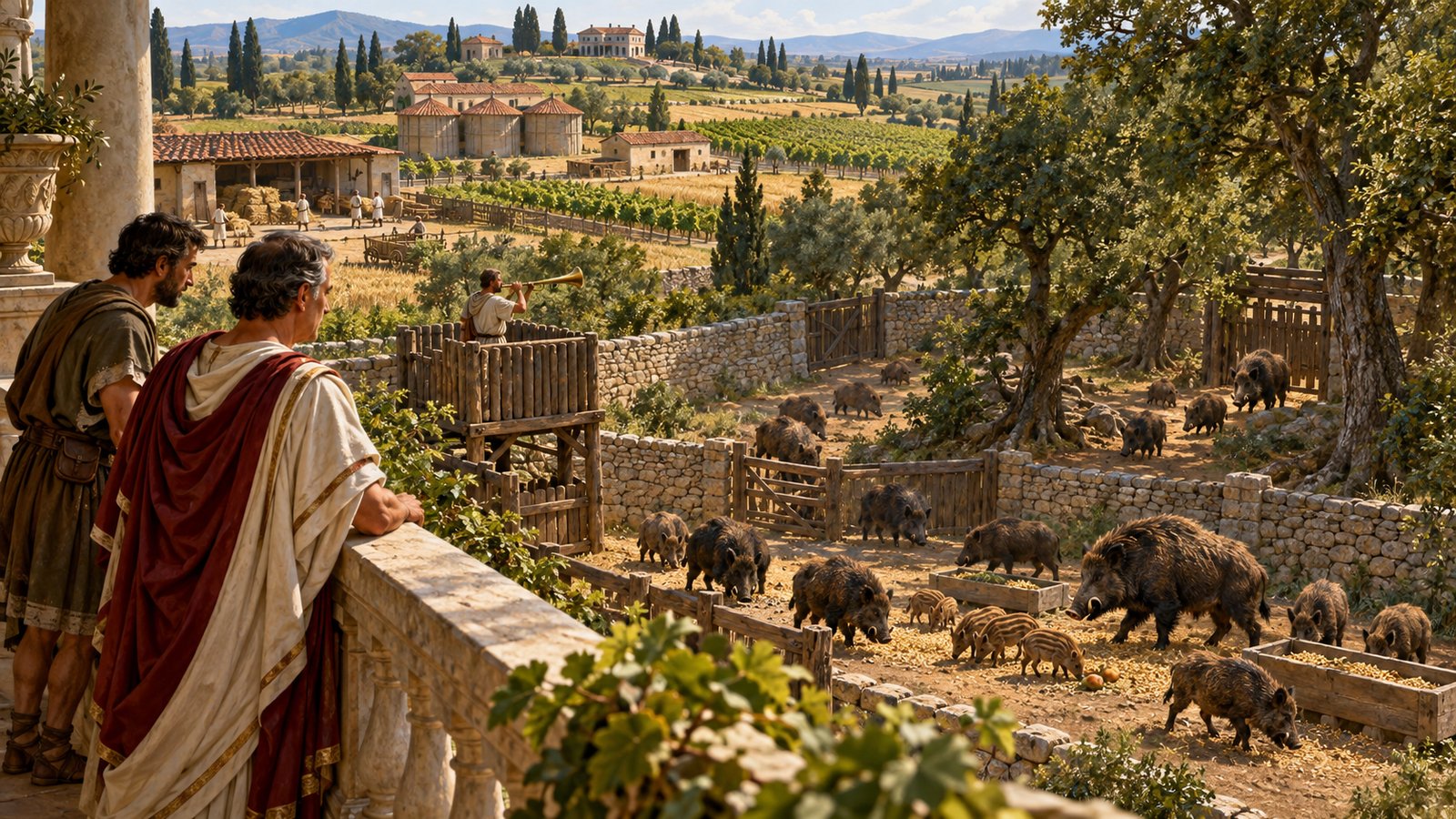
The trumpet joins those parts. It let an owner call dangerous animals out of trees without searching the whole preserve. At one dinner, Hortensius used the signal to produce a spectacle for guests: the massed boars looked, Varro jokes, like an aedile’s show in the Circus.
A high wall made woodland countable property
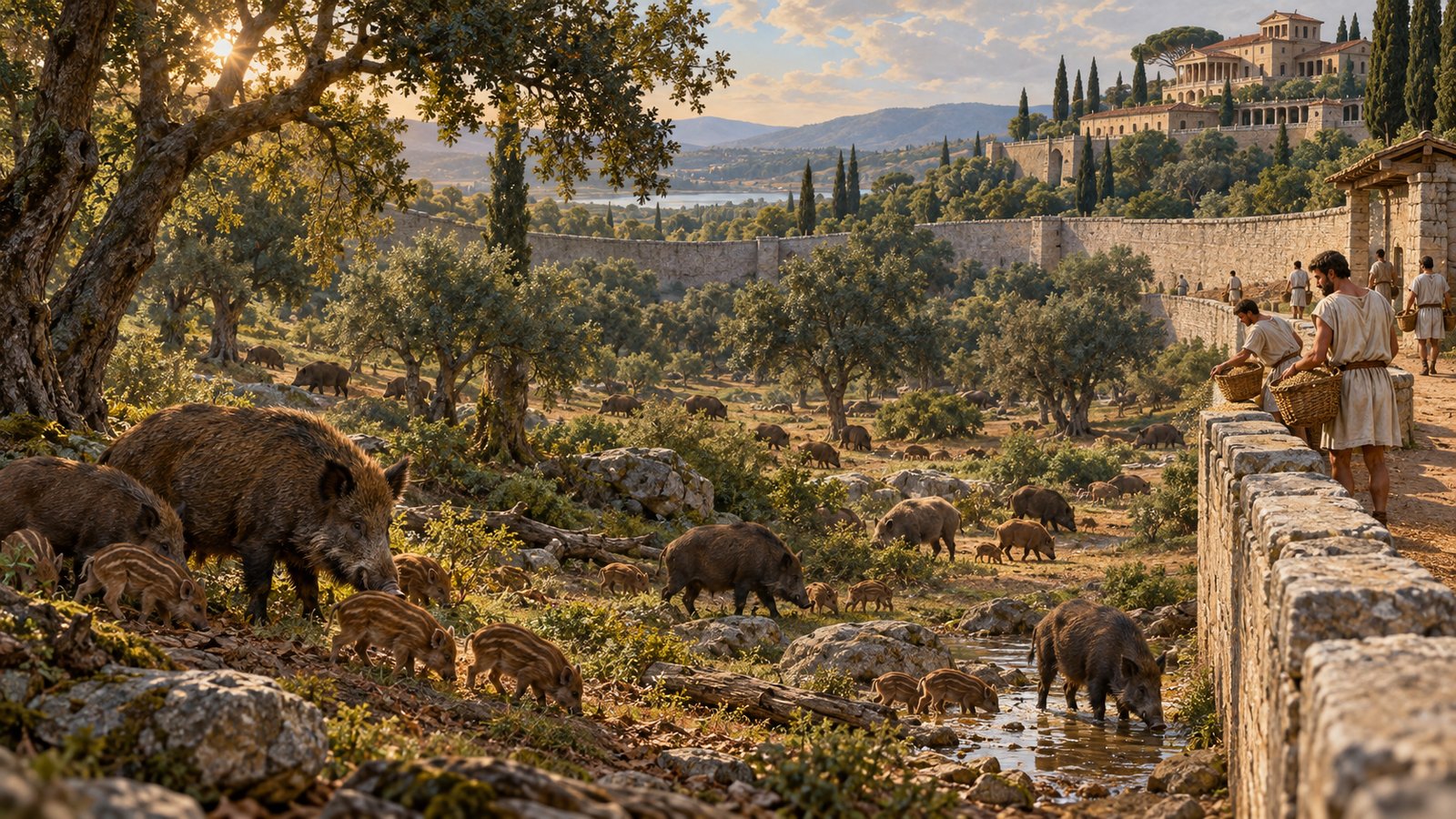
The boar preserve belonged to the broad family of enclosures that Varro discusses around the villa. It differed sharply from a small pen. The space could cover several jugera and retain trees, shade, undergrowth, and enough uneven ground for the animals to inhabit something resembling their preferred environment.
The wall was the decisive artificial edge. Wild boars were powerful, mobile, and capable of damaging crops. Keeping them for profit required more than claiming a patch of forest. A high boundary converted roaming animals into a herd whose increase and removal could be managed by one estate.
Woodland inside the enclosure did not mean the property was unmanaged. Trees gave shelter and made the preserve visually convincing, but feeding points and walls redirected movement. The owner produced a designed wildness: enough habitat to sustain and display boars, not enough freedom for them to disappear into neighboring land.
Varro names elite owners including Quintus Fulvius Lippinus and Quintus Hortensius. Their presence places the preserve in the culture of villa investment as well as husbandry. A large game enclosure advertised space, capital, and control over animals that most farmers would meet as threats.
That scale contrasts with the masonry, burrows, and predator cover of a Roman rabbit warren. Both systems built boundaries around animals associated with the wild. The boar preserve, however, had to absorb far greater force and leave room for a herd whose very appearance could become entertainment.
Scattered feed taught the herd to answer sound
The animals could not be managed solely from the wall. Varro describes a regular feeding place where food was distributed broadly. Scattering reduced the pressure that one heap would create when many heavy animals arrived together and gave more of the herd access.
At feeding time, a trumpet sounded. Repetition created the connection: noise predicted food, and the boars came toward the source. Varro does not describe training each animal individually. The routine worked at herd scale.
This conditioned response solved an inventory problem. In woodland, the owner could not easily see every animal at once. Bringing the herd to one zone exposed numbers, condition, age groups, and absences. Feeding became an occasion to inspect what the walls contained.
The trumpet also reduced the need for attendants to drive boars through cover. A person could stand at the prepared place and make the environment pull the animals inward through expectation. The signal substituted learned movement for a dangerous chase.
Food remained the foundation. A trumpet without repeated feeding would be only noise. Varro’s mechanism depended on consistency: scatter feed, sound the call, and allow the association to strengthen. The dramatic instrument worked because an ordinary task happened reliably behind it.
The method echoes the copper noise used around a moving bee swarm, but the mechanisms differ. Dust and clashing sound accompanied an attempt to settle insects in flight. The boar trumpet was a learned invitation maintained through regular feeding inside a closed landscape.
Hortensius turned feeding time into a banquet spectacle
Varro’s memorable scene takes place during a dinner at Hortensius’s estate. The host ordered the trumpet sounded. Boars emerged in large numbers and gathered around the feeding place while the guests watched.
The display converted routine management into hospitality. No new trick was invented for the meal; the owner simply timed a working signal for an audience. Feeding made the spectacle credible because the animals already knew what to do.
Varro compares the crowd of boars with an aedile’s display in the Circus. The joke enlarges the preserve into a public show while keeping it unmistakably private. One landowner could summon, before his dining companions, a mass of animals that suggested civic entertainment.
The comparison also exposes status. Walls, wooded acreage, attendants, feed, and breeding stock represented sustained expense. The sudden appearance looked effortless only because the estate had already paid for the system that produced it.
Guests saw abundance in motion rather than receiving an account book. Hundreds of feet, bristled backs, and jostling bodies made reproductive success visible. The trumpet transformed stock levels into theatre.
Yet the scene should not be romanticized as harmless intimacy with wildlife. These remained wild boars confined for human pleasure, meat, breeding, and sale. The high wall and controlled feeding place existed precisely because proximity carried force and risk.
Breeding converted spectacle into a market
A preserve stocked only for one feast would consume itself. Varro instead refers to males and breeding females, treating reproduction as part of the enclosure’s economics. Young animals replaced those removed and expanded the owner’s saleable stock.
The woodland setting supported that cycle by giving the herd more than a bare holding pen. Space and cover allowed adults and young to occupy the enclosure while the wall kept the result attached to one estate.
Regular feeding supplemented what the ground provided and concentrated observation. An owner deciding which boars to sell, retain, or slaughter needed chances to see them. The trumpet assembled the evidence.
Varro links increase with profit. Pleasure did not cancel calculation. The same boars that impressed guests could be assigned value, and successful breeding changed a prestigious enclosure from a pure expense into a source of revenue.
This combination resembles the peacock business built around elite demand. Both turned banquet animals into reproductive systems. Boars required a walled landscape rather than an island poultry enclosure, and their feeding call gave abundance a much more dangerous public shape.
The preserve therefore sat between forest, farm, market, and theatre. Trees supplied the look and part of the habitat. Walls established ownership. Feed and trumpet organized the herd. Breeding created new animals, sale realized value, and hospitality displayed the whole apparatus to peers.
Varro’s trumpet is memorable because it makes management audible. Before the boars appear, the signal announces that the apparent forest has a schedule. The herd that comes running reveals the hidden work behind the wall.
It also clarifies the boundary between taming and control. Varro does not say the boars became docile household animals. They remained a herd requiring height, distance, barriers, and predictable handling. What changed was one part of their movement: at a familiar sound, hunger drew them to a chosen place. The estate did not erase wild behavior; it built a narrow routine around it. That distinction explains why the preserve could be simultaneously productive and impressive. Guests watched strength appear on command, while the wall quietly acknowledged that command had limits.
Sources
Marcus Terentius Varro, On Agriculture, 3.13.