
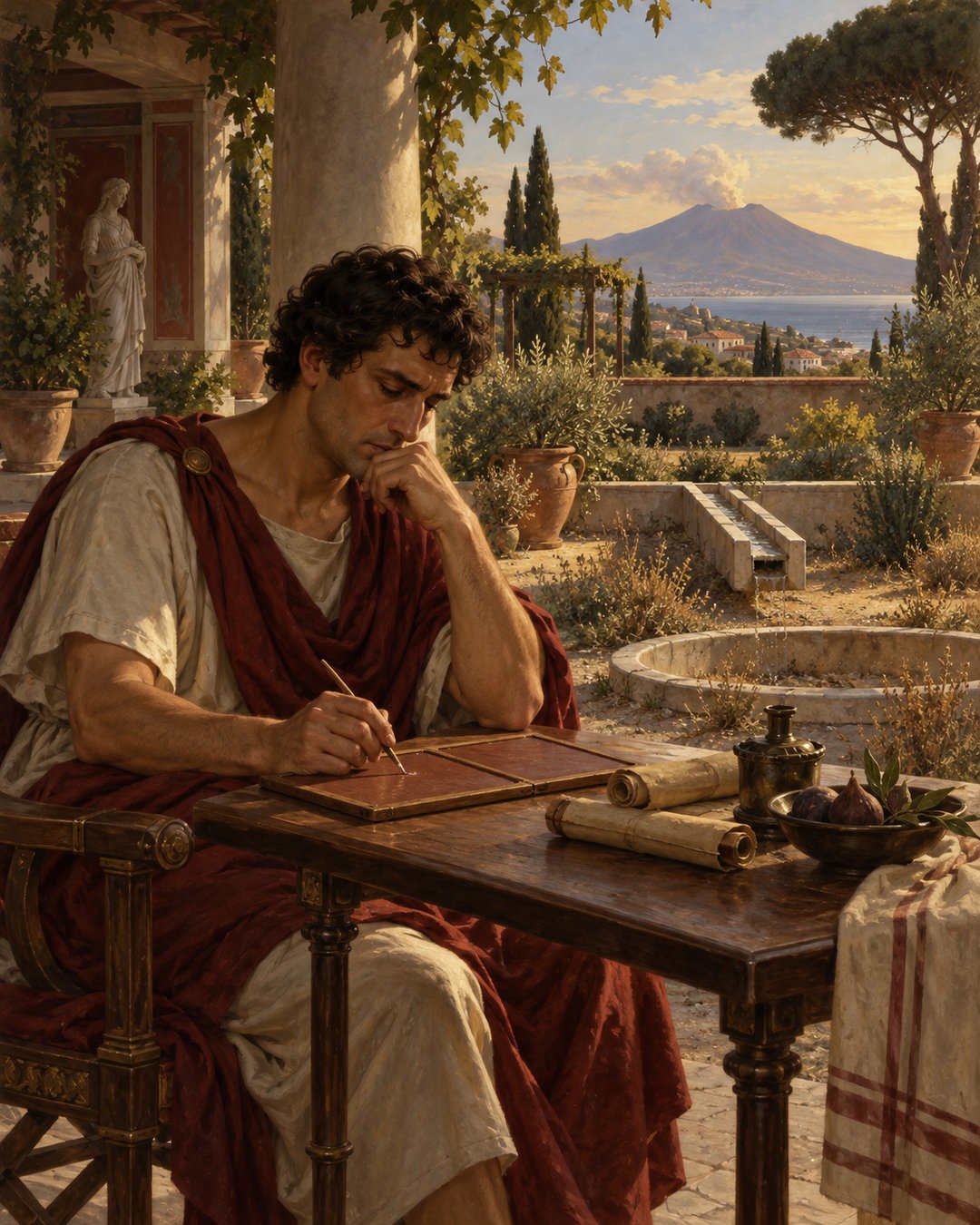
A story reached Aulus Gellius through an unnamed commentary. Virgil, it said, once wrote Nola into a passage of the Georgics beside wealthy Capua and the slope of Vesuvius. The poet owned land nearby and asked the people of Nola to let him conduct city water to his estate. They refused. Offended, he supposedly struck their town from the poem and replaced Nola with ora, “the region.”
It is a perfect literary revenge story: one denied watercourse answered by one vanished place-name. Gellius does not certify it. In Attic Nights 6.20 he says plainly that the note’s truth or falsity is not his concern. Then he turns to something he believes he can judge. The surviving word ora, he argues, sounds better.
That pivot changes the whole chapter. The anecdote explains the revision through wounded pride, but Gellius evaluates it through vowels. He listens to the end of one line and the opening of the next, where sounds meet without a consonant between them. The resulting hiatus prolongs the voice. To his ear it is not a blemish but a deliberate piece of melody.
Gellius therefore keeps two questions apart. Did the citizens of Nola really deny Virgil water, and did the poet retaliate? He leaves that unresolved. Does ora produce an effect that ancient poets used elsewhere? On that question he builds an argument from Homer, Catullus and the physical act of reading verse aloud.
An Unnamed Commentary Supplied the Grievance
The source of the biographical claim matters. Gellius does not say that he witnessed a document from Virgil, found a civic record at Nola or heard the story from a named authority. He says that he found it noted in “a certain commentary.” That is enough to transmit the report, but not enough to turn it into secure biography.
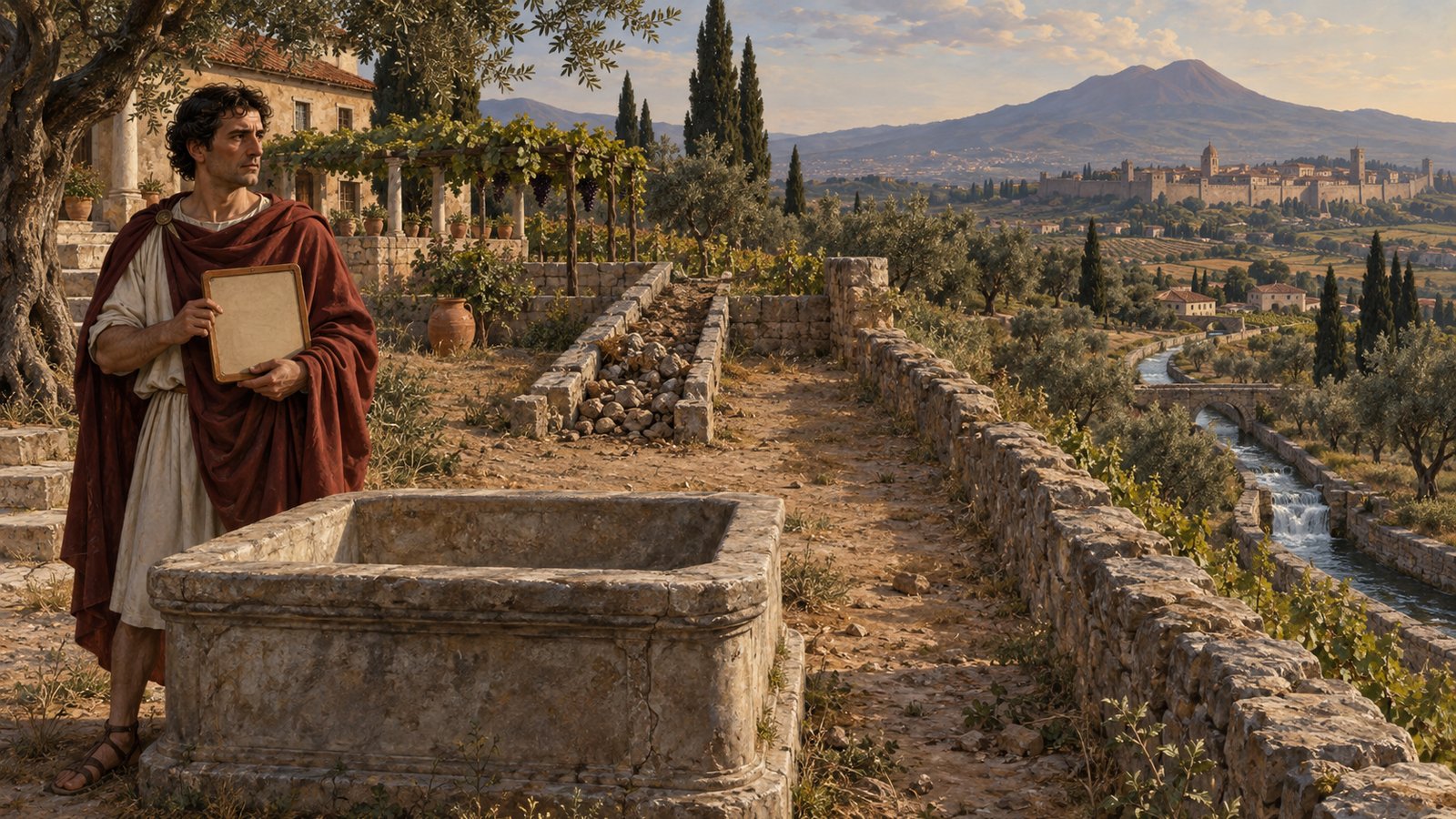
The note gave a sequence with attractive clarity. An earlier version named Capua and Nola. Virgil had an estate near the latter town. He requested permission to bring its water onto his land. The community refused the favour. The offended poet then erased the town as if consigning it to oblivion, leaving the broader “region near Vesuvius” in its place.
Each movement sharpens the moral symmetry. Nola withholds something that should flow across land; Virgil withholds the name that could flow through centuries of readers. The city remains in Campania, but not in that line. Such balance is one reason the account is memorable. It is also a reason to notice how neatly it behaves before accepting it.
Gellius models that restraint in a single sentence. He neither denounces the commentary nor adopts its motive as fact. He suspends judgment. The distance is especially striking beside Silius Italicus’s intensely documented veneration of Virgil, where Pliny names the admirer, his habits and the tomb he treated like a shrine. Here the chain stops at an unidentified note.
That does not make the chapter empty. It narrows what the chapter can safely prove. The water dispute belongs to reported explanation. The two competing words and their sound belong to criticism. Gellius moves from the first to the second without pretending that confidence transfers automatically between them.
One Syllable Changed a City into a Region
The proposed substitution is tiny on the page. Nola and ora each fit into a compact space. Yet their work is different. One fixes the verse to a named city. The other describes the surrounding tract near Vesuvius. A local point becomes a broader landscape.
The anecdote interprets that semantic change as punishment. Removing the proper noun denies Nola the memorial advantage of appearing in Virgil’s poetry. Gellius even reports the gesture as if the poet were assigning the city to oblivion. But he does not make that picturesque motive carry his textual preference.
Instead he listens across the line boundary. The final vowel of the preceding line meets the opening vowel in the next. With ora, the voice passes through that encounter without the consonantal interruption that Nola would introduce. Gellius hears the sound stretched and softened by hiatus.
Hiatus could be described as a gap, but the chapter treats it as audible continuity. The mouth leaves one vowel and enters another while the metre continues. What looks like separation in grammatical analysis becomes prolongation in performance. The page preserves the letters; the voice reveals the effect.
This is why the difference cannot be reduced to dictionary meaning. Both readings can identify the geography well enough for a listener to picture Campania and Vesuvius. Only one creates the precise meeting of vowels that Gellius wants to discuss. His verdict depends on how the verse occupies breath and time.

Gellius Tested the Reading with Homer
A personal preference would have been easy to state and difficult to defend. Gellius instead compares the feature with admired poets. He says many famous writers create similar melody and that the recurrence looks like art rather than accident. Homer, in his assessment, does it more frequently than anyone else.
He supplies examples rather than relying on Homer’s prestige alone. One piles successive vowel sounds into a description of a cold fountain. Another places them in a phrase about pushing a stone upward. The translated meanings are not the proof; the Greek sounds are. His reader is expected to pronounce or at least imagine them.
The comparison establishes a family of effects. Virgil’s line need not match Homer’s subject, metre or language word for word. What matters is the controlled encounter between vowel endings and vowel openings. Recurrence across highly regarded poetry makes it plausible that the sound can be sought rather than merely tolerated.
That method resembles the lexical attention in Gellius’s encounter with a grammarian who could not sustain his account of one word, but the engine is different. There the pressure comes from examples that expose a bad definition. Here examples establish an aesthetic practice and help discriminate between readings.
Gellius is also careful about the scale of his claim. He does not prove the history of the revision by showing that hiatus can be beautiful. He proves only that the extant wording participates in a recognizable poetic technique. The sound argument supports ora; it does not verify the quarrel over water.
Catullus Turned Sound into Textual Evidence
Catullus gives Gellius a Latin comparison. In a drinking poem, the wording joins a feminine adjective to acina, “grape” or “berry.” Gellius notes that another gender was more usual. The less ordinary grammatical choice, however, produces the vowel blend he admires.
For him, melody explains why Catullus wrote ebria acina. The phrase lets one vowel lean into the next. Grammar remains intelligible, but sound influences which permissible form the poet selects. That is a stronger claim than saying a line happens to be pleasant. It makes euphony evidence for wording.
The point becomes textual when Gellius confronts alternatives. Some copies offered forms equivalent to ebriosa or ebrioso. He rejects them without hesitation as readings inherited from corrupt exemplars. The wrong form is not merely less attractive; it obscures the pattern that links Catullus with the Homeric practice under discussion.
His confidence here contrasts with his reserve about Nola. Manuscript variants can be compared against grammar, metre, usage and a demonstrated sound effect. The estate story lacks that kind of accessible test in the chapter. One claim therefore receives a verdict while the other remains bracketed.
This distinction is the chapter’s most useful discipline. Ancient miscellanies preserve anecdotes, quotations, variants and criticism in the same small space. Their proximity does not give every element equal status. Gellius can repeat a vivid explanation, refuse to authenticate it and still use the occasion to make a precise argument about poetry.
The Better Sound Did Not Prove the Better Story
If the replacement word is musically effective, the revenge tale may feel more convincing. The temptation is to reason backward: a satisfying revision must have had a satisfying cause. Gellius refuses that move. Artistic fit and biographical truth answer different questions.
The water request may preserve a genuine local memory, a later attempt to explain a variant or something between those possibilities. Attic Nights 6.20 does not provide the material needed to decide. A responsible account must keep the reporting verbs visible: the commentary claimed; the town was said to have refused; the poet supposedly reacted.
What the chapter does permit is unusually concrete. It gives the two readings, identifies the adjacent vowels, names hiatus, describes the prolonged sound and places it beside examples from Greek and Latin poetry. It also shows Gellius treating corrupt copying as a live danger when a variant breaks the pattern.
The result is not a story about a thin-skinned poet secretly authenticated by clever philology. It is a story about criticism setting its own limits. Gellius lets the grievance attract attention, then refuses to spend more certainty than his evidence holds. His firmest judgment begins only when the line can be heard.
Nola did not vanish from history, and the chapter does not prove that Virgil tried to erase it. What disappears is one consonant and one syllable from a reported earlier reading. In the space left behind, two vowels meet. Gellius declines to rule on the town’s offence, but he asks the reader to listen closely enough to understand why the quieter word endured.
Sources
Aulus Gellius, Attic Nights 6.20.