
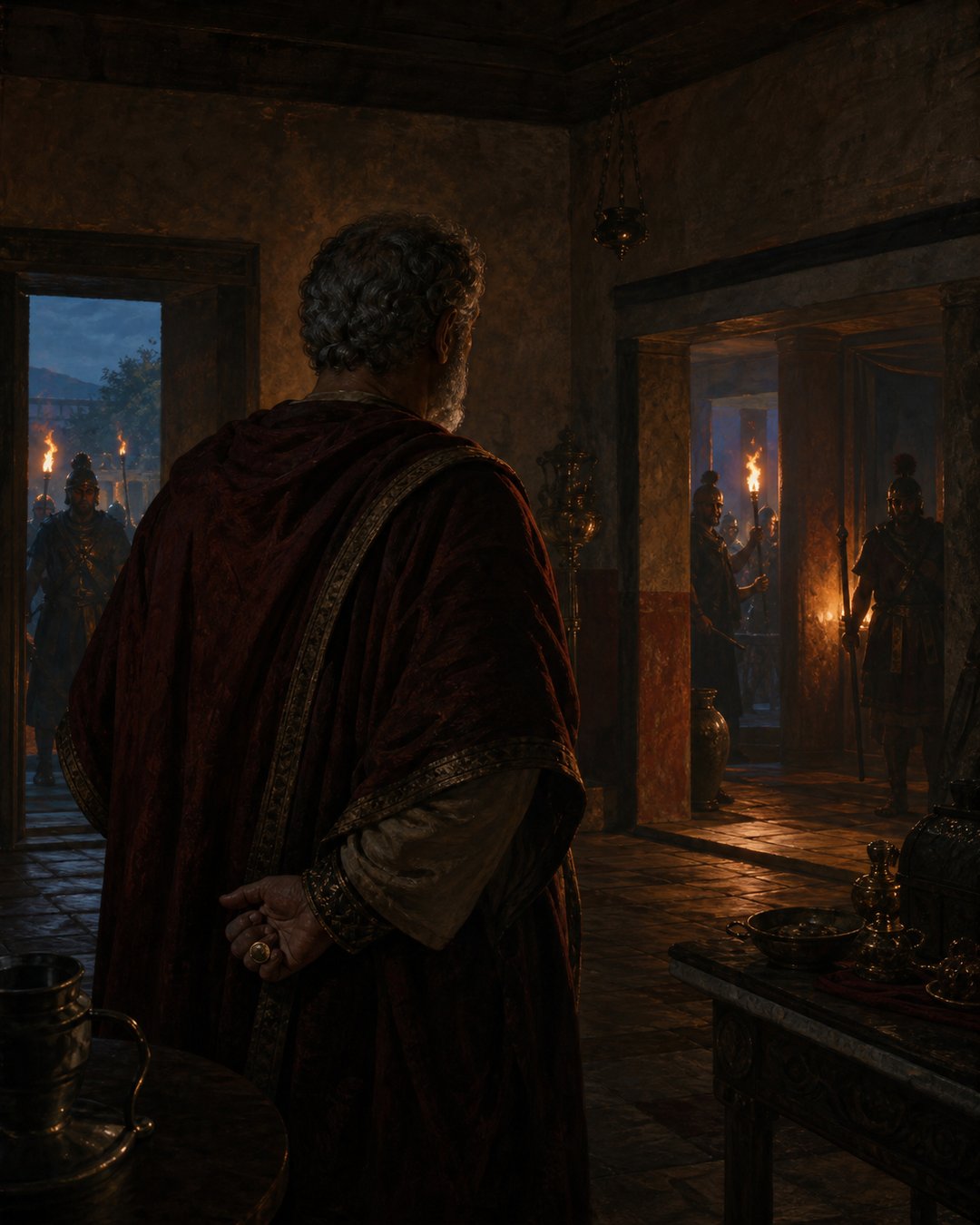
The house had been chosen by a man who no longer trusted a single door. Ancient accounts say Hannibal arranged several exits, expecting that a place of refuge could become a place of arrest. When royal soldiers finally surrounded it, a servant checked the routes. Every way out was covered.
Hannibal had spent his life making movement into power. He crossed mountains, changed roads, forced armies to turn and made Roman commanders fear what lay beyond their sight. In Bithynia, near the end of his exile, geography collapsed to the rooms of one guarded residence.
The last exit was not architectural. Plutarch says poison had long been kept ready beneath the bezel of a ring. Cornelius Nepos also makes poison the means by which Hannibal avoided surrender. The traditions differ in detail, but together they present a death shaped by anticipation: multiple doors against betrayal, then a concealed reserve against capture when the doors failed.
Exile changed command into dependence
After the Second Punic War, Hannibal did not simply disappear into private retirement. He remained active at Carthage and later left under Roman pressure. His movements through Hellenistic courts demonstrate both his fame and his weakness. Kings valued the counsel of Rome’s most celebrated enemy, yet his safety depended on their calculations.
A battlefield commander can issue orders within an army. An exile advises, persuades and waits for a host to decide. Hannibal’s knowledge still had value, but it no longer came with an independent state capable of protecting him. Every new court offered opportunity and created another political dependency.
He eventually reached Prusias I of Bithynia. Cornelius Nepos presents him assisting Prusias against Eumenes of Pergamon. The famous episode of clay vessels filled with snakes belongs to this period: Hannibal supposedly had the pots thrown onto enemy ships, where they broke and spread panic. Whether every flourish happened exactly as narrated, the story keeps his old reputation alive. He still wins by making an opponent misunderstand an ordinary container until too late.
That reputation had already become larger than elephants. Hannibal’s Alpine crossing mattered because he sustained an army, intelligence network and sequence of decisions through hostile terrain. In exile, the same reputation made him useful to Prusias and intolerable to Rome.
Roman power arrived as a diplomatic request
Hannibal’s last crisis did not begin with legions storming Bithynia. Ancient sources connect it to Roman envoys and pressure on Prusias. Nepos says the Romans demanded that the king cease sheltering their enemy. Plutarch associates the mission with Titus Quinctius Flamininus.
This was Rome acting across distance without needing to annex the kingdom. Prusias had to weigh hospitality against the cost of refusing a dominant Mediterranean power. Hannibal’s protection was therefore only as strong as the king’s willingness to absorb that cost.
Ancient writers debated the honor of the episode. Hannibal was old, displaced and no longer leading a Carthaginian army. Pursuing him could look like prudent security or vindictive fear. Plutarch preserves criticism of Flamininus for extinguishing a famous enemy who no longer posed the danger he once had.
The argument itself reveals Hannibal’s symbolic weight. Rome had defeated Carthage decades earlier, yet his body still mattered. Custody could provide triumph, punishment or reassurance. Leaving him free permitted the possibility—however reduced—that another king might turn his experience into resistance.
The house was built around distrust
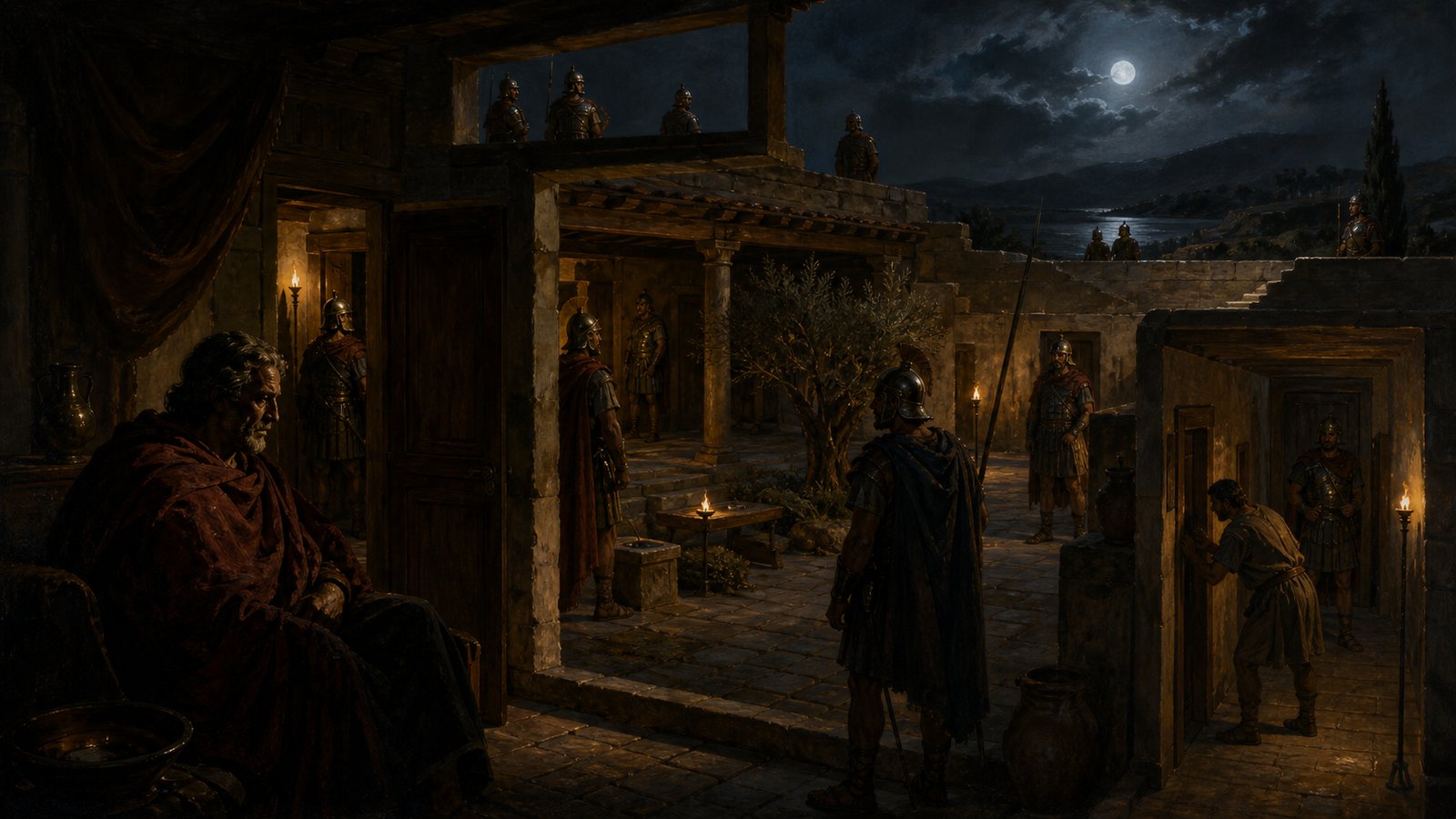
Nepos says Hannibal’s dwelling had exits in several places. Later retellings commonly sharpen the image to seven. The number is memorable, but the mechanism matters more than the count. Hannibal expected surveillance and betrayal closely enough to make escape routes part of domestic architecture.
A refuge normally separates safe interior from dangerous exterior. Multiple exits reverse that confidence. Each wall becomes a possible route because the principal entrance cannot be trusted. The house embodied the condition of exile: sheltered by a ruler, watched by that ruler’s people and prepared for protection to vanish.
Prusias’s soldiers understood the same map. They did not need to defeat Hannibal in open combat. They surrounded the residence and covered its ways out. A servant’s inspection confirmed that guards occupied them. Preparation met counter-preparation, and the enclosing ring was complete.
The scene offers a dark counterpart to Caesar’s escape through Alexandria’s harbor. Caesar reached water while still carrying the documents of command. Hannibal reached no open route at all. His captors controlled the boundary between room and road.
Poison made capture the one outcome Rome could not command
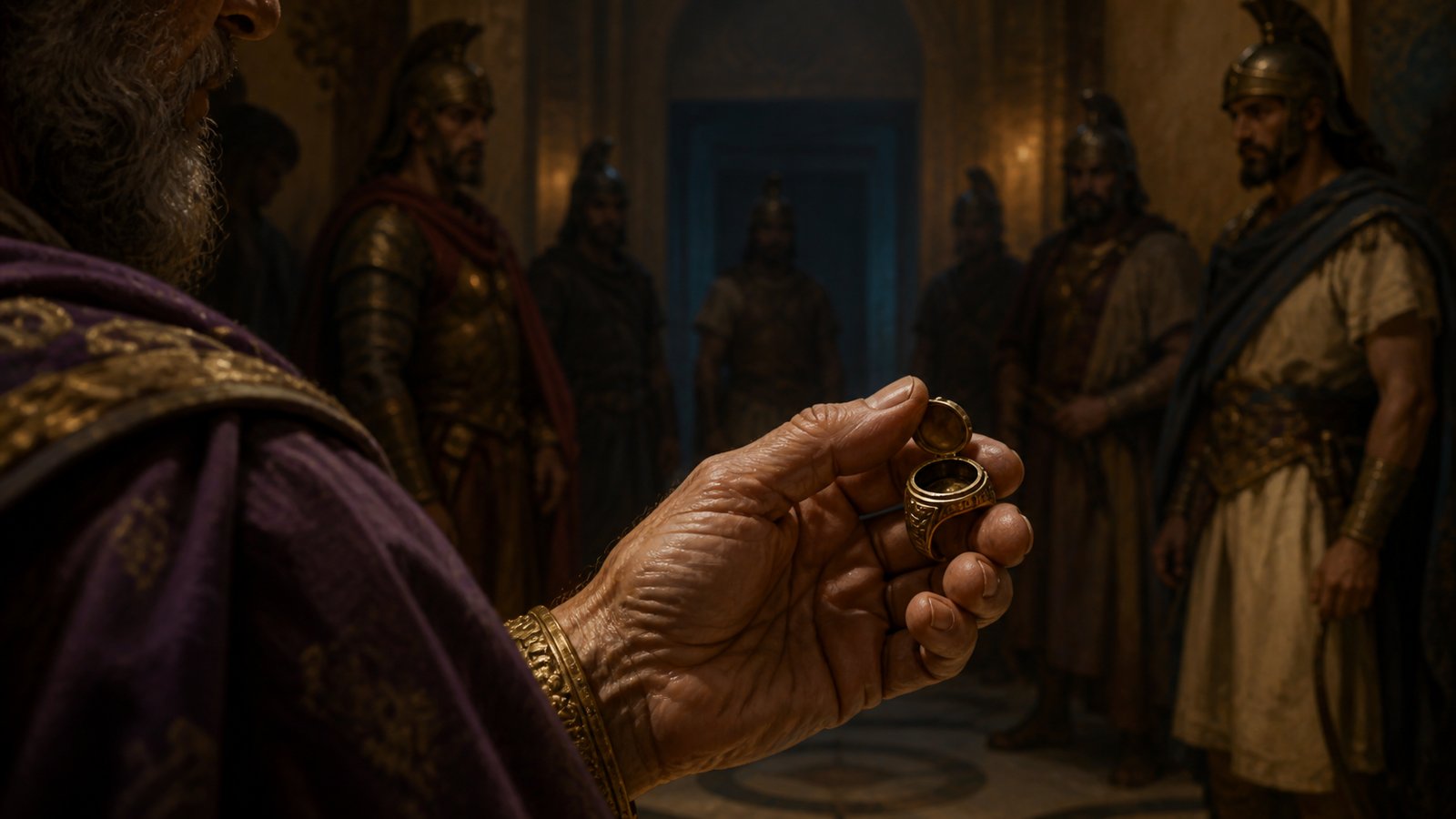
Plutarch’s ring supplies the final reserve. Poison hidden under a bezel travels with the body, is difficult to separate from ordinary display and remains available when baggage, horses and doors are gone. It is the smallest possible escape mechanism in a story that once stretched from Spain to Italy.
Ancient accounts give Hannibal words condemning Roman persistence and relieving Rome of its long anxiety. Such death speeches are polished literary forms, not transcripts taken beside the cup. They tell us how later authors interpreted the moment: Rome’s greatest enemy chooses his own end while accusing the victors of being unable to leave an old man alone.
Suicide denied the Romans several outcomes. There would be no living prisoner to display, interrogate or place under guard. Prusias could hand over only a body. Hannibal had lost strategic freedom, but he retained control over the final threshold between capture and death.
The choice should not be romanticized into an easy victory. It records the destruction of every safer option. Carthage could not receive him, allied courts could not securely shelter him, Prusias would not resist Roman pressure and the physical exits were held. Poison was agency reduced to its narrowest and harshest form.
The closed doors finished a Mediterranean pursuit
The precise year and some circumstances remain disputed in ancient tradition. Hannibal’s death is commonly placed in the 180s BC and associated with Libyssa in Bithynia. Variations caution against treating each architectural or verbal detail as a police report.
Yet the sources agree on the larger pattern. Hannibal had become dependent on foreign rulers. Rome’s reach followed him. His host’s protection failed. Capture appeared imminent, and poison prevented it. Nepos’s exits and Plutarch’s ring make that political sequence physical.
Prusias’s position deserves attention because betrayal was not a private change of heart. A king sheltering Hannibal had to balance prestige, usefulness and obligation against Roman demands. Once the balance shifted, every feature designed for safety could be turned against the guest. Guards who had once protected the residence knew its approaches. Royal authority could close roads, question servants and make the surrounding territory hostile without declaring a battle.
Rome had once struggled to locate and contain an enemy moving through Italy. At Libyssa, it needed no second Cannae and no encirclement by legions. Diplomacy isolated Hannibal before soldiers surrounded the house. The final maneuver belonged to a system of influence rather than a battlefield.
The setting also changed what evidence survives. No neutral witness inventoried the rooms or inspected the ring for modern readers. Nepos and Plutarch shaped inherited reports into moral biography, selecting objects that expressed character and fortune. Their details should be read with caution, but not discarded as decoration. Multiple exits communicate sustained fear; concealed poison communicates preparation; royal guards communicate the withdrawal of sanctuary. Each object carries a political fact even where exact reconstruction remains uncertain.
That is why the ending remained compelling to biographers. The objects reverse the scale of Hannibal’s earlier career. Roads become doors. Armies become guards. Strategic reserves become poison under a stone. The commander who repeatedly escaped Roman plans found every visible route occupied and carried one invisible route with him.
Sources
Cornelius Nepos, Hannibal 10–12
Plutarch, Life of Flamininus 20
Hannibal biographical reference