
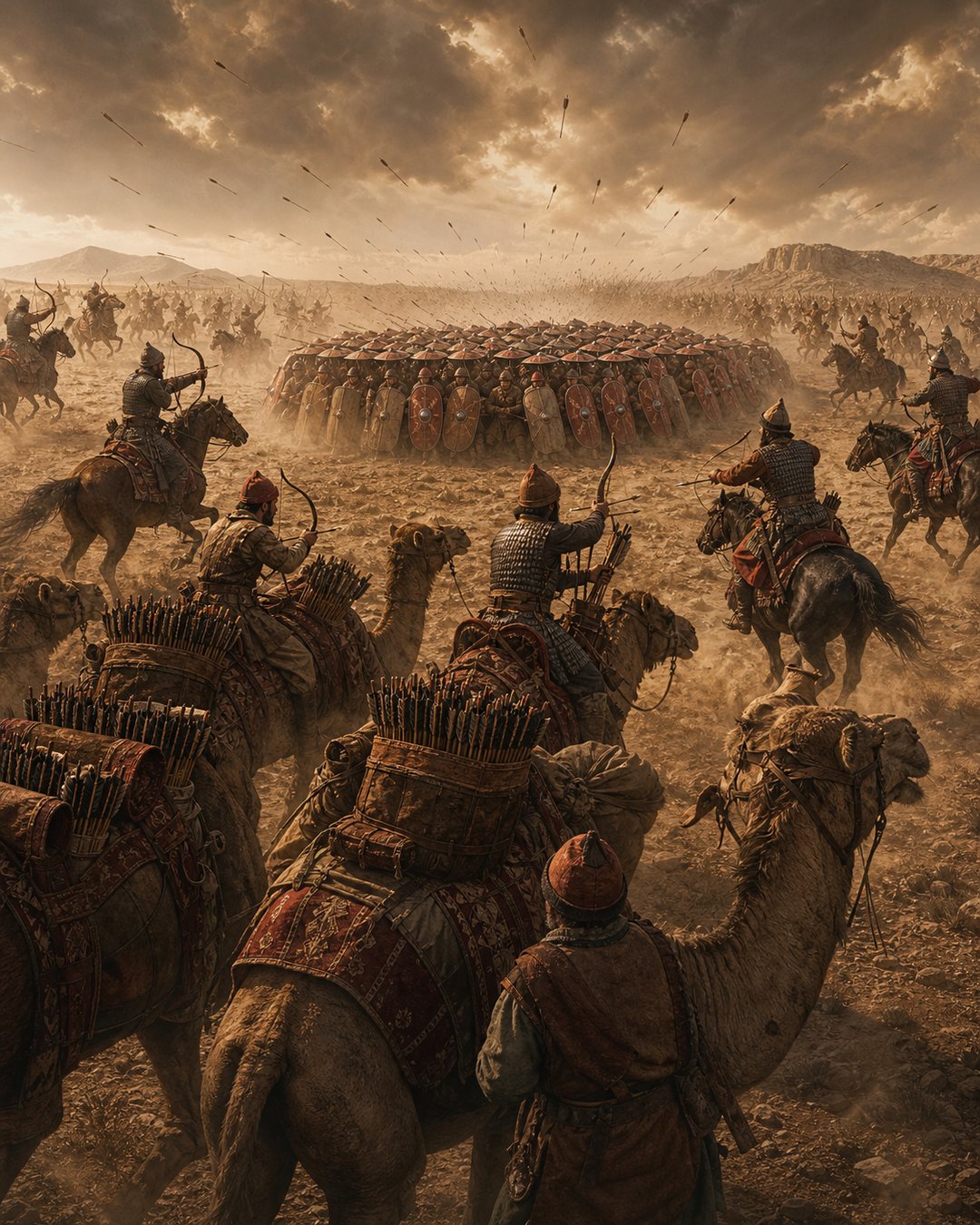
The Roman line waited for the arrow storm to spend itself. A bow could keep its distance, but a quiver was finite. Once the riders had emptied theirs, Marcus Licinius Crassus expected a different battle: withdrawal, confusion or the close combat in which heavily armed infantry could finally impose its strength.
Then men rode back toward the rear and returned with full quivers. Behind Surena’s mounted force stood camels loaded with arrows. The apparent limit was not a limit at all.
At Carrhae in 53 BC, Rome suffered one of the Republic’s most notorious defeats. The usual explanation contrasts legionary infantry with Parthian horse archers and armored cataphracts. That contrast is real, but it becomes much more revealing when the camels enter the picture. Surena did not merely bring archers. He built a supply system that allowed them to keep the Romans under missile pressure longer than Crassus thought possible.
Crassus planned for the quiver’s end
Crassus had marched into Mesopotamia seeking war with Parthia. Wealth and political rivalry shadowed the campaign, but the immediate military problem was physical. His army was strongest when disciplined infantry could approach, hold ground and bring shields, pila and swords into a controlled fight. Surena offered almost none of those conditions.
Plutarch describes a theatrical unveiling before the battle. Parthian equipment had been concealed; then coverings came away, armor flashed and drums sounded. The display mattered because it announced a force organized around movement and shock. Horse archers could circle beyond easy reach. Heavily armored riders could threaten any group that broke shape or became isolated.
Crassus still possessed a plausible expectation. Mounted archers carried limited ammunition. If Roman troops endured the first barrage without dissolving, the enemy would eventually have to retire for supplies or accept a closer engagement. Plutarch explicitly says Crassus expected the Parthians to exhaust their missiles. His error was not ignorance that arrows run out. It was ignorance about where Surena had placed the next arrows.
Roman armies understood logistics. The repeatable earthworks in a Roman marching camp depended on tools, assigned labor and baggage moving with the column. Carrhae exposed the same truth from the other side: an enemy’s tactical reach could be created by what followed behind its fighters.
Camels turned ammunition into a mobile reserve
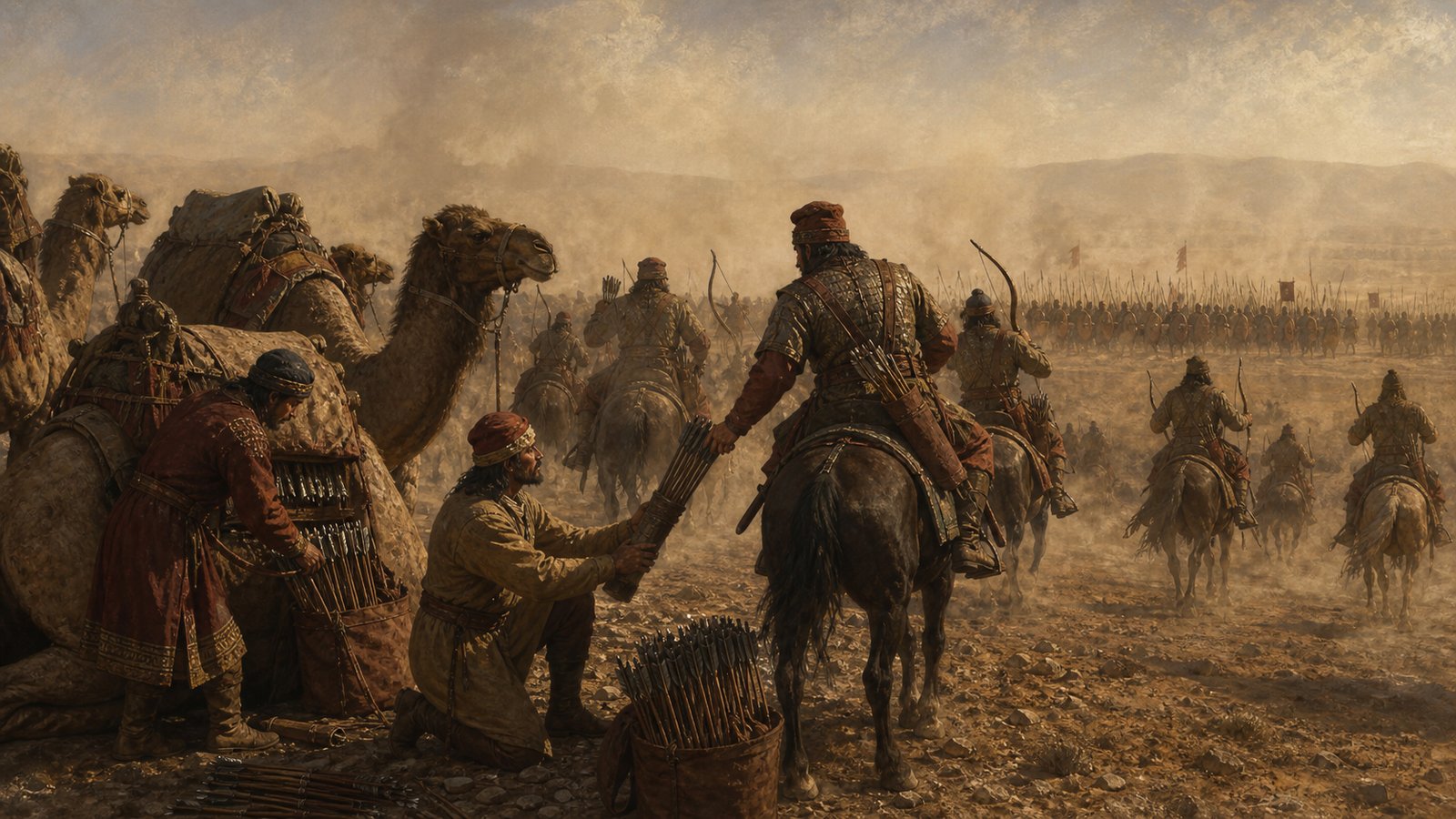
Plutarch’s description is concise. Camels stood nearby loaded with arrows. Riders who had spent their supply could obtain more and return. The animals were not charging the Roman line. Their battlefield value lay in weight and endurance, carrying a reserve across dry country while keeping it close enough to sustain the mounted attack.
A pile of arrows in a distant camp would have interrupted the pressure. Riders leaving in large numbers would give the Roman formation relief and perhaps an opening to move. A mobile train behind the action shortened that pause. Small groups could rotate back, replenish and rejoin while others continued shooting.
The mechanism was simple enough to overlook because the visible violence belonged to horses, bows and arrows. Yet the camels changed the duration of every other weapon. A horse archer with one quiver posed a temporary problem. A network of horse archers connected to repeated resupply posed an operational trap.
Surena therefore converted carrying capacity into time. Every additional bundle prolonged the period in which the Romans had to stand, shield themselves and watch for a cavalry charge. Ammunition did not need to be infinite. It only needed to outlast Roman confidence, bodies and daylight.
Roman protection became a fixed target
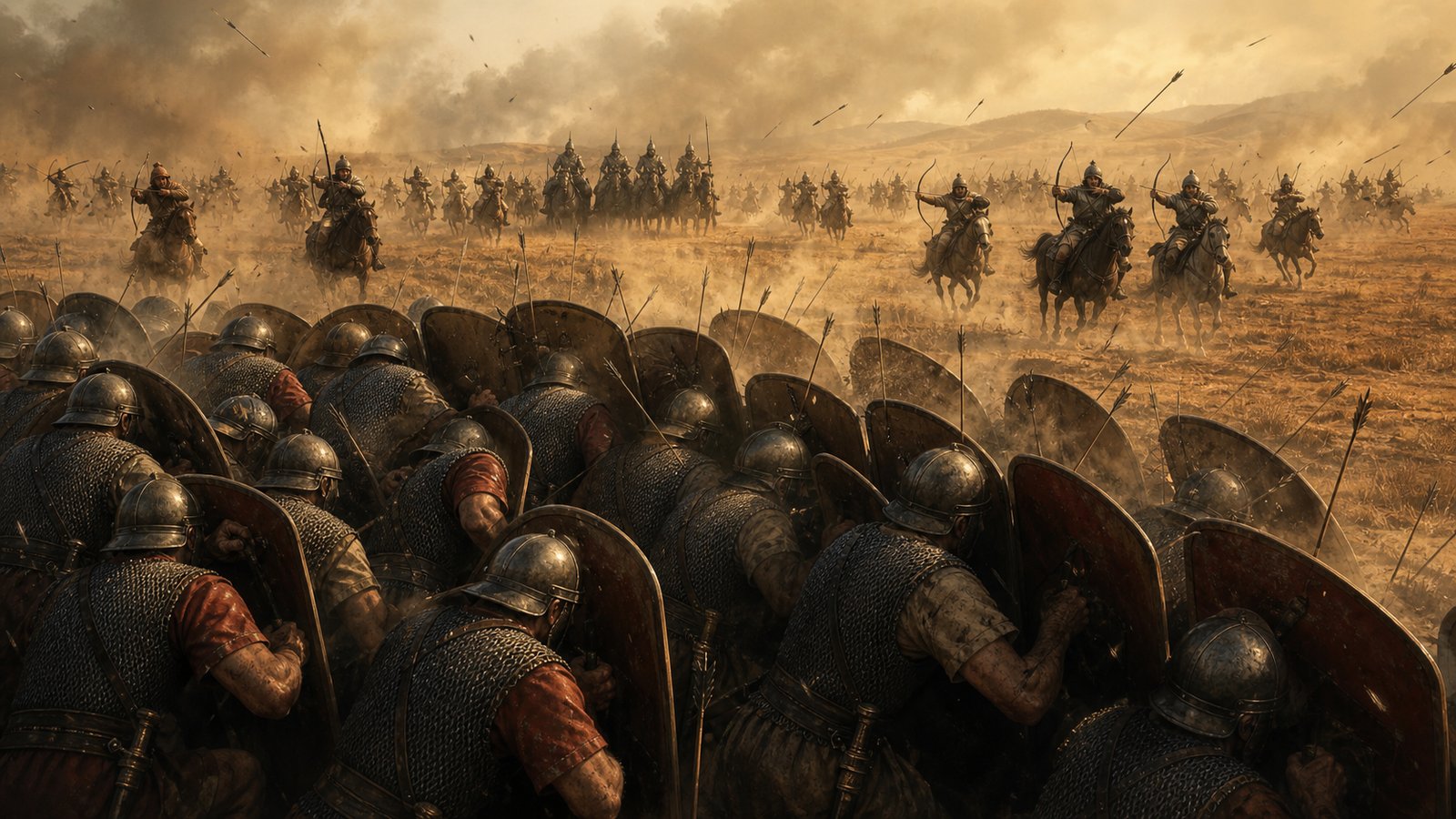
The Roman answer to missiles was cohesion. Shields overlapped, men closed ranks and the formation tried to reduce exposed surfaces. Such discipline could prevent an immediate rout. It also made the army a compact target that the Parthians could work around without entering sword range.
Plutarch emphasizes the force of the arrows. He describes missiles penetrating defenses and hands pinned to shields. Ancient battle narrative magnifies suffering, but his physical point is clear: shelter was incomplete. A shield that stopped one arrow could become heavier and harder to hold. A wounded hand weakened both defense and formation.
The Romans faced a punishing choice. Remaining dense reduced exposure to sudden cavalry penetration but accepted the continuing barrage. Advancing toward riders who could withdraw wasted energy and loosened order. Scattering to reduce the target invited armored horsemen to exploit gaps. Surena’s two mounted arms made each Roman response dangerous in a different way.
The contrast with Rome’s corvus boarding bridge is sharp. In the First Punic War, Roman commanders had created machinery that forced naval combat toward an infantry fight they understood. At Carrhae, Surena controlled the conversion. He refused the close battle Crassus needed.
Publius chased the pressure and lost contact
Crassus eventually sent his son Publius with a detachment to drive away the attackers. Movement promised relief. If the Romans could catch the horse archers, the entire logic of the barrage might collapse. Instead, the mounted enemy drew Publius farther from the main force.
Once separated, his troops faced the same combination at greater disadvantage. Horse archers maintained distance and missile pressure. Cataphracts supplied the threat of impact. The detachment could not easily retreat in order, could not compel the archers to stay near, and could not rely on the mass of the main army.
This episode shows why the arrow train was more than an efficient storehouse. Sustained pressure provoked decisions. Waiting hurt. Chasing offered hope. The longer Surena could keep shooting, the more likely Roman commanders were to choose movement on Parthian terms.
Publius’s destruction then returned to the main battle as terror and proof. The Romans had not merely failed to catch the enemy. Their attempt had demonstrated that detachment from the formation could be fatal. The survivors were pushed back toward the original dilemma with fewer options and less confidence.
The smallest detail explains the largest failure
Carrhae ended in retreat, broken negotiations and the death of Crassus. The consequences spread far beyond one field: lost soldiers, captured standards, a damaged Roman reputation and a frontier rivalry that continued for generations. None of that means a camel train alone defeated Rome.
Terrain, leadership, intelligence, morale and the complementary use of horse archers and cataphracts all mattered. The value of Plutarch’s camels is that they reveal how those elements were connected. Mobility requires supply. Missile pressure requires replacement missiles. A commander’s expectation about time is only as good as his knowledge of the enemy’s reserve.
Roman memory often made defeat into a lesson about arrogance or foreign cunning. Logistics provides a colder reading. Crassus built his response around the exhaustion of a resource. Surena had already designed a way to renew it. The tactical surprise began in cargo loads, not in a miraculous bow.
The animals also clarify the division of labor inside Surena’s force. The archers did not each have to carry every shaft they might use during the day, which would burden the horse and rider. Nor did every camel need to approach the dangerous edge of the action. Loads could remain behind the moving screen, protected by distance while still close enough for rotation. The battlefield system assigned speed to horses, carrying weight to camels and shock to armored cavalry.
When the Roman line looked outward, it saw riders that would not stay and arrows that kept arriving. The decisive system extended behind that horizon. Camels waited with the weight that made motion sustainable, turning bundles of shafts into hours of control.
Sources
Plutarch, Life of Crassus 21, 23–25
Battle of Carrhae historical reference