
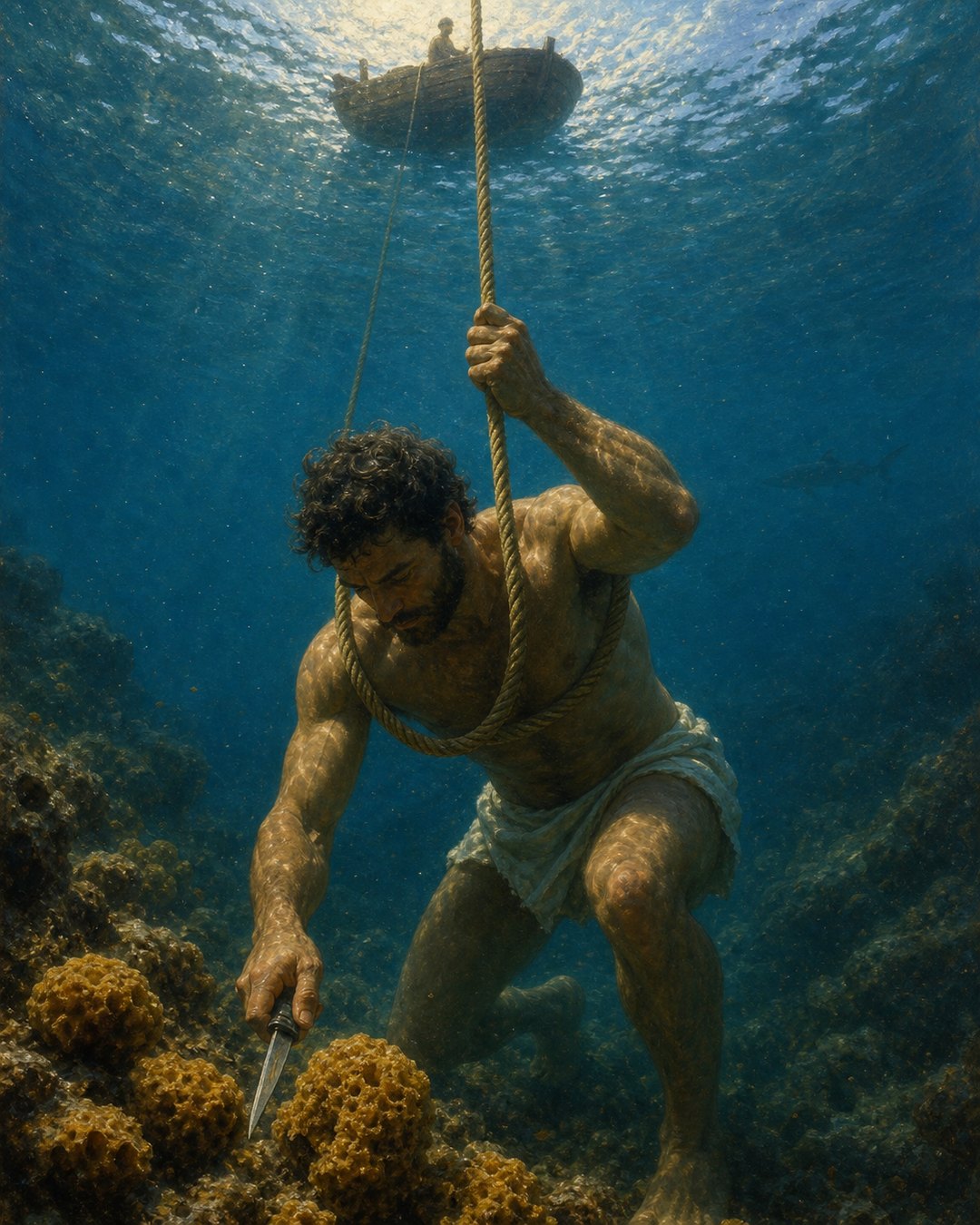
The sponge diver disappeared with a cord fixed beneath his shoulders. On the boat, companions held the other end. Below, one hand managed a short pointed blade while the other pulled the line to signal danger. Pliny the Elder describes this arrangement in a passage where harvesting turns suddenly into a fight for extraction.
The crew did not simply drag at full force from the beginning. They drew the diver along at a moderate pace. When he came close to the vessel, they had to pull him out with extreme speed. Pliny believed dogfish made that last stretch especially perilous because the diver, occupied with reaching the surface, could no longer face the animal as boldly as he could underwater.
Whatever we make of every zoological detail in the account, its labor system is remarkably concrete. A person worked beyond speech and easy rescue. The cord carried information to the boat, transferred the crew’s strength back to his body, and joined a dangerous underwater task to a team that could not see all of it.
The harvest began with a living body fixed to rock
Pliny first explains what the diver sought. He distinguishes three kinds of useful sponge. The tragi were thick, hard and rough. The mani were also thick but softer. A fine, close-textured kind called Achillium could be made into tents for wounds. Texture therefore connected habitat to different human uses.
All grew on rocks. Pliny treated sponges as creatures with a kind of life and even intelligence, reporting that they contracted when a hand approached to tear them away. The contraction supposedly made separation more difficult. He also notes small shells within them and describes tubes through their bodies.
Ancient natural history mixed observation with interpretations modern zoology would revise. The safe reading is not that every explanation was correct, but that harvesters recognized variation, attachment and condition. A sponge was not loose cargo waiting on the bottom. It had to be found in the right environment and separated from stone.
This was a different working surface from the knotted fishing nets that turned open water into a managed catch. A net extended the fisher’s reach from boat or shore. The sponge diver carried the working body down to the rock and brought the harvest back by ascent.
Depth, sun and place changed the material
Pliny maps sponge quality across water and coast. The largest were the kind he calls manos, while those near Lycia were especially soft. Specimens from the Hellespont were rough, and those around Malea coarse. Deep, calm sea produced softness; exposure to sun encouraged putrefaction.
These distinctions made the collector’s knowledge geographical and sensory. A useful sponge was judged through resistance, texture, size and condition, not merely by species name. Deep water promised better material but demanded a more difficult descent and recovery. Quality and danger could rise together.
Torone supplied another striking claim. Pliny says detached sponges there could survive and regrow from roots left on the rock. He also reports a bloodlike color remaining where some were torn away, especially in the African Syrtes. Such details show observers attending closely to the scar of removal even when their explanation of life processes remained ancient.
The same sea could reorder familiar substances. Coral was described as soft underwater and hard after exposure to air. Sponge behaved differently, swelling with water and degrading under unwanted sun. Collectors learned materials through transitions between seabed, surface and shore.
The diver divided his hands between signal and defense
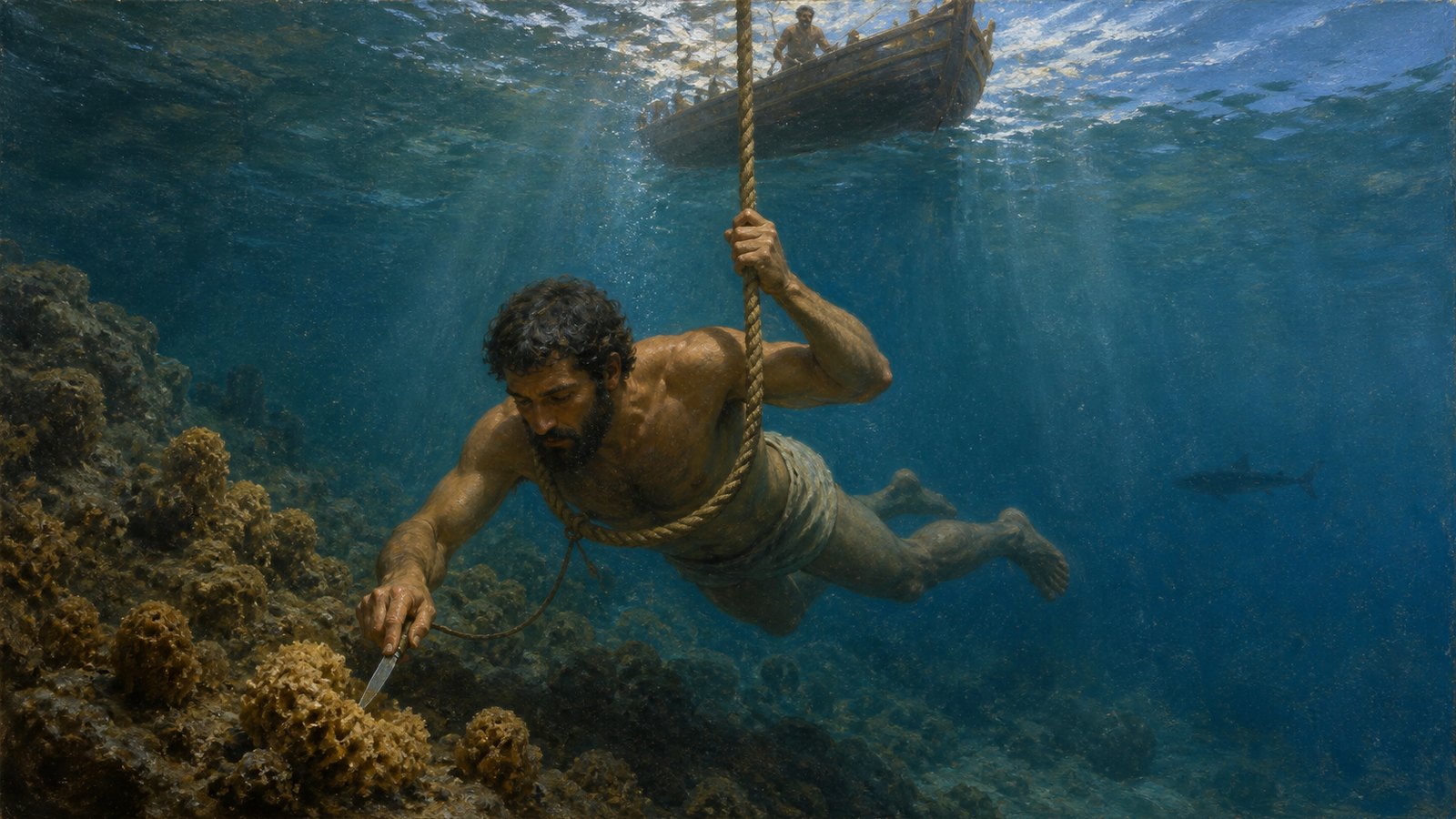
Pliny’s account of danger centers on dogfish near the sponge grounds. He says divers carried very sharp stilettos fastened by strings so the tools would not be lost. The blade was not presented as elaborate equipment. Its importance came from remaining attached and available while the swimmer’s position changed.
He also preserves the divers’ report of a dark fish-cloud pressing over them, then interrupts it with doubt. Pliny thought darkness and fear created that particular enemy because nobody had identified such a creature. By contrast, he records flat-fish as a welcome sign: divers called them sacred because they believed those fish did not share water with the dangerous animals they feared.
Underwater, the diver tried to confront the animal rather than flee blindly. Pliny says the dogfish and human were on something like equal terms below because each could frighten the other. The passage is not a neutral marine-biological report; it preserves divers’ danger lore and Pliny’s dramatic interpretation. Yet the gestures he records form a coherent working method.
The right hand wielded the stiletto. The left pulled the rescue cord according to the urgency. This division matters. A person who could not call to the boat converted alarm into tension on a line. Companions above had to distinguish that signal from the ordinary movement of a diver, current and ascent.
Tool security also mattered. A blade dropped in deep water was gone when most needed. Tying it to the body kept it within reach but introduced its own entanglement risk. The diver descended as a small connected system: cutting or defensive tool on one string, body under the shoulders on another, hands assigned separate jobs.
The surface removed the diver’s best defense
Pliny places the greatest danger not at maximum depth but during the exit. While submerged, the diver could turn and meet a threat. As he worked upward and tried to leave the water, his posture and attention changed. He lost the ability to face the animal with the same confidence.
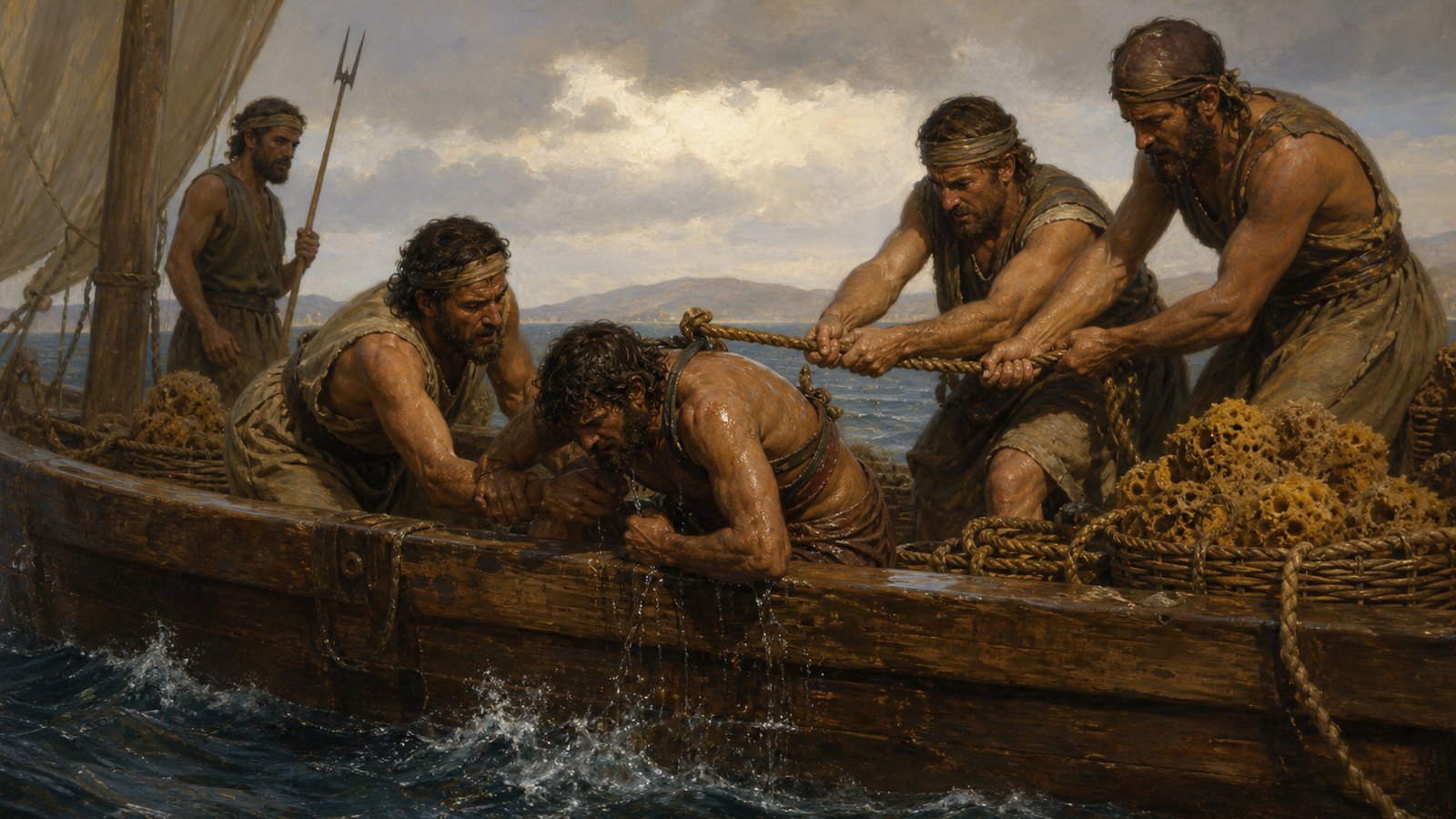
The boat crew compensated in stages. At first they hauled moderately. Near the ship, they had to whip the diver out in an instant. The slow pull controlled ascent; the final burst shortened exposure beside the hull. The rescue protocol depended on recognizing that one pace did not fit the whole route.
Pliny adds a grim detail: a diver already being drawn out might be dragged from the helpers’ hands if he failed to aid them by rolling his body into a ball. The posture reduced the awkward length that had to clear the side and perhaps protected vulnerable limbs. It also demanded cooperation from someone exhausted and frightened.
Other crew members brandished pronged fish-spears, but Pliny says the animal could position itself beneath the ship. The hull created safety above and a blind zone below. The diver’s last body-length through the water was therefore where separate roles converged—signal, haul, defensive posture and lookout.
A sponge was the product of an entire boat crew
Pliny writes his chapters as natural history, moving from sponge varieties to animals found around them. Inside that catalog, however, appears a compact account of organized work. The harvest required a knowledgeable diver, a secured cutting tool, a shoulder line, attentive haulers and people prepared with spears.
The cord joined those roles without eliminating the diver’s agency. He did not become passive cargo once the line tightened. He chose when and how urgently to pull with his left hand, defended himself with the right, and changed his body for the final extraction. The crew supplied power, but the person below supplied information.
Maritime infrastructure is often imagined at monumental scale. Lighthouses made routes and dangerous coasts legible from a distance. Sponge work operated through much smaller equipment: a cord, a blade, a wooden hull and practiced timing. Both systems answered the same fundamental problem of human action in water—how to extend knowledge and assistance beyond the stable ground.
The harvested sponge could later appear as a household, medical or cleaning material, detached from the risk that acquired it. Pliny’s sequence restores that submerged history. Before the soft object reached a buyer, someone had to cut it from rock. Before that person reached the deck, companions had to feel a message travel up one cord and know exactly when to pull hard.
Sources
Pliny the Elder, Natural History, 9.69–70.