
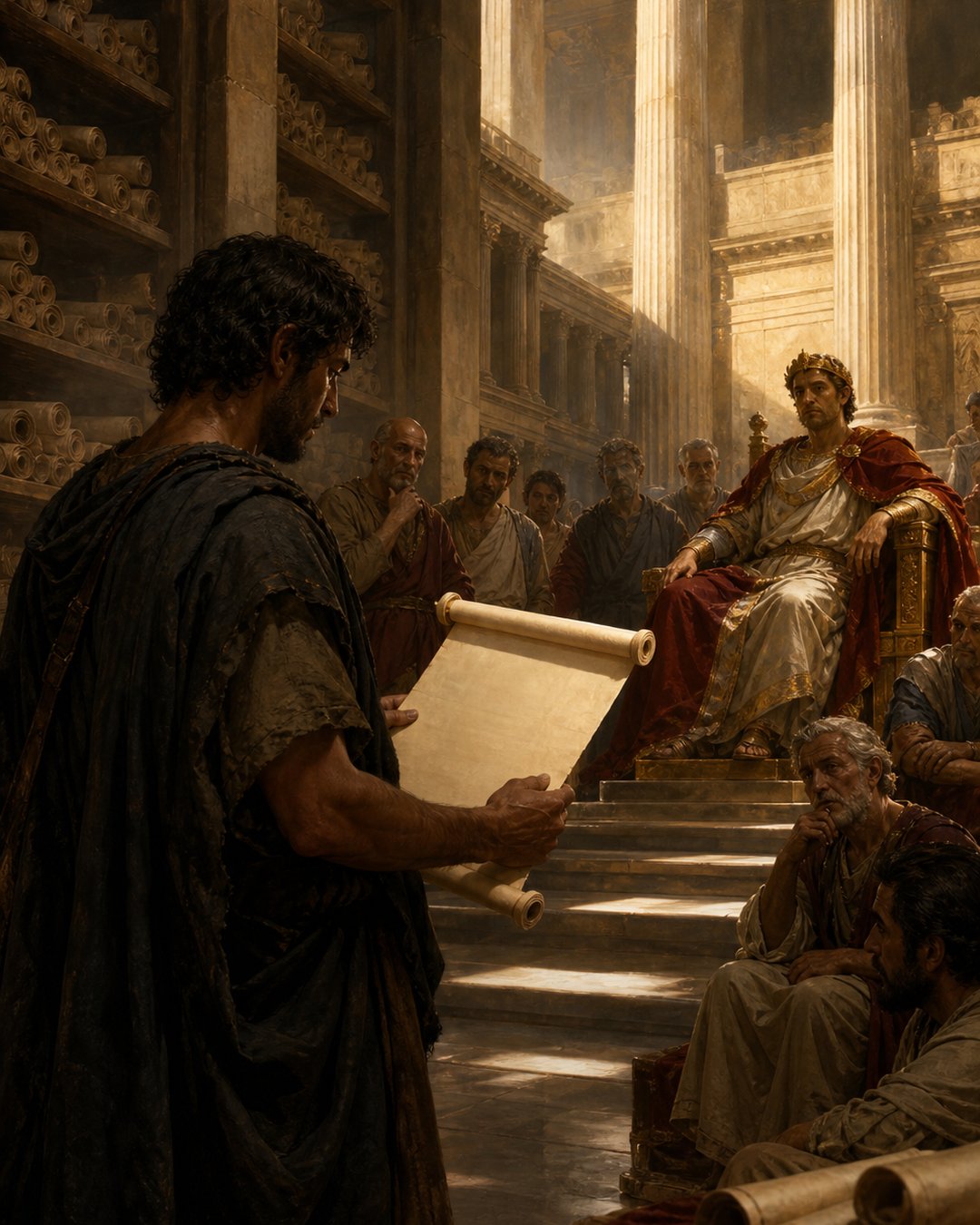
Zoilus arrived in Alexandria with an aggressive literary identity. Vitruvius says the Macedonian called himself Homeromastix and read works attacking the Iliad and Odyssey before Ptolemy. The king was offended but withheld an answer. Later the critic fell into poverty and asked the same court for help.
The reply made reputation into an economy. Homer, the king reportedly said, had been dead for more than a thousand years and had still supplied livelihoods to many thousands. Someone claiming greater talent ought to support not only himself but others. After that rebuke, Vitruvius gives Zoilus no stable death. Philadelphus crucified him in one story; people at Chios stoned him in another; a third sent him alive to a pyre at Smyrna.
Those endings cannot all be biographical fact. Vitruvius knew they conflicted and introduced them as varying reports. Their value lies in the multiplication itself. Once Zoilus had been cast as the man who attacked a poet unable to answer, cities and rulers could compete to give the critic a punishment matching his literary offence.
Homeromastix turned criticism into a public persona
Vitruvius introduces Zoilus as a Macedonian who came to Alexandria and adopted the surname Homeromastix. The name did more than identify a writer. It presented him as the scourge or chastiser of Homer, a role built around opposition to the most prestigious poems in Greek culture.
His target was specific. He recited writings against the Iliad and Odyssey before the king. Vitruvius does not summarize Zoilus’s arguments, quote his objections or test whether any criticism was perceptive. The anecdote is interested in posture and reception: a living critic attacked an absent author whose works commanded admiration.
That imbalance shapes the accusation. Homer could not respond face to face. Ptolemy therefore saw the performance not as an exchange between scholars but as abuse delivered safely against the dead. The critic’s chosen persona became evidence of unfairness before the contents of his criticism were considered.
Alexandria’s books already carried mechanisms for judging originality. In the contest where Aristophanes exposed recycled poems from memory, shelves allowed claims to be checked against earlier works. Zoilus’s episode reverses that scene. The older author remains available as text but unavailable as a speaker.
The king answered poverty with a thousand-year calculation
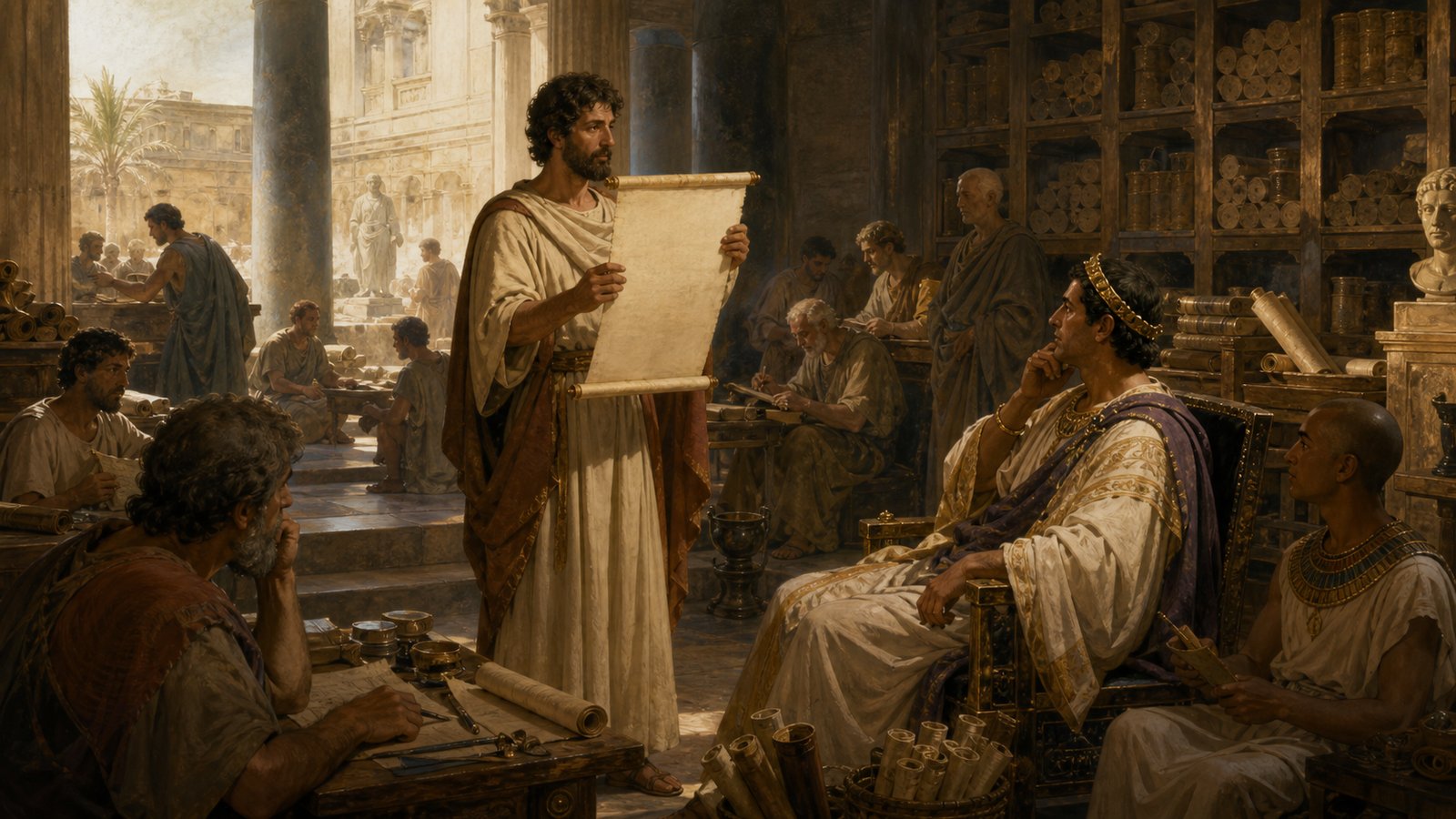
Ptolemy’s first response was silence. Vitruvius says he thought the attack outrageous yet made no rejoinder. Zoilus stayed in the kingdom, became poor and eventually sent a request that something be bestowed on him. The critic who had approached the court through denunciation now approached it through need.
The king’s reported answer avoided the merits of Homer and measured literary value through endurance. Homer had been dead for more than a thousand years, he said, while providing a livelihood for many thousands. A man who claimed higher genius ought to support not merely himself but many others.
The numbers are rhetorical, not an audited account of every performer, teacher, copyist or scholar who lived from Homer. They make a simple contrast. Zoilus was alive and unable to sustain himself; Homer was dead and still sustained an enormous human world around the poems. Time and dependent labour became the king’s evidence.
This is also a picture of literature as infrastructure. Poems survive through readers, reciters, educators, copyists and collections. The books that supported such work could outlast any one owner, much as Lucullus’s library became a meeting place for Greek visitors. The rebuke denies Zoilus patronage by contrasting his isolated request with that wider economy.
Three punishments replaced one recoverable ending
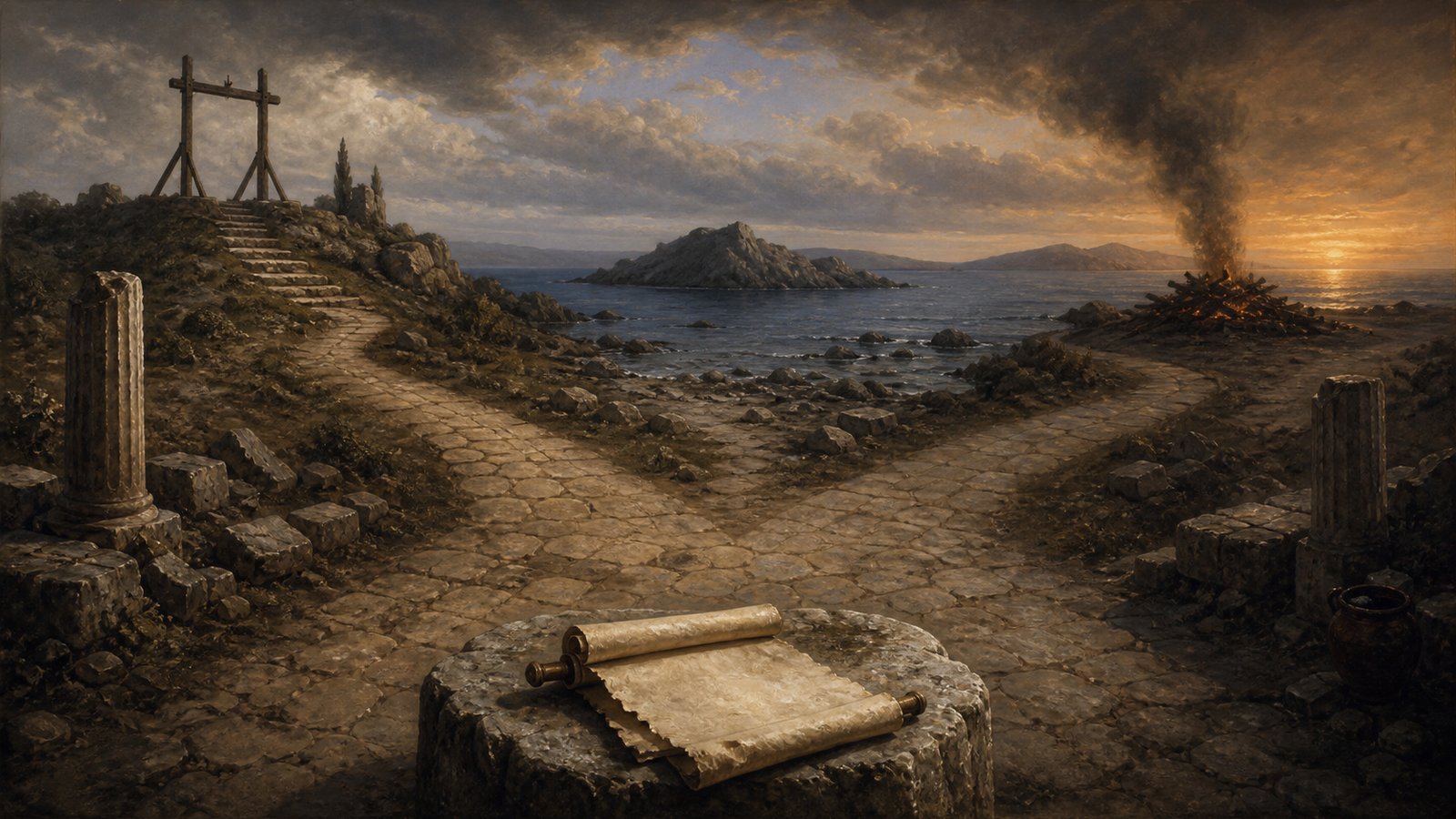
Vitruvius then signals uncertainty plainly: the stories of Zoilus’s death differed. One made Philadelphus crucify him. Another had him stoned at Chios. A third placed his death at Smyrna, where he was thrown or burned alive upon a funeral pyre. The translations vary slightly in phrasing, but the locations and modes remain incompatible.
This is not the kind of variation that can be merged into a single sequence. A man cannot be executed by a king in one place, stoned to death on an island and also die on a pyre at another city. At least two stories must be wrong, and the passage supplies no method for selecting the survivor.
The honest historical result is therefore bounded. Vitruvius attests that these reports circulated, not that all three events occurred. He also attests their common moral direction. Each delivers a spectacular punishment to the critic, relocating judgment from the literary court into the body and the city.
Later readers may want to identify the most plausible tradition, but Vitruvius’s preface does not preserve the evidence such a verdict would require. There are no witnesses, dates, chains of transmission or reasons to prefer Chios over Smyrna. The contradiction is not an invitation to invent certainty.
The cities made criticism look like civic guilt
Why did the ending multiply? Each version gave a community or ruler the role of defending Homer. Philadelphus supplied royal justice. Chios supplied a collective stoning. Smyrna supplied a death shaped like ritual destruction. Different settings could absorb the same lesson while claiming the decisive act for themselves.
Vitruvius intensifies the moral language by comparing Zoilus’s fate to punishment for parricide. Homer appears as a father of poetry; attacking him becomes figuratively close to attacking ancestry. The violence of the reported endings then seems, within the source’s argument, proportionate to an offence against inherited culture.
That does not make the executions reliable or the punishment defensible. It shows how biography can be bent by reception. Once a writer is reduced to the enemy of a revered predecessor, later storytellers have little reason to preserve ambiguity about his ideas. They instead improve the moral ending.
The three cities expose that process because they overproduce closure. One terrible death would finish the hostile biography. Three reveal repeated acts of narrative finishing, each version trying to make Zoilus’s end express what audiences believed his criticism deserved.
Vitruvius needed the contradiction more than a verdict
The tale appears in the preface to a book on architecture, where Vitruvius discusses earlier authors and his own use of inherited knowledge. Just before Zoilus, he tells how Aristophanes identified poets who had stolen other writers’ work. Immediately after Zoilus, he insists that he is not putting his name on other men’s books or seeking reputation by finding fault with them.
Zoilus therefore functions as a negative model of authorship. Vitruvius presents his own writing as grateful collection: earlier thinkers furnished materials, and the new author acknowledges the fountain from which he draws. Theft hides dependence; hostile attack converts dependence into contempt. Proper authorship names what it inherits and adds to it.
Within that argument, choosing the true death would contribute little. Every version already says the same thing about reputation: a writer who attacks the dead can be answered by stories after his own death. Zoilus loses control of his ending just as Homer had lost the ability to answer him in person.
Three incompatible deaths are poor material for a confident biography and excellent material for a study of literary memory. Vitruvius preserves the crack instead of sealing it. Through that crack we see the machinery of hostile tradition—how criticism became character, character became guilt, and guilt kept searching the Mediterranean for a final punishment.
Sources
Vitruvius, On Architecture, 7, preface 8–10.