
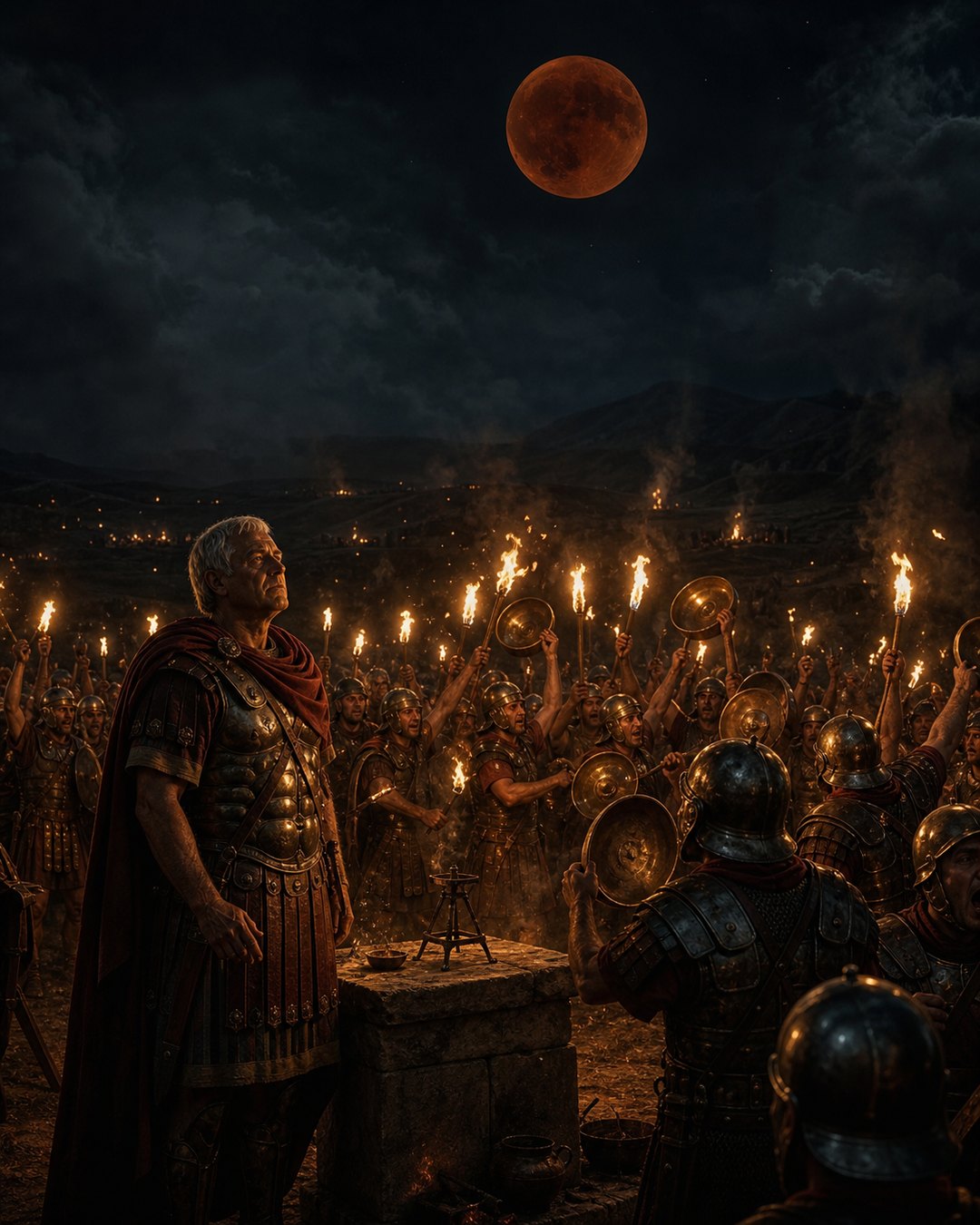
The moon disappeared over two armies waiting near Pydna. After supper, while the camps settled for the night, the full moon lost its light by degrees, changed colour and became totally eclipsed. Roman soldiers clashed bronze vessels and raised torches and firebrands. Across the plain, Plutarch says, fear moved through the Macedonian camp with a rumour that the darkened moon foretold the eclipse of King Perseus.
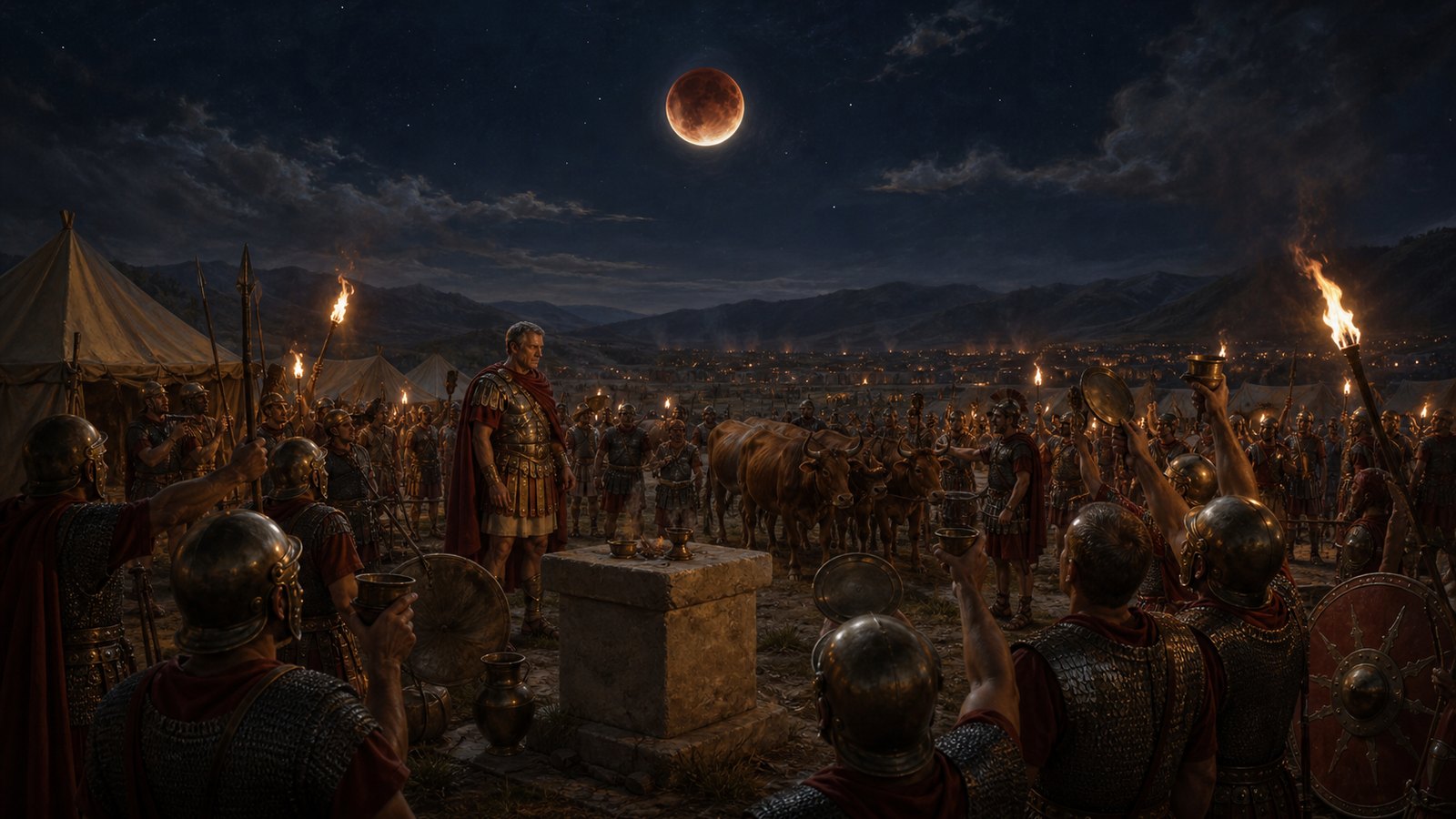
Lucius Aemilius Paullus understood the physical explanation. Plutarch presents him as knowing that the moon entered the earth’s shadow and recovered its light after passing through it. Yet knowledge did not send him to bed or cancel ritual. As brightness returned, he sacrificed eleven heifers to the moon. At dawn he offered twenty victims to Hercules without receiving an accepted sign. The twenty-first finally promised victory—but only to defenders.
The condition fitted the command problem Aemilius had already created. He had refused battle with troops tired from marching, concealed the establishment of a camp and waited for the sun to move west rather than glare into Roman faces. Plutarch’s sequence is not a contest in which science defeats superstition. It is a portrait of command conducted through several kinds of uncertainty at once: fatigue, formation, celestial fear, sacrifice and light on the battlefield.
Aemilius Hid a Camp Behind the Appearance of Battle
Before the eclipse, Aemilius had approached Perseus’s position in battle order. The ground near Pydna suited a phalanx: smooth space allowed its dense formation to work, while smaller hills could support light troops. Two shallow rivers crossed the field. The Roman commander admired the size and arrangement of the Macedonian force and stopped.
Younger officers pressed for an immediate attack, especially Nasica, whose recent movement over the mountains had succeeded. Aemilius answered that he might have shared their eagerness at their age. Many victories, he said, had also taught him how men were defeated. Troops tired after a long march should not be thrown against an enemy already formed and ready.
The halt did not look like a retreat. Aemilius ordered the visible front to remain arranged as if combat were imminent. Behind it, soldiers began trenches and fortification. Units peeled away in succession until the army entered its camp quietly. He used one formation to shield the creation of another.
This makes the night’s religious drama part of an already cautious timeline. Aemilius was not waiting because the sky suddenly frightened him into passivity. He had delayed before the moon darkened, for reasons grounded in fatigue and enemy readiness. The eclipse arrived inside a command decision already committed to preparation.
Scipio’s night attack on the camps of Syphax used darkness to accelerate surprise. At Pydna, darkness served the opposite purpose. The army rested and fortified while its commander preserved the option to fight on better terms the next day.
Bronze Noise and Fire Made the Eclipse a Camp Event
Plutarch describes the moon at full height before it dimmed. The loss was gradual, not a single blink: light faded, colours shifted and total eclipse followed. That progression gave thousands of people time to watch and respond. The astronomical event became a social event because each camp produced meaning in sight of the other.
The Romans clattered bronze vessels and lifted burning brands and torches, invoking the return of the moon’s light. Those actions were loud, bright and collective. They did not require every soldier to hold the same private theory of eclipses. The response gave the camp something to do while the familiar night sky changed above armed men expecting battle.
Plutarch sharply contrasts the Macedonians. Terror and amazement seized them, he says, and a rumour identified the moon’s eclipse with the coming eclipse of their king. This is a literary report written long after the battle, not a transcript of every Macedonian soldier’s thought. Its value lies in the contrast Plutarch chose: Roman action against Macedonian rumour, and a commander’s composure against a king’s threatened fortune.
Signals of flame could carry deliberate information when torches were organized into a coded battlefield alphabet. The firebrands at Pydna did something less precise but still operationally important. They made the Roman response visible, synchronized attention and refused silent helplessness.
Aemilius’s knowledge sits inside this collective ritual rather than outside it. Plutarch says he was no novice and understood the earth’s shadow. The same man nevertheless waited for the returning light and sacrificed eleven heifers to the moon. Natural explanation answered why darkness occurred. It did not answer what a Roman commander should publicly do with that night before battle.
Twenty Unaccepted Offerings Made the Twenty-First Conditional
At daybreak Aemilius sacrificed to Hercules. One victim did not give the desired indication, nor did the next. Plutarch extends the sequence through twenty offerings without an accepted sign. The repetition matters because it prevents the final result from looking automatic. Ritual consumed time and produced refusal before it produced direction.
The twenty-first victim yielded signs that promised victory to defenders. That final word limited the reassurance. Aemilius could not simply cite divine approval for any action he preferred. The omen, as Plutarch reports it, favoured a posture: hold, receive and prevail rather than launch an impatient assault.
The commander then vowed a hecatomb and solemn games to Hercules. Plutarch does not give a surviving inspection chart for the victims, nor does he explain which features made the last signs favourable. It would be false precision to invent the colour, organs or gestures. What the narrative supplies is number, delay, divine recipient and the defensive condition.
The bronze liver from Piacenza divided a model organ into named divine zones, evidence for a highly structured Italian tradition of reading signs. Pydna gives no comparable object. Instead, Plutarch shows interpretation affecting tempo. The sacrifice does not explain the phalanx or move a cohort; it tells the commander not to rush the role his army should occupy.
The distinction matters because “an omen before battle” can become a reusable shell that hides the actual mechanism. Here the number of attempts and the grammatical condition are the story. Twenty failures lengthened the morning. The twenty-first did not predict victory without qualification. It aligned religious permission with restraint.
The Westering Sun and Rival Openings Kept Victory from Looking Simple
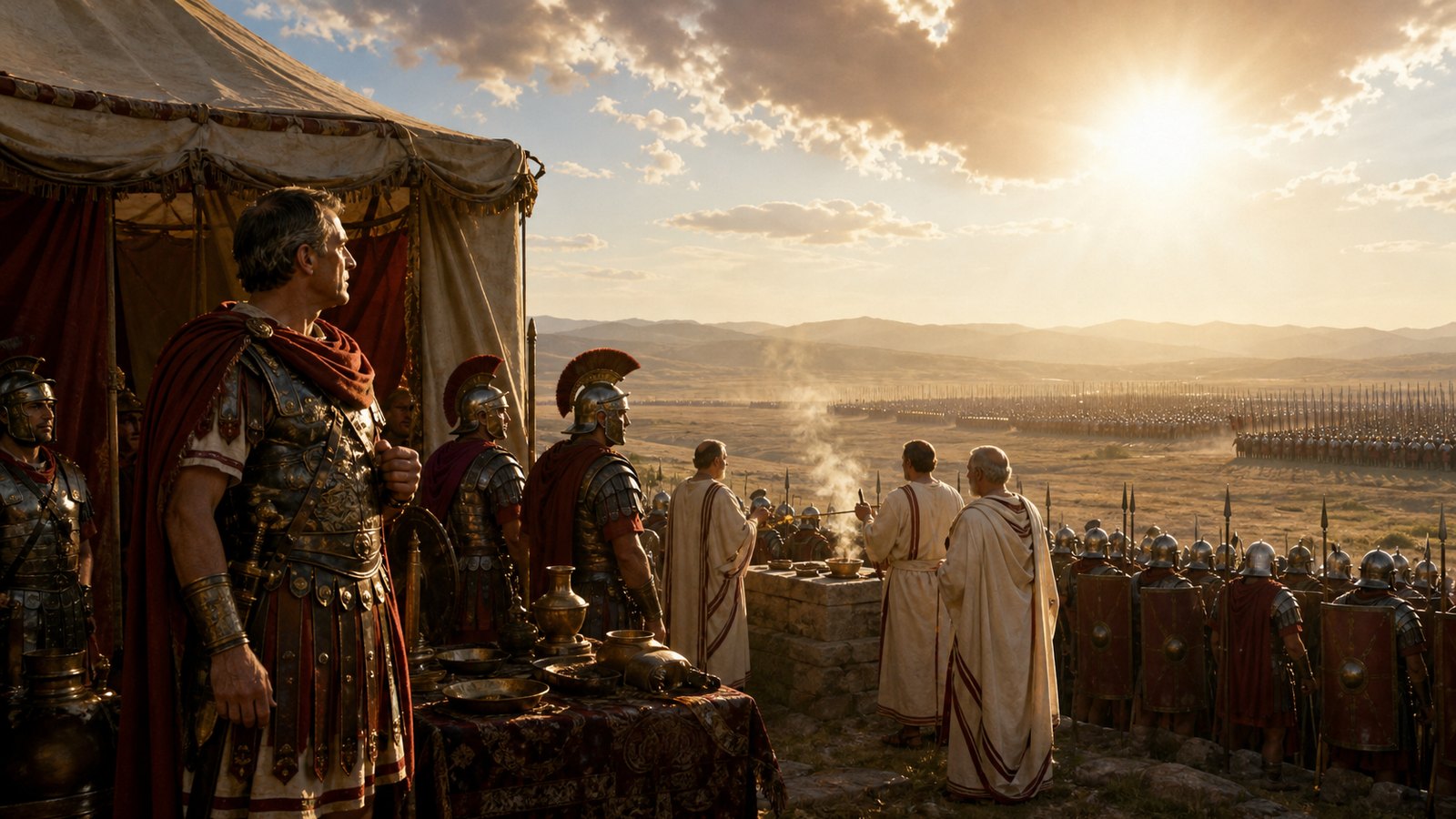
Aemilius ordered his captains to prepare, but he also waited for the sun to decline westward. Morning light would have faced the Romans and dazzled them. This was not a symbolic sun. It was glare entering soldiers’ eyes across a real alignment of armies. Time of day could change what men saw when pikes lowered and formations closed.
The delay joins three prior choices: not attacking after the march, building the camp under cover of a battle front and accepting a defender’s omen. None guaranteed victory. Together they reduced avoidable disadvantage before the fighting began. Command appears as the accumulation of bounded decisions rather than one theatrical stroke.
Even the opening of battle remained disputed in Plutarch’s sources. One story had Aemilius release an unbridled horse and send Romans after it, drawing the enemy into a clash. Another began with Thracians attacking Roman pack animals, followed by seven hundred Ligurians and reinforcements from both sides. Plutarch preserves both instead of pretending certainty.
When the Macedonian pikes formed a bristling wall, Aemilius was alarmed. He later spoke of the sight, according to Plutarch. During the battle he concealed that feeling, riding through the Roman ranks calmly without helmet or breastplate. Knowledge of eclipses had not made him fearless; successful command required fear not to become the army’s visible instruction.
Pydna’s prelude therefore resists a single explanation. The Romans did not win merely because their commander understood astronomy, nor because a sacrifice promised success, nor because he managed the sun. Plutarch made each element constrain the others. The moon could be physically explained and ritually answered. The omen could favour Rome and still demand defence. The commander could appear serene while privately confronting a formation unlike anything he remembered.
The twenty-first ox belongs at the centre because it did not remove uncertainty. It gave uncertainty a condition. Aemilius still had to decide how to preserve that condition in terrain, daylight and the uncontrolled moment when two armies finally moved.
Sources
Plutarch, Aemilius Paullus, 17–18.