
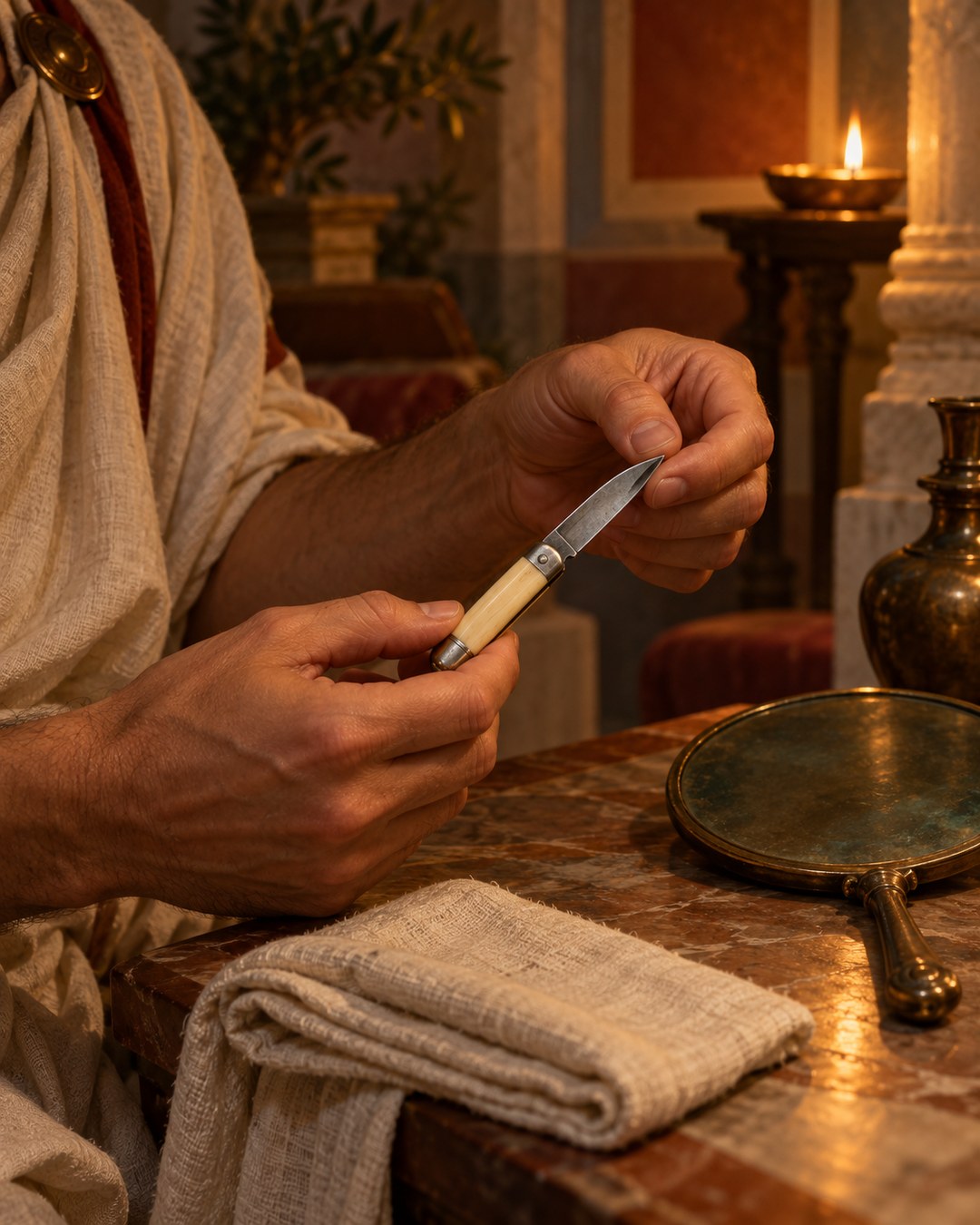
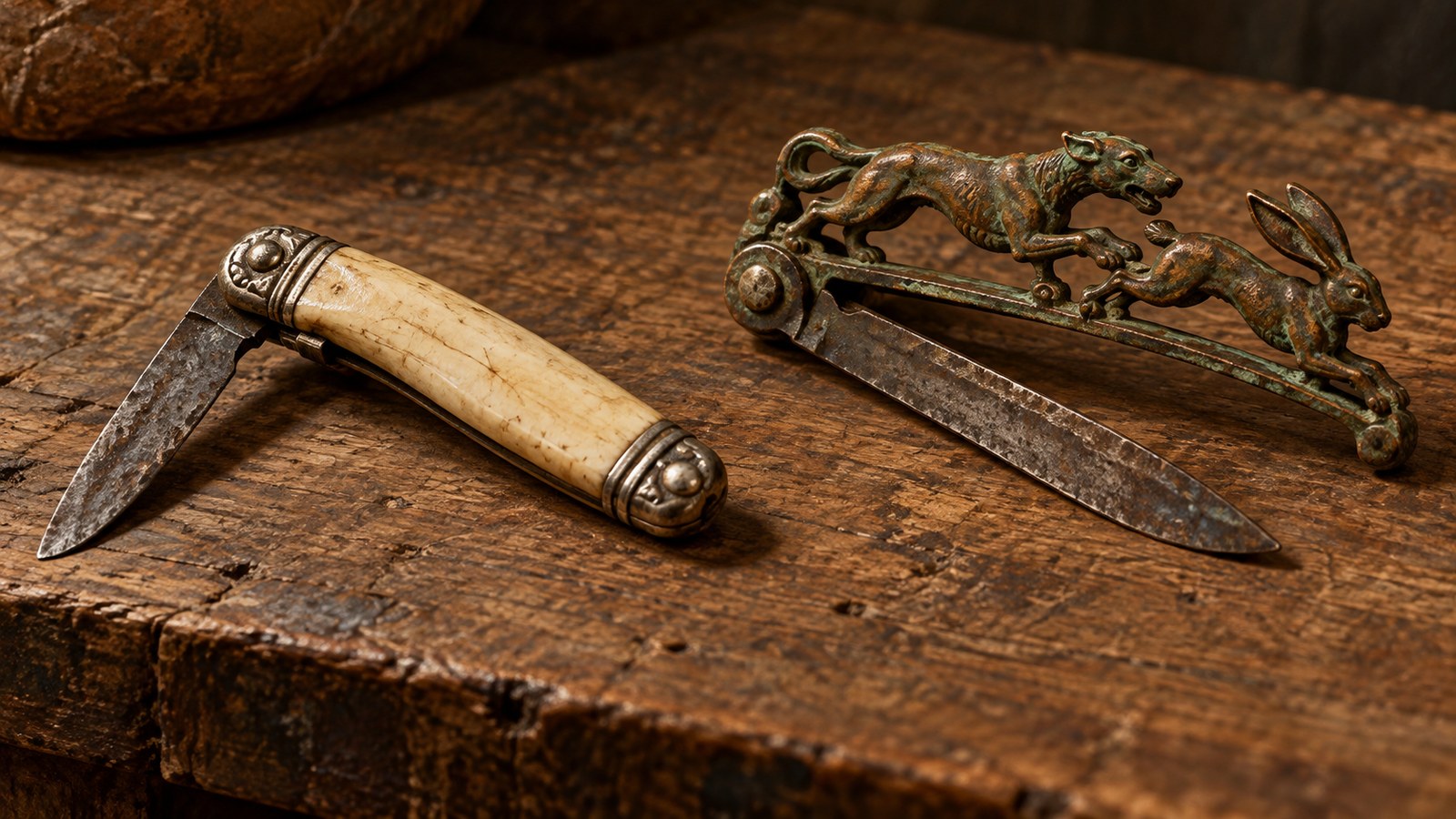
A Roman folding knife could fit inside the length of a modern palm and still carry several kinds of work. One example in London Museum is a 70-millimetre toilet knife: iron blade, ivory handle, silver mounts. The museum suggests that a knife like it might have cut nails. Another surviving object is not a complete knife but a 68-millimetre copper-alloy handle. Its openwork decoration shows a hound pursuing a hare, while its underside preserves the slot into which an iron blade folded.
Together, the records show that “folding” was not a minor label. It governed the shape of the handle, the position of the pivot, and the way a sharp edge occupied space when the tool was closed. The mechanism also created a surface that could be decorated far beyond what the blade required. Roman compactness was built, not merely achieved by making everything small.
A Toilet Knife in Ivory and Silver
The toilet knife is dated to the second or third century AD. It measures 70 millimetres long, 33 millimetres wide, and only 8 millimetres deep. Its blade is iron. Its handle is ivory, and silver mounts complete the assembly. Those materials place a dark working edge beside pale carved organic material and bright metal details.
The museum’s proposed use is careful: a knife like this might have been used for cutting nails. The wording does not prove the routine of its individual owner, but it does identify the object as a folding toilet knife rather than a general kitchen blade. The scale fits that reading. This was an implement for controlled work close to the body, not for dividing a carcass or cutting heavy rope.
Personal care in the Roman world required tools with edges, points, and hooks. The recent evidence of a Roman surgical hook shows a more invasive end of that spectrum. The toilet knife belongs to a different task and setting, yet both objects remind us that a small metal working end had to be shaped, controlled, cleaned, and held.
Its folding form mattered because an exposed blade is awkward when stored among other possessions. The record does not preserve a carrying case or describe exactly where this knife travelled, so certainty should stop there. What can be seen is that the handle was more than a grip. It was the place into which the blade could close, turning a sharp tool into a compact object.
The Hound Ran across a Mechanical Handle
The second record preserves an openwork copper-alloy handle from a clasp knife. Its image is kinetic: a hound pursues a hare. Yet the scene was built around the requirements of a moving blade. At the junction with the lost iron blade, a rectangular terminal concealed the pivot. On the underside, a slot received the blade when it folded. Traces of iron still remain around the pivot area.
The handle measures 68 millimetres long, 23 millimetres wide, and 7 millimetres deep. It is therefore close in length and depth to the toilet knife, although the two objects are not presented as a matched set. The comparison is useful because it shows two different solutions at nearly the same compact scale. One used ivory and silver around a grooming implement. The other turned copper alloy into an openwork chase scene.
The hound and hare were not painted on a flat panel added after the mechanism was complete. They formed the openwork body of the handle itself. The decoration had to coexist with the channel below and the pivot at the terminal. A maker could not let the animal scene obstruct the blade’s path. Visual design and moving geometry occupied the same few centimetres.
This combination is easy to miss when a corroded handle is displayed without its full iron blade. The slot makes the absent movement recoverable. Closed, the edge entered the underside. Opened, the blade rotated away from the decorated grip. The rectangular terminal hid the point around which that change occurred. The remaining iron at the pivot confirms that the copper-alloy object once met a ferrous working part.
Folding Was a Sequence, Not a Shape
To make either knife, several relationships had to be right. The blade needed room to rotate. The pivot had to hold it at the junction. The handle needed enough depth to receive the edge. A slot that was too narrow would catch; one that was too broad would leave the blade poorly contained. The archaeological record supplies the components, while the folding action connects them.
The action also divided the object into two states. Open, the implement presented a working edge and a handle. Closed, much of the dangerous edge disappeared into the grip. That transition is the central mechanical fact. It explains why the handle had internal architecture even when its outer surface advertised ivory, silver, or an animal chase.
Roman craft often joined unlike materials because each did a different job. The ivory-handled knife placed iron, ivory, and silver together. The clasp knife paired an iron blade with cast or worked copper alloy. The same logic appears in the tiny seal box that managed wax and cord: the useful object emerges from the cooperation of materials, openings, and movement rather than from one substance alone.
The dimensions make that cooperation unusually tight. The complete toilet knife is 33 millimetres wide but only 8 millimetres deep; the clasp handle is 23 millimetres wide and 7 millimetres deep. Within those shallow profiles, makers still had to reserve space for an iron edge, a pivot, and material strong enough to survive repeated opening. Compactness was not an empty absence of bulk. It was a crowded arrangement of parts.
Folding also made wear concentrate at a particular place. The blade’s edge did the cutting, but the pivot repeatedly bore motion. That is why the traces of iron around the clasp handle’s pivot are so informative. They survive where blade and handle met, exactly where the object changed between open and closed.
Small Tools Carried Large Choices
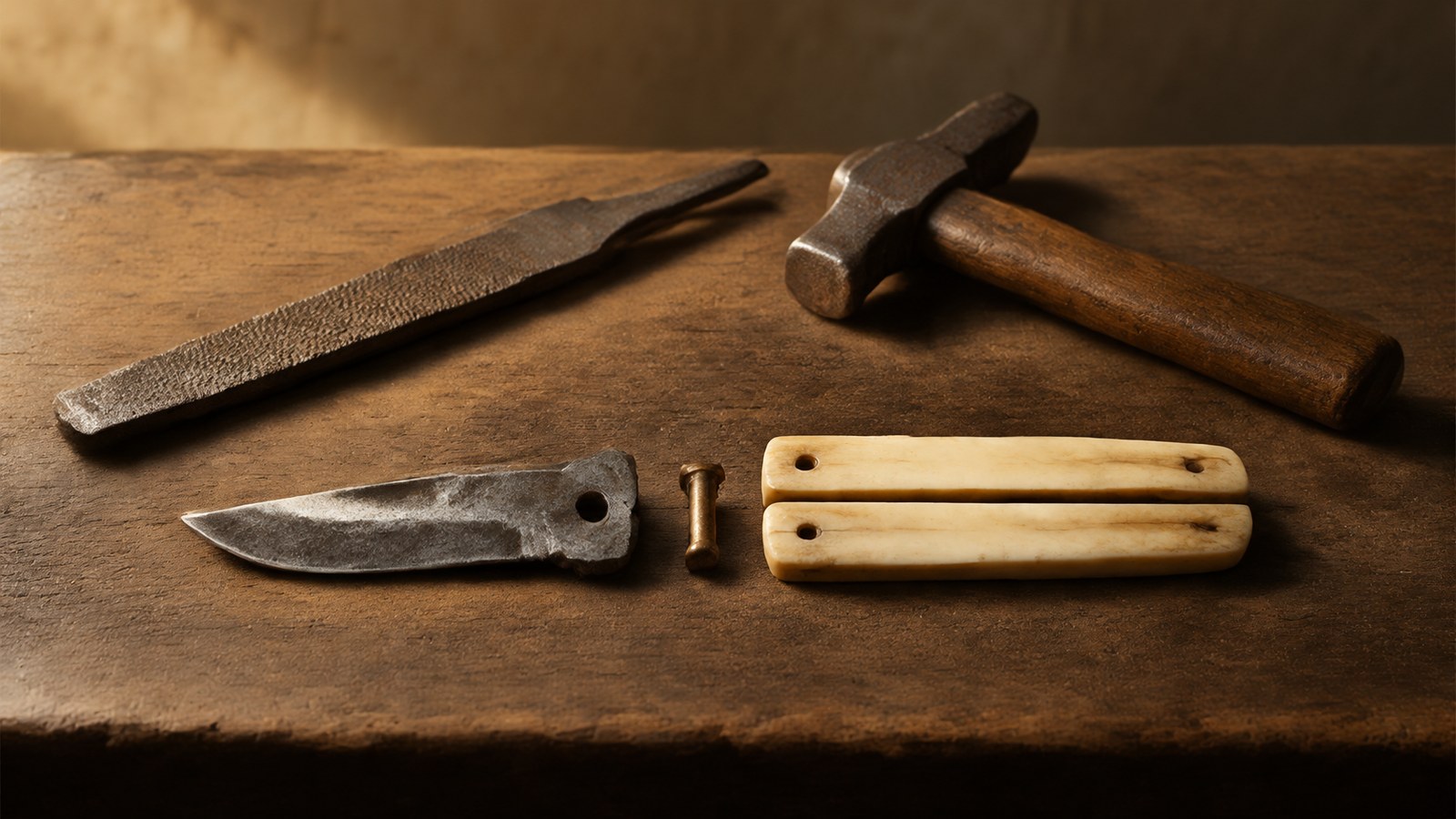
The toilet knife and openwork handle should not be collapsed into one imagined owner. They are separate museum records with different materials and different surviving parts. Their value lies in comparison. Both show an iron blade meeting a separately made compact handle. Both turn a few millimetres of internal space into the means of concealing an edge.
Their differences expose choice. Ivory and silver made the toilet implement visually refined even though its proposed work was as ordinary as nail cutting. Copper-alloy openwork turned the clasp knife into a tiny pursuit scene. Neither decoration was required simply to sharpen iron. It belonged to the part the user saw and held.
That is the larger lesson of these pieces. Portability did not force Roman objects to become anonymous. The mechanism actually gave makers a new design problem and a new design surface. A handle had to be hollow or slotted enough to receive the blade, strong enough to hold a pivot, comfortable enough to control, and available for whatever statement its material or imagery carried.
When closed, the knife withheld its most important working part. The ivory, silver, hound, or hare remained visible while the edge vanished inside. The compact object therefore reversed the hierarchy we expect from a tool: its function could disappear, but its handle still communicated care, craft, and ownership. Opening it restored the edge; closing it returned the tool to a decorated object only seven or eight millimetres deep.
Sources
London Museum, “Folding knife” collection record; London Museum, “Folding knife handle” collection record.