
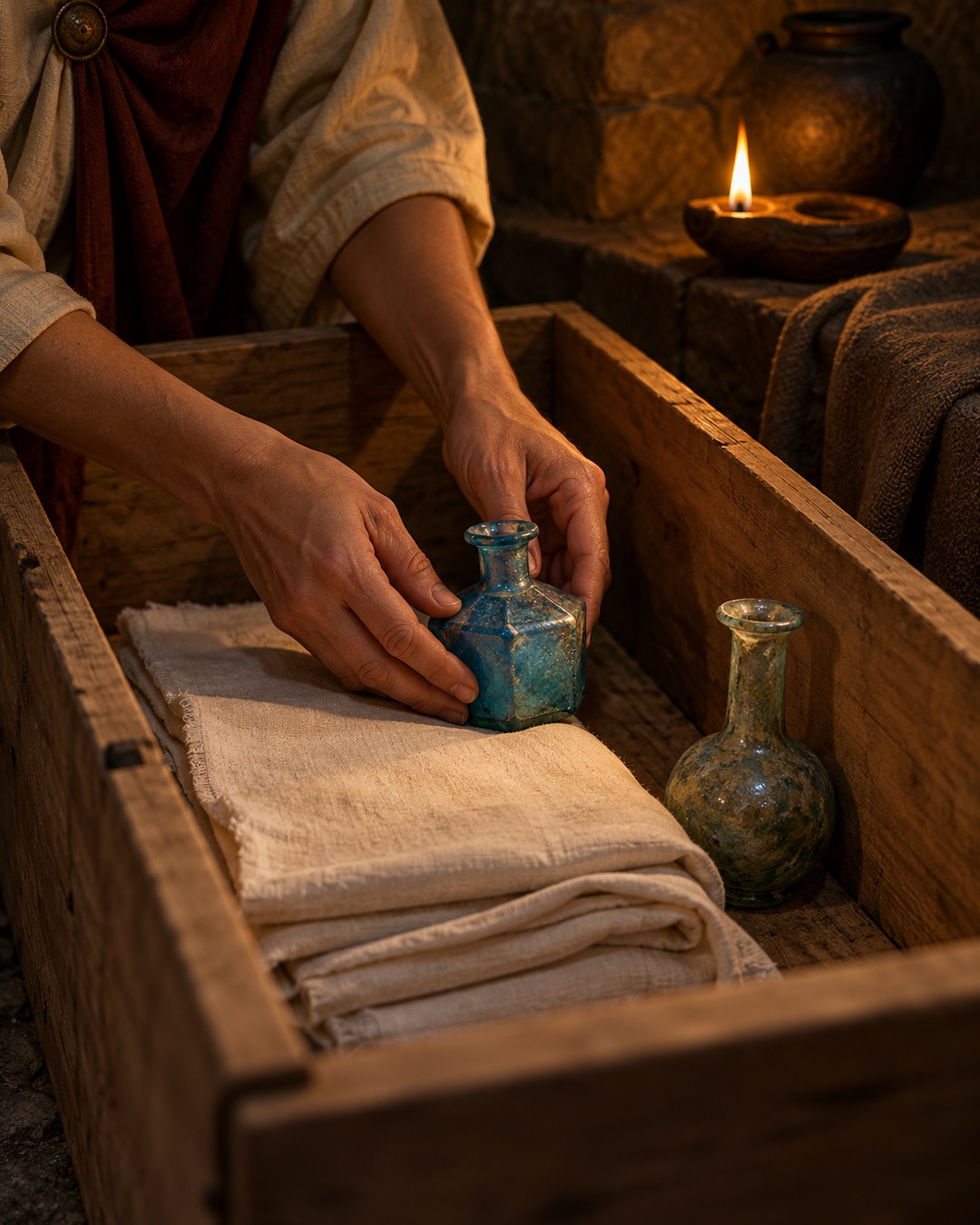
A small blue bottle entered a grave with more history behind it than the grave could explain. London Museum dates the prismatic hexagonal vessel to AD 50–125. It came from burial B525, where a woman had been placed in a wooden coffin with this bottle and another known as a Frontinus bottle. The museum notes that inhumations generally date to AD 200 or later. Both bottles may therefore have been old by the time they were buried.
That gap changes the object. It was not necessarily made for the funeral, carried straight from a shop, and sealed underground while new. Its bubbles, handle, moulded base, and pontil scar belonged first to production and use. Only later did the bottle acquire its final archaeological setting beside a coffin. The grave preserved the last decision made about it, not the whole sequence that led there.
A Hexagon Made in Blue Glass
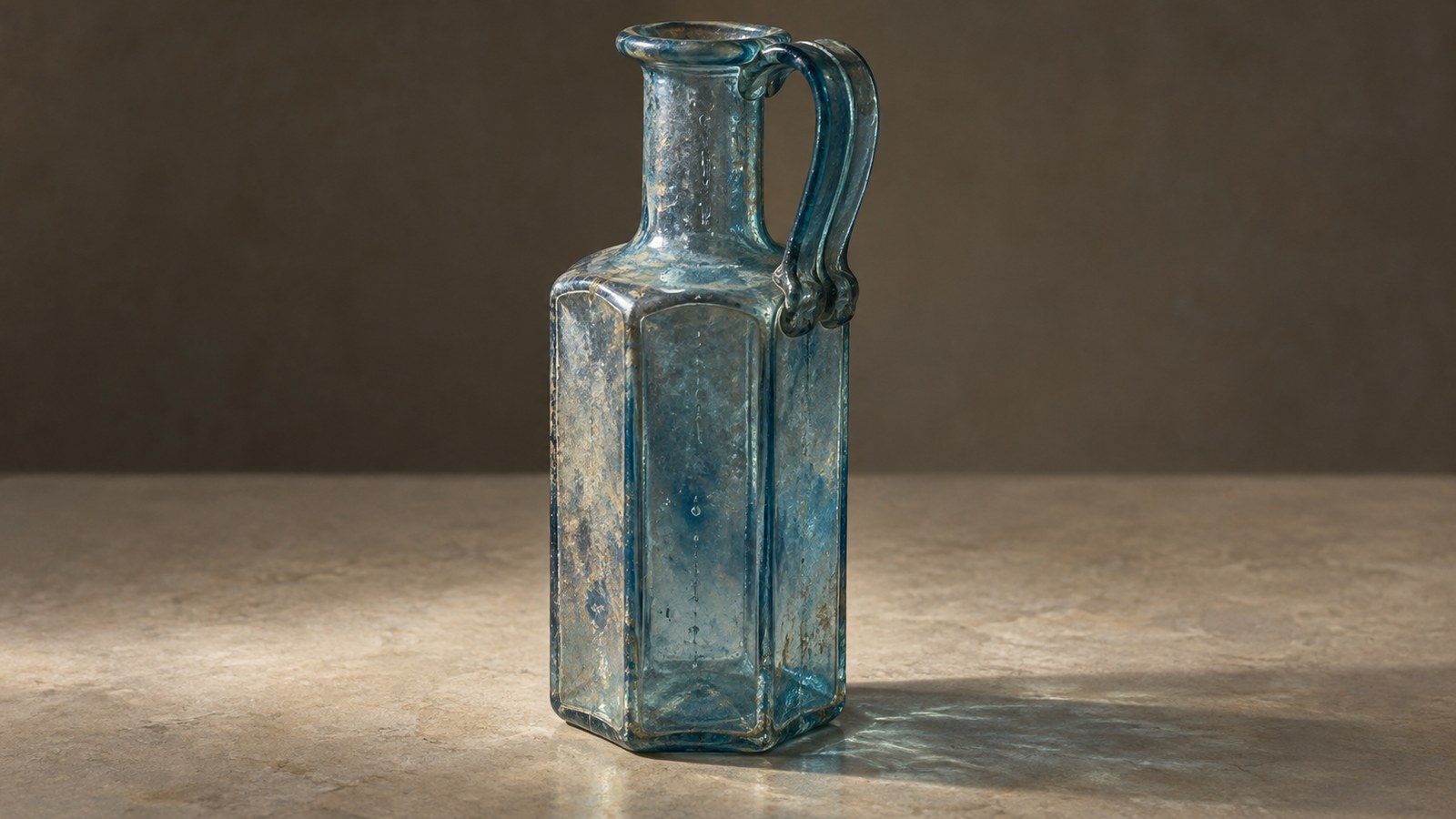
The vessel is natural blue glass and measures 113 millimetres high, 69 millimetres wide, and 60 millimetres deep. Its body is prismatic and hexagonal. The museum describes the glass as good quality, although occasional large bubbles and impurities remain. Smaller elongated bubbles are visible in the neck.
Those imperfections are not damage from the burial. They are evidence of molten material made solid. The elongated bubbles in the neck record the direction in which the glass was drawn or stretched, while the larger bubbles interrupt the otherwise clear blue mass. A surviving bottle can therefore show two scales at once: its deliberate six-sided outline and the irregular pockets trapped inside it.
The bottle is near-complete rather than whole. About half the rim survives. The neck and body are present, and the handle survives as two sherds that have been glued. This condition matters because the reconstruction can still reveal the vessel’s design without pretending that burial left it untouched.
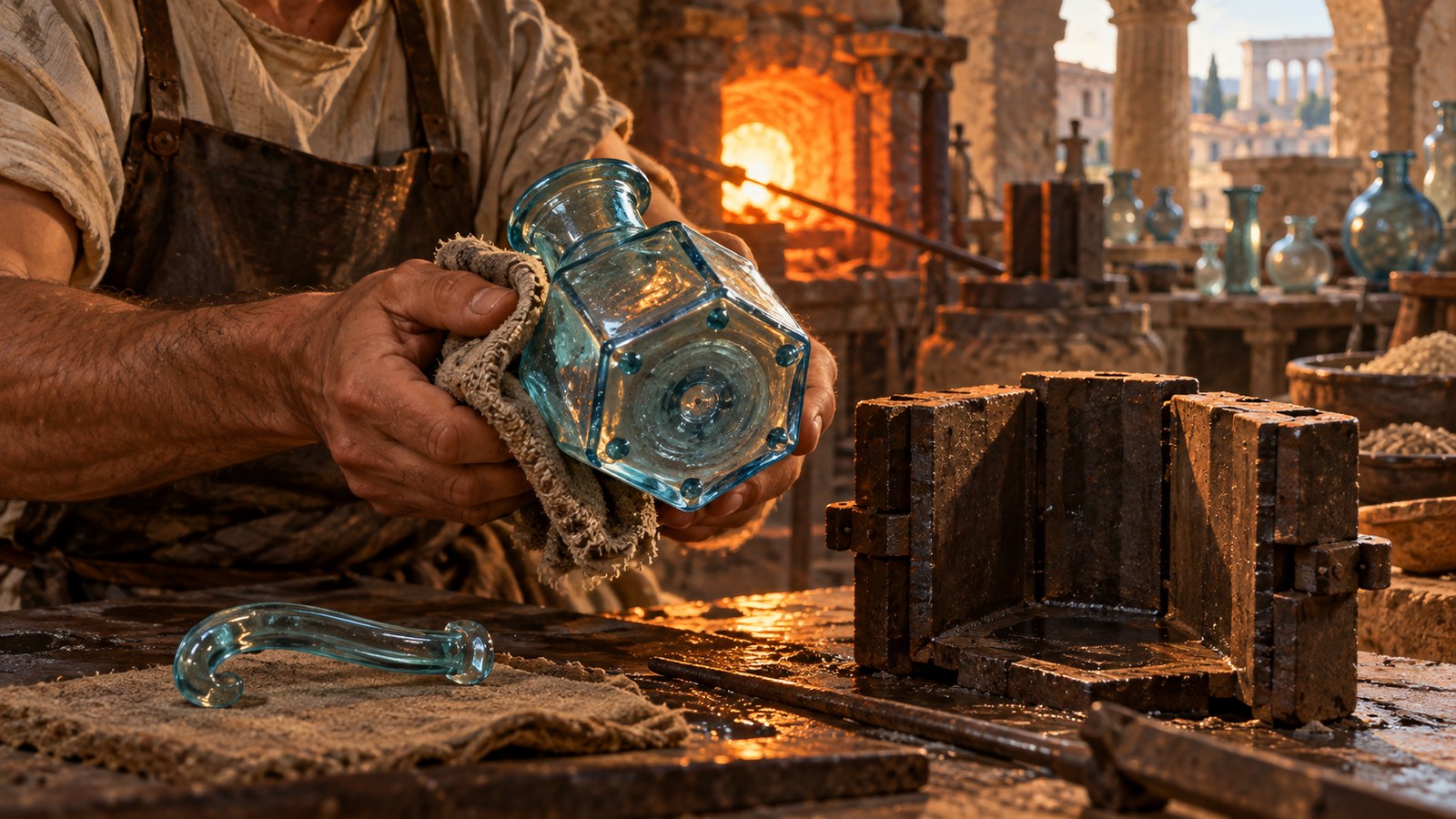
Roman glassmaking could turn breath and heat into repeatable hollow forms, a process examined in how Roman glassblowing made vessels from breath. This bottle adds a mould to that process. Its repeated angles were not simply carved into cold glass. The hot vessel was mould-blown so that pressure carried the material against a prepared shape.
The Base Kept the Workshop’s Fingerprints
The rim is narrow, flat, and folded inward. The handle is very broad. At its attachment, a slightly bifurcated claw divided the contact, while a wide central trail ran along the handle. These features joined the neck and body without erasing the character of glass applied while hot.
The base is more explicit. A dot occupies each angle, and a lightly moulded circle surrounds a central dot. The middle is slightly kicked upward. A pontil scar remains there, marking the place where a working rod supported the vessel during finishing. Pattern and scar share the same small surface: one came from the mould’s intended design, the other from the handling required after inflation.
The six-sided body, angular dots, central circle, and broad handle made the bottle recognizable even before its contents are considered. The museum record does not identify what this individual vessel held. Its history should not be padded with an invented perfume, medicine, or drink. The construction alone is specific enough to follow.
The base design also repeats the vessel’s geometry at a smaller scale. A dot occupies every angle of the hexagon, while the central dot and surrounding circle organize the middle. The slightly raised centre and pontil scar interrupt that planned symmetry with evidence of finishing. Seen from below, the bottle carries both the mould’s repeatable pattern and the singular mark left when this individual vessel was handled hot.
That restraint is important because colour can tempt a dramatic story. Another vessel, the blue glass vase rebuilt from 189 pieces, survived through painstaking reconstruction. This bottle presents a different kind of survival: near-complete form, visible workshop marks, and a burial context that opens a chronological question rather than answering its contents.
The Coffin Came Later
The bottle was recovered from burial B525, an inhumation of a woman in a wooden coffin. A Frontinus bottle accompanied it. The collection record then makes a cautious chronological observation. Inhumations can generally be dated to AD 200 or later, while the hexagonal bottle belongs to AD 50–125. Both vessels may have been old when buried.
“May” carries the argument. The museum is not claiming a documented chain of owners or an exact number of years in use. The earliest end of the bottle’s date range and the broad date of the burial do not supply a personal biography. They do show that manufacture and deposition need not belong to the same moment.
If the bottle was old, several histories remain possible without any one becoming fact. It could have stayed useful, been kept after its original contents vanished, passed between people, or survived in storage. The grave does not select among those routes. What it does establish is the final association: two bottles placed with a woman in a wooden coffin.
This final association is materially strong and narratively incomplete. The wood defined the burial container. The glass objects occupied space inside or alongside it. The woman, the Frontinus bottle, and the hexagonal bottle became one archaeological deposit even though they had not necessarily begun their histories together.
The presence of two bottles strengthens the burial association but does not make their earlier histories identical. The museum calls one a Frontinus bottle and the other a prismatic hexagonal bottle. Different forms arrived at the same final context. If both were already old, the coffin gathered at least two surviving objects whose manufacture preceded the burial by an uncertain interval.
Old Objects Complicate a Grave Date
An object’s production date is not automatically the date of the context in which it is found. This bottle makes that rule tangible. A vessel made between AD 50 and 125 could remain above ground until an inhumation of AD 200 or later. Archaeologists must therefore read the grave as an event that gathered objects with potentially unequal ages.
The bottle itself offers several clocks, none precise enough to stand alone. Its form and manufacturing technique support the museum’s production range. Its condition records breakage and reconstruction. Its placement belongs to the burial. The inhumation supplies a later contextual horizon. The responsible interpretation keeps those layers distinct before asking how they connect.
The possibility of age also changes how we imagine value. Old does not necessarily mean precious, antique in a modern collector’s sense, or inherited through a named family. It means only that the object may have remained available long after manufacture. Yet availability itself matters. Glass had to avoid destruction through use, moves, cleaning, and storage before it could be chosen for burial.
Its near-complete condition is part of that survival, but it should be read accurately. About half the rim remains, and the handle has been reconstructed from two glued sherds. The bottle is neither an untouched time capsule nor a handful of pieces from which any form could be imagined. Enough survives to establish the neck, handle, body, dimensions, and manufacturing details while the losses remain visible.
At the end, the bottle’s broad handle, folded rim, dotted base, and scarred centre went underground together. The funeral did not remove its workshop history; it enclosed it. The result is a compact object with a long sequence: molten blue glass expanded in a mould, finishing around a pontil, an unknown interval of use or keeping, and a final place beside another bottle in a woman’s coffin. The grave is where that sequence stops, not where it starts.
Sources
London Museum, “Prismatic hexagonal bottle” collection record.