
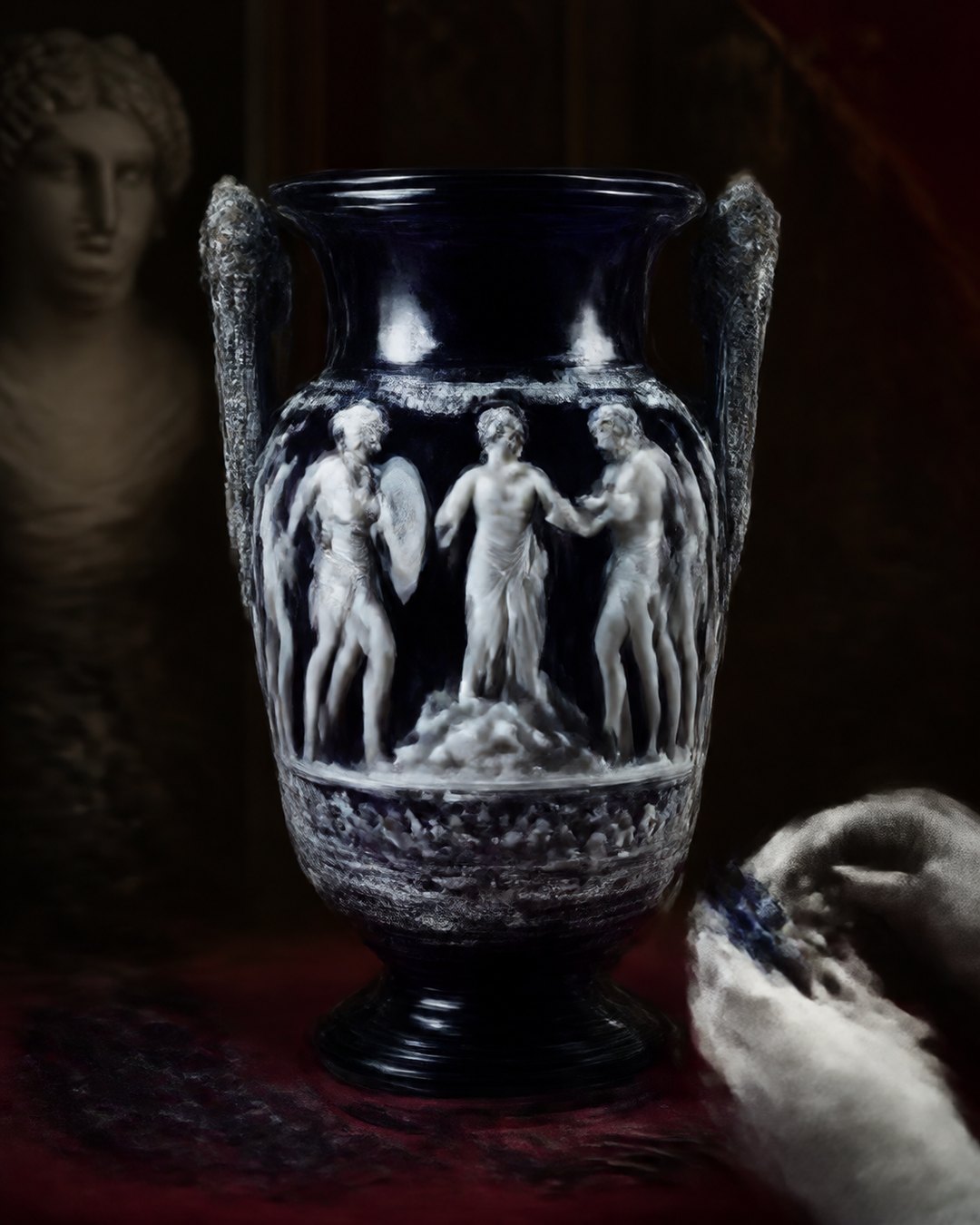
The man did not knock the Portland Vase from its case by accident. On 7 February 1845, William Lloyd entered the British Museum, picked up a nearby carved object and struck one of the most famous Roman glass vessels in the world. The vase collapsed into 189 recorded fragments. A museum attendant had been close enough to watch; the act was damage in public, not a crack discovered later in storage.
That violence created an odd double survival. The dark-blue body and white figures had already crossed roughly eighteen centuries, moved through Italian collections and inspired an industrial ceramic copy. Now the object also had to survive its own fame. Each attempt to join the fragments would leave evidence about what restorers thought a repaired antiquity should look like.
Its ancient construction makes the survival more startling. This is cameo glass: a pale outer layer was fused over a darker vessel and then cut away so figures emerged in relief. One slip could bite into the blue ground; one flaw in heating could spoil the blank before carving began. The Portland Vase carries both kinds of labour—the Roman maker’s irreversible cutting and the conservator’s effort to make modern intervention reversible.
White Glass Had to Become a Skin
The vessel is small enough to hold in two hands, about twenty-five centimetres high, yet its surface behaves like monumental relief. Its body is a deep cobalt blue. Over that sits opaque white glass, not paint and not a later coating brushed onto a finished pot. The white layer belongs to the vessel’s construction and gave the cutter material to remove.
Producing the blank required control before any figure appeared. Ancient cameo glass could be made by gathering one colour over another or by fitting layers together while hot; the exact workshop sequence for this vase remains debated. Whatever variation the maker used, the essential risk was the same: the two glasses had to form a stable layered body with enough white thickness for relief and a clean blue field beneath it.
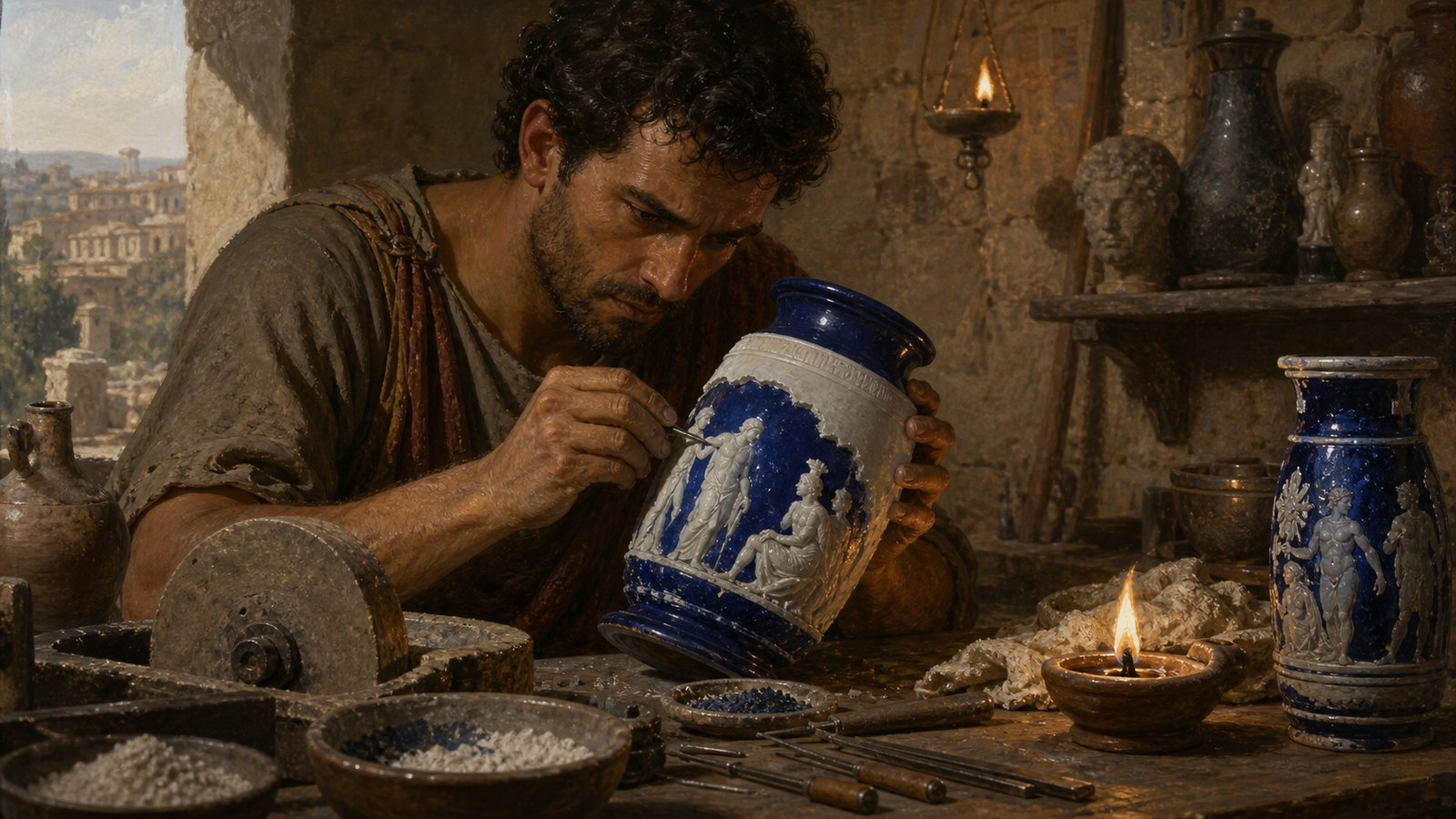
The cutter then treated the outer layer like a shell. Broad areas were ground away to expose the dark ground, while modelling remained in white. Bodies, cloth and plants emerge through differences in depth. The result depends on contrast rather than added pigment. A shoulder may be nearly opaque at its highest point and thin toward an edge, allowing the blue beneath to cool the white visually.
This process belongs beside the transformation of breath and molten glass into Roman vessels, but it asks for a different final discipline. Ordinary blown glass could leave the pontil and cutting room quickly. Cameo work prolonged the danger: a complete vessel became raw material again under abrasives, drills and the maker’s hand.
Two Scenes Refuse a Single Name
The surviving relief runs around the body in two principal scenes separated by handles. Reclining and seated figures occupy a landscape of rocks, trees and a serpent. A smaller scene appears on the base. The images look deliberate enough to invite a story, but no ancient label identifies the people and no inscription supplies a key.
Interpretations have ranged across Greek and Roman myth, marriage symbolism and Augustan politics. Peleus and Thetis, Ariadne, Augustus and members of the imperial family have all entered the discussion in different combinations. The number of proposals is evidence of the problem, not permission to choose the most dramatic one as fact. Gesture and attribute can narrow possibilities without forcing a unanimous reading.
That uncertainty changes the way the vase should be viewed. Its technique is securely visible; its iconography remains contested. The object therefore separates two kinds of knowledge that are often blended in museum captions. We can describe the layered glass, the cut relief and the pattern of damage with confidence while keeping the identities of the figures conditional.
The blue ground also resists a simple comparison with Egyptian blue pigment surviving through its material signature. Here colour is not a painted mineral layer on another support. It is the support. Light enters a coloured glass wall and returns around raised opaque figures, making the material method inseparable from the scene’s atmosphere.
A Sarcophagus Story Became a Provenance Problem
The vase is often said to have been found in a sarcophagus near Rome, sometimes specifically the supposed tomb of the emperor Alexander Severus. That story has circulated for centuries, but its earliest history is not documented with the precision modern archaeology would demand. The first secure record places it in the collection of Cardinal Francesco Maria del Monte in the early seventeenth century.
It then passed into the Barberini collection and became known as the Barberini Vase. Later owners connected it to the family of the dukes of Portland, whose name it still carries. These names map collecting history, not ancient identity. Each label marks a household or collection through which the glass moved after excavation had stripped away most of its original context.
By 1810 the vase had been deposited at the British Museum on loan. Its reputation had already expanded beyond antiquarian circles. Josiah Wedgwood had spent years producing ceramic versions in black jasperware with pale relief, translating the difficult colour logic of Roman cameo glass into a reproducible modern material. The copies made the silhouette famous even among people who would never handle ancient glass.
Fame protected the vase by keeping attention on it, but it also exposed the object to handling, display and imitation. Its modern biography is therefore not an appendix to the Roman one. The loss of archaeological context, the rise of named collections, Wedgwood’s copying and museum display all shaped what viewers expected to see when the blue vessel entered a public gallery.
One Blow Made 189 Conservation Decisions
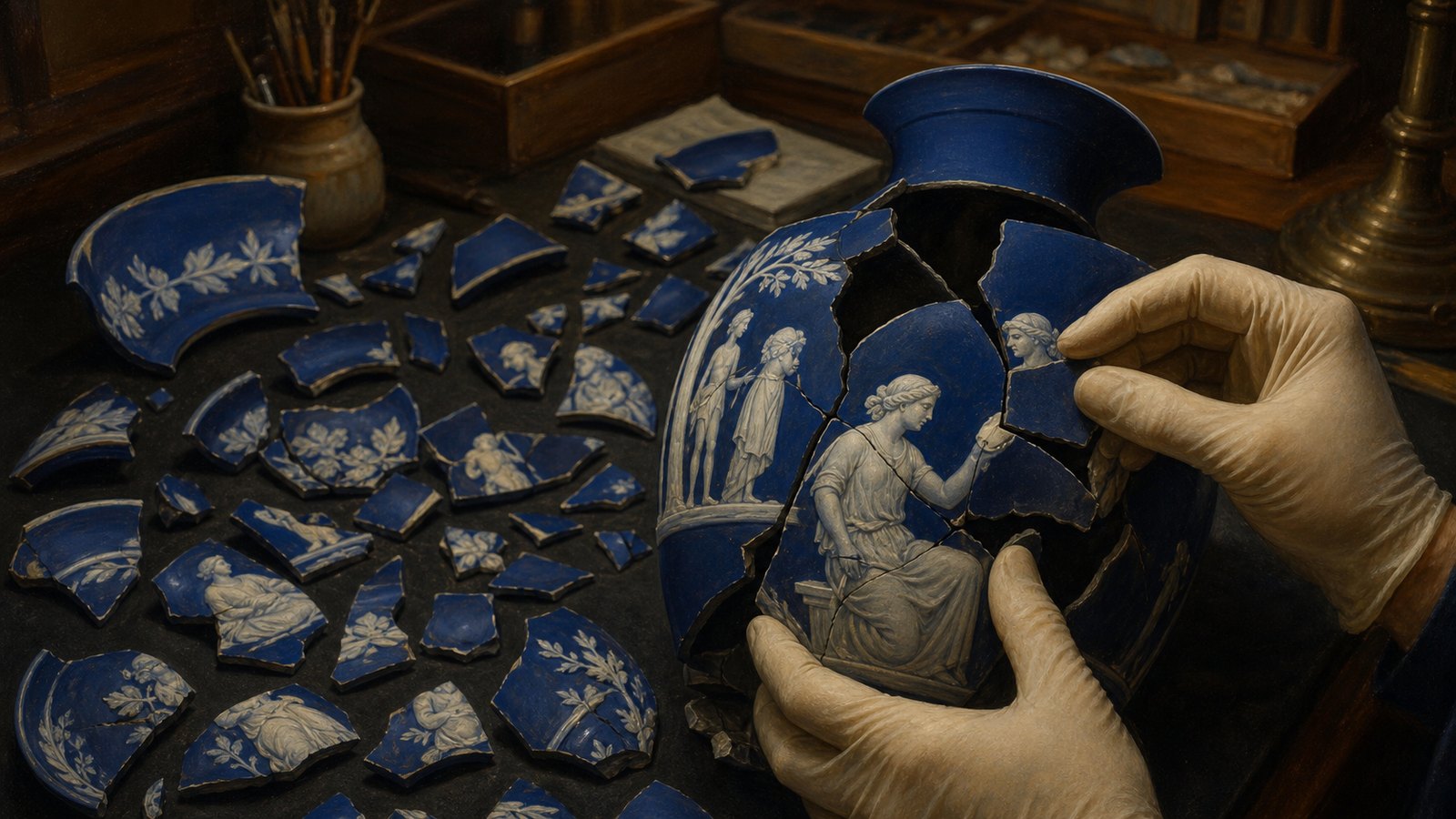
Lloyd’s 1845 attack changed the object from an intact celebrity into a puzzle. Museum records counted 189 fragments. Some pieces were tiny, and their curved edges had to be placed within a surface whose white relief could cross a break. Joining the blue wall was difficult enough; aligning a hand, fold or branch made every fraction of a millimetre visible.
The first major repair was undertaken by John Doubleday. His reconstruction returned the vase to display, but not every fragment was incorporated. Later repair campaigns altered joins and fills as materials and conservation standards changed. A nineteenth-century restorer was expected to make an object legible and whole; a modern conservator must also consider aging, documentation and whether an intervention can be removed without harming ancient surfaces.
The British Museum dismantled and restored the vase again in 1988–89. Old adhesive had discoloured and weakened. Conservators separated fragments, cleaned joins, used a stable modern adhesive and filled losses with materials chosen to match visually without pretending to be Roman glass. The work became a case study in the shift from heroic reconstruction toward recorded, distinguishable and reversible treatment.
The vase consequently contains more than Roman tool marks. Break edges, old adhesive traces, fills and the disposition of surviving fragments document changing ideas about authenticity. Repair did not erase the 1845 event. It organized the damage so the ancient form could be read while preserving evidence that the form had been broken.
The Breaks Explain Why the Vase Still Matters
A masterpiece label can flatten an object into praise. The Portland Vase becomes more useful when its risks are restored. Roman makers had to create a layered blank, control heat and thickness, and carve white glass without ruining the blue body. Modern custodians had to decide how much of a shattered vessel should look seamless and how much repair should remain detectable.
Its unresolved imagery is part of that discipline. The figures may invite stories, but the material facts do not need a final mythological cast list to be extraordinary. A viewer can follow where white glass remains thick, where it thins toward blue, where a fracture interrupts a limb and where a modern fill completes the circumference.
The same principle appears in the vanished wax behind Roman bronze casting: finished ancient art often conceals a sequence of expendable stages. Cameo glass began with material that was deliberately cut away. Conservation added another paradox, preserving the whole by using joins future conservators should be able to undo.
The blow in 1845 did not make the vase important, but it revealed the terms of its importance. A luxury object is never only the moment of ancient completion. It is also extraction, ownership, imitation, display, breakage and care. On this vessel, those histories remain visible in blue glass, white relief and 189 remembered pieces.