
Why Bread Could Be More Dangerous Than Swords in Rome
Rome could survive insults, bad weather, ugly rumors, and even military disaster far from the capital. Hunger was different. Hunger arrived in the hand, the queue, the market, the loaf, and the anger of people who believed the city owed them more than speeches.
That is why bread could become more dangerous than swords. A sword threatened the body. A failed grain supply threatened the bond between ruler and capital.
Claudius learned it in the Forum
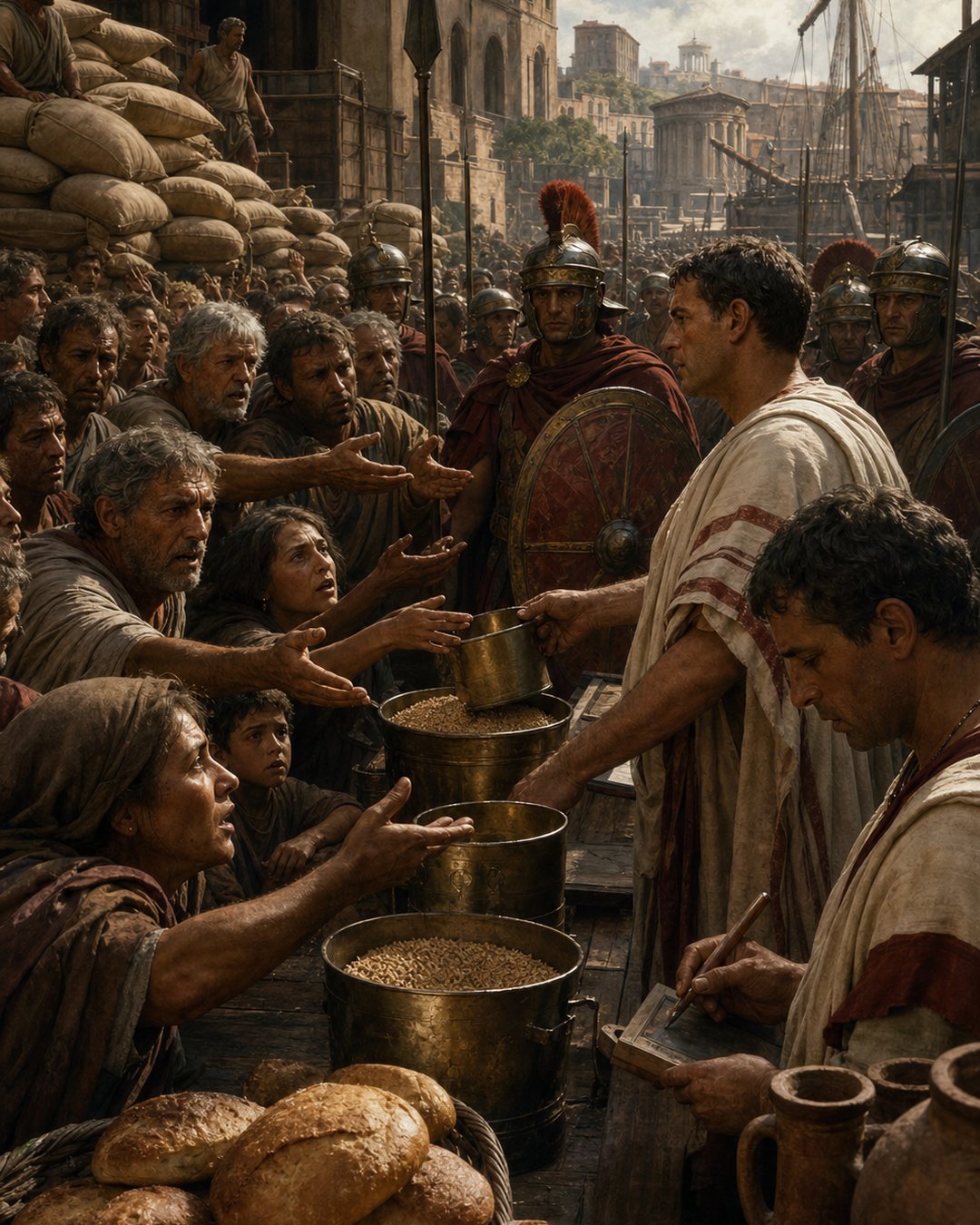
Suetonius gives the scene with almost theatrical force. In Claudius 18, a shortage drove a crowd to surround the emperor in the Forum, shout abuse, and throw pieces of bread at him. Claudius escaped with difficulty. The detail is small, physical, and devastating.
The crowd did not throw a philosophical argument. It threw the symbol of the promise that had failed. Bread in that moment became accusation. The emperor who could command armies looked vulnerable because the capital doubted its next meal.
The grain route was an imperial nervous system
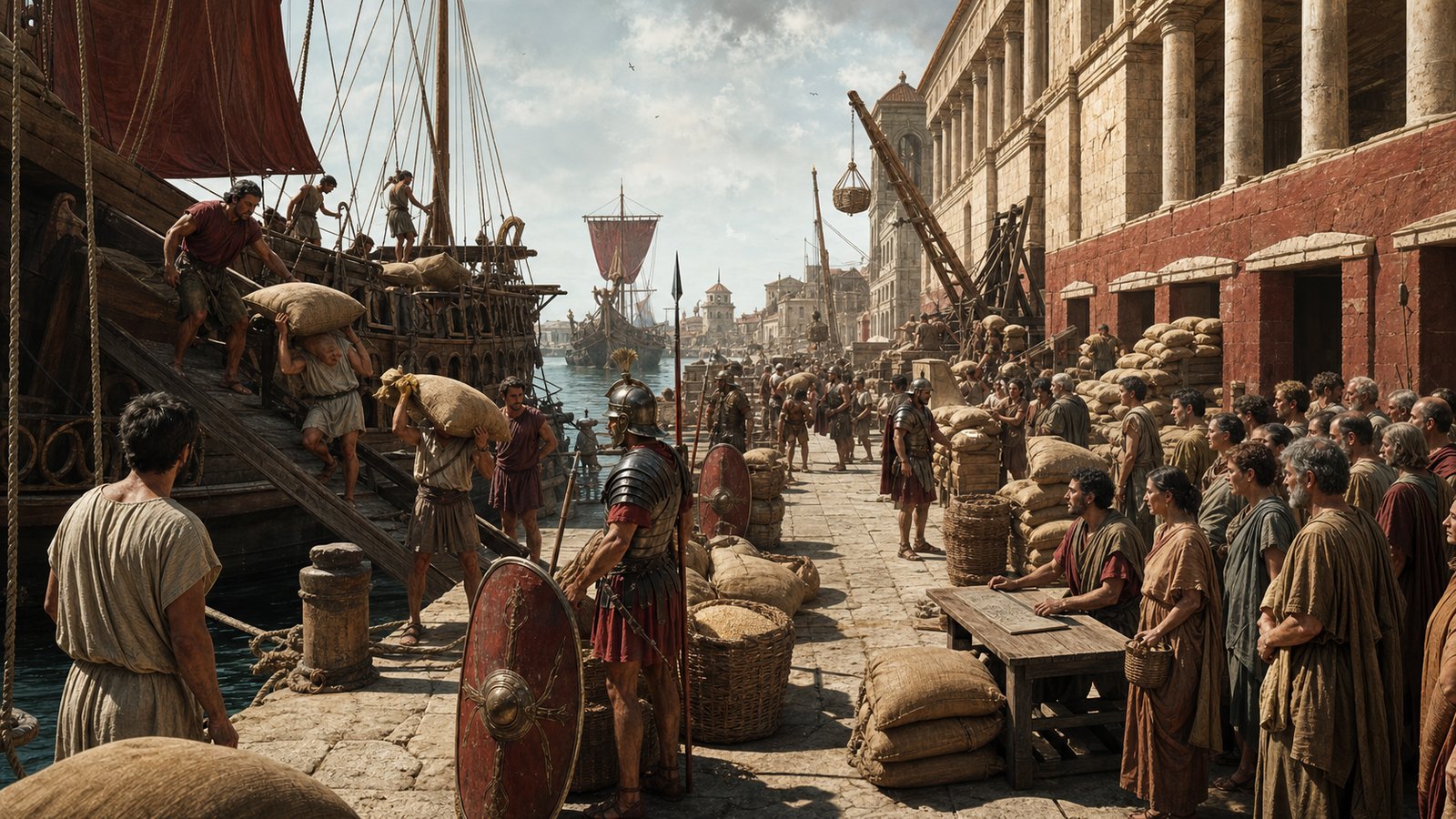
Rome’s food supply depended on ships, ports, storehouses, river transport, officials, weather, labor, and provincial extraction. Egypt and North Africa were not background scenery. They were part of the capital’s stomach. Ostia, the Tiber, granaries, clerks, sailors, and bakers formed a political chain that most people noticed only when it strained.
A delay at sea could become anxiety in the city. A rumor about warehouses could become a crowd. A bad harvest far away could embarrass a ruler in the Forum. That is the political danger of bread: it made empire local every day.
Augustus understood the promise
Suetonius, in Augustus 42, describes the careful management of public distributions. The details matter because grain was not merely charity. It was a relationship. The ruler appeared competent when the queue worked, the ration arrived, and prices did not turn daily life into panic.
That competence was hard to glorify. A full granary is less dramatic than a battle standard. But a full granary could keep the capital quiet, and quiet was one of the most valuable sounds in Roman politics.
A hungry Rome was never just hungry
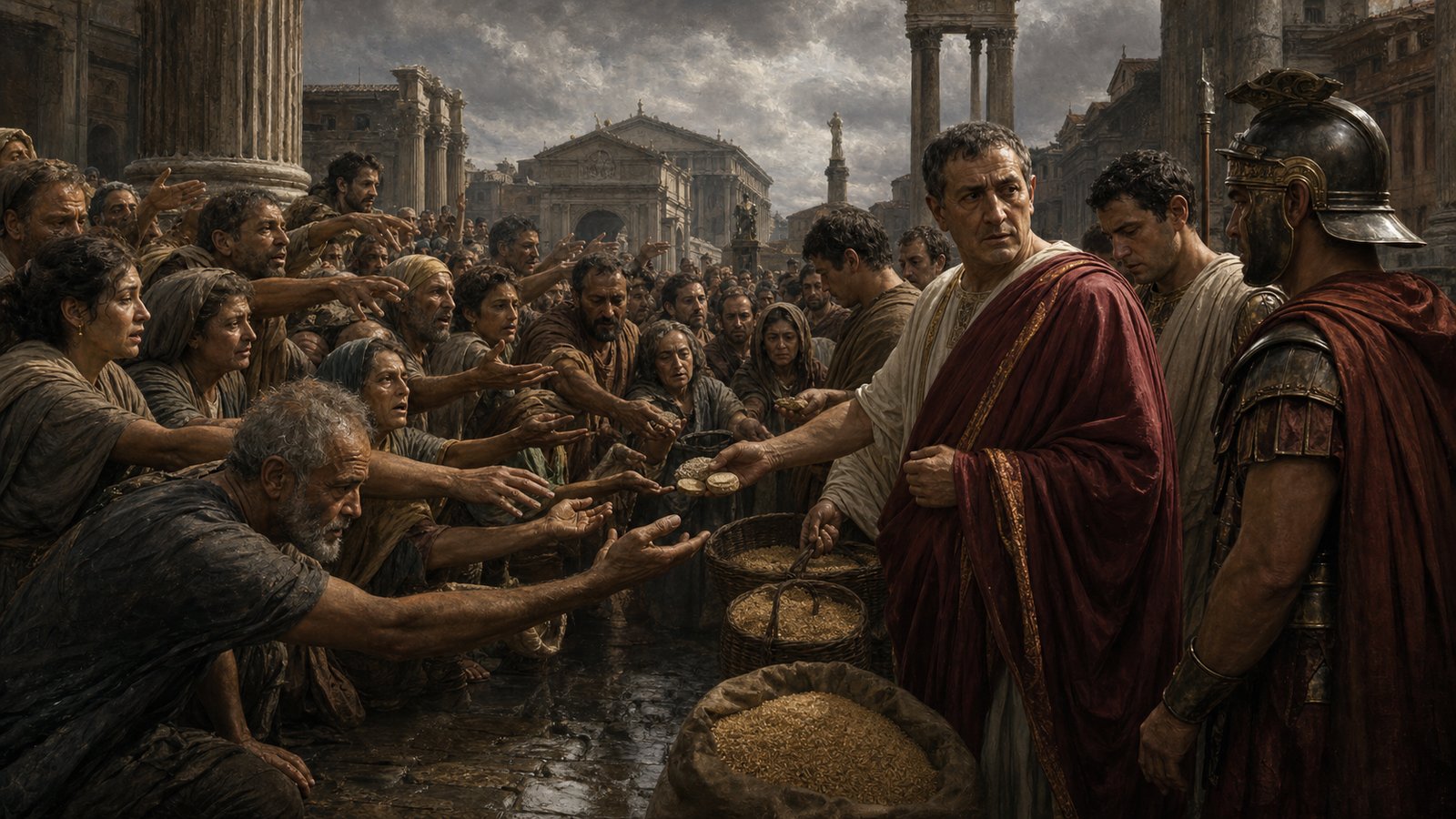
Tacitus, in Annals 12.43, links scarcity to fear under Claudius. That is the crucial word. Scarcity did not remain an economic problem. It became emotional and political. People asked whether officials were corrupt, whether ships had arrived, whether the emperor cared, and whether tomorrow would be worse.
In a capital of hundreds of thousands, food was not private. It was public confidence measured by weight, price, and rumor. The grain dole, market supply, and imperial reputation could not be separated neatly.
Why soldiers watched the bread line
The presence of force near food distribution was not accidental. Officials needed order because a bread crowd could turn from complaint to danger quickly. Yet soldiers could not solve the basic problem. They could manage a line, not create grain. They could intimidate a crowd, not restore trust.
That made the emperor’s task awkward. He had to appear generous without seeming afraid, powerful without seeming distant, and practical without admitting how fragile the system was.
The loaf was a political object
Roman politics often appears in marble: temples, arches, inscriptions, statues. Bread belonged to a different register. It was ordinary, perishable, and handled by everyone. That made it more intimate than propaganda carved in stone.
A loaf told the urban poor whether the imperial system had reached them. A missing loaf told them the same thing more loudly. When Suetonius’ crowd threw bread at Claudius, it turned daily dependence into public judgment.
The danger was not that bread replaced armies. It was that bread revealed what armies could not fix. Rome’s rulers had to feed the city because the city’s obedience was never made of fear alone.
Food made distance visible
The grain supply forced ordinary Romans to care about places many would never see. Egypt, Africa, Sicily, Ostia, and the Tiber became part of daily expectation. A storm at sea or a failure in storage could travel as fear before the ships themselves appeared. Empire was not an abstract map when dinner depended on it.
That distance also made blame complicated. Was the problem weather, merchants, officials, provincial harvests, corruption, hoarding, transport, or imperial negligence? A hungry crowd did not need a precise answer to become dangerous. Uncertainty itself could become a political fact.
The ruler had to perform competence
Feeding Rome required more than grain. It required visible confidence. The emperor needed the crowd to believe that someone was counting sacks, watching ships, punishing failure, and planning ahead. The system could be sophisticated and still fail politically if people believed nobody was in control.
That is why Suetonius’ Claudius scene is so revealing. The emperor is not defeated by an army. He is humiliated by a public test of provision. In a city trained to expect bread as part of civic life, scarcity made sovereignty look thin.
Why the crowd mattered
The Roman crowd was not a single mind, but rulers ignored it at their own risk. In the grain queue stood citizens with memories, expectations, and neighbors. Rumor could turn individual worry into public pressure. Once that happened, the emperor faced more than appetite. He faced a verdict on whether the imperial bargain still worked.
This is why bread belongs at the center of Roman political history. It shows power at its least glamorous and most exposed. A ruler could survive criticism from philosophers or resentment from senators. A ruler who could not feed Rome risked hearing the city answer with its hands.
The detail changes the whole room
The useful habit is to stay with the concrete detail long enough for it to change the story. A furnace, a boundary trench, a thrown crust of bread, or a neglected bundle of petitions is not decoration. It is evidence of how Roman power entered daily life. The grand interpretation only works when it is tied to objects, places, bodies, and named ancient witnesses.
That is also why the simpler version is not enough. Rome did not survive as a set of slogans. It survived in practices that people repeated, feared, resented, enjoyed, and remembered. Follow those practices closely, and the familiar story becomes less flat, more human, and more dangerous.
That method also guards against the easy myth. Instead of saying that Rome was simply brutal, brilliant, decadent, or modern, it asks where the claim can be seen. Who is standing in the scene? What number, room, route, office, ritual, or ancient sentence anchors the argument? Once those anchors are visible, the article is no longer a recycled Roman mood. It becomes a specific case study in how a particular Roman system worked.
The system was strongest when nobody noticed it
That is the final irony. Grain administration succeeded politically when it vanished into normal life. No one praised the empire every time a loaf appeared, but the habit of expecting that loaf quietly strengthened the idea that Rome could organize the world. The proof of power was not only victory. It was repetition.
When repetition broke, the hidden structure became visible. Ports, weather, clerks, merchants, guards, storehouses, imperial orders, and urban patience suddenly stood in the same line. Bread mattered because it made the whole empire answerable to the hunger of the capital.
Sources & Further Reading
- Suetonius, Claudius, 18
- Suetonius, Augustus, 42
- Tacitus, Annals, 12.43
- Cambridge Ancient History: Rome and the Mediterranean economy