
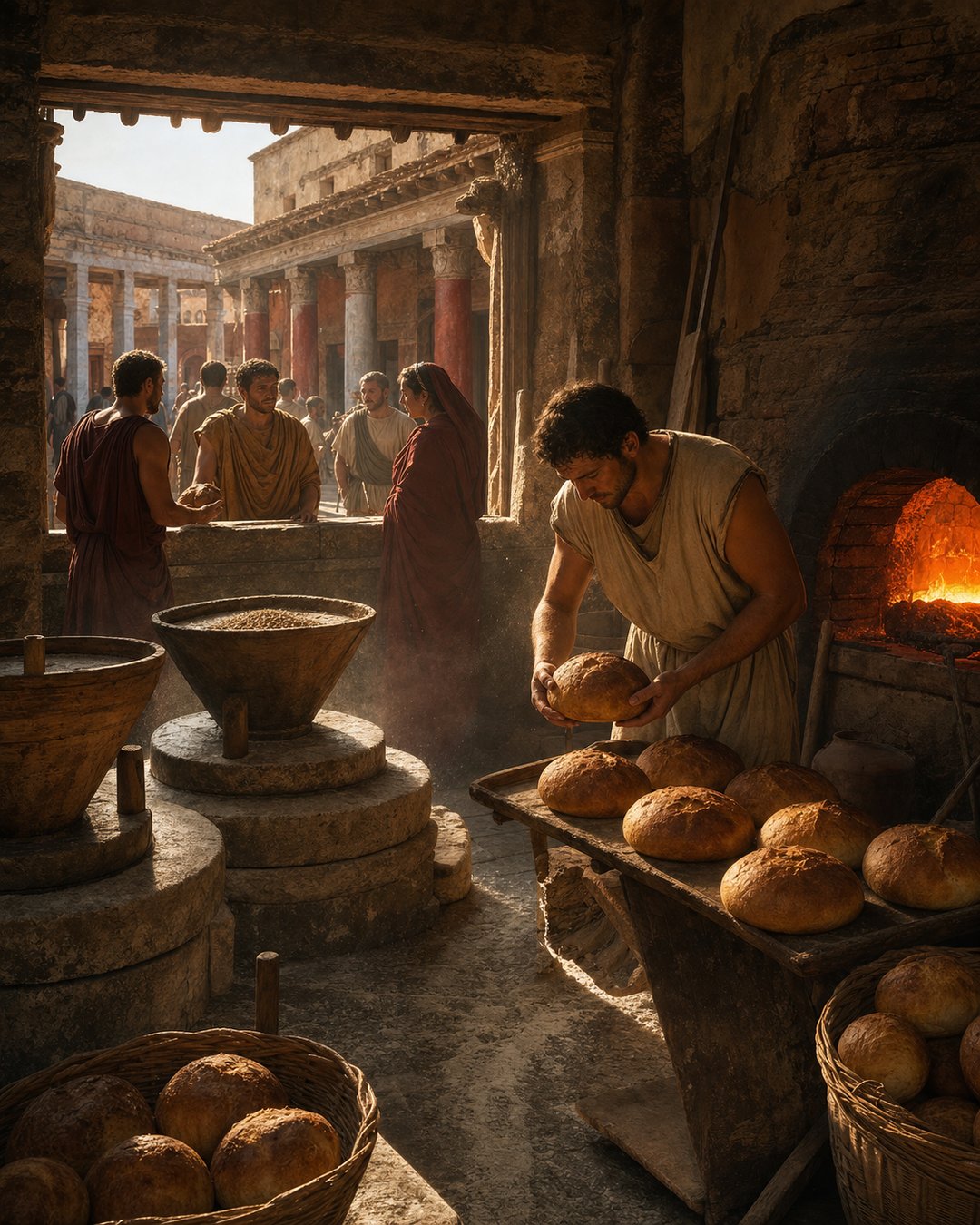
A Roman loaf was never only a quiet household object. Before it reached the hand, it had passed through grain, stone, sweat, oven heat, street trade, and the gaze of people who knew where bread came from.
Roman bakeries made bread a public routine because the city could not eat on private intention alone. The pistor, the mill, the shopfront, and the morning counter turned hunger into repeated urban labor.
The loaf began with stone, not romance
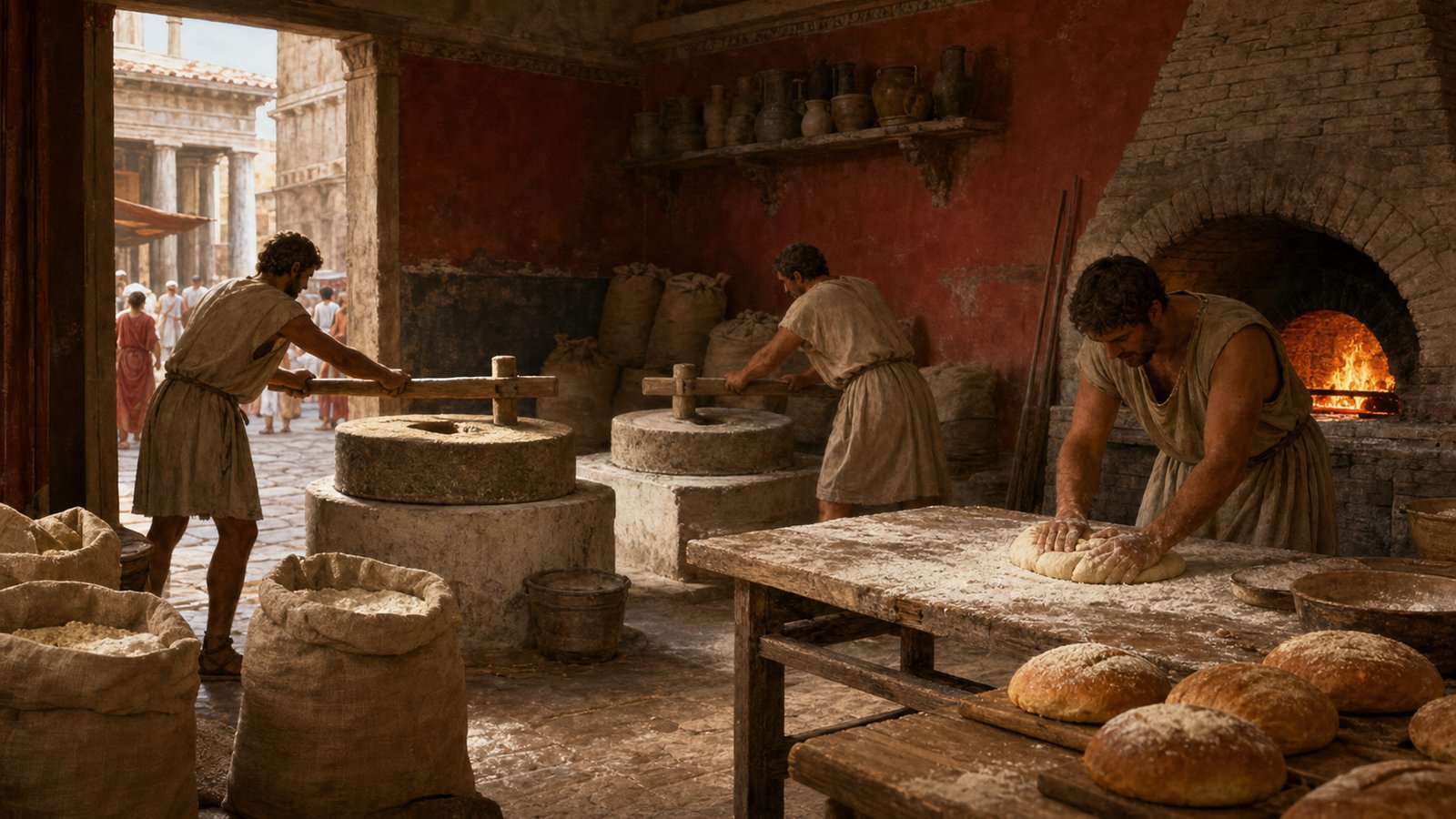
The word pistor can lead us to both baker and miller, which is a useful warning. Bread did not begin as a golden loaf. It began as grain that had to be broken down by hard, repetitive work. The mola, the mill, was part of the story before any oven glowed.
This physical beginning matters because it keeps Roman food history from becoming sentimental. Flour was not an abstraction. It was made by pressure, motion, dust, and time. A bakery announced that effort in ways a finished loaf could hide.
The bakery opened labor onto the street
A taberna was not a sealed modern shop. It pushed work and selling toward the public way. A passer-by could see heat, baskets, flour, and bargaining close together, and that closeness made bread part of street life.
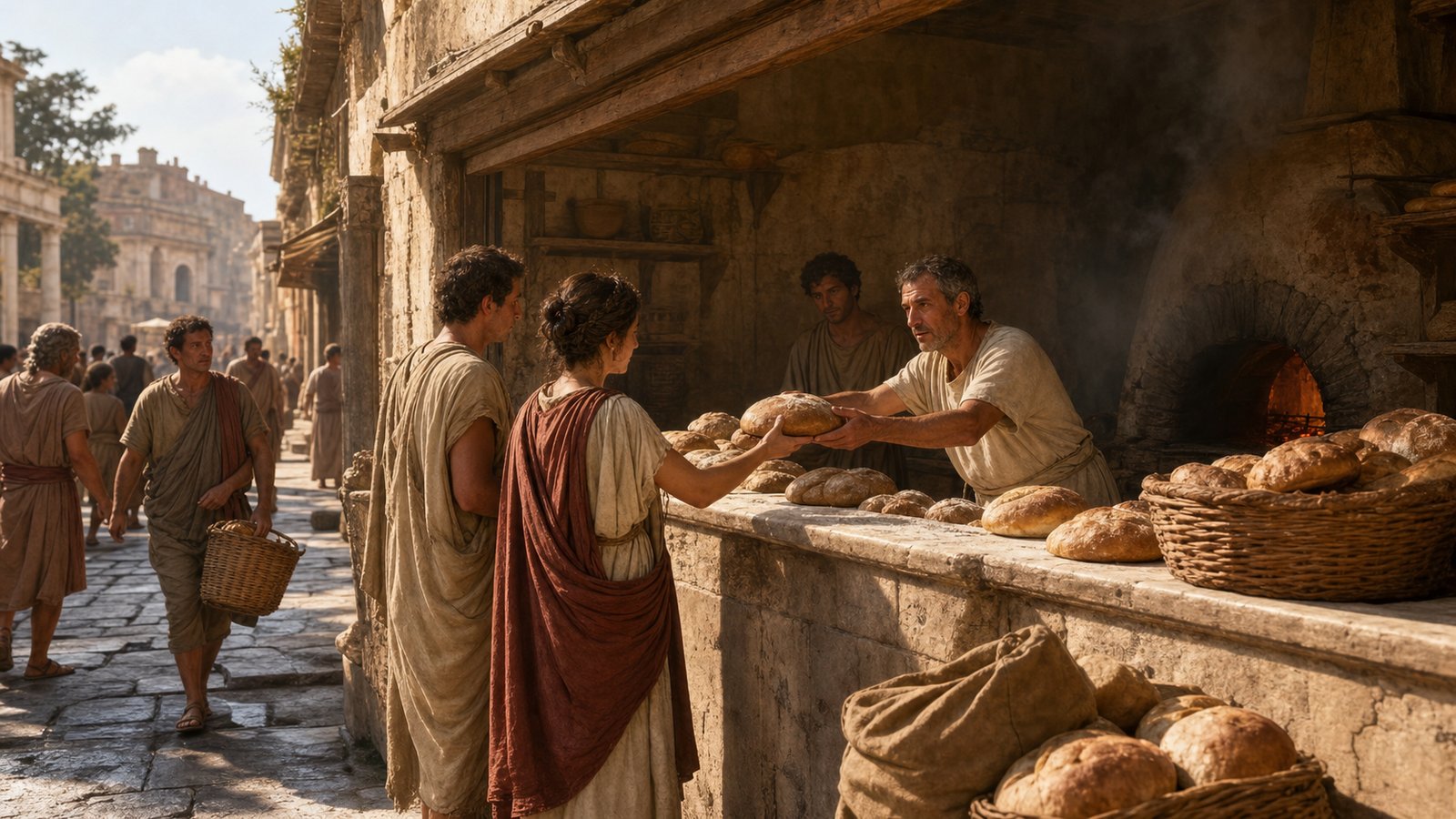
Imagine the morning scene: flour on a tunic, a worker turning back toward the oven, customers waiting near a stone counter, a child staring at loaves that have not yet cooled. The bakery has already made appetite social.
Food supply created a civic rhythm
Roman markets and provision spaces remind us that food was a public problem long before it became a private meal. The macellum concentrated provisions; the forum gathered business and movement. Bread belonged to that same city rhythm of getting, selling, waiting, and measuring.
A bakery did not govern Rome, but it helped Rome feel governable. People knew when counters opened, where loaves appeared, and how daily need moved through the neighborhood. Repetition made supply familiar.
Heat made dependence hard to ignore
The bakery’s power was partly sensory. Smoke, warm stone, flour dust, rough hands, and stacks of round loaves made the hidden chain of food visible. The customer did not need a lecture on urban dependence. It was present in the room.
That visibility mattered in a city where many people could not grow their own grain or bake every loaf at home. Bread forced strangers into a shared routine: producers, buyers, carriers, fuel suppliers, and neighbors all joined the same ordinary demand.
Public bread made trust repeatable
The bakery also created a memory of reliability. People returned to a place because a loaf had been there before. The seller remembered customers, customers judged weight and quality, and the street watched the small negotiations of need.
This was not equality. A poor customer and a prosperous customer did not meet the counter with the same freedom. Yet both relied on a visible routine that made bread less mysterious and more accountable than a private promise.
The daily quality of bread is exactly why it matters. Roman political history often turns toward crises, generals, emperors, and riots, but cities survive through repeated acts that almost disappear because they work. A bakery is one of those acts made architectural.
The pistor stands at the crossing point between labor and sale. He is not only a craftsman; he is a sign that the city has converted grain into something ready for public exchange. His work compresses fields, transport, grinding, fuel, and neighborhood expectation into a loaf that can be carried home.
The millstone adds another lesson. It turns invisible preparation into visible strain. If a loaf looks simple, the mola answers with weight and abrasion. Bread was civilization in a form that still required bodies, animals, stones, and time.
Street-facing production also shaped trust. A hidden kitchen can make claims, but an open bakery gives the neighborhood evidence. People see the oven, the loaves, the workers, and the queue. A bad day or a short supply becomes part of public knowledge.
That public knowledge could become political when scarcity pressed hard enough, but most days it worked more quietly. The bakery trained people to expect that the city would repeat itself tomorrow: grain ground again, ovens lit again, counters opened again, loaves bought again.
A Roman bakery therefore belonged with roads, aqueducts, and markets in the infrastructure of confidence. It was smaller, hotter, and more ordinary, but it performed a similar task. It made a basic need appear in a recognizable public form.
The scene also reminds us that urban life is a bargain with dependence. The person buying bread may feel independent for a moment, but the loaf has already passed through a chain longer than one household. The counter is where that chain becomes tangible.
If we look closely, bread becomes a civic object. It carries the discipline of timing, the pressure of supply, the habits of trade, and the expectation that tomorrow’s hunger will meet tomorrow’s labor. A bakery made that expectation visible enough for the street to trust, doubt, remember, and return.
The counter also made scarcity legible. If fewer loaves appeared, the street would know before any official explanation arrived. Neighbors could see the queue, hear complaints, and compare today’s supply with yesterday’s. Bread was therefore a daily report on the city’s ability to convert grain into confidence.
The work created a chain of remembered competence. Someone had to acquire grain, someone had to grind it, someone had to manage fire, someone had to sell at the right hour, and someone had to judge whether the loaf was worth the coin. Each step could fail, which is why repetition mattered so much.
A bakery was also a place where social distance narrowed without disappearing. Richer and poorer customers might stand near the same heat and smell the same bread, but they did not experience shortage with the same fear. Public routine exposed dependence; it did not erase inequality.
That tension makes the bakery historically useful. It shows Rome not as a machine that solved hunger, but as a city that made the work of feeding visible enough to be recognized. The loaf in the hand was a finished thing; the bakery behind it was the public routine that made the finish believable.
The bakery also put time into the neighborhood. Ovens had to be heated before customers arrived; flour had to be ready before dough could be shaped; loaves had to cool before they could be handled. A working bakery taught nearby people to read the day through smell, smoke, and queue.
That daily visibility gave bread a kind of public memory. If a counter became unreliable, the failure did not vanish into private disappointment. It could be discussed by people who had seen the same shortage, the same burned batch, or the same crowded morning. In that sense, the bakery made ordinary trust collective.
Sources & Further Reading
- Smith Dictionary, Pistor
- Smith Dictionary, Mola
- Smith Dictionary, Taberna
- Smith Dictionary, Macellum
- Smith Dictionary, Forum