
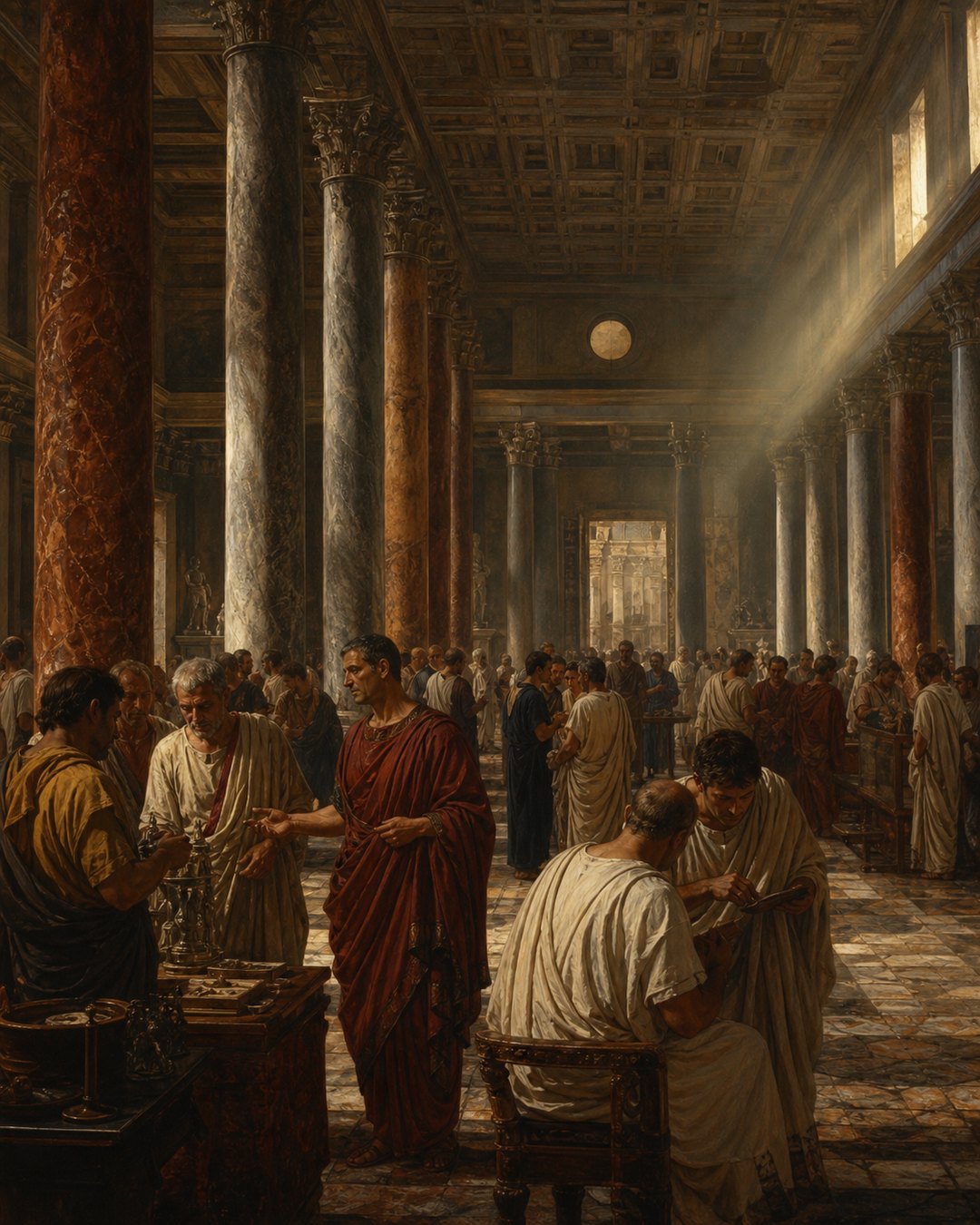
A private dispute changes when it happens under columns. A debt, a bargain, a legal argument, or a promise sounds different when other people can see the waiting, hear the murmur, and remember the faces.
Roman basilicas made private business public because they gave ordinary pressure a civic setting. Commerce and law did not vanish into closed rooms; they gathered under a roof built for visibility.
The basilica was a public business machine
The basilica was a building for business, legal proceedings, and gathering. That combination is the key. It did not separate public life from practical need; it housed the place where they met.
A merchant could negotiate, a litigant could wait, an advocate could speak, and a clerk could handle records under the same architectural authority. The building made activity look official even before any final decision.
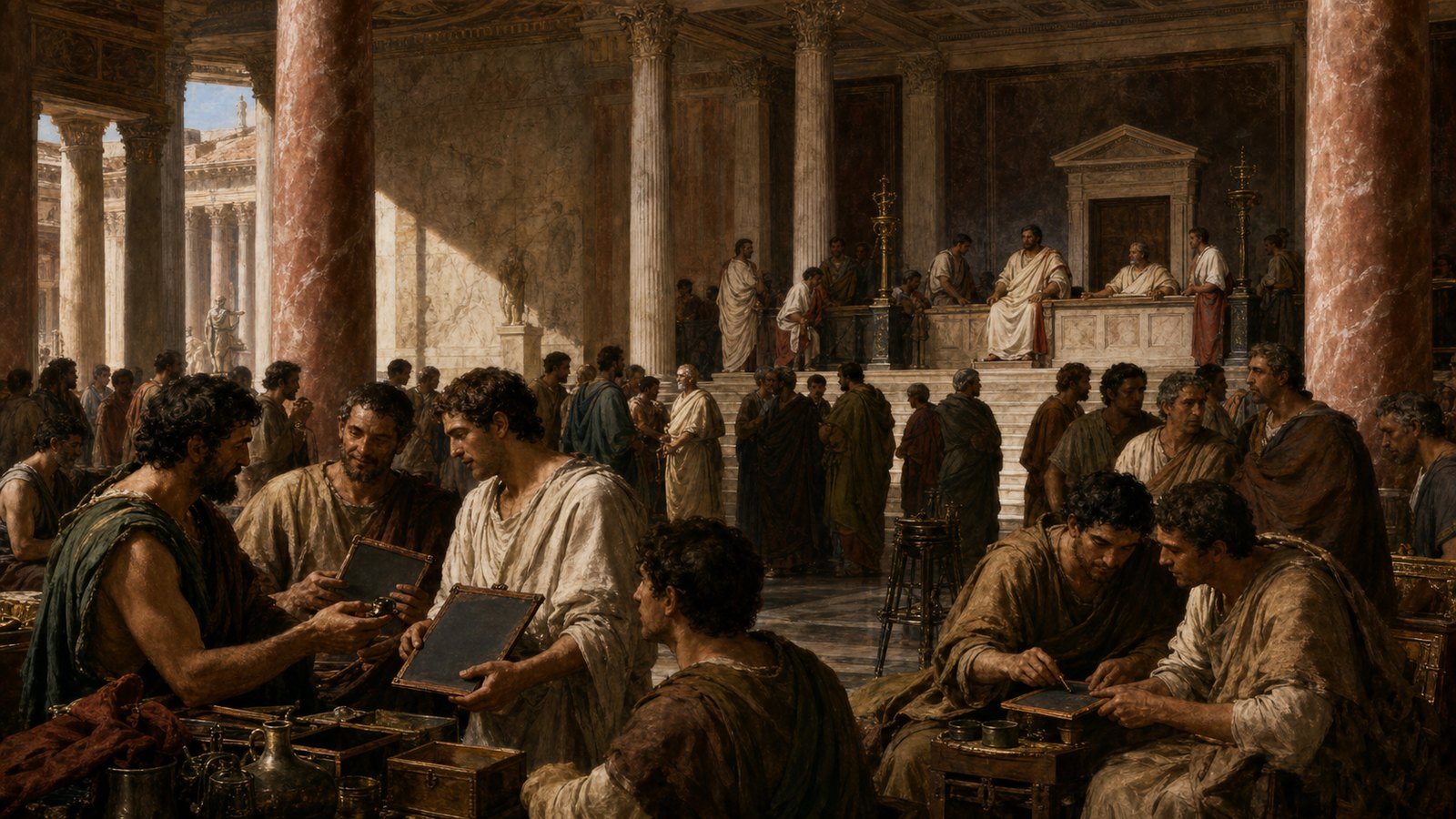
Columns made waiting visible
Architecture matters because waiting is never neutral. In a basilica, people could see who was present, who had company, who seemed anxious, who had advocates, and who waited near the tribunal.
Imagine a morning hall: sandals scraping stone, wax tablets held against the chest, voices echoing between columns, a merchant counting on his fingers while a client glances toward the raised end. Private business has become public posture.
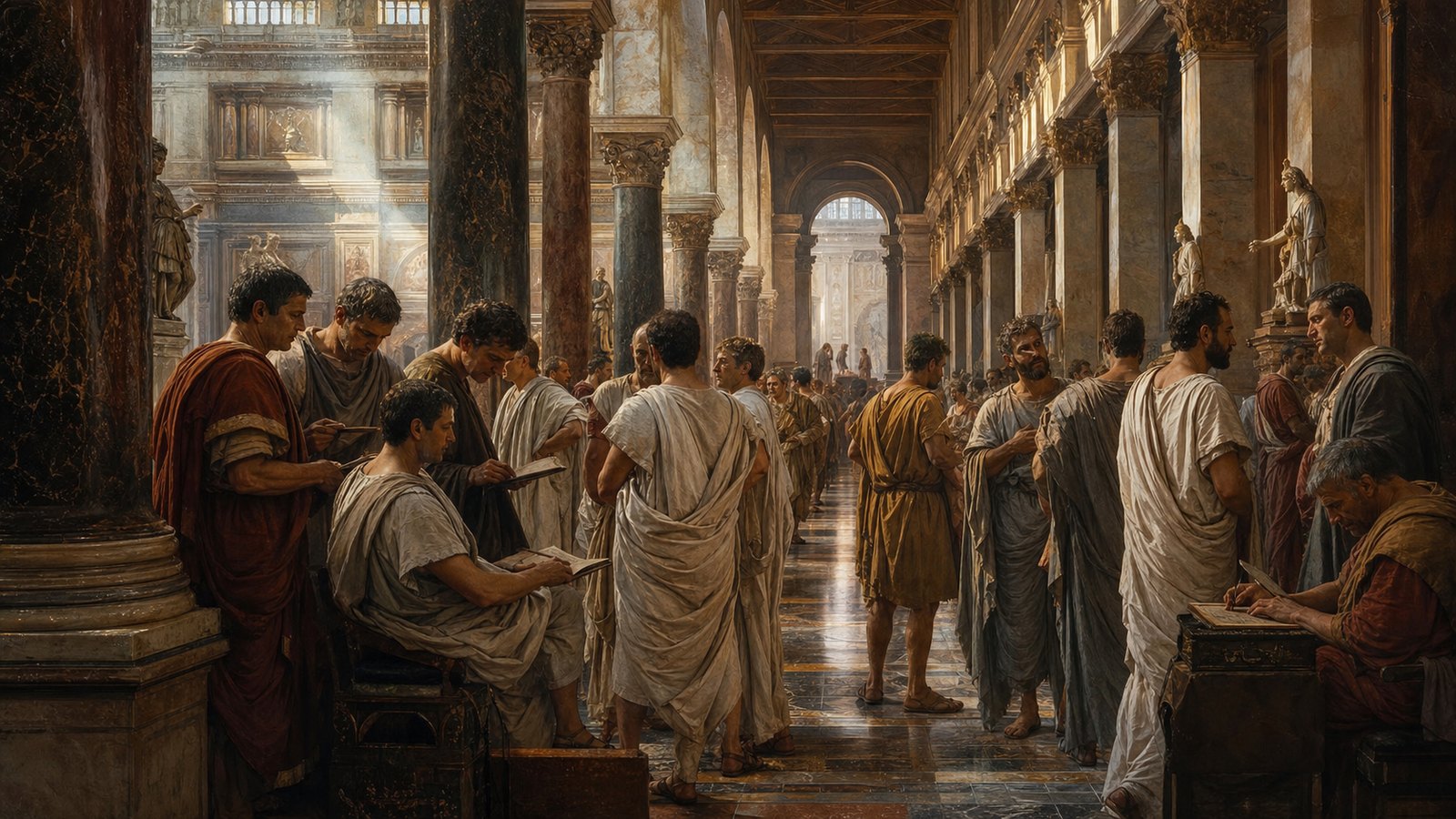
Tablets gave claims a material life
Tabulae made words portable and inspectable. A claim written down can outlast the heat of a conversation. It can be carried, checked, copied, stored, and challenged.
This gave the basilica a memory beyond sound. People did not only talk; they brought records into a space where talk and writing could reinforce or contradict each other.
Records connected the hall to authority
The tabularium reminds us that public records and archives mattered to Roman authority. A basilica was not simply a noisy market hall; it belonged to a culture that trusted visible records, stored memory, and repeatable procedure.
That connection gave business a civic shadow. A private arrangement could touch public record, legal expectation, and the broader habit of remembering who owed what to whom.
A roof made pressure shareable
The forum gathered political, legal, and commercial movement, and the basilica extended that world indoors. It gave pressure a roof without hiding it from the city.
That is the point. Private business did not become equal or fair simply because it was visible. But visibility changed the stakes. A promise, quarrel, or delay witnessed in public could become harder to dismiss as nothing.
The basilica shows Rome’s genius for making ordinary affairs architectural. Instead of treating business as background, the city gave it a recognizable public frame. The building told people where practical conflict belonged.
A roof also changed sound. Voices carried, footsteps repeated, and negotiations became part of a shared acoustic environment. The person arguing a claim did so inside a room that made secrecy harder and memory easier.
Merchants needed that environment because trust is never purely private in a city. A bargain depends on reputation, witnesses, documents, and the possibility that others will remember whether a person keeps his word.
Legal business needed it for similar reasons. A dispute handled in public does not guarantee justice, but it creates a setting where procedure can be seen. People watch the ritual of waiting, speaking, recording, and deciding.
The basilica therefore made business theatrical without making it fake. The performance mattered because public life depends on recognizable forms. A person who knows where to stand and whom to approach has already entered a system.
The building also compressed many kinds of status. Wealth, literacy, citizenship, connections, patience, and confidence could all become visible in a single hall. Some arrived with advocates; others arrived with worry.
This mixture kept the basilica from being merely decorative. Its columns did not simply impress. They organized movement and made the room feel like a place where private pressure could be handled by civic routine.
Records deepened that effect. A tablet held in the hand changes the body of the person holding it. It suggests evidence, memory, account, or obligation. In a basilica, such objects could become part of public persuasion.
The tabularium points toward the larger Roman faith in retrievable memory. Authority becomes stronger when it can say not only “we decide,” but also “we remember.” The basilica lived near that habit of recorded public life.
For ordinary people, this might have been both useful and intimidating. The building offered a place to pursue business, but it also exposed vulnerability. Debt, accusation, bargaining, and delay could all become visible beneath the same roof.
That exposure is why the basilica matters. It turned private business into something the city could see happening. Rome did not need every deal to be noble; it needed deals and disputes to pass through forms that made them legible.
A basilica was therefore one of Rome’s quieter institutions of confidence. It made practical life visible enough to be trusted, contested, remembered, and repeated under columns that gave business a public shape.
The public roof also slowed the tempo of pressure. A man had to wait, watch others wait, and recognize that his case or bargain was only one part of a larger civic rhythm. That shared delay could be frustrating, but it also made business feel procedural rather than purely personal.
The hall gave witnesses without turning every witness into a judge. People nearby might not know every detail, yet their presence mattered. They supplied the social fact that the transaction, argument, or appeal had not happened in complete darkness.
This mattered in a city where reputation could be capital. A merchant who argued dishonestly, an advocate who blustered, or a debtor who delayed too visibly could carry that impression beyond the building. Architecture helped rumor acquire a location.
The basilica also protected memory from being only elite memory. Documents and officials still favored the literate and connected, but the open hall let many kinds of people encounter the procedures by which business became public.
For Rome, that was a practical kind of order. The building did not make private interest disappear. It made private interest pass through a room where columns, records, witnesses, and repeated routines could turn pressure into something the city knew how to handle.
The raised tribunal or prominent end of the hall gave the room a direction. People could orient themselves toward decision, advice, or record, rather than drifting through business as isolated private actors. Architecture helped convert confusion into sequence.
The basilica’s openness also made status visible. A person with companions, documents, and confidence moved differently from someone arriving alone. The building did not hide inequality, but it did give inequality a public setting in which it could be noticed.
That visibility could restrain as well as expose. A bargain made under many eyes invited later memory; a denial made after visible waiting could sound weaker; a promise connected to tablets could travel beyond the moment. Public business gained afterlife.
The result was a building that made Rome’s practical confidence easier to repeat. People knew where disputes could go, where documents could appear, where advocates might gather, and where private claims would become part of the city’s shared noise.
Sources & Further Reading
- Smith Dictionary, Basilica
- Smith Dictionary, Tabulae
- Smith Dictionary, Tabularium
- Smith Dictionary, Forum