
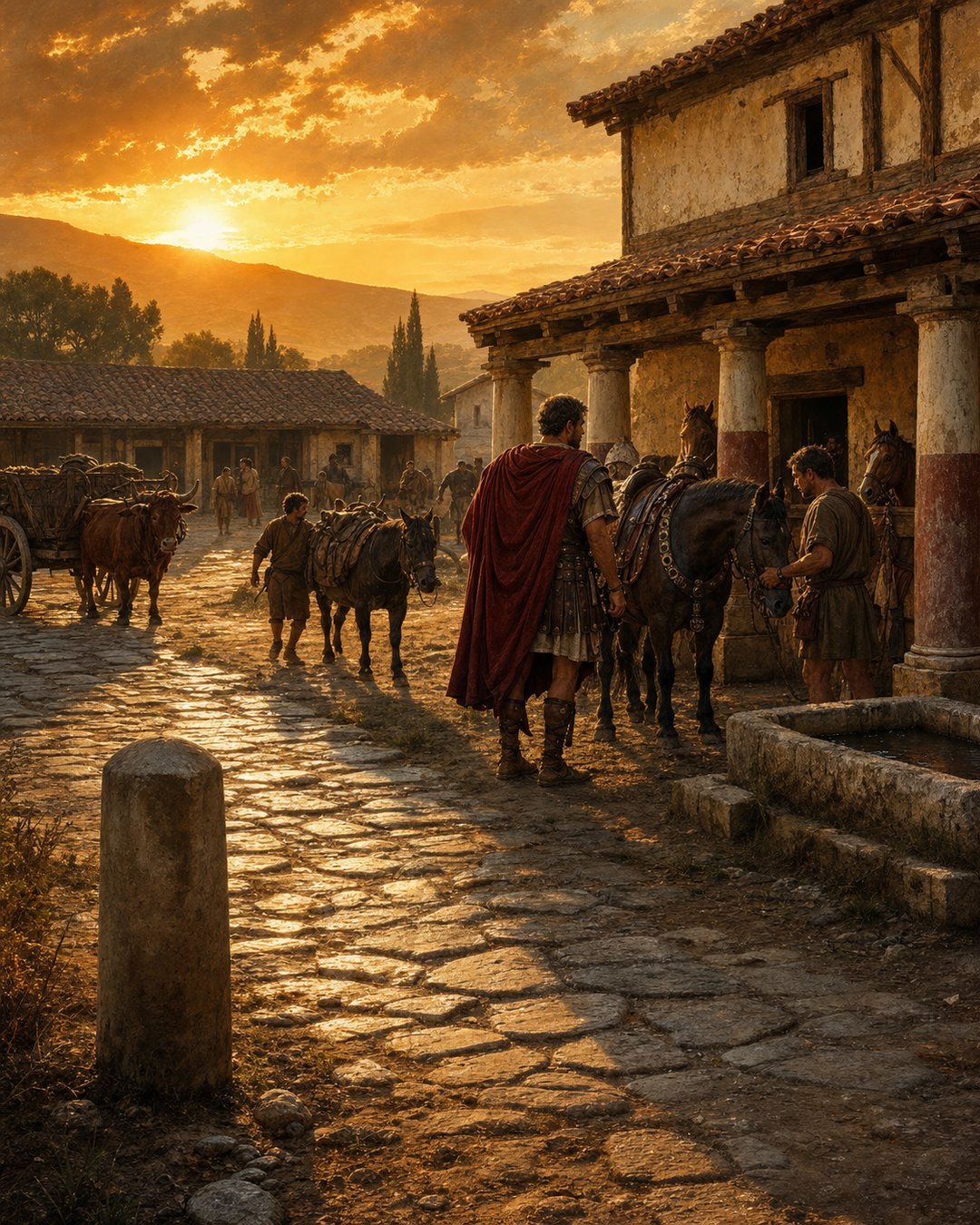
A Roman road can look self-sufficient in the imagination: straight stone, disciplined engineering, and a line across the landscape. But a road without places to stop is only a hard surface that exhausts people and animals.
Roman mansiones made imperial travel reliable because they turned distance into a chain of known halts. Arrival, rest, repair, exchange, record, and departure made movement repeatable.
The station made distance measurable
Mansio describes a stopping place, and that changes the meaning of the road. Distance became manageable when it could be divided into expected stages rather than endured as an endless line.
A traveler could think in stations: where animals might drink, where a wheel might be checked, where food might be found, where a message might be handed forward. The road acquired a rhythm.
Rest was part of speed
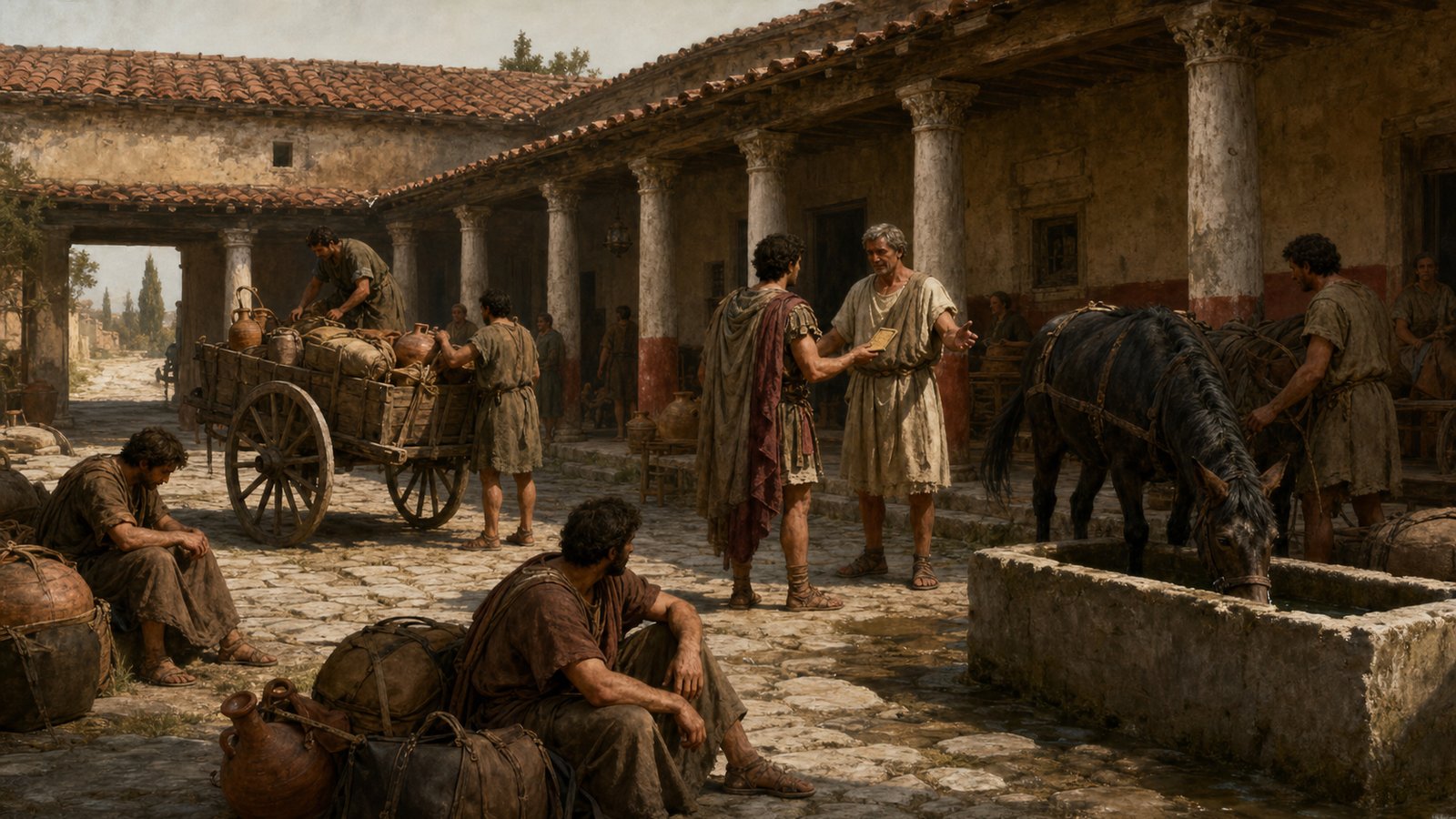
A station did not slow movement in a simple sense. It made movement continue. Tired animals, broken harness, hungry travelers, and confused messengers could turn a road into failure unless there was a place to recover.
Imagine the mini-scene at sunset: dust rising around mules, a courier holding a sealed tablet, a cart wheel being examined, lamps appearing under a tiled roof, and an innkeeper counting arrivals. Reliability has a courtyard.
Inns and stations made fatigue visible
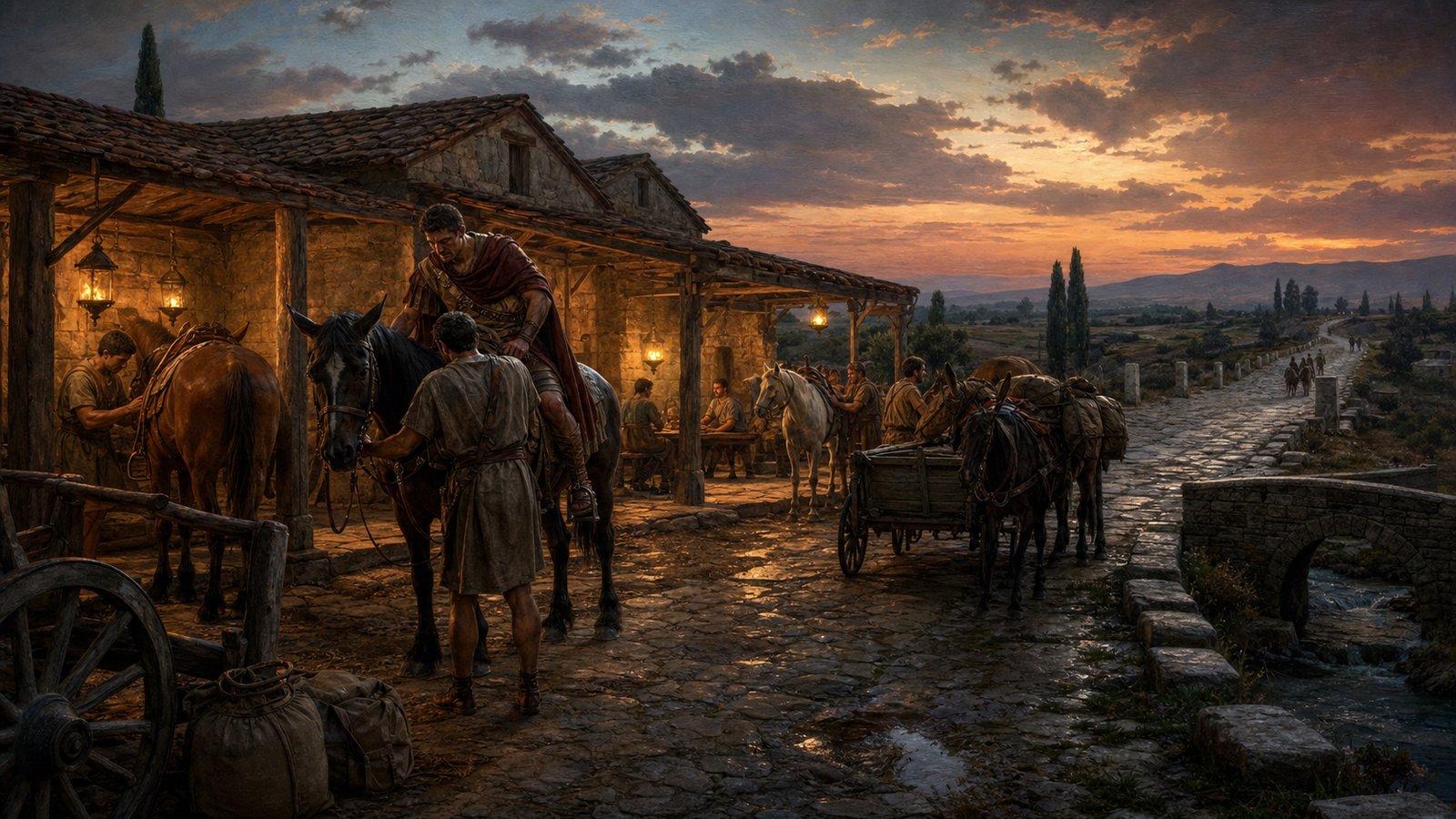
Caupona reminds us that travel needed food, drink, and shelter. Roman mobility was not an abstract line on a map. It passed through bodies that became hungry, cold, injured, impatient, or lost.
The station made that bodily cost visible. Dust on legs, sweat-dark animals, worn wheels, and impatient voices showed that imperial reach depended on ordinary care.
Bridges and stations worked as one system
Pons, the bridge, solved one problem: crossing. Mansio solved another: continuing. Reliable travel required both. A bridge without rest still left exhausted travelers; a station without crossings trapped them near obstacles.
Together they turned landscape into sequence. The road was not only stone underfoot but a network of crossings and pauses that kept movement from collapsing.
Records let movement stay official
Tabulae mattered because travel often carried orders, accounts, names, and obligations. A message needed more than speed. It needed memory and recognition as it passed from hand to hand.
Written records helped a journey remain official after one traveler left the courtyard. The tablet turned departure into continuity.
The mansio made empire feel practical at the scale of tired animals. That scale matters. Grand power can fail if a mule cannot be watered or a wheel cannot be repaired.
A station also made the road socially visible. Travelers from different directions met, exchanged news, compared delays, and learned what lay ahead. Movement produced information as well as arrival.
The sensory details were part of the system: hoof sound on stone, lamp smoke, damp straw, cooking smells, leather straps, and the creak of carts entering the yard. These were the textures of reliable distance.
A road station could also make hierarchy visible. Officials, couriers, merchants, servants, soldiers, locals, and inn workers might share the same space without sharing the same status. The road gathered unequal people into a single practical rhythm.
The station’s importance lay in repetition. One stop could save one journey, but a chain of stops made long-distance movement dependable enough to be planned.
This is why mansiones belong to the history of administration, not only travel. They made orders, supplies, and people move through known points where the system could recover from strain.
A bridge showed that Rome could overcome a river. A station showed that Rome understood exhaustion. The second achievement was less monumental but just as necessary.
The road also needed local knowledge. A courtyard gathered people who knew weather, animals, routes, prices, rumors, and dangers. Travel reliability often depended on this human intelligence.
Records preserved part of that order. A tablet could carry a message forward, note a duty, or remember an obligation after the traveler’s dust had settled.
The mansio therefore turned motion into administration. It created a point where bodies rested, animals changed condition, objects were checked, and messages retained authority.
Without such places, the Roman road would still impress the eye but fail the traveler. Stone can guide movement; it cannot feed a mule or mend a wheel.
This practical truth makes the station historically powerful. It shows empire not as a line on a map, but as a sequence of solved inconveniences repeated across distance.
Every arrival at a mansio was a small test. Could the system absorb fatigue, confusion, damage, and hunger quickly enough for movement to resume?
When it could, imperial travel felt reliable. When it could not, distance returned as danger. The station marked the difference.
Roman mansiones made travel reliable by making stopping part of movement. They taught that an empire moved not because roads never paused, but because the pauses were organized.
The mansio also made uncertainty manageable. A traveler leaving one station could aim for another, turning the unknown road into a series of practical expectations rather than a single frightening distance.
That expectation supported official movement and ordinary movement alike. Even when access and status differed, the logic was the same: reliable travel needed known places where strain could be absorbed.
The courtyard was a small administrative theater. Animals, wheels, packs, messages, food, and people could be inspected, exchanged, delayed, or sent onward from one visible center.
This made time more predictable. A road without stations leaves travelers guessing how long endurance will last. A road with stations lets movement be planned around intervals.
The station also connected imperial systems to local labor. Someone had to provide fodder, water, repair skill, lamps, bedding, or information. Long-distance power rested on local hands.
That dependence did not weaken the system; it made the system real. Empire moved through thousands of practical acts too small for triumphal history but too important to omit.
The mansio shows why Roman infrastructure cannot be reduced to stone. The road surface mattered, but so did the places where bodies recovered and messages remained legible.
By organizing the pause, the station protected the journey. It made stopping a tool of movement, and that is why distance could feel governed rather than merely endured.
A road station also made failures easier to locate. If a courier vanished, an animal failed, or a wheel broke, the chain of stations gave the system known places to ask questions and restart movement.
The empire did not need every traveler to understand the whole network. It needed each stage to work well enough that the next stage could receive people, animals, goods, and messages without beginning from chaos.
A mansio also made information move sideways. News about road conditions, weather, suspicious delays, prices, or danger could gather in the same courtyard where animals drank and wheels were checked.
That information mattered because travel was never only movement through space. It was movement through uncertainty, and the station reduced uncertainty by concentrating witnesses.
For a courier, the difference between an empty road and a staffed station could decide whether an order remained urgent or became stale. The organized pause protected the speed of the message.
The station therefore made Roman roads humane in the most practical sense. They acknowledged that bodies and animals fail, and they built recovery into the route itself.
Sources & Further Reading
- Smith Dictionary, Mansio
- Smith Dictionary, Caupona
- Smith Dictionary, Pons
- Smith Dictionary, Tabulae