
Justice can feel invisible until someone gives it a place to stand. In Rome, legal authority did not exist only inside minds or private consultations. It appeared in magistrates, attendants, tribunals, boards, notices, advocates, and citizens waiting to see how disputes would be framed.
Roman praetors put justice on public boards because law needed visible expectations before it could claim public force. The edict did not make everyone equal, and it did not remove patronage or status. It made legal power appear as something more stable than rumor.
The praetor gave legal expectation a face
Praetor names a magistrate whose public role mattered before any single decision. People did not encounter law as pure abstraction. They encountered an office, a person, attendants, timing, place, and repeated procedure.
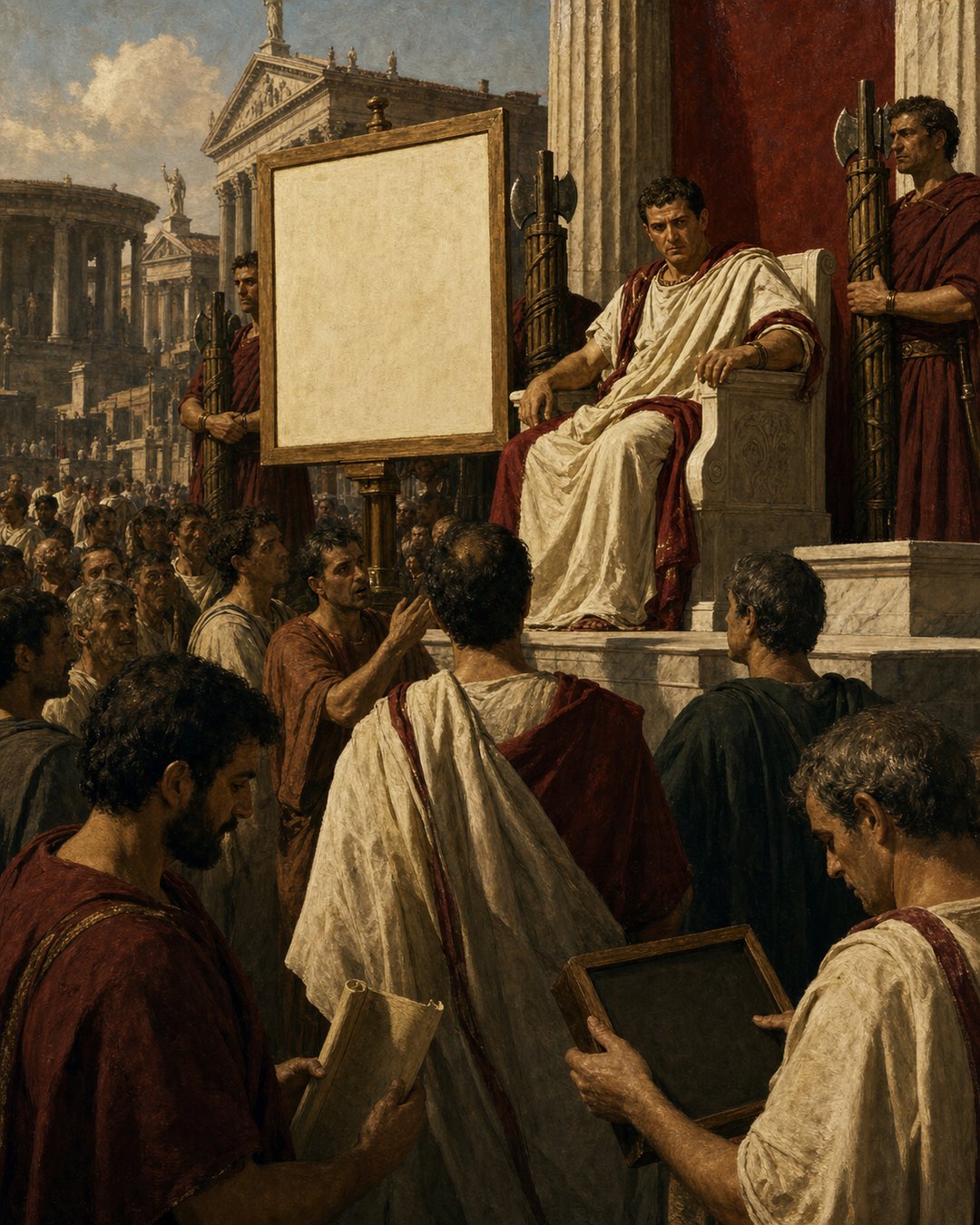
Picture the Forum: a raised tribunal, citizens craning to see, advocates reading a board, tablets tucked under arms, lictors marking authority with their presence. Law has acquired a scene before a case is heard.
The edict made future disputes partly legible
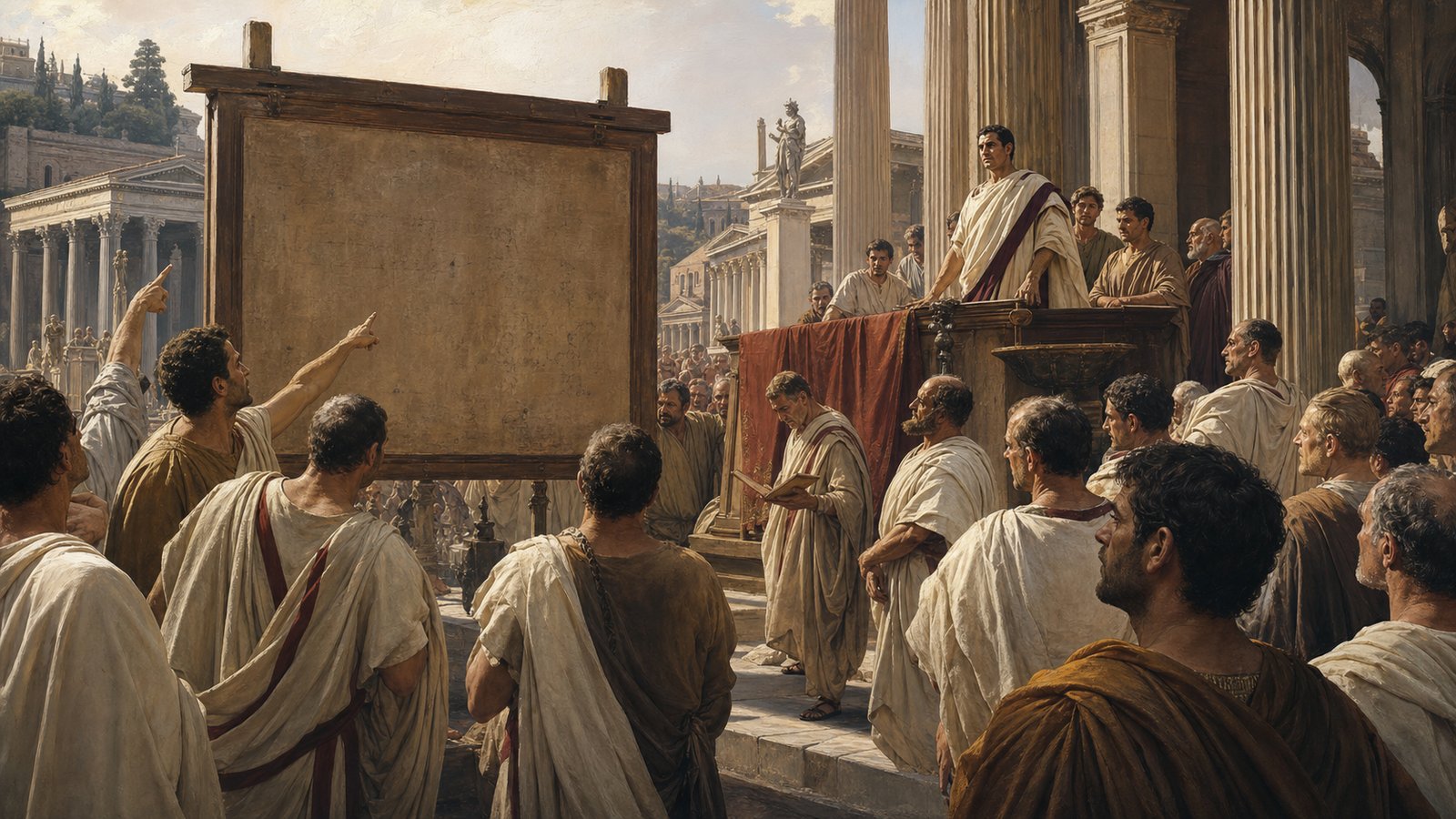
Edictum, the edict, matters because it looked forward. It announced how the magistrate would approach classes of business and remedies. That did not make the future certain, but it made expectations visible enough to plan around.
A public rule does political work even before it is enforced. It tells citizens and advocates what kinds of claims may be recognized, what language might matter, and where argument should begin.
The album turned knowledge into a public object
Album could describe a whitened board used for public display. The material point is important. When legal information stood on a board, it became an object of gathering, reading, pointing, arguing, and remembering.
This links the praetor’s board to Roman public notices. Both show Rome turning authority into something that could be seen in a public place rather than only heard secondhand.
The tribunal arranged the crowd’s attention
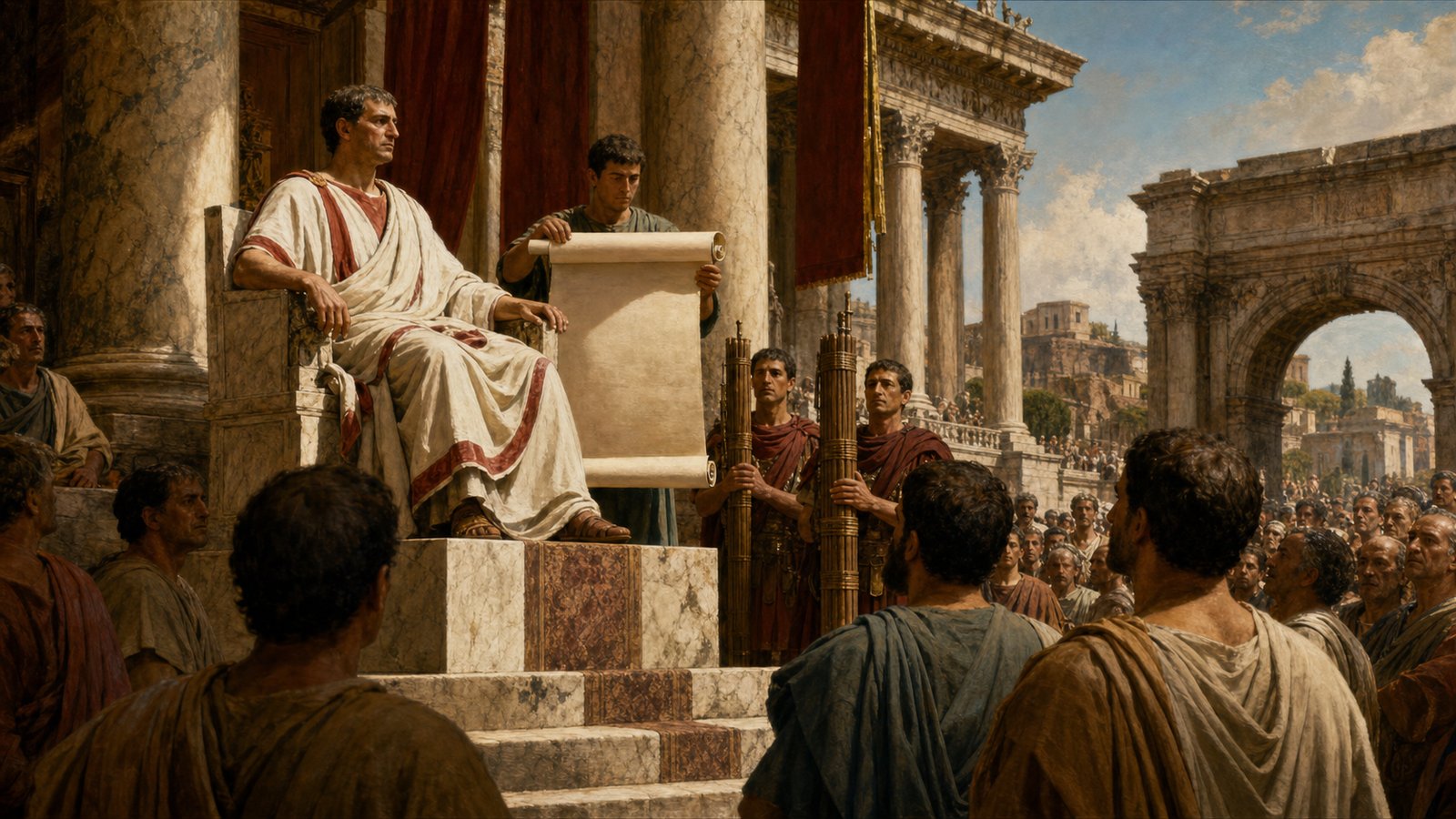
Tribunal was not decorative furniture. A raised seat or platform shaped sightlines and hierarchy. It told the crowd where authority sat, where litigants approached, and how the legal scene should be read.
Lictors and attendants sharpened that message. They did not decide the law by themselves, but they made office recognizable. A magistrate’s authority arrived with a visual grammar people already understood.
Visible law could still be unequal
Putting rules in public did not erase inequality. Wealthy men could hire better advocates, patrons could shape access, and status influenced confidence. Yet public display mattered because it made legal expectation harder to hide completely.
Praetors put justice on public boards by making law visible before judgment. The board did not guarantee fairness. It gave Roman legal power a surface where people could gather, read, challenge, and remember.
The most important thing about the board was not that every passerby studied it carefully. Public display works even when literacy is uneven. Readers could explain it to others, advocates could cite it, and the sight of the board itself taught that rules had a recognized place.
The board also changed rumor. Without a public point of reference, people depend on whispers about what the magistrate might do. With an edict displayed, rumor had to orbit a visible object that could be checked or contested.
This made law more theatrical in the sober civic sense. The tribunal, board, attendants, and crowd formed a set of cues. People learned how legal authority looked before they learned the details of each dispute.
The arrangement did not make power gentle. It could make power more effective. A rule written in public can still favor the powerful, but it gains force from appearing orderly, known, and repeatable.
Roman public life often worked through that combination of display and discipline. Calendars made time visible. Milestones made distance visible. Edicts made legal expectation visible. Each object helped authority enter daily life.
For litigants, the board could be intimidating. It reminded them that their private quarrel would be translated into public categories. A grievance had to become the kind of claim the magistrate’s system could recognize.
For advocates, the board was a tool. They could read its promises, test its gaps, and use its language to frame argument. Public law created a field for professional skill as well as civic expectation.
The board’s whitened surface mattered because it separated official display from the visual clutter of the city. It said: look here; this is not ordinary talk. Material presentation helped information become authoritative.
The raised tribunal performed a similar separation. The praetor was physically above the crowd, not because truth lived at a higher altitude, but because public hierarchy needed a visible shape.
Still, the crowd’s presence mattered. Law that is performed before witnesses enters memory differently from law hidden in a private room. People can argue afterward about what was said, who approached, and whether procedure looked proper.
The edict also made the magistrate accountable in a limited way. A publicly announced expectation could be quoted back, compared with action, or remembered after the year of office changed. Public words leave traces that private discretion does not.
Roman praetors put justice on boards because visibility gave law a civic body. The legal system did not float above Rome. It stood on platforms, appeared on surfaces, moved through voices, and gathered people who needed to know how disputes might be heard.
That public body could be fragile. A damaged board, a confusing announcement, or a magistrate who ignored his own display would weaken the claim that law was orderly. Visible law demanded maintenance just as roads and aqueducts did.
The legal board also taught citizens where authority began. Before a verdict, before punishment, before settlement, there was a displayed set of expectations. Rome made the beginning of legal reasoning public enough for people to locate it.
The scene becomes more revealing when we remember the city around it. Markets, temples, monuments, and political conversations pressed close. The edict board inserted legal order into that dense public world, competing for attention with every other sign of power.
A citizen who could not master every clause could still understand the larger message: disputes were not supposed to be pure improvisation. They would pass through a magistrate’s announced framework and a public procedure recognized by the city.
That recognition gave the board its force. Justice was not only the final decision. It was the visible preparation for decision: the posted expectation, the raised seat, the attendants, the crowd, and the memory that law had been made to stand where Rome could see it.
Public boards therefore made legal authority both stronger and more exposed. Stronger, because official words could organize behavior before conflict erupted. More exposed, because once displayed, those words could be noticed, cited, misunderstood, resented, or used against the magistrate who posted them.
This is the Roman lesson hidden in a simple board. Power often lasts not by remaining mysterious, but by choosing the surfaces on which people are allowed to see it. The praetor’s album was one such surface, turning justice into a public object before it became a judgment.
Sources & Further Reading
- Smith Dictionary, Praetor
- Smith Dictionary, Edictum
- Smith Dictionary, Album
- Smith Dictionary, Tribunal
- Smith Dictionary, Lictor