
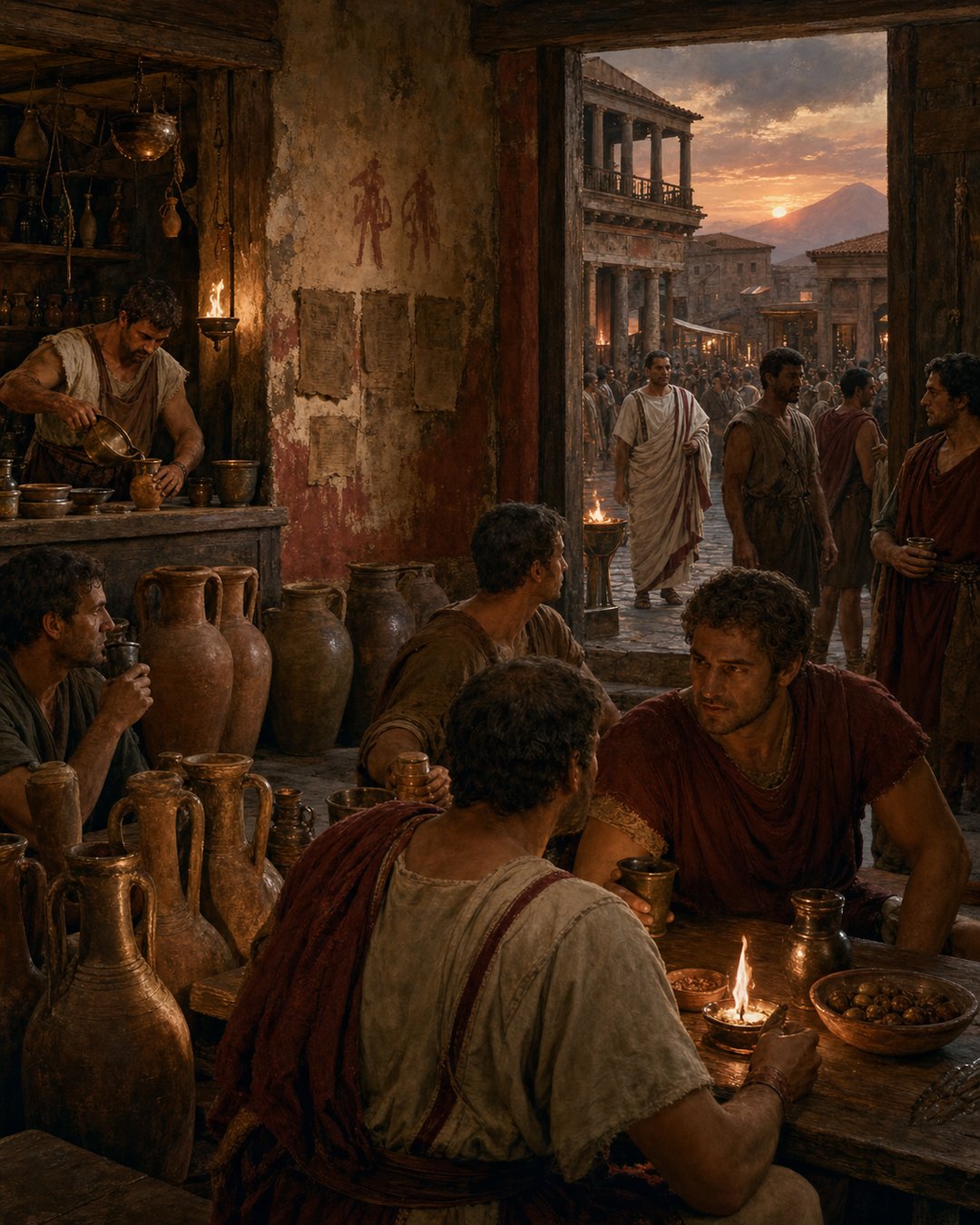
A Roman tavern did not need a speaker’s platform to matter politically. It only needed a counter open to the street, a few cups, the smell of cooked food, and people who kept coming back because daily life gave them reasons to pause there.
The taberna made politics hard to keep private because it joined commerce, hunger, credit, gossip, and public messages in the same narrow space. A candidate’s notice on a wall and a rumor over wine could belong to the same street corner.
The shopfront pulled private life into the street
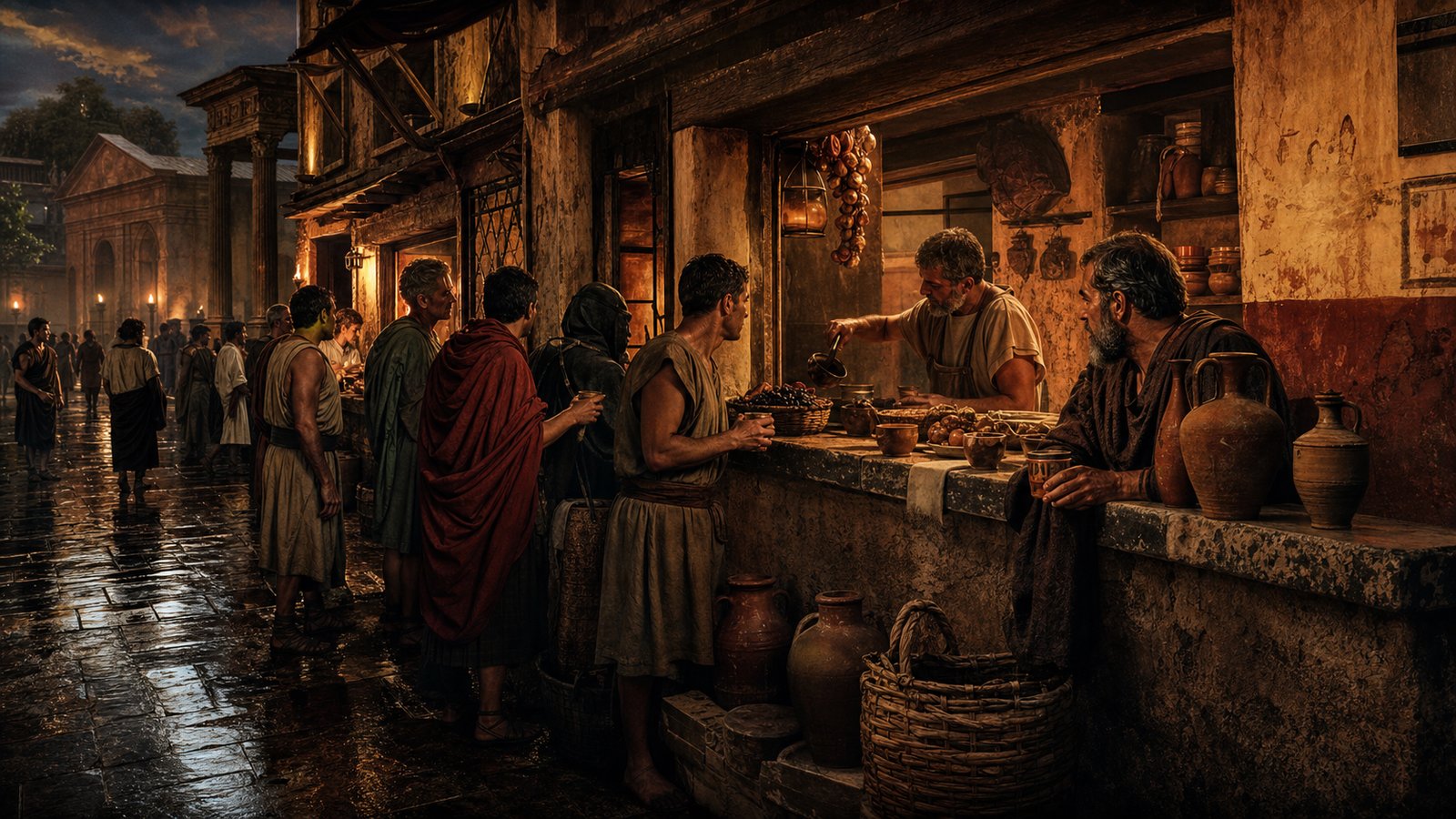
A taberna faced outward. Its counter, doorway, goods, and customers belonged to the public edge of the building even when the business itself was small. That architecture made everyday talk visible.
Picture dusk in a Pompeian street: amphorae against a wall, oil lamps near a masonry counter, wet paving outside, and men leaning close enough to hear what the next table says. The room is commercial, but the conversation is civic.
Food and drink created repeat meetings
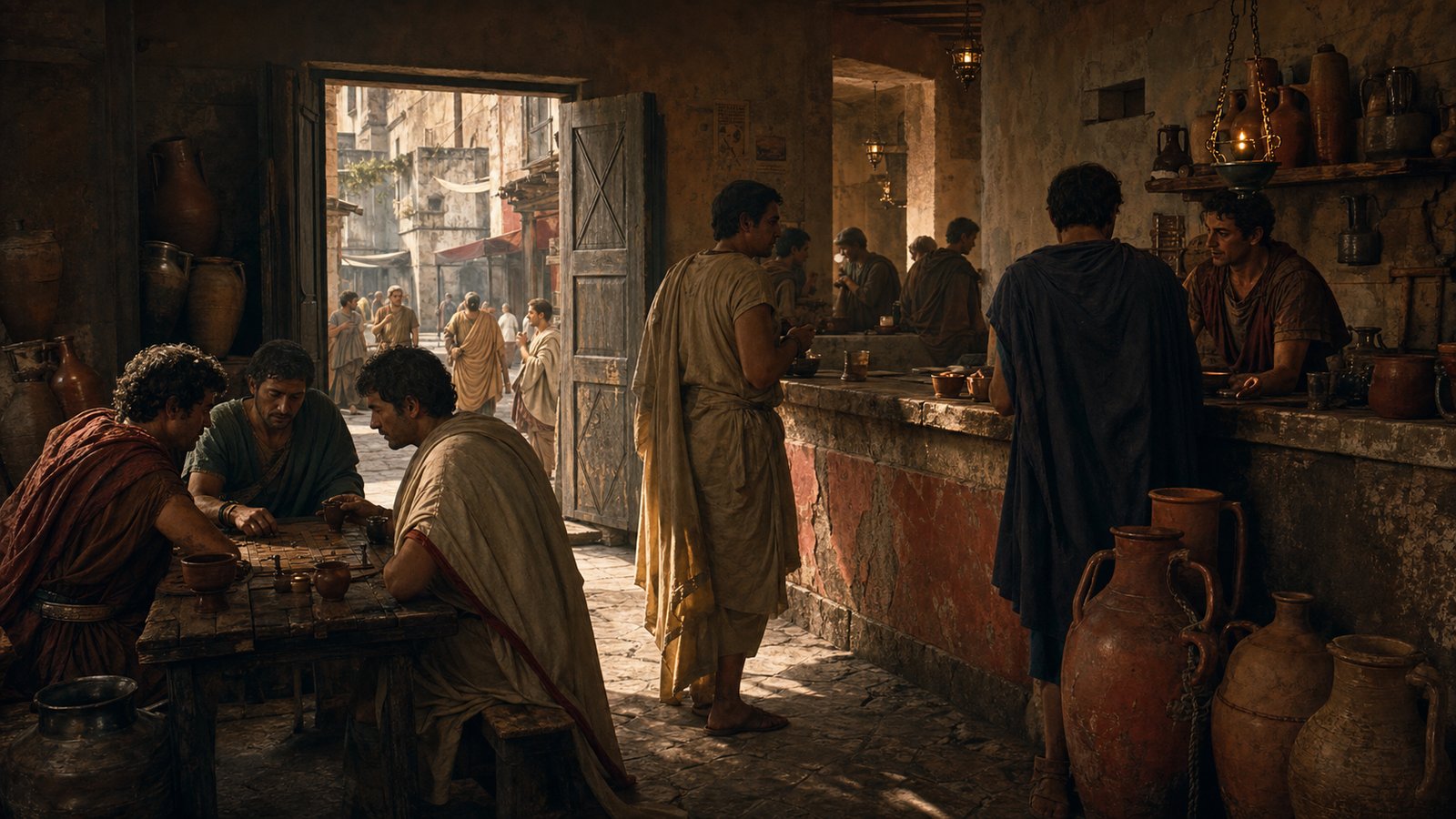
Politics travels best where people return. A tavern gave neighbors a repeated meeting place because food, wine, work breaks, and errands drew them through the same door again and again.
This did not make every cup a political act. It made politics difficult to isolate. News about prices, grain, magistrates, debts, patrons, and scandals could move through the same channel as a lunch order.
Pompeii shows messages on ordinary walls
Pompeii’s electoral notices remind us that public persuasion did not live only in official buildings. It appeared on walls that shoppers, servants, freedmen, workers, and householders passed in the routines of the day.
That detail changes the scale of Roman politics. A tavern patron did not need to enter the Forum to encounter a campaign. The street brought politics to him, and the counter gave him somewhere to discuss it.
The taberna mixed ranks without erasing them
Roman society remained sharply unequal, but street-front commerce brought different statuses into contact. Workers, customers, freed people, slaves running errands, and citizens with votes might share a doorway even if they did not share power.
The mixture mattered. Information could pass sideways as well as downward. A joke, complaint, endorsement, or warning overheard in a tavern could travel faster than a formal speech.
Rumor had a physical setting
Rumor is often treated as invisible. In a Roman neighborhood it had furniture: counters, cups, benches, doorways, wall notices, jars, and gaming boards. The setting helped rumor survive because people knew where to find one another.
The sensory world mattered too. Wine smell, lamp smoke, scraped stools, dice or counters on a board, and voices from the street made the taberna a place where attention gathered naturally.
Politics became a habit before it became a decision
A vote, petition, or public demonstration may look like the political moment. The taberna shows the quieter preparation: repeated talk that makes names familiar, grievances shared, and loyalties feel normal before anything official happens.
This is why Roman taverns made politics hard to keep private. They gave public life a small, ordinary room where private worries could become neighborhood knowledge.
The point is not that taverns controlled elections. It is that Roman politics needed circulation, and circulation often depended on ordinary spaces. A wall notice meant more when people paused nearby long enough to read, repeat, mock, or defend it.
The taberna also linked economic pressure to public opinion. If prices rose, credit tightened, or a patron failed someone, the people affected could compare stories in a place already built for exchange.
That comparison could be dangerous for elites because it made private dependence visible. A man who controlled votes through favors still had to live with the fact that disappointed clients talked to one another.
A street-front business also shortened the distance between household and city. The doorway connected domestic blocks to urban movement, so information entered and left with every customer.
The taberna was therefore not a formal institution, but it behaved like a small civic amplifier. It helped turn scattered impressions into shared judgment.
For historians, that scale is valuable. It shows politics before speeches, before violence, before laws, and before monuments. It shows politics as talk repeated in places where people had reasons to linger.
The walls of Pompeii preserve only fragments, but the fragments point toward a lively urban habit. Public messages worked because they met a city already trained to talk in public.
The tavern counter was one of the places where that training happened. Rome’s public life did not only unfold in marble spaces. Sometimes it began beside amphorae, lamps, and a cup passed across a counter.
The pattern also mattered because it was repeatable. Romans learned authority through repeated encounters with objects and places that seemed ordinary: a counter, a seal, a road, a monument, a mark, a queue, or a familiar route through the city.
That repetition gave small details political weight. A single scene might look trivial, but the habit formed around it could teach people where to gather, whom to trust, what to remember, and how to recognize power when it appeared.
For this reason the evidence should not be reduced to decoration. Material details changed behavior. They shaped how people moved, spoke, waited, watched, and judged one another in daily life.
The human scale is essential. Rome was not experienced only through emperors, armies, and laws. It was also felt through surfaces, doorways, hands, lamps, dust, food, wax, stone, and the sound of other people nearby.
When those details are put back into the story, the larger system becomes easier to understand. Roman power lasted partly because it found ways to become useful, visible, memorable, and difficult to ignore in ordinary settings.
The surviving evidence is fragmentary, but the fragments point toward a world where public life was built from repeated practical encounters. What looks small in isolation could become large because it happened every day.
That daily quality is the key. A city does not become Roman only by decree. It becomes Roman when people keep meeting Roman forms in the places where they eat, work, travel, mourn, write, bargain, and remember.
Attention to these forms also protects the story from becoming too abstract. The empire was made of institutions, but institutions had to touch bodies and routines before they could feel real.
In that sense, the object or place at the center of this article is a clue. It shows where official systems and private lives met, and where Rome turned an idea into a visible habit.
The lesson is not that every Roman saw the system clearly. Most people probably noticed immediate needs first: a drink, a document, a road, a family duty, a message, a promise, or a name on stone.
Yet those immediate needs gave the system its strength. Power became durable when people used its forms for their own practical reasons, not only when officials demanded obedience.
That is the quieter story behind the grander one. Rome endured through places and objects that made authority feel normal because they kept appearing at the moments when people needed something done.
Sources & Further Reading
- Smith Dictionary, Taberna
- World History Encyclopedia, Roman Food
- World History Encyclopedia, Roman Daily Life
- Pompeii Sites, Electoral inscriptions
- Metropolitan Museum of Art, Roman Architecture