
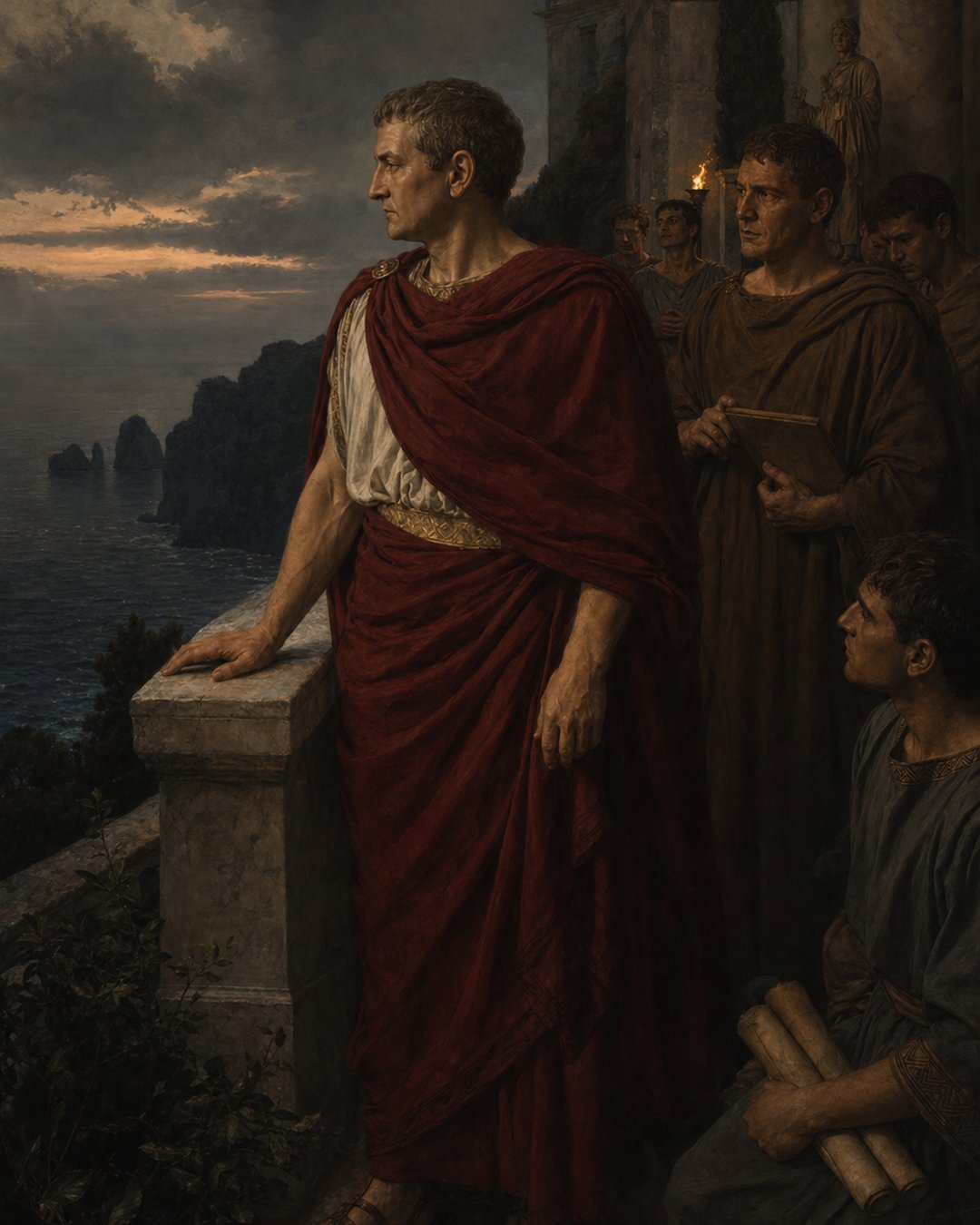
Tiberius did not stop ruling Rome when he withdrew to Capri. That is what makes the island years so revealing. A weaker system would have required the emperor’s body to be constantly visible in the capital. The early Roman Empire had already become something stranger: a government in which access, letters, fear, precedent, and delegated authority could let one man remain central while living across the water.
Tiberius ruled from AD 14 to 37, inheriting the political machine Augustus had built under republican forms. The Senate still met. Magistracies still existed. Speeches were still delivered in Rome. Yet everyone understood that imperial favor mattered. When Tiberius withdrew from the city and spent much of his later reign on Capri, he did not abandon power. He changed the route by which power traveled.
Capri offered distance with control
Capri was not a random hideaway. The island rises from the Bay of Naples, with cliffs, sea approaches, villas, and a natural sense of separation. For an emperor who distrusted the city’s pressures, distance had obvious uses. Visitors could be controlled. Rumors could be filtered. Access became a privilege rather than an expectation.
That physical geography mattered politically. In Rome, senators could watch faces, cultivate encounters, and read public gestures. On Capri, the emperor became harder to reach and harder to interpret. A message had to travel. A petitioner needed permission. An enemy could not easily know whether silence meant neglect, suspicion, or a decision already made.
Withdrawal made intermediaries powerful
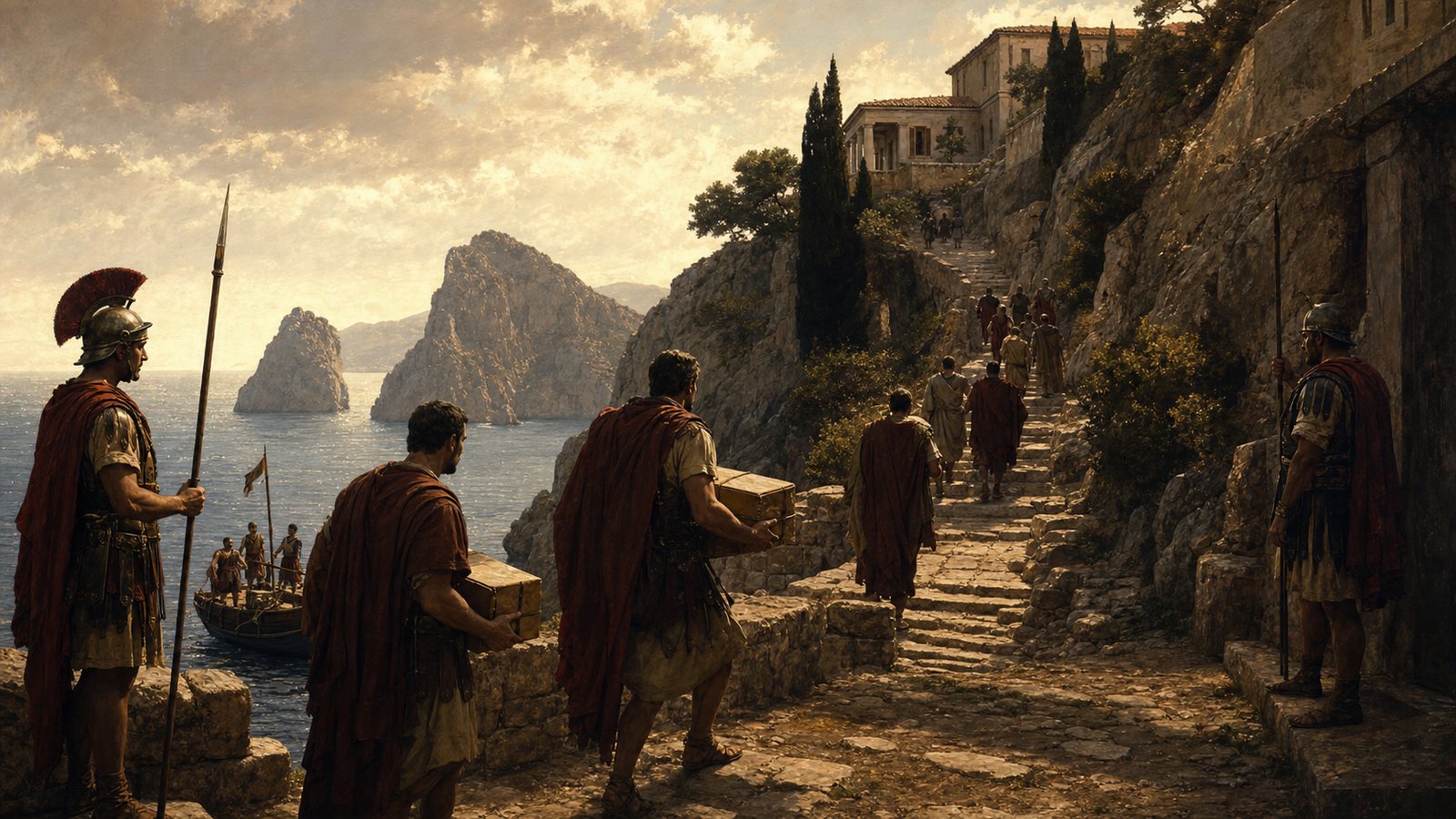
Remote rule increased the importance of men who controlled information. Sejanus, commander of the Praetorian Guard, became the most famous example. During Tiberius’ reign he accumulated influence before his dramatic fall in AD 31. His rise shows how dangerous imperial distance could be. If the emperor was absent, the person who seemed closest to him could become a second center of fear.
The problem was not only one ambitious adviser. A remote emperor made everyone ask the same question: who truly speaks for him? Letters, audiences, delays, and rumors gained weight. Political life became a struggle not simply for office, but for access to the mind of a man not present in the room.
The Senate still had to perform loyalty
Tiberius’ withdrawal did not free the Senate. It may have made senatorial behavior more anxious. Tacitus presents the reign as a world where treason accusations and informers gained frightening power. Whether every scene carries Tacitus’ own senatorial bitterness, the pattern is clear enough: under a suspicious emperor, men watched their words because words could be reported upward.
Distance sharpened that fear. A senator could not easily test the emperor’s mood in person. Public loyalty had to be performed toward an absent ruler whose reactions might arrive later through letters or commands. The result was government by interpretation. Men tried to guess what Tiberius wanted, and guessing wrong could be fatal.
Ancient writers turned Capri into a moral landscape
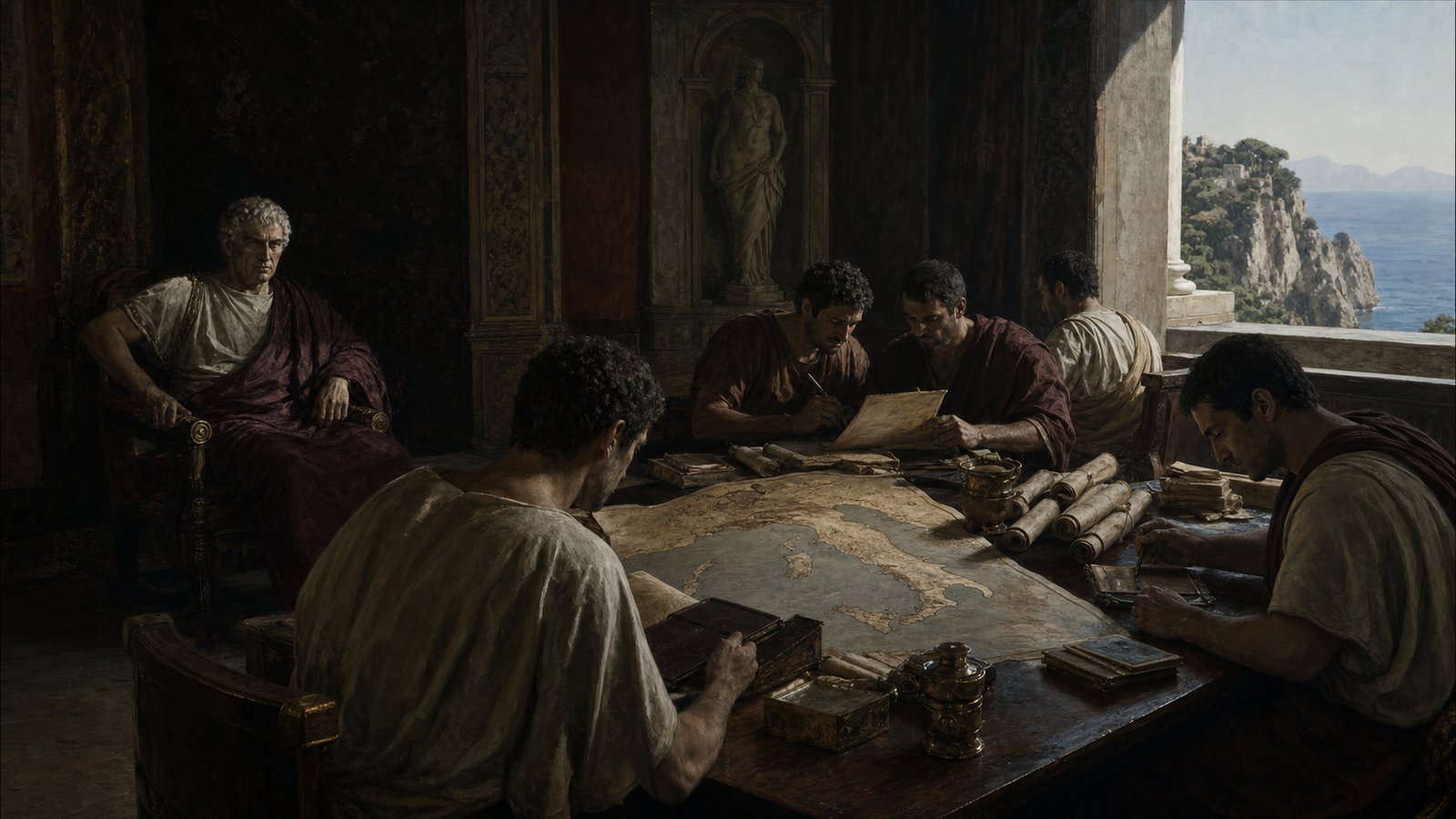
Suetonius made Capri the setting for secrecy and scandal. Tacitus made the later reign a study in suspicion, servility, and corrupted speech. These writers were not neutral travel guides. They used the island to explain what they thought Tiberius had become: withdrawn, mistrustful, and dangerous to approach.
Even if we treat the most lurid claims cautiously, the island itself remains historically important. Capri gave later Romans a place to imagine hidden power. The emperor was not in the Forum, not constantly in the Senate, not easily visible to the aristocracy whose ancestors had once ruled Rome openly. He was above the sea, receiving reports and sending decisions back.
The fall of Sejanus proved the emperor was still emperor
Anyone tempted to see Capri as abdication has to explain the fall of Sejanus. In AD 31, the powerful prefect was destroyed by imperial command. The episode showed that distance did not mean impotence. Tiberius could let influence gather around an intermediary and then cut it away when he chose.
That is the real lesson of the island years. Roman imperial power did not require constant public presence. It required recognition that the emperor’s decision mattered wherever he was. Capri made that recognition more unnerving. The ruler could be absent and still decisive, hidden and still central, silent and still feared.
Rome learned that remoteness could rule
Tiberius ruled from an island because the imperial system allowed power to detach itself from daily visibility. The city continued to function, but its political class orbited an absent center. Couriers, informers, guards, senators, and freedmen all became part of a chain leading toward a man across the water.
That is why Capri is more than a biographical curiosity. It shows the Principate’s quiet transformation of Roman politics. Augustus had wrapped monarchy in republican forms. Tiberius’ retreat exposed how far that transformation had gone. Rome could still look like Rome, with Senate, offices, ceremonies, and speeches. But the final weight of power could sit on a cliff above the Bay of Naples, waiting for messages to arrive.
Absence changed the texture of fear
An emperor in Rome could be watched. His expressions, illnesses, guests, and public movements gave the elite clues. An emperor on Capri became a screen onto which rumors could be projected. That did not weaken fear; it made fear less stable. Men could not easily distinguish policy from delay, anger from silence, or authentic instruction from the ambition of an intermediary.
This is why Tacitus’ account feels so claustrophobic even when the emperor is physically far away. Political danger did not require Tiberius to stride into the Senate every morning. It could arrive through accusations, letters, and the knowledge that someone had the emperor’s ear. Remote government made Rome depend on channels, and channels could be controlled.
Capri also revealed one of the Principate’s central tensions. Augustus had made monarchy look like restored order. Tiberius showed that the monarch could become unreachable while the forms continued. The Senate still had words, titles, and procedures. But the practical question remained brutally simple: what did the absent emperor want, and who could safely say it?
Why the detail still matters
The article’s central point depends on concrete evidence rather than a modern slogan. A named person, a dated reign or crisis, a physical setting, and an ancient-source detail give the story its weight. Without those anchors, Roman history turns into a parade of familiar legends. With them, the legend becomes a clue to how Romans explained power, fear, status, and memory.
That is also why the surviving ancient sources must be used with caution rather than discarded. Suetonius, Tacitus, Plutarch, Cassius Dio, and Appian often wrote with moral purpose, political memory, or hindsight. Their anecdotes may sharpen a scene, but the sharpening itself tells us what later Romans thought the scene meant. The safest reading keeps both truths in view: the exact detail needs scrutiny, and the fact that Romans preserved it still reveals the pressure points of their political world. For readers, the payoff is a firmer kind of curiosity: not whether the story is simply true or false, but why this particular story became the one Romans remembered. It also keeps the writing honest: the article can be vivid only where the fact sheet has supplied real names, dates, places, institutions, and sourceable scenes.
Sources & Further Reading
- Britannica, Tiberius
- Tacitus, Annals, 4
- Britannica, Sejanus
- Suetonius, Tiberius, 39-43
- Britannica, Capri
- Britannica, Roman Senate
- Britannica, Augustus
- Tacitus, Annals, 6