
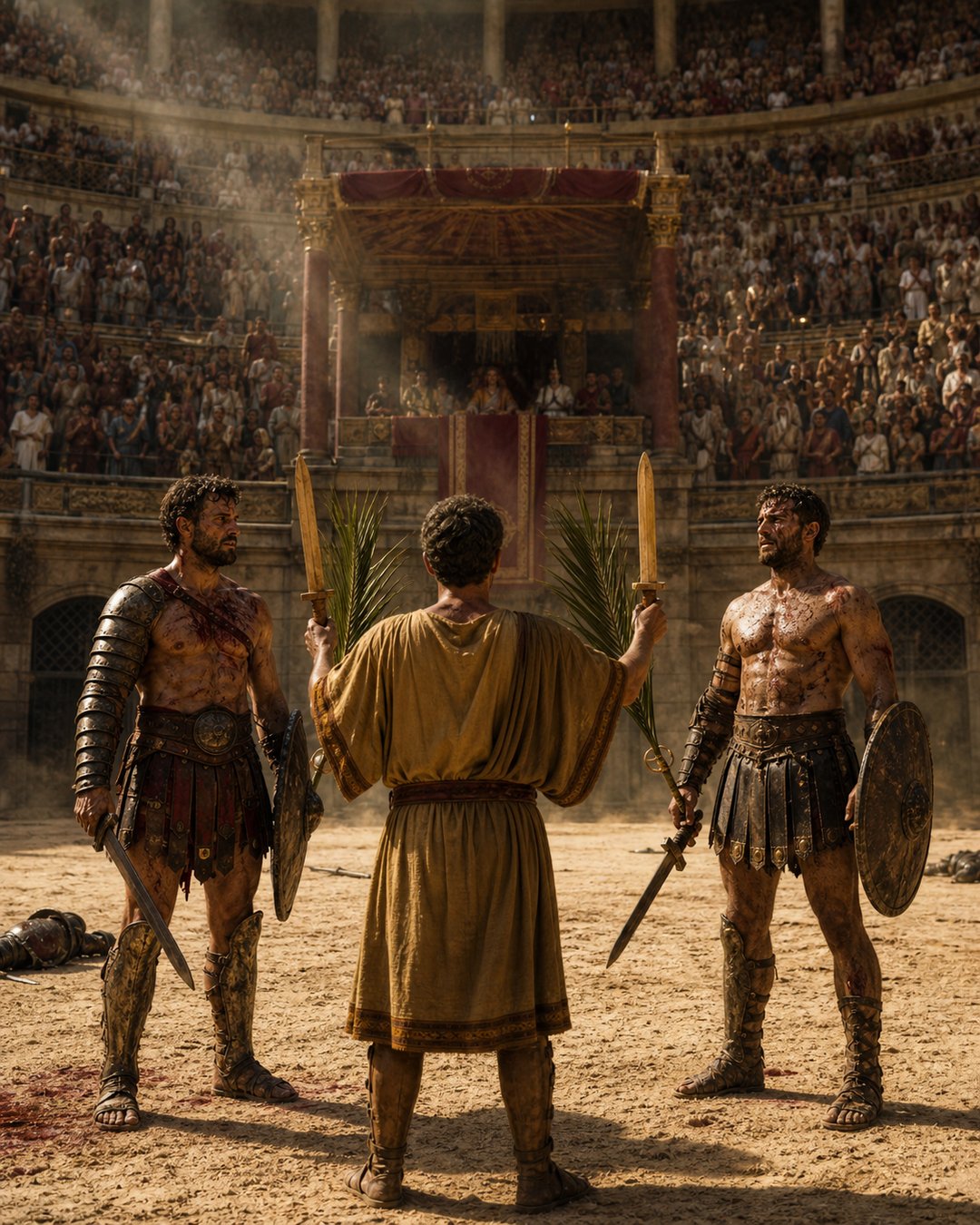
The crowd had already chosen an ending. Priscus and Verus had fought for a long time without separating themselves, and the spectators loudly demanded that both be released. The ruler did not immediately give them what they wanted. In Martial’s poem, Caesar remained inside the announced rule: the contest had to continue until a fighter signalled submission.
Then the impossible symmetry held. The men fought equally and yielded equally. Instead of forcing the poem to invent a loser, the emperor sent each gladiator a palm and a wooden sword. One bout produced two victories and, in Martial’s telling, an outcome no earlier prince had allowed.
Almost everything commonly repeated about Priscus and Verus grows from this short epigram. That makes the poem precious and dangerous. It preserves names, pressure from the audience, a rule, gifts, surrender and release—but not full lives. Its real subject is the conversion of a stalemate into a spectacle of imperial judgment.
Equality Became the Bout’s Central Problem
Martial begins not with the fighters entering but with the contest already prolonged. Verus and Priscus continue, and the courage of each remains equal for a long time. Duration matters because a quick exchange would not establish the pattern. The poem asks its audience to watch equivalence persist until ordinary victory becomes difficult to produce.
The fighters are named, but their equipment is not. Martial does not identify one as a retiarius, murmillo or another class in this poem. Modern images that assign exact armour may be plausible reconstructions, yet they are not details supplied by the surviving text. The secure drama lies in matching performance rather than costume.
This distinguishes the episode from the equipment logic of the shieldless net fighter. There, asymmetry creates the contest: reach and mobility answer armour and shield. Here, Martial withholds technical differences so that neither man’s advantage interrupts his governing word—equal.
The spectators recognised the impasse. They repeatedly demanded discharge for both combatants with a great uproar. Their request shows an audience trying to shape the decision, not merely absorbing violence in silence. Yet noise alone did not end the bout. The poem inserts a rule between popular desire and imperial response.
The Emperor Performed Obedience to His Own Rule
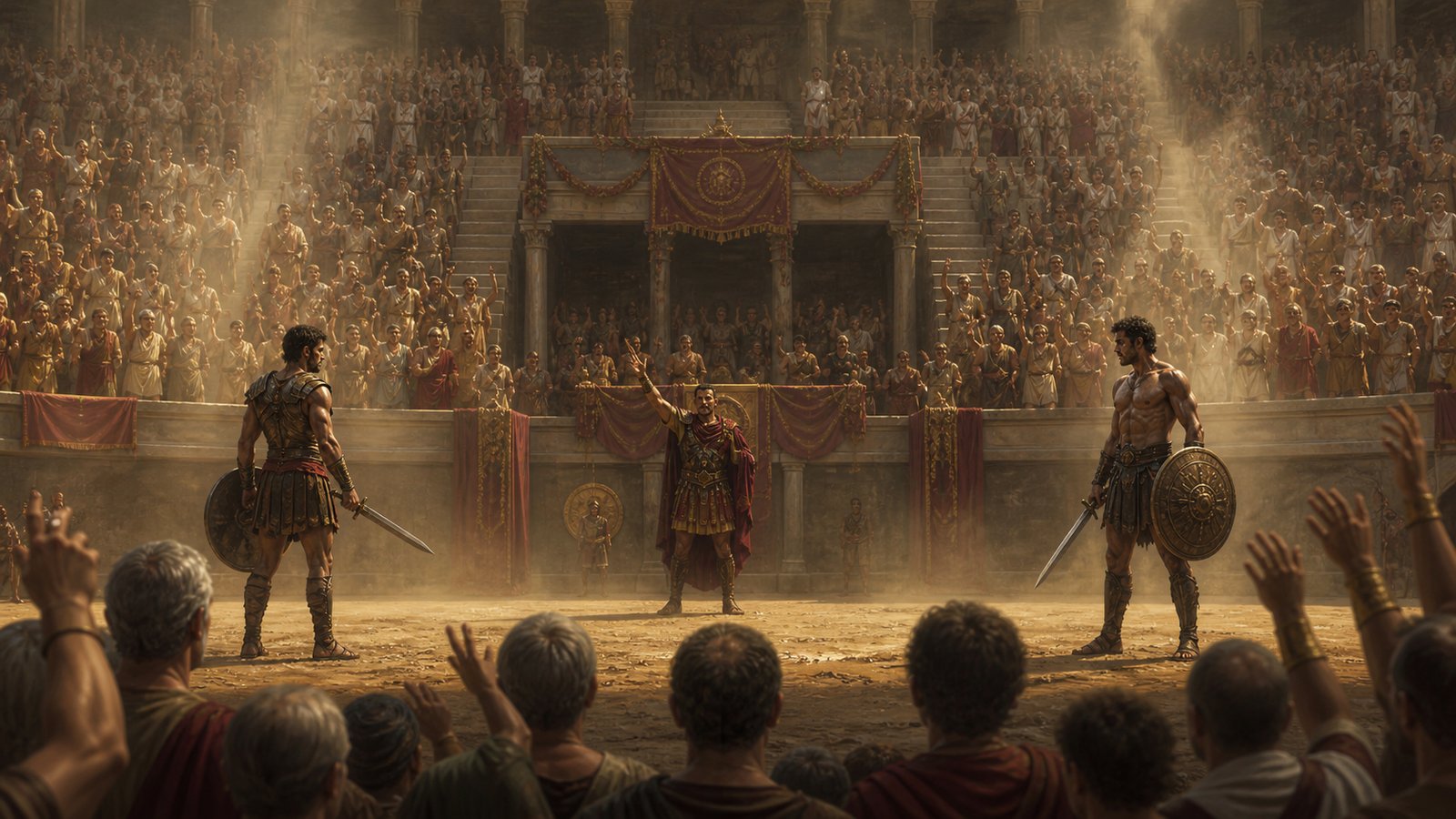
Martial says Caesar obeyed his own law. The rule required a contest, once begun, to proceed toward the stated reward until one fighter indicated defeat with a finger. The Latin phrase is often discussed as ad digitum. The old translation’s note acknowledges debate about the exact expression while taking it as a submission signal.
The formulation flatters the ruler in a precise way. He possesses the authority to make an exception, but first appears constrained by the conditions he announced. Imperial power is presented as strongest when it can display self-restraint. The crowd asks; Caesar waits; the rule continues to govern the arena.
During the prolonged fight, he repeatedly gave dishes and gifts, an action Martial explicitly says was permitted. One translation explains the dishes as food distributed to sustain combatants and spectators, although that explanatory note should not be mistaken for a new line of the poem. At minimum, the text makes generosity accompany delay.
The emperor’s role therefore has two faces. He refuses the premature ending sought by the crowd, yet he punctuates the continued contest with rewards. Discipline and largesse are staged together. The bout is not outside politics; it is a compact demonstration of how the prince wishes his rule to be seen.
Both Men Found the Same Gesture at the Same Time
At last, Martial says, an end was found for the well-matched contest. The phrasing avoids describing a decisive wound or technical breakthrough. Priscus and Verus fought equally and resigned equally. The repetition turns simultaneity into the only solution that does not betray the poem’s long preparation.
Surrender was normally supposed to separate victor from defeated. In this case it failed to do so because both arrived together. The announced condition had been met—submission occurred—but it had not supplied a single loser. The rule produced a result it was not designed to rank.
This is the crucial turn. The emperor does not ignore the rule that he had just honoured. He interprets an unprecedented equal submission as grounds for an unprecedented equal award. Discretion enters after procedure rather than replacing it at the beginning.
The scene belongs beside the broader argument in why gladiators carried meanings beyond entertainment. Skill, endurance, submission, mercy and status were legible to an audience at once. Martial compresses those meanings until the decision about two bodies becomes praise of one ruler.
Palm and Rudis Changed the Meaning of the Stalemate
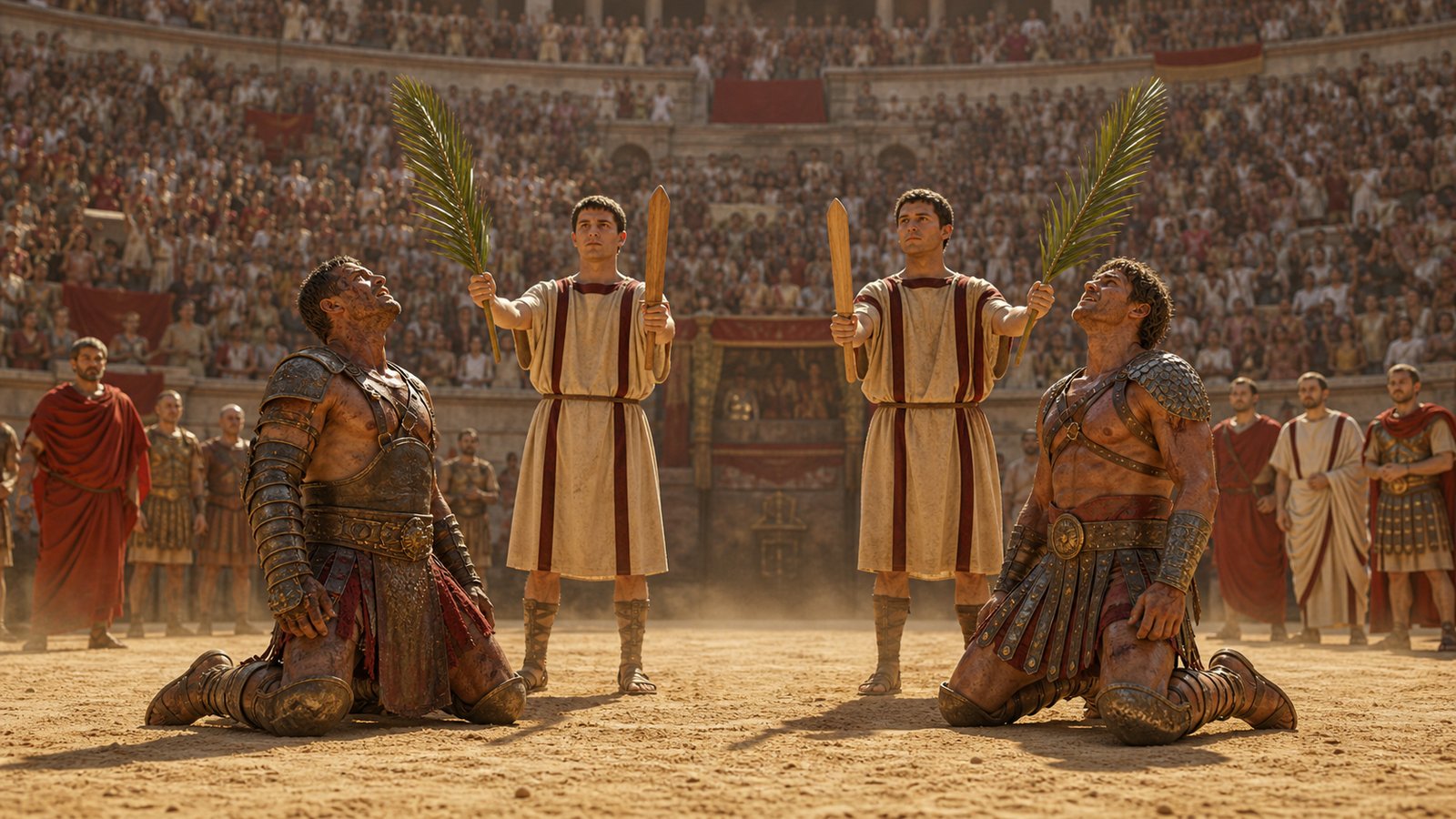
Caesar sent a palm to each fighter. The palm marked victory; giving two refused to treat equality as failure. Martial also says that each received a rudis, translated in the nineteenth-century edition as a wand or wooden sword and explained as the sign of release from further gladiatorial service.
The pair of objects completed different parts of the decision. The palms answered who had won: both. The wooden swords answered what happened next: both were released. A draw could have left status unresolved, but matched symbols converted it into a double honour.
Martial praises the result as the reward received by ingenious or skilful courage. His language protects the fighters from appearing merely indecisive. They had not failed to defeat one another through weakness; their equal virtus had created a problem worthy of an exceptional prize.
We should still resist writing biographies that the objects cannot support. The poem does not tell us where either man was born, how many earlier bouts he fought, which school trained him or what he did after release. The wooden swords close the literary scene. Anything beyond that requires evidence this epigram does not provide.
Martial Gave the Last Victory to Caesar
The final couplet reveals the poem’s destination. Martial claims that under no other prince had it happened that two men fought and both became victors. Whether or not every earlier arena outcome was available for checking, the claim functions as court poetry: exception proves the emperor’s uniqueness.
The names Priscus and Verus survive because the poet needed two balanced human figures. Their endurance makes the praise persuasive. Crowd pressure establishes that the desired mercy was public. The rule establishes order. The equal surrender creates a puzzle. The double award lets Caesar solve it magnificently.
The surrounding collection celebrates imperial spectacles with mythological scenes, animals, water displays and the amphitheatre itself. Within that architecture of praise, the duel supplies a human mechanism. No collapsing scenery is needed. Timing, noise, a finger, two palms and two wooden swords are enough to produce wonder.
That literary setting does not make the event worthless as evidence. It tells us how Martial wanted the bout remembered and which details could carry meaning for his audience. The repeated terms themselves are evidence: long duration, equal courage, public clamour, an announced condition, simultaneous surrender and paired awards had to form an intelligible sequence for Martial’s readers. What remains uncertain is everything the poem chooses not to hold—armour, wounds, earlier records and later lives. That changes the question. We cannot watch an unedited record of Priscus and Verus; we can watch a poet arrange equality into imperial theatre. The men both win inside the poem. Caesar receives its final applause.