
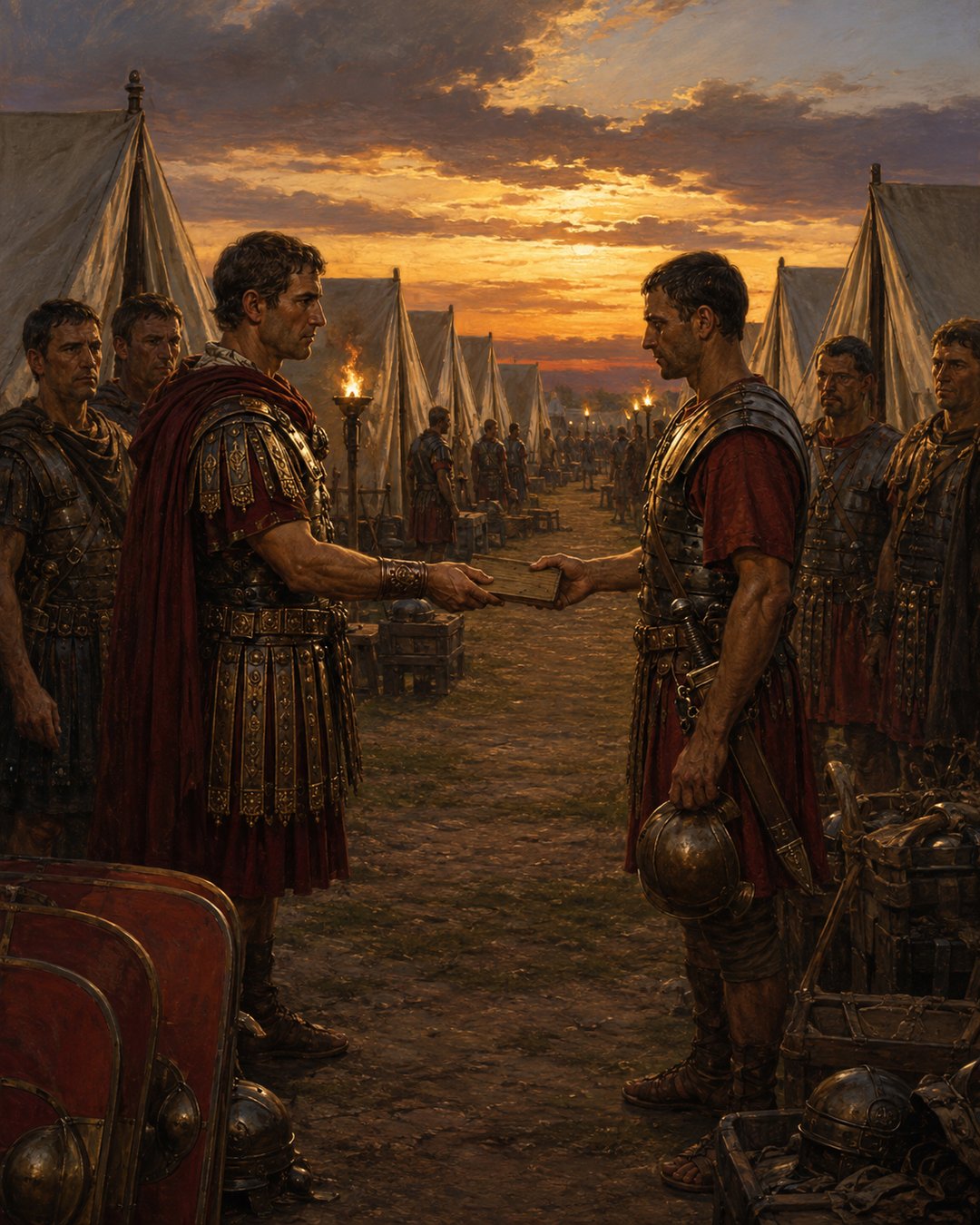
At sunset, a soldier reported to a tribune and received the Roman camp’s watchword. Polybius pauses to explain that the word was not entrusted to memory alone. It was inscribed on a small wooden tablet.
The man carried that tablet back to the tenth maniple at the lower end of a camp street. A commander passed it onward before witnesses. The next commander repeated the handoff, and the object advanced through the maniples until it reached the units nearest the tribune.
Before darkness, the tablet had to return to the tent where its journey began. If every issued piece came back, the tribune knew the word had travelled through the whole chain. If one did not, its marks showed where transmission had stopped.
The password mattered, but the circuit mattered more. Roman security turned an invisible message into a moving object whose route, timing and custody could be checked.
Sunset Started a Closed Chain of Custody
Polybius places the procedure inside the ordered geometry of a marching camp. From the tenth maniple of each class of infantry and cavalry, at the lower end of the street, one man was selected. Because carrying the watchword was his duty, he was excused from ordinary guard service.
He reached the tribune at sunset. The timing created a narrow operational window: late enough for the night’s word to be current, early enough for it to cross the formation and return before dark.
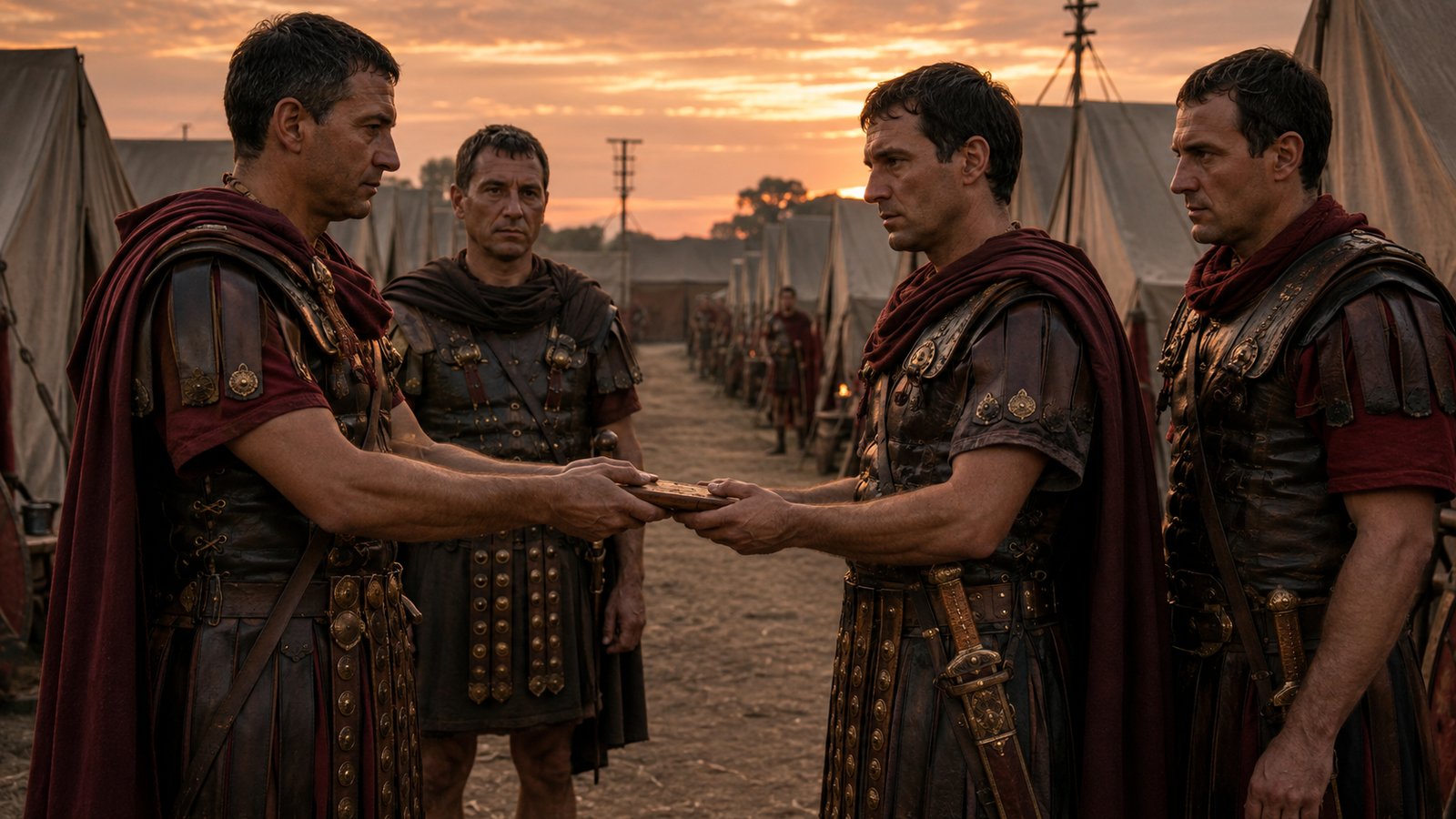
The tablet did not circulate casually among soldiers. It passed between commanders, and every transfer took place before witnesses. That detail protected both message and messenger. A commander could not easily deny receiving it, while a courier could not invent a completed handoff.
The route moved inward from the units farthest down the street to the first maniples near the tribunes. Physical camp order became an accounting order. Everyone knew which neighbour came next, so an expected sequence did not need to be improvised each evening.
Unlike a shouted instruction, the tablet left a recoverable trace. The spoken word might vanish as soon as it was heard. Wood could be counted, marked and returned.
A Return Proved More Than Delivery
A modern reader might expect the tablet to finish with the last recipient. Polybius makes its return essential. The first maniples delivered it back before night closed over the camp.
That completed loop gave the tribune evidence about the entire route. Receipt at the far end would prove only that one object arrived. Return along the prescribed chain showed that every link had participated in order.
Polybius says the tablets carried marks by which a missing return could be assigned to a quarter. The marks need not preserve a diary of conversation. They made otherwise identical pieces distinguishable enough for the officer to start inquiry at the right place.
This was a compact answer to scale. A consul and a few tribunes could not personally tell thousands of men the word. They also could not accept mere assurance that distribution had probably happened. Delegation worked because the object came back.
The logic resembles the repetitive discipline behind the recruit’s work against a six-foot training stake. Neither system depended on one spectacular act. Reliability came from doing a small sequence correctly every time.
Night Patrols Ran a Second Tablet Circuit
The watchword circuit prepared the camp for darkness. A second set of objects checked whether guards remained at their posts once darkness arrived.
The outer face of the camp belonged to the velites. Polybius gives ten men to each entrance. Other pickets protected the consul, tribunes, cavalry, quaestorium, legates and council. A camp was not guarded by one ring but by overlapping responsibilities.
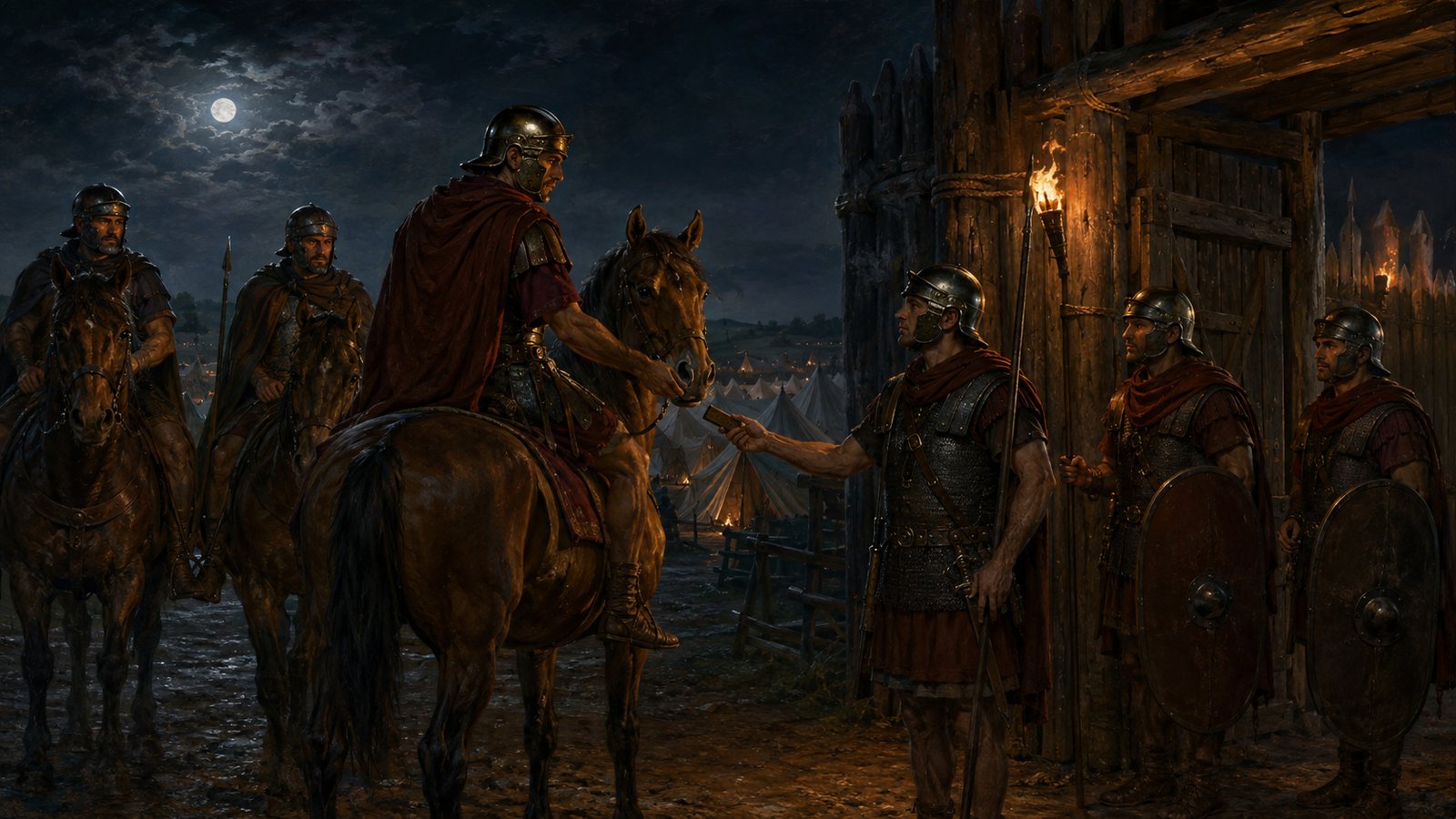
For each station, the tribune issued a very small tablet carrying a sign. Meanwhile four young cavalrymen were selected to inspect the watches. They drew lots, then received written orders telling each inspector which stations to visit and at what time.
A bugle sounded from the first maniple of the triarii when a watch began. The signal synchronized men scattered across gates, rampart and tent streets. The inspector set out with companions, not alone. They would become witnesses if a guard was asleep or absent.
At an alert station, the patrol collected its tessera. The object was proof that the inspector had reached the assigned place and found someone awake to surrender it.
Daybreak Turned Tokens into an Audit
At dawn, each patrol returned the tablets gathered on its circuit. A complete set allowed the men to leave without question. A short set opened an investigation.
The signs identified the missing station. Its centurion brought the picket before the tribune, and the patrol’s companions could testify about what they had seen. Responsibility could move in either direction. A negligent guard might have failed; an inspector might have skipped a post and blamed it.
This is why witnesses appear in both systems. The camp did not treat wooden tokens as magical truth. An object established sequence and location; testimony interpreted the failure.
Polybius continues into severe military punishment, reminding us that this administration had coercive force. The routine should not be romanticized as tidy paperwork. Its precision existed because sleeping, desertion and false reporting could endanger an army and could bring brutal consequences.
The audit also exposed failure quickly. It did not wait for a surprise attack to reveal a sleeping gate. Every sunrise produced a rehearsal of accountability based on the night just completed.
The Camp Made Distance Legible
Roman marching camps were rebuilt again and again, yet their repeated layout let procedures travel with the army. The lower end of a street, the first maniples, the tribunes’ tents and the gates formed recognizable positions even when the ground changed.
That regularity allowed one tablet to stand for a route. A missing return did not say merely that someone had failed somewhere. Combined with marks and sequence, it narrowed a large camp into a particular break.
The system joined central command to local knowledge. The consul issued orders through tribunes, cavalry officers and centurions. The watchword moved through commanders. The inspectors moved through stations. Information went outward, while evidence came back.
Readers can set this administrative movement beside the wooden horses used to standardize mounting practice. One trained bodies to repeat a manoeuvre; the other trained units to repeat a communication route. Both reduced dangerous improvisation before a crisis.
A password can be stolen or overheard. Polybius does not claim otherwise. His interest is in ensuring that the authorized army actually received it and that assigned guards could be checked. Secrecy without distribution would lock out friends; distribution without audit would hide gaps.
By sunrise, the night’s small pieces of wood had done three jobs. They carried access, proved visits and located omissions. The Roman camp’s security rested not on one whispered word but on the disciplined return of objects that should never have gone missing.
The procedure also economized attention. Tribunes did not need to accompany every handoff or patrol every gate. They needed a known starting point, a fixed return time and marked evidence. Exception drew command attention; a complete return allowed ordinary work to continue.
Because the system restarted each evening, an old success could not excuse a new omission. Yesterday’s returned tablet proved yesterday’s circuit only. Sunset created a fresh chain, and dawn closed it. Security was renewed as a sequence of bounded daily accounts.
Sources
Polybius, Histories 6.34–37.