
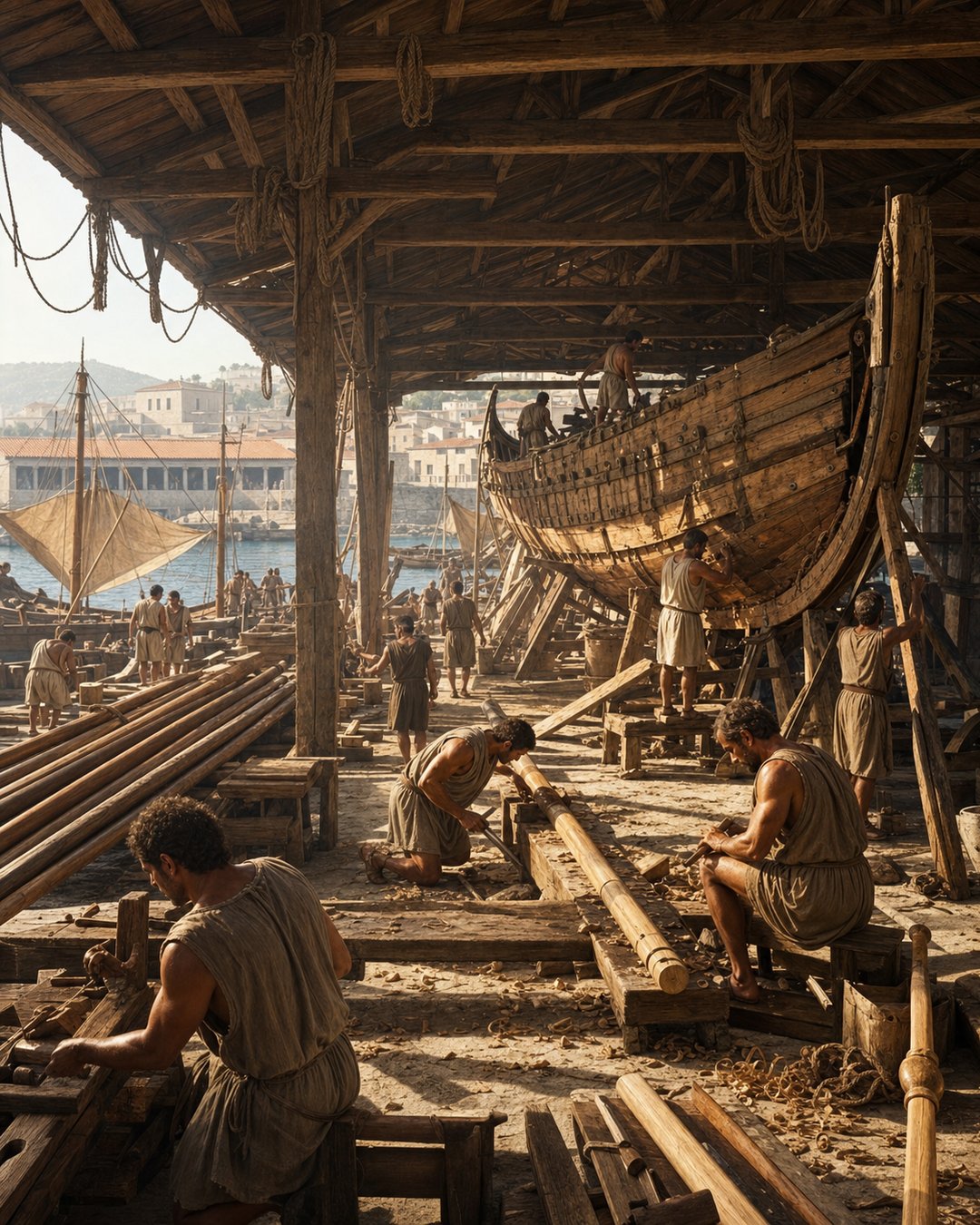
A fleet at sea can look sudden, as if ships simply appear when war or transport demands them. Roman naval power was less magical than that. It needed timber, sheds, rope, carpenters, caulk, records, crews, and space along the water.
Roman navalia made sea power visible because they turned readiness into a place. A ship shed or dockyard allowed people to see the work that had to happen before a vessel could become an instrument of authority.
The ship shed made readiness inspectable
Navalia were ship sheds or docks, and the definition already changes the story. Naval strength did not exist only in open water. It could be stored, sheltered, repaired, counted, and inspected at the edge of a harbor.
A ship under cover told observers that sea power had a body even while still. Hulls, ribs, oars, and rope made future movement visible before a sail was raised.
Maintenance mattered before glory
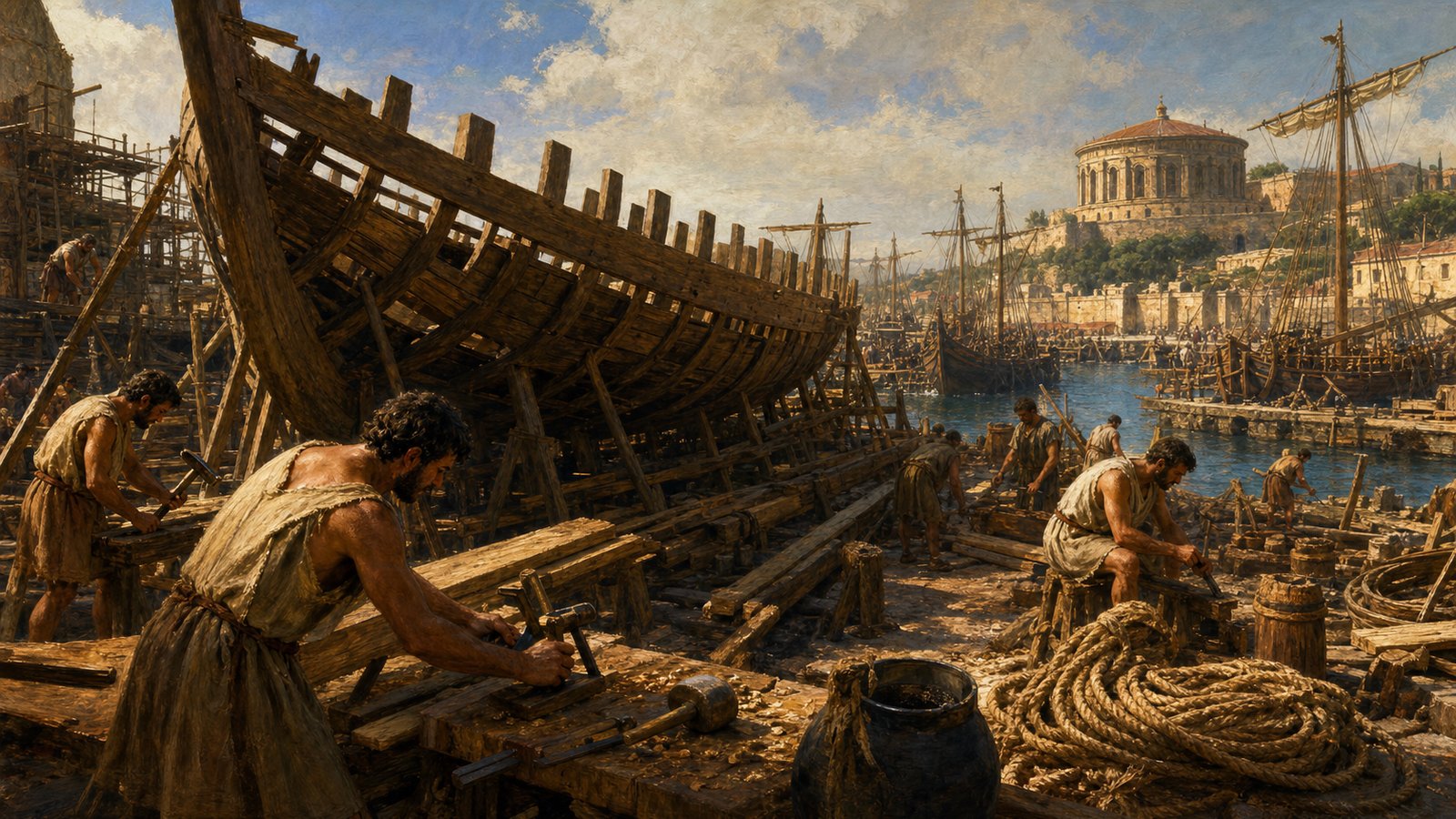
Roman war stories often prefer battles, but ships decay while waiting. Seams open, ropes fray, hulls need attention, and oars must be stored or replaced. A navalia made that unglamorous maintenance part of public power.
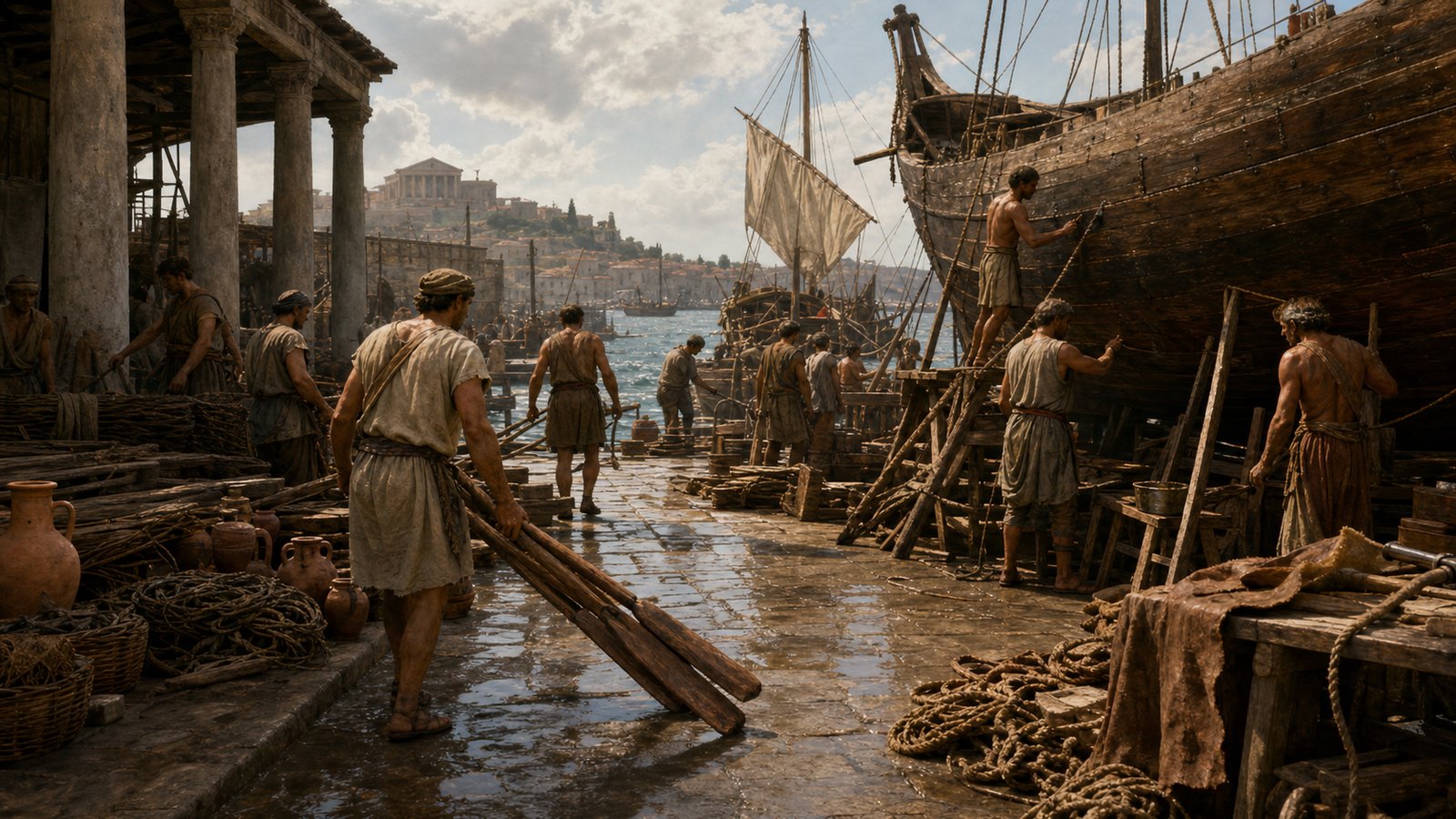
Picture the mini-scene: a carpenter kneeling beside a hull, a sailor dragging oars across wet stone, coils of rope stacked near a pillar, and harbor light flashing under a half-repaired ship. Readiness smells like tar and timber.
The harbor turned materials into authority
A dockyard concentrated goods that otherwise would seem scattered. Timber from one place, rope from another, metal fittings, tools, provisions, and labor all met in one organized edge between land and sea.
This concentration made the sea feel governed. The water beyond remained dangerous, but the navalia announced that Rome could prepare, repair, and send ships from a controlled point.
Records kept the fleet from becoming rumor
Tabulae matter because ships required memory. Crews, repairs, supplies, equipment, and obligations could not be managed only by shouted orders on a quay.
A tablet in a dockyard may look small beside a hull, but it helped make the hull administratively real. Naval power needed written memory as much as muscle.
Sea power became visible when it was not moving
The most revealing thing about a navalia is that it made stillness meaningful. A ship not sailing could still be part of power if it was housed, repaired, and ready.
That changed how people saw a harbor. The dockyard turned waiting into preparation and preparation into a public sign of reach.
A navalia also made cost visible. Ships consumed wood, space, labor, and time long before they carried soldiers or goods. The dockyard showed that command of the sea was expensive even on quiet days.
The physical details carried authority: wet rope, shaved timber, bronze tools, sailcloth folded in shadow, and the scrape of hulls against supports. These were not background texture. They were the materials of maritime order.
Ship sheds also protected memory. A vessel with a place could be counted, assigned, repaired, neglected, or praised. A fleet without places becomes a rumor; a fleet in sheds becomes an inventory.
This is why naval infrastructure belongs with roads and forts. It made movement possible by preparing for it before movement began. The spectacular voyage depended on the ordinary dock.
The dockyard also gathered different workers into one visible system. Sailors, carpenters, rope handlers, supervisors, and scribes could all be part of a ship’s readiness without doing the same job.
Their cooperation showed that sea power was not a single heroic skill. It was a compound of craft, discipline, storage, record, and command. The navalia made that compound readable.
A harbor without maintenance is only a place where ships rot. A navalia made the harbor into an instrument by giving vessels shelter, tools, and repeated attention.
That repeated attention mattered politically. An enemy might fear a fleet that had not yet launched if the infrastructure showed that launch was possible. Readiness can intimidate before action.
For ordinary observers, the dockyard made distant sea routes tangible. The Mediterranean was too large to grasp, but a hull under repair could stand for all the voyages, risks, and commands attached to it.
The ship shed therefore narrowed the scale of empire. Sea power could be seen in one beam, one oar, one caulked seam, one written list of gear.
It also revealed vulnerability. A broken mast, missing crew, or neglected hull could expose weakness as clearly as a ready vessel displayed strength. Infrastructure made both confidence and failure visible.
This double meaning gave the navalia its importance. It was not propaganda in stone only; it was a working test of whether Roman maritime claims could be maintained.
When a fleet finally sailed, the public story moved to waves and battle. But the deeper story began earlier, among sheds, tools, records, and men bent over timber.
Roman navalia made sea power visible by turning readiness into a built environment. They showed that command over water began on land, where people could see the work before the ship disappeared beyond the harbor.
That is the quiet lesson of the ship shed. Power is not only the moment of departure. It is the maintained possibility of departure, stored under a roof beside the sea.
The navalia also made preparation accountable. A commander could claim readiness, but hulls, oars, rigging, and workers gave that claim physical evidence or exposed it as wishful speech.
This was especially important because sea power could disappear from sight once ships sailed. The dockyard was the visible phase of a force that would later vanish over the horizon.
In that sense, the ship shed translated distance into objects. A rope coiled on the quay, a patched seam, or an oar stacked in order all pointed toward voyages not yet made.
The system also depended on time. Timber needed shaping, hulls needed drying or repair, gear needed sorting, and crews needed assignment. A navalia made waiting productive rather than idle.
The public edge of the harbor sharpened the meaning. Anyone passing could see whether the maritime world looked active, neglected, crowded, or prepared. The sea was no longer an empty backdrop.
Workers gave the place its pulse. Carpenters, caulkers, sailors, haulers, and scribes each handled a different part of readiness, but the dockyard made their tasks belong to one visible project.
Naval authority therefore rested on maintenance before command. Orders mattered only if the hull floated, the oar held, the rope did not fail, and the crew could find its gear.
The navalia made this truth difficult to miss. It showed that Roman sea power was built day by day in timber shade, with tools, lists, sweat, and the smell of harbor water.
A ship shed also joined military ambition to ordinary craft. Without the carpenter setting a plank correctly and the sailor finding stored gear, the grand language of command had nothing seaworthy beneath it.
That is why the dockyard could make future action visible. The hull at rest was a promise that movement could resume, provided the repeated work of repair and storage continued.
Sources & Further Reading
- Smith Dictionary, Navalia
- Smith Dictionary, Pons
- Smith Dictionary, Tabulae