
A Record You Could Hold In One Hand
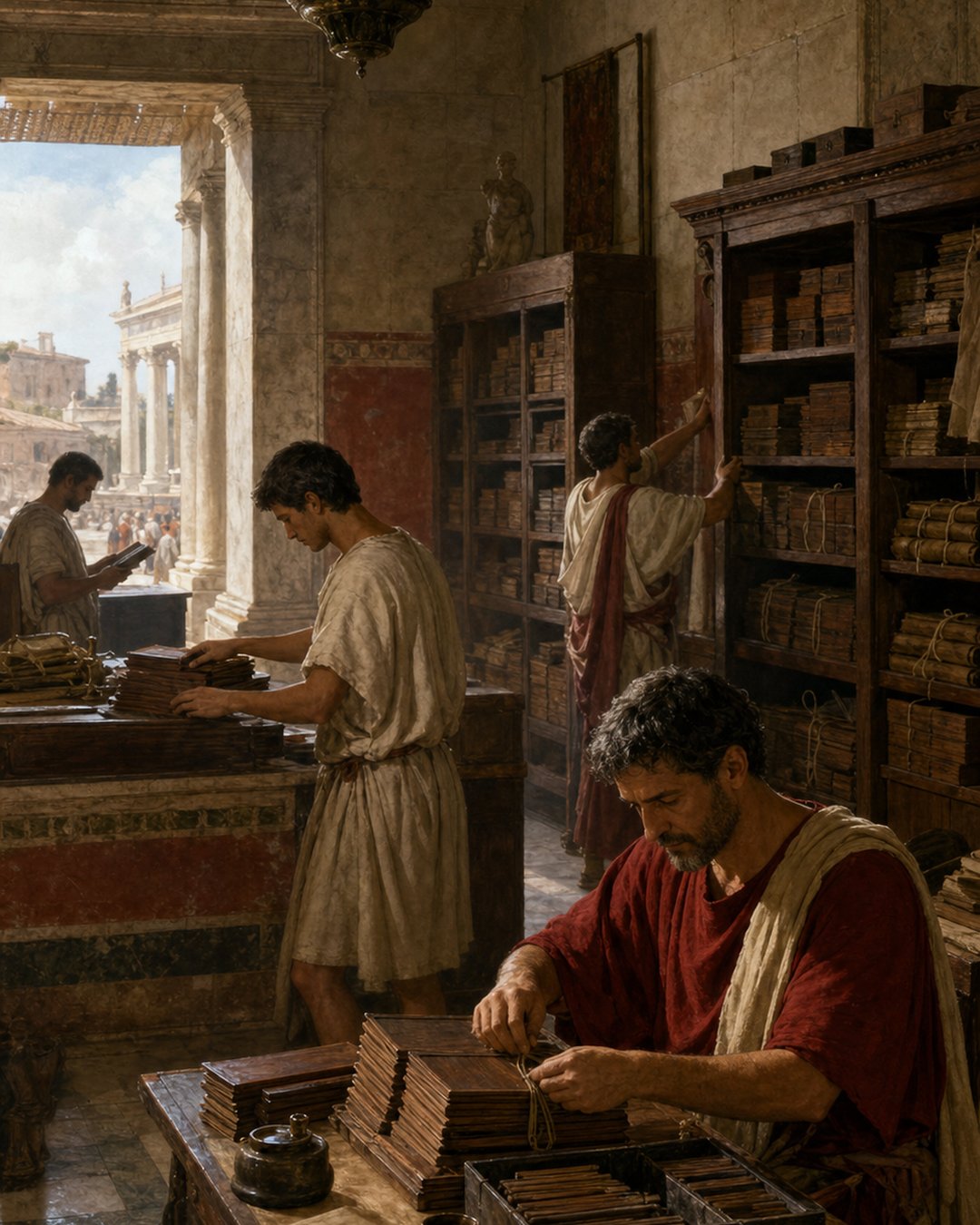
The Roman state did not remember only through marble, bronze, and famous laws carved in public places. A great deal of its everyday memory was smaller, darker, and easier to carry: a wooden tablet with wax inside it, a stylus mark pressed into the surface, a cord around the leaves, and sometimes a seal that warned other hands not to open it casually. That modest object made a claim possible before anyone built a monument. It said that a promise, account, order, list, or message could leave one room and still remain recognizable in another.
That is the useful way to think about tabulae. They were not glamorous, but they solved a problem every large society creates for itself. Speech disappears. Memory bends. A public counter is busy, a magistrate changes, a messenger gets dust on his feet, and a household still needs proof that something was agreed. The tablet gave Roman business a portable surface. It could be carried under an arm, stacked on a shelf, tied closed, opened in front of witnesses, and compared with another tablet later. Rome’s memory became more than recollection; it became an object.
Wax Made Correction Part Of The System
Stone inscriptions look final because they were meant to. Wax tablets worked differently. Their strength was not permanence in the monumental sense, but controlled usefulness. A stylus could cut a line into wax, and the surface could also be smoothed for reuse when the record no longer needed to stand. That made tablets especially good for the traffic of daily administration: figures, names, drafts, notes, private letters, memoranda, and transactions that needed to be real without pretending to be eternal.
This mattered because Roman administration was not a single clean chain from emperor to subject. It was a swarm of smaller encounters. A clerk checked a name. A creditor remembered a sum. A local official received a message. A household kept track of obligations. A soldier or trader needed words that could travel farther than the person who first spoke them. The wax surface gave those encounters a practical middle life between memory and monument. It was serious enough to carry authority, but ordinary enough to be used again tomorrow.
Cords And Seals Turned Notes Into Evidence
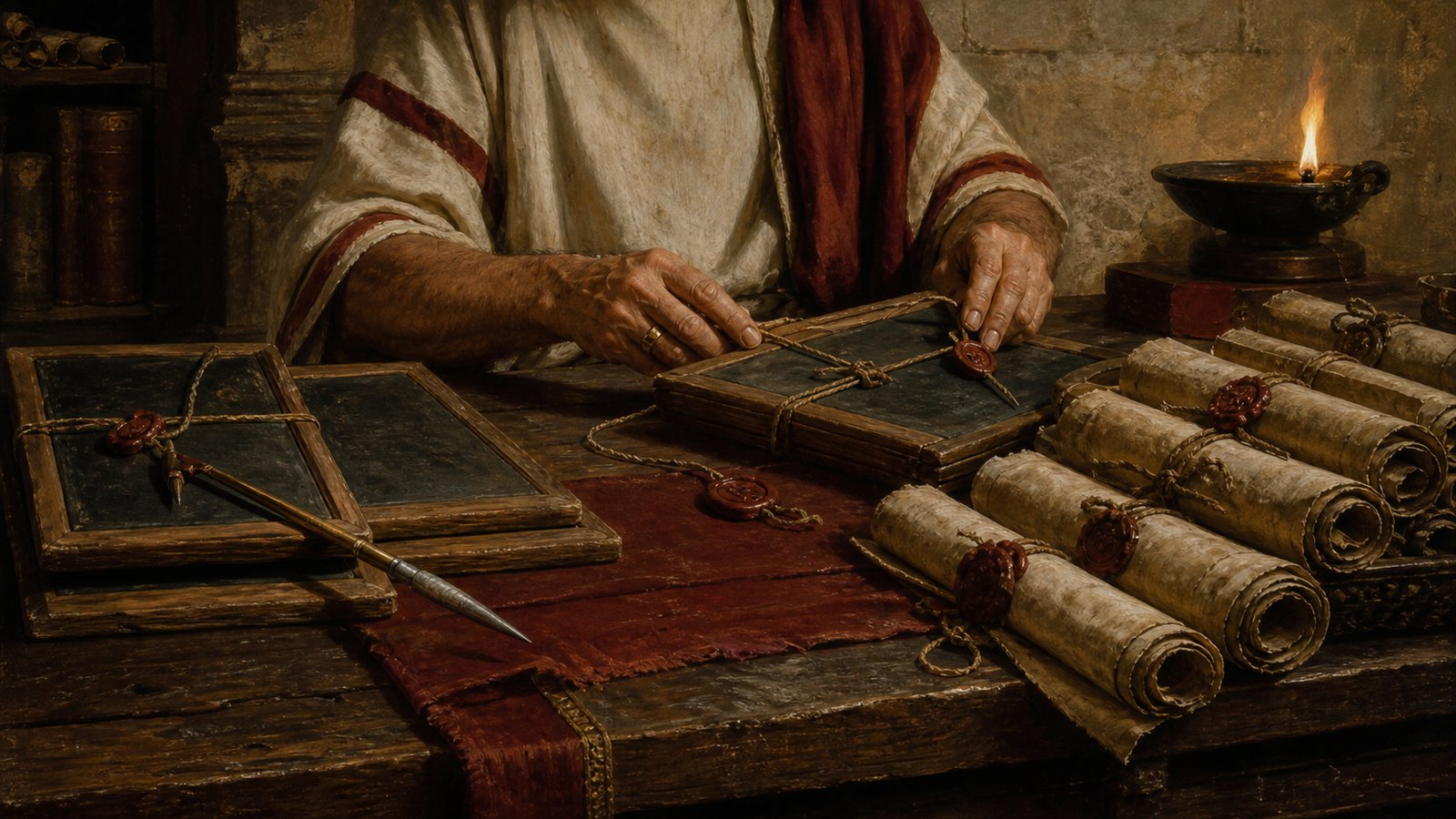
The tablet’s power did not come from writing alone. Its physical behavior mattered. When tablets were closed, tied, and sealed, the record acquired a visible boundary. A sealed packet told the next reader that the words inside had been protected during their journey. The cord, the wax, and the seal did not magically guarantee honesty, but they made interference harder to hide. In a world where many obligations depended on trust, that visible protection was part of the message.
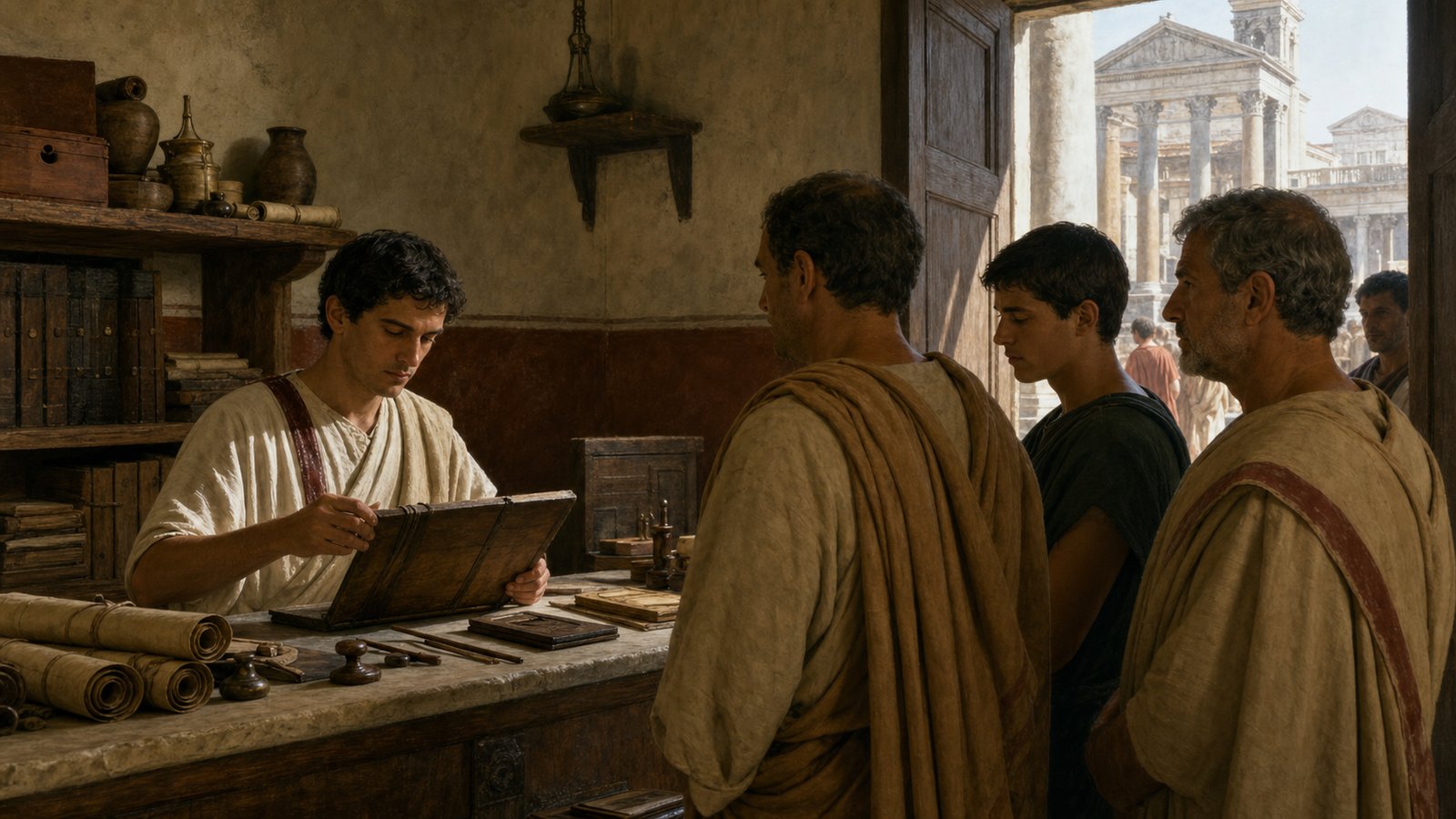
Imagine the scene at a counter near the forum. The important feature is not a dramatic speech. It is the pause while a tablet is brought forward, the cord handled carefully, the surface inspected, and the record read aloud or checked against another note. The object slows the moment down. It gives witnesses something to look at. It turns an assertion into a procedure. That procedure is one reason a small wooden object could matter in public life even when it never appeared on a triumphal arch.
Portable Memory Changed The Shape Of Authority
Authority in Rome often worked by being seen. Lictors, standards, arches, seating plans, inscriptions, and processions made rank visible. Tablets did something quieter but just as important. They made continuity visible. A person did not have to be in the original room to confront the original obligation. The record could move. It could arrive at a house, a shop, an office, a military post, or a storage room with enough physical identity to be taken seriously.
That portability changed the feel of government and business. If a message can travel as an object, then distance loses some of its power to blur responsibility. If an account can be grouped with other accounts, then one transaction can be checked beside another. If a sealed tablet can be produced in front of witnesses, then memory stops being only the strongest person’s version of events. It becomes something with edges, weight, and a place on the table.
The Archive Began Before The Archive
When we picture archives, we often imagine shelves and rooms first. Rome certainly had spaces where records accumulated, but the habit of archiving began earlier than the building. It began each time a tablet was kept instead of discarded, tied with others, placed in a box, or carried to someone who needed to verify it. A storage shelf full of tablets was not simply a pile of old wood. It was a map of unfinished obligations, remembered decisions, and reusable facts.
That makes the tablet a useful corrective to the grandest image of Roman power. Rome was not held together only by legions, roads, aqueducts, and emperors on coins. It also depended on clerks who could find a record, messengers who could deliver one, households that could keep one, and public offices where a tablet could be checked without relying entirely on memory. The state looked massive from a distance, but much of its working memory fit into boxes small enough to move.
Why A Small Object Could Feel Public
The tablet’s public quality came from repetition. One tablet might contain a private note, but the practice taught Romans that important words could be handled, protected, witnessed, stored, and recovered. Over time, that expectation shaped behavior. People who knew records existed had to act as if some later reader might appear. The possibility of a preserved note changed the meaning of a promise before anyone challenged it.
That is why the wax tablet deserves a place beside Rome’s more spectacular public technologies. It did not shout across the city. It did not carry water over arches or push an army down a paved road. It did something more intimate. It made memory portable. It allowed an agreement to leave the mouth, pass through a hand, survive a walk across town, and wait on a shelf until someone needed the past to answer back.
The most Roman part of the object may be its lack of drama. A tablet could sit beside oil lamps, account boxes, and bundled scrolls without demanding attention, yet it quietly changed the room. The person who possessed the record possessed a version of the past that could be produced on command. The person named inside it had to reckon with a memory that was no longer merely human. In that sense, wax did not make Roman life softer or less formal. It made formality small enough to travel.
Seen this way, the tablet links the household to the office and the office to the city. It belongs with the ordinary furniture of authority: the counter, the shelf, the seal, the waiting citizen, the clerk who knows where a bundle should be kept. Rome’s public order was built from those repeated gestures as much as from famous decrees. The tablet mattered because it gave those gestures a durable object, and because thousands of such objects could make a society feel answerable to its own records.
Sources & Further Reading
- Smith Dictionary, Tabulae