
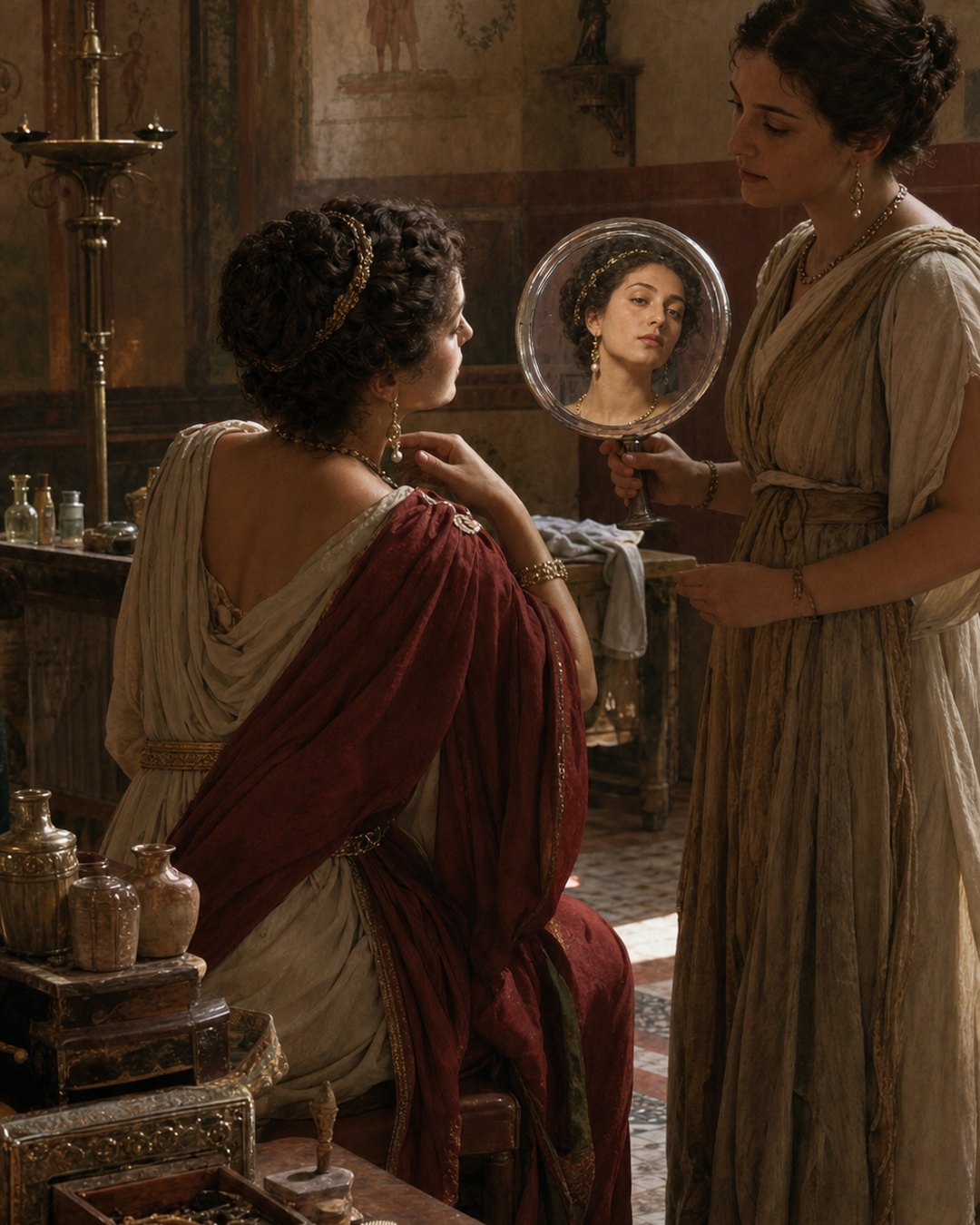
A Roman mirror did not begin with a face. It began with ore, alloy, heat, hammering, abrasion, and the patient removal of every dull patch that broke the reflection. Before anyone could inspect an earring or arrange a fold of cloth, a craftsperson had to persuade metal to behave like an image.
That material fact changes the object. The Latin speculum can tempt us to picture a familiar pane of glass, but the usual ancient looking glass was a polished metal plate. It could be silver or a copper-and-tin alloy, small enough for the hand, round or oval, and dependent on care. Roman reflection was manufactured, portable, and never entirely separate from the labor that kept it bright.
The Reflection Was a Metal Surface
The standard mirror of Greek and Roman antiquity was not transparent glass with a metallic backing. Smith’s Dictionary of Greek and Roman Antiquities describes metal as the normal material: first a composition of tin and copper, and later, increasingly, silver. A basin or cup polished smooth enough could also return an image. The essential technology was therefore a surface capable of taking and holding a fine polish.
Silver carried obvious prestige, but it also had a practical optical role. Vitruvius observed that a thicker plate produced a stronger reflection. That detail anchors the mirror in weight and workmanship. A thin wash of brilliance could look luxurious, yet the quality of what appeared in it depended on how much carefully prepared metal lay beneath the shine.
Ancient writers occasionally mention gold, obsidian, emerald, and other reflective stones. Those exceptional materials attracted stories because they were exceptional. The ordinary history is more physical: alloy selection, casting, shaping, smoothing, and polishing. A Roman face emerged from a worked surface, not from a magically clear window.
Brundisium Sold a Difficult Kind of Brightness
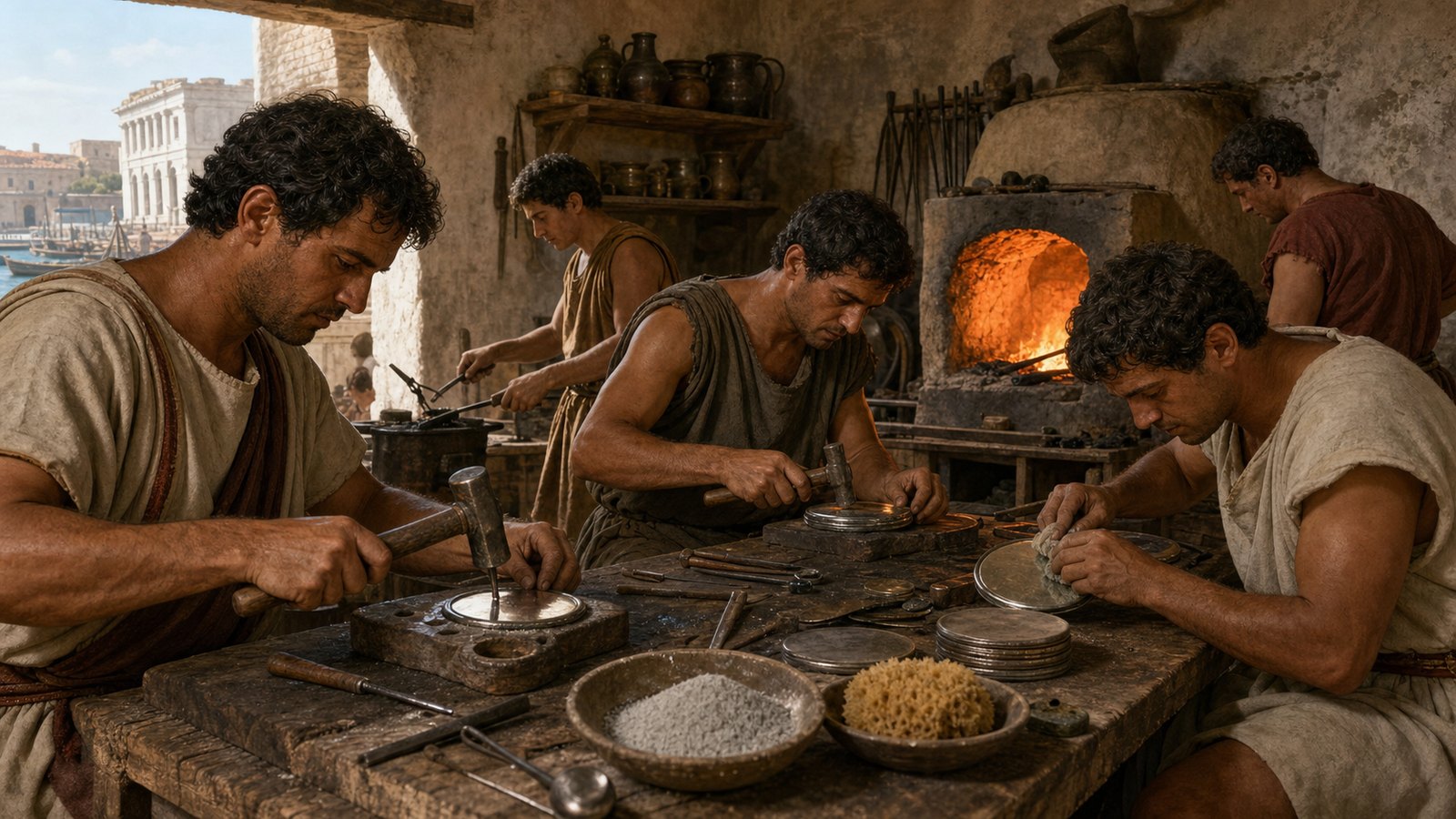
Pliny credited Brundisium with the best mirrors made from copper and tin. The Adriatic port is usually remembered as the end of the Appian Way and a gateway toward Greece, yet this notice gives it another identity: a place associated with a demanding polished product. A workshop had to make a pale alloy, form a useful plate, and finish it without leaving a warped or cloudy field.
The alloy’s weakness created continuing work. Smith notes that copper-and-tin mirrors soon became dim unless carefully preserved. They could not simply be purchased, placed in a room, and forgotten. Before use, a neglected surface needed cleaning and polishing again. Brightness was an achievement with an expiration date.
The maintenance kit could travel with the object. A sponge and powdered pumice was commonly fastened to ancient mirrors. Pumice supplied the abrasive; the sponge helped carry it across the plate. The pairing makes the mirror feel less like passive decoration and more like a small instrument whose performance depended on repeated attention.
A Silver Mirror Could Still Become Ordinary
Pliny placed the invention of silver mirrors in the time of Pompey the Great, but the dictionary points out that Plautus had already mentioned them much earlier. The contradiction is useful. Roman authors often attached an invention to a famous name even when surviving literature showed that the thing had a longer history. The mirror’s chronology is less tidy than a single inventor story.
By the imperial period, silver mirrors had spread far enough for Pliny to complain that even maidservants used them. The remark is socially loaded, but that is exactly why it matters. An object could remain valuable enough to appear in discussions of silver plate while becoming familiar enough to trigger elite irritation when people of lower status possessed it.
The Digest repeatedly mentions mirrors in legal passages about silver goods. A reflective surface could therefore be beauty equipment, crafted property, household wealth, and an item that lawyers had to classify. As with Roman signet rings, a small personal object could carry material value far beyond its size.
Most Mirrors Moved with the Person Using Them
Museum survivors are commonly small, round or oval, and fitted with a handle. Their scale shaped the act of looking. Instead of confronting a permanent wall of reflection, a user raised an object, tilted it toward the light, and searched a limited field. The hand determined the angle, while the polished plate determined how much detail returned.
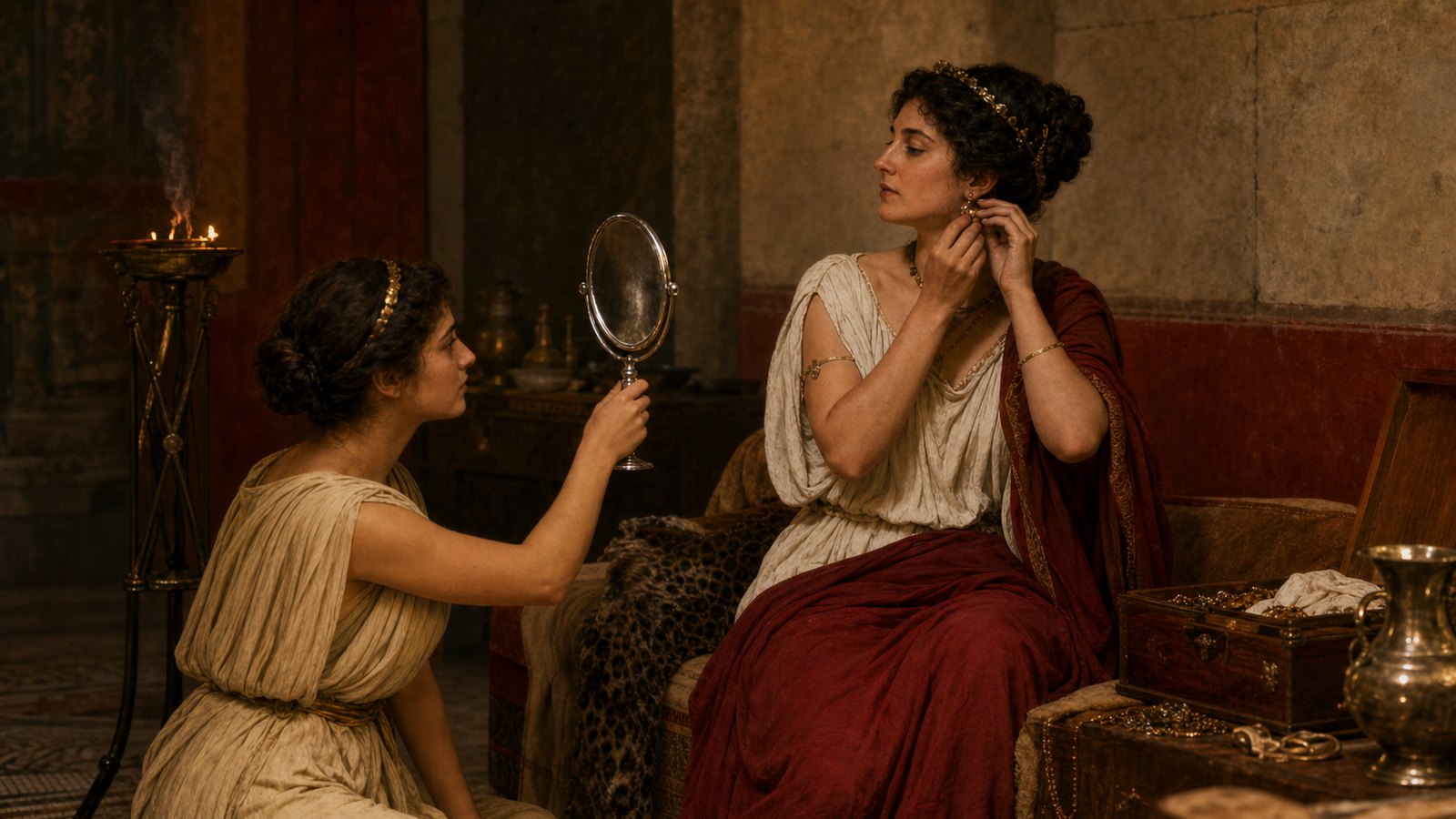
The mirror could also place two people into one grooming scene. Propertius describes female attendants holding mirrors before their mistresses, and vase images preserve the same arrangement. Ovid imagines a lover admitted to the toilet and performing the service himself. Reflection was personal, but producing the useful view could be social labor.
Picture the short sequence. An attendant lifts a handled disc beside an oil lamp. The mistress turns her head, checks a pin, and asks for a different angle. The metal catches the brighter edge of the room while the attendant’s wrist holds it steady. No modern glass offers a large, effortless image; posture, light, polish, and another person’s hand all have to cooperate.
A Clear Face Revealed an Invisible Chain of Work
Romans did know glass mirrors backed with metal, and Pliny associated their manufacture with the glasshouses of Sidon. Yet they remained inferior enough that they did not replace metal mirrors or enter literary descriptions of costly furniture in the same way. The technology existed without becoming the ordinary solution.
Large mirrors existed too. Seneca referred to examples equal to the length of a whole body, and legal or architectural texts mention mirrors fixed to walls. Their rarity makes the handheld pattern more revealing. Most encounters with a reflection were movable and bounded, part of dressing rather than a permanent expansion of the room.
The polished face of a mirror concealed a supply chain. Miners and merchants provided metal. Founders controlled heat and alloy. Metalworkers shaped and finished the plate. Traders moved products from places such as Brundisium. Household attendants managed the object in use, and pumice restored the surface when air and handling stole its shine.
The difference between a dim plate and a useful one was visible immediately, but the standard of success was unforgiving. A cup only needed to hold liquid; a mirror had to return recognizable features across its surface. Scratches, uneven hammering, tarnish, and careless cleaning interrupted the image. This made finish quality something a buyer could judge without understanding the workshop. The face itself became the test of the maker’s control.
Maintenance also changed ownership into a routine rather than a single purchase. A silver mirror might advertise expense, while a Brundisian alloy mirror advertised access to skilled manufacture, yet neither stayed bright by status alone. Someone still had to fetch the pumice, dampen the sponge, rub the plate, inspect it in the light, and decide whether another pass was needed. Household luxury depended on repeated, often low-status work. The clearer the image looked at the dressing table, the easier it was to overlook every hand that had preserved that clarity.
The result could look intimate: one person examining one face. But the image depended on many people who were absent from it. A mirror showed the owner while hiding the craftsperson, porter, merchant, and attendant who made the moment possible. Its most Roman quality was not vanity alone. It was the compression of specialized labor, status, maintenance, and service into a disc small enough to hold in one hand.
Sources & Further Reading
- Smith Dictionary, Speculum