
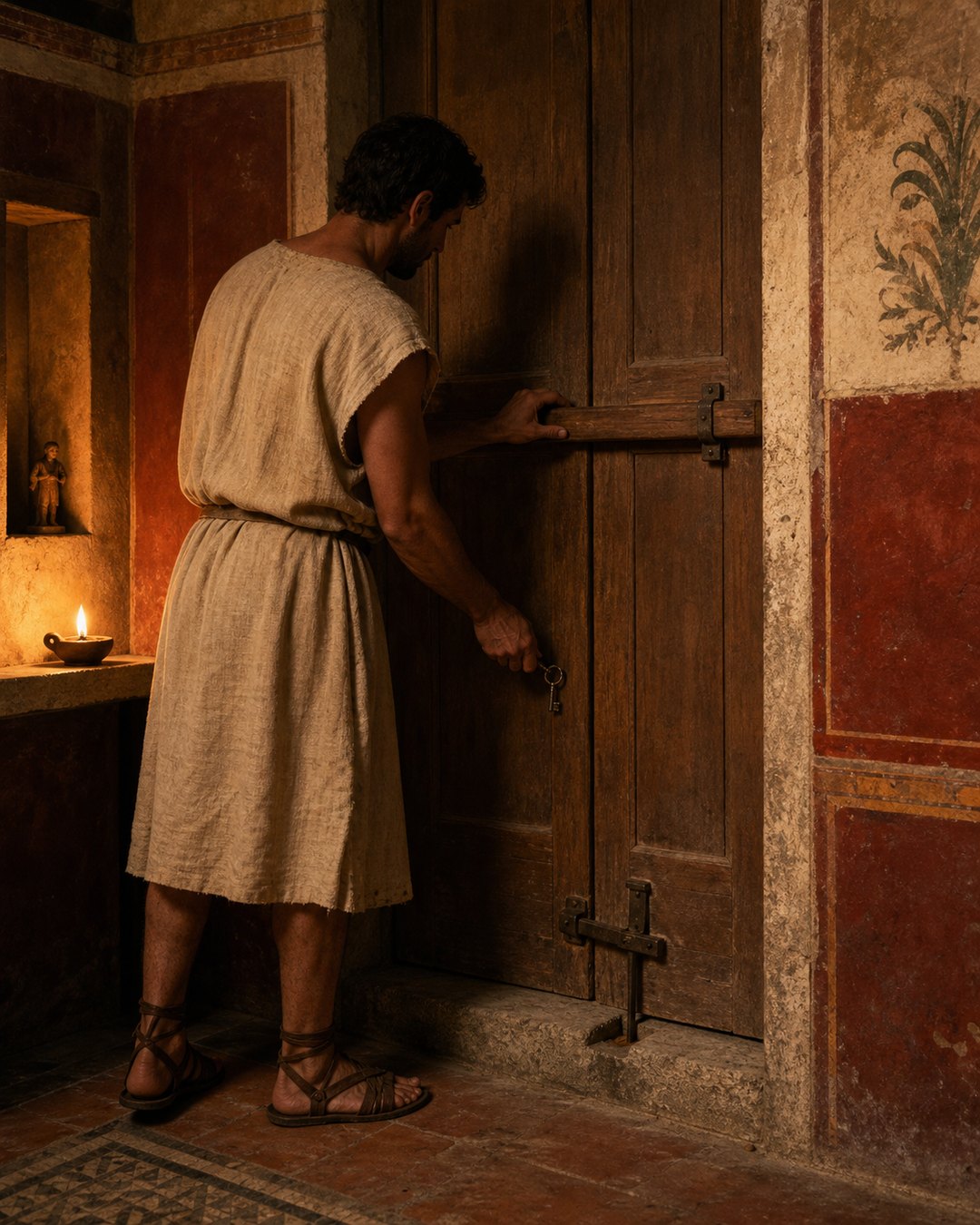
A Roman lock began below eye level. On surviving Pompeian thresholds, two holes mark where the fastenings of a double door entered the stone. Each leaf had its own bolt. Before a key became the object carried on a ring, security was a matter of wood, iron, leverage, and a socket worn into the sill.
That physical sequence changes how a Roman doorway looks. The entrance was not merely a decorated frame between street and atrium. It was a small machine for controlling movement. Bolts held each leaf, a crossbar strengthened the closure at night, rings pulled the wood shut, and eventually a key let someone work the mechanism from outside. The history of the lock is therefore also a history of who could make a boundary move.
The Threshold Was Already More Than a Strip of Stone
Romans distinguished the main street entrance, the janua, from doors inside the house, which could be called ostia. A substantial house commonly had another opening at the rear, the posticum or posticula, sometimes leading toward a garden. The vocabulary divided a building into different approaches before anyone considered the hardware. Front, back, and interior doors did not carry identical expectations.
The complete doorway joined four indispensable pieces: the sill below, the lintel above, and a jamb on either side. The threshold itself attracted religious caution. Vitruvius records the concern with approaching it on the right foot; temple steps could be arranged in an odd number so that a worshipper who began with the right foot placed that same foot on the threshold. A person crossed a physical line and a meaningful one at the same instant.
This makes a bolt entering the sill especially revealing. The threshold did not only separate surfaces. It received the mechanism that converted two moving leaves into a closed wall. The holes still visible at Pompeii are modest archaeological details, but they preserve repeated actions: lower the iron, feel for the socket, test the leaf, and move to the second fastening. Security was built into the point people were careful to cross.
Two Door Leaves Needed Two Decisions
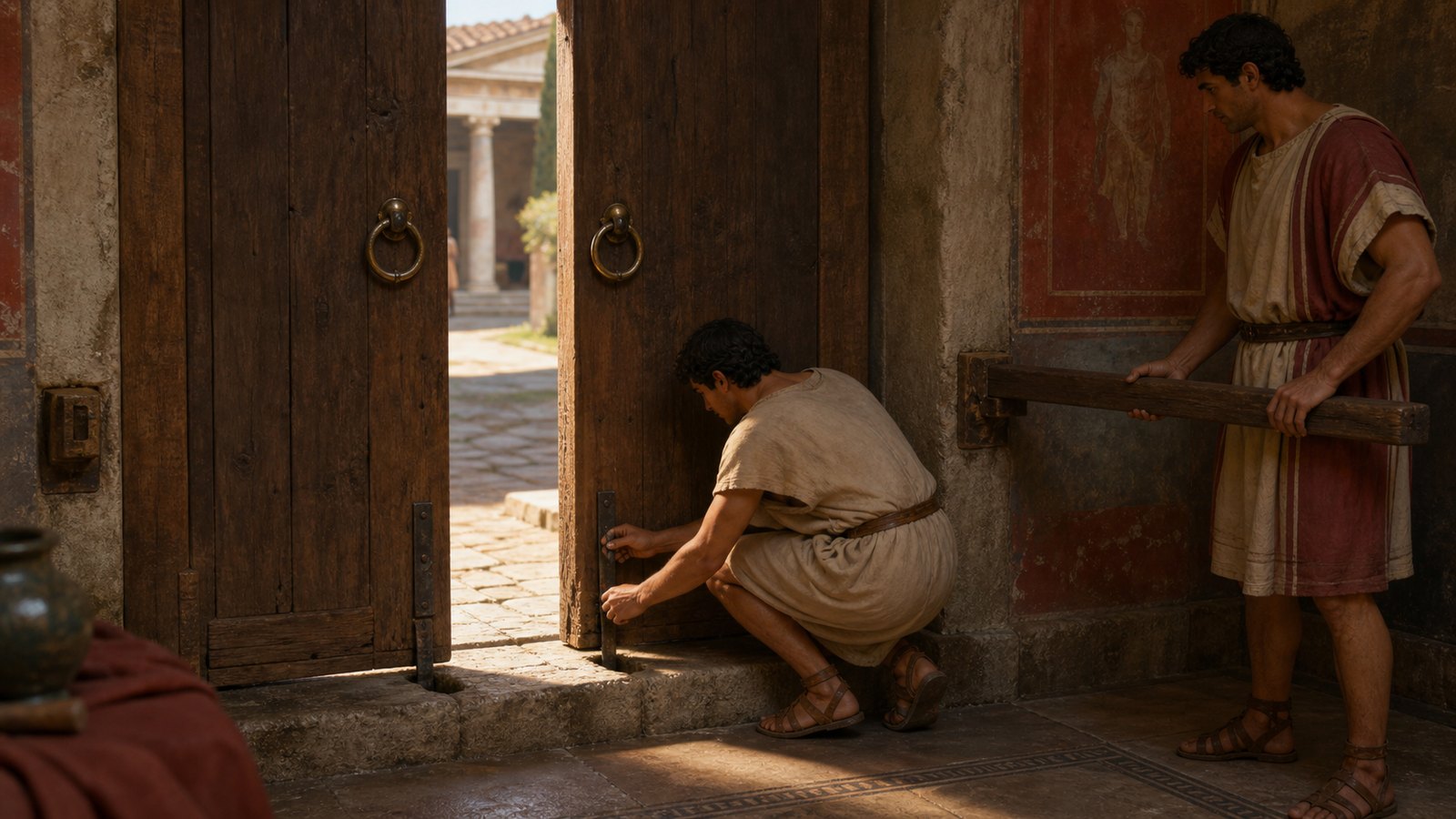
Important Greek and Roman doorways usually held two folding leaves. Ancient comedy repeatedly uses the sound of a single leaf creaking open, and each leaf was broad enough to admit a person without requiring the whole entrance to be exposed. The arrangement gave a household choices. One side could open for ordinary passage; both could open when width, ceremony, or traffic demanded it.
The leaves usually opened inward. Vitruvian terminology places them behind the jambs, and the same construction survives at Pompeii and other ancient sites. Rome remembered one striking exception: M. Valerius Publicola was honored with the privilege of doors that opened outward. The exception works because the normal direction was recognizable. Even the swing of a front door could become a civic distinction.
At the bottom of each leaf sat a bolt, or pessulus, which could be pushed into a matching socket in the sill. Pompeian thresholds preserve paired holes, and literary sources speak naturally of the bolts in the plural. Closing a double entrance was not one gesture. It was a sequence performed twice, one fastening for each independent piece of wood.
Night Added a Bar Across the Whole Entrance
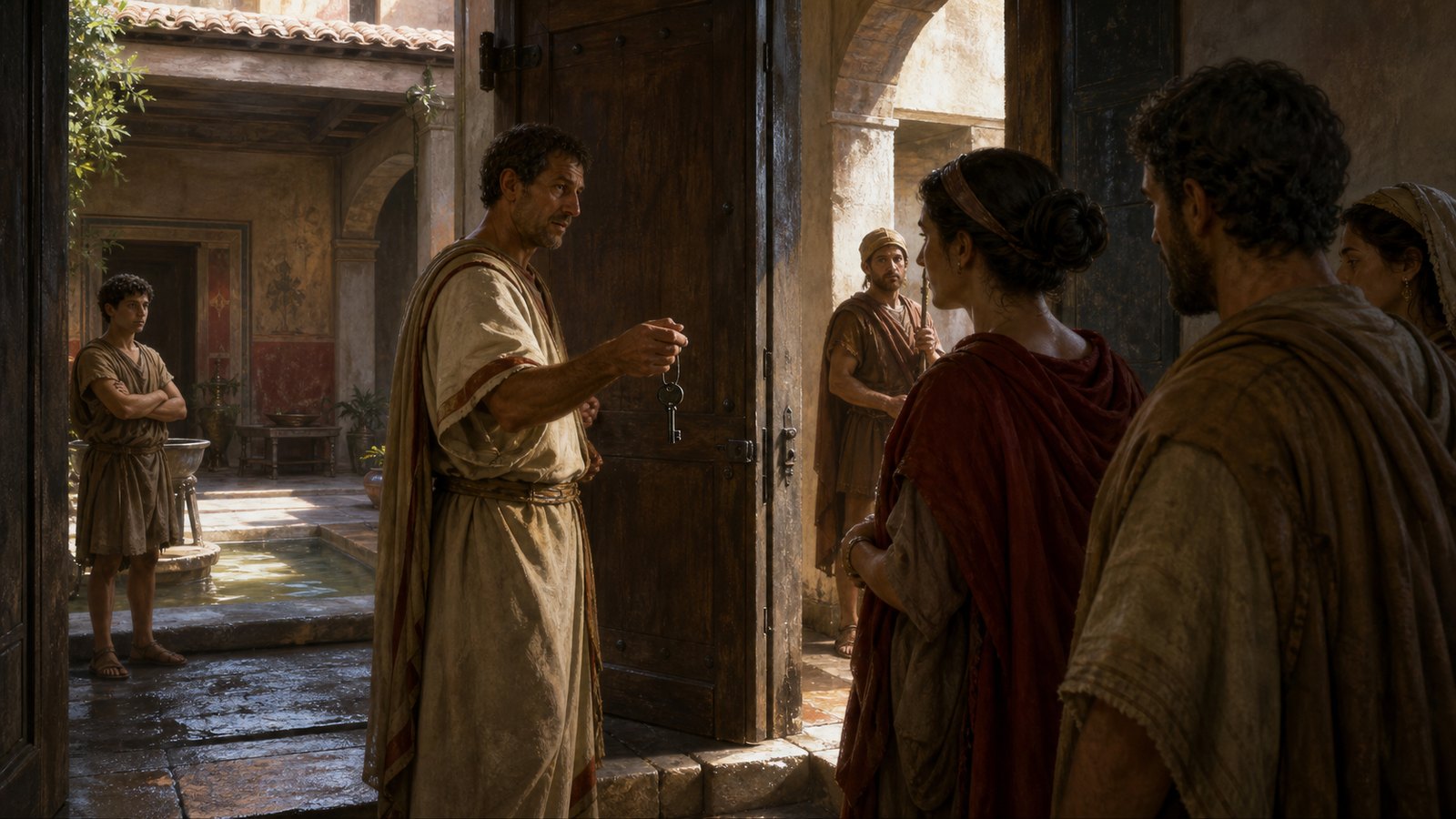
Floor bolts fixed the separate leaves. After dark, the front door could receive another defense: a wooden or iron bar laid across the full opening and inserted into sockets at the sides. Latin terminology distinguished fastening with the bolt from securing with the bar. The words followed the mechanism because the actions were materially different.
A crossbar solved a problem that two lower bolts did not. It made the doorway resist as a single unit rather than as neighboring leaves. Its strength came from the surrounding wall and jambs, which received force through the side sockets. The entrance became a system: timber or metal across the opening, bolts into stone below, and hinges or pivots carrying the leaves behind the frame.
This extra layer was not confined to the street. Sources describe chamber doors barred as well as bolted. The point is not that every Roman slept behind identical hardware. It is that ancient writers could imagine security as cumulative. A door might be shut, bolted, and then barred, each verb naming another physical obstacle between one space and the next.
A Leather Thong Was an Early Answer to the Outside
A bar is strongest when someone remains inside to move it. The harder problem was allowing an authorized person outside to operate a fastening without simply weakening the door. The Odyssey preserves an early solution: a leather thong passed through a hole and connected to a loop, ring, or hook that could catch and move the bolt.
The device sounds simple because its parts are simple. Yet it changes the logic of the entrance. The fastening no longer answers only to a hand on the protected side. A small tool can transmit that hand’s intention through the door. The ring or hook in this arrangement became an ancestor of the key, while the bolt developed into a more elaborate lock.
That lineage matters more than treating the Roman key as a miniature modern object. The key belonged to a mechanical family that began with pulling, lifting, or sliding a barrier. Its teeth and shape mattered because they engaged hidden parts. Its portability mattered because it let the ability to open the boundary leave the building and return with a person.
Pompeii Preserved Keys Small Enough to Wear
Keys recovered at Herculaneum and Pompeii show how far Greek and Roman locksmithing advanced beyond the thong-and-hook solution. Some were attached to finger rings. The combination compressed access into an object that could remain on the body, harder to misplace than a loose tool and immediately available to the wearer.
A ring key did not need to resemble the long ceremonial keys seen in later art. Its significance was practical. Metal had to match a particular mechanism closely enough to release it. The same society that made authority portable in a signet ring could also make access portable in a key ring. One impressed wax; the other moved metal. Both turned a small carried object into permission that other people might not possess.
Survival distorts the picture. Wooden doors were the norm and have largely vanished, while marble and bronze examples endured. One Pompeian tomb door, cut from a single marble slab, was recorded at three feet high, two feet nine inches wide, and four and a quarter inches thick; traces of its lock remained. The dimensions give rare mass to a system otherwise reconstructed from holes, hardware, texts, and smaller finds.
The Door Announced Access Before It Denied It
Security did not make the entrance invisible. Door rings helped pull the leaves shut and could double as knockers. Some were handsome objects, including examples shaped with animal heads. Outside a superior house, the vestibule could contain seats where morning visitors waited. The threshold joined an invitation to approach with a mechanism that controlled the final step.
That combination extends the argument made by the Roman doorway as a display of status. Decoration, height, and the waiting vestibule told a visitor what kind of household stood beyond. Bolts, bar, and key answered the next question: whether the visitor would actually enter. Appearance established the claim; hardware enforced the decision.
A Roman lock was therefore not one ingenious piece hidden inside a door. It was the endpoint of several older solutions layered together. The sill received the bolts. The jambs received the bar. The rings moved the leaves and summoned attention. The key carried one person’s ability to act on the mechanism from the street. Long before access became an abstract permission, it had weight, friction, and a place in the floor.
Sources & Further Reading
- Smith Dictionary, Janua