
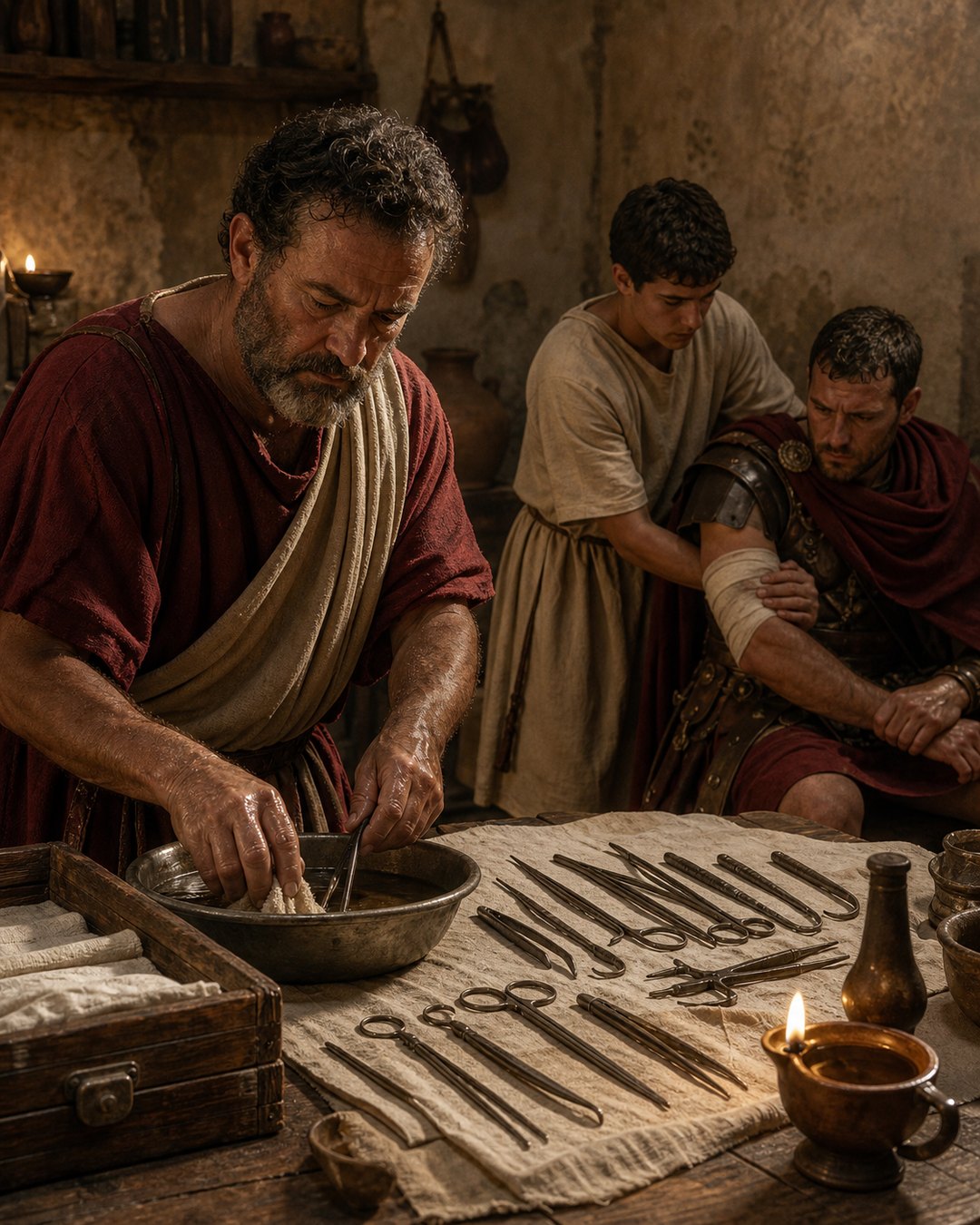
The Latinized word chirurgia carries its own correction to the way ancient surgery is often imagined. It joins hand and work. Bronze probes, forceps, hooks, knives, and cauteries mattered, but an instrument lying on a table did nothing. Treatment began when a trained hand examined a wound, aligned a limb, chose restraint, or decided not to cut.
Roman surgery was neither modern medicine in sandals nor meaningless superstition. Its practitioners inherited Greek arguments, temple traditions, case experience, manuals, and professional rivalries. They could be technically ambitious and dangerously limited at the same time. The clearest way into that world is not to ask whether they could cure everything, but how they defined skilled action under uncertainty.
Chirurgia meant work performed by hand
Celsus explained surgery as the branch of medicine that cures by means of the hand. Another ancient formulation emphasized cutting and burning. Both definitions locate the practice in intervention: the practitioner does not only prescribe food, rest, or medicine but physically changes the injured or diseased body.
That did not make every manual act an operation in the modern sense. Examining, cleaning, pressing, reducing a dislocation, setting a fracture, bandaging, draining, cutting, and cauterizing occupied different points on a spectrum. The hand connected judgment to tissue, and each extra step increased both possibility and danger.
A Roman patient would have felt that distinction immediately. Advice could remain at conversational distance. Surgery required proximity, assistants, light, cloth, water, restraint, and trust. The room narrowed around the injured part while the practitioner committed a decision to the body.
Wounds taught the earliest lessons
The surgical tradition described in the ancient reference reaches back to epic accounts in which treatment centered on wounds. War created repeated, urgent problems: missiles to remove, bleeding to control, tissue to clean, pain to endure, and injured men who still had to be moved or sheltered.
Repeated wounds did not guarantee good outcomes, but they created observation. A practitioner could see which injuries closed, which became swollen, which positions eased a limb, and which interventions made a patient worse. Experience accumulated unevenly, carried by teachers, texts, assistants, and specialists rather than by a single public system.
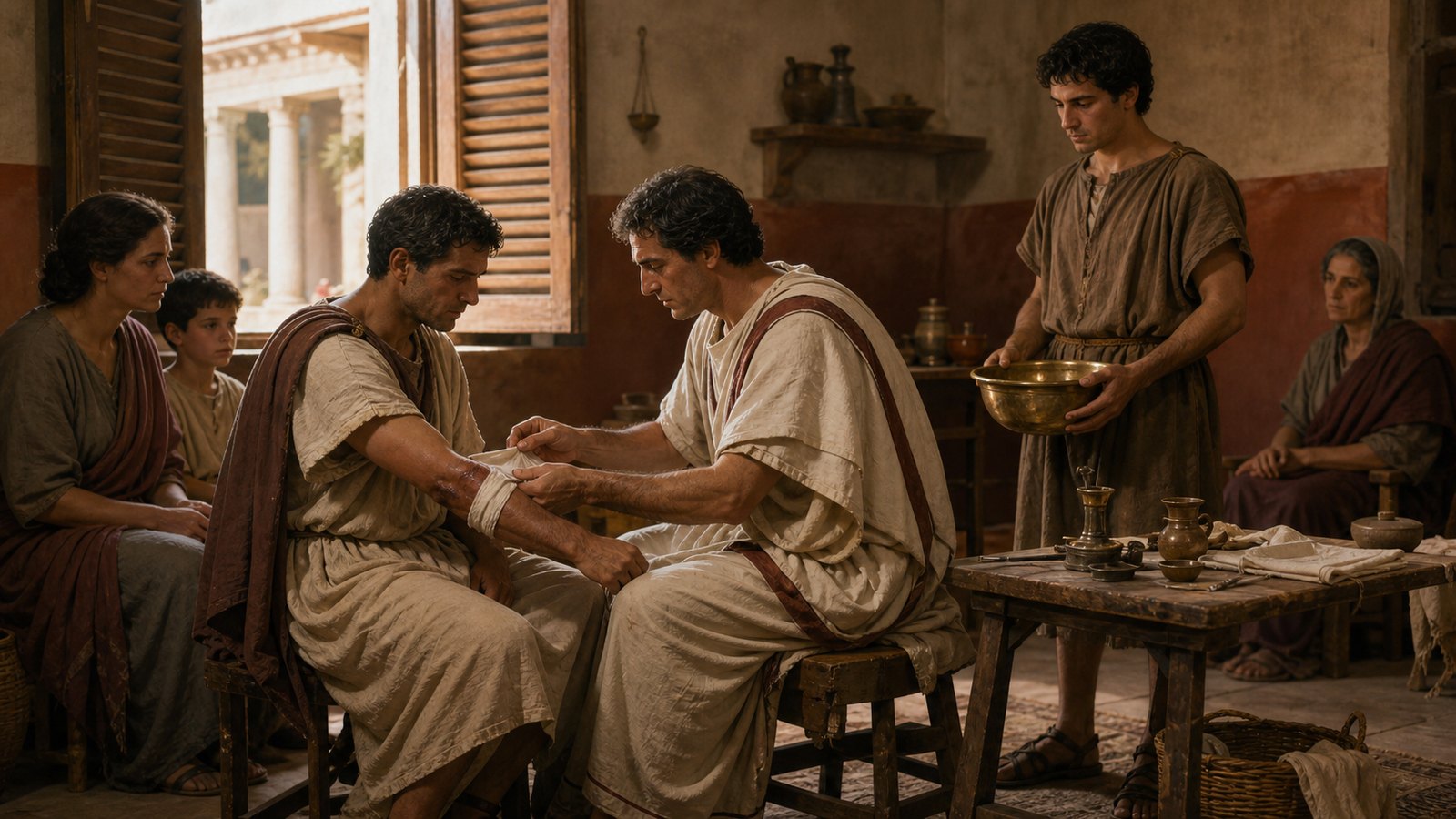
The visual remains should not trick us into imagining a perfectly equipped legionary hospital everywhere. Care happened in camps, houses, workshops, and improvised rooms. What made a space medical was the temporary organization of patient, practitioner, helpers, water, light, cloth, and tools.
Fractures and dislocations rewarded disciplined technique
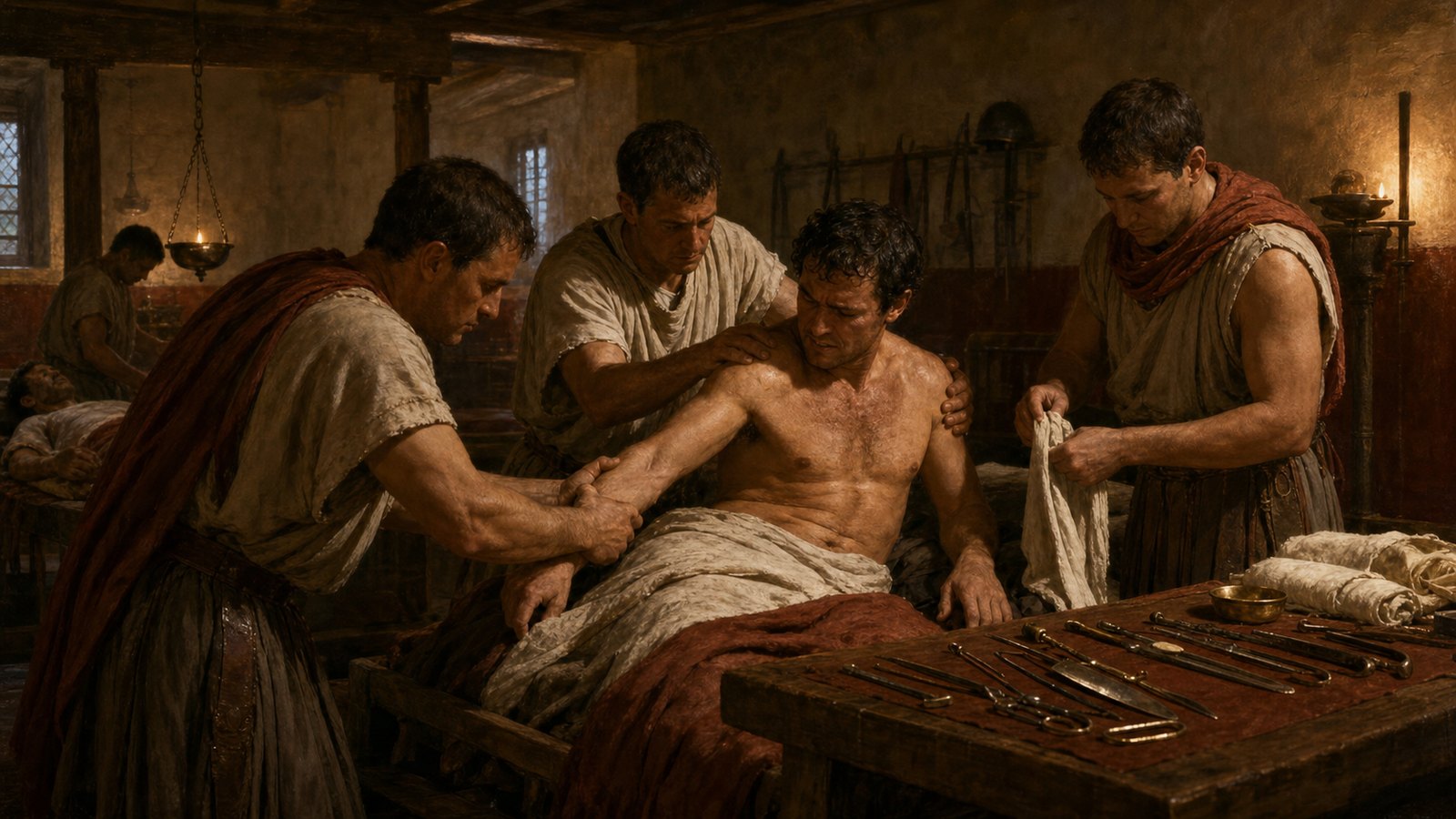
The Hippocratic surgical writings earned later admiration for their treatment of fractures and dislocations. These injuries made mechanical reasoning unavoidable. A displaced joint could not be persuaded back by eloquence. The practitioner had to understand direction, leverage, traction, resistance, and the need to hold a corrected position.
Such work depended on coordinated bodies. One person steadied the patient, another applied traction, and the experienced hand judged alignment. Pain could cause sudden movement; excessive force could create new damage. Success required a controlled sequence, not a heroic wrench.
This manual logic echoes torsion artillery’s dependence on measured force, though the ethical stakes were opposite. In both, force had to travel through material under tension. In surgery, the material was living, vulnerable, and capable of suffering from the correction itself.
The skull exposed the danger of looking certain
The surgical corpus discussed trephination and warned operators that skull sutures might be mistaken for fractures. The warning is more revealing than a triumphant instrument list. Bone presented patterns that could deceive the eye, and an intervention based on a false reading could turn uncertainty into irreversible harm.
A practitioner therefore needed both technique and doubt. The bronze tool could be finely made, but no craftsmanship in the instrument solved a mistaken diagnosis. Ancient medicine’s limitations were severe, including limited anatomical knowledge and no germ theory, yet some texts still recognized that the operator’s interpretation was itself a source of risk.
That awareness belongs beside the failures. It shows a profession trying to define caution from experience: inspect, compare, remember misleading appearances, and teach the next hand what had fooled the previous one. A recorded mistake became a form of equipment if someone learned from it.
The oath drew a line around expertise
The medical oath associated with the Hippocratic tradition included a striking refusal: the practitioner would not cut for bladder stone but would leave that operation to people who specialized in it. The rule acknowledges that a healer’s title did not confer competence in every dangerous procedure.
The same oath framed practice through conduct. It promised to avoid harm, reject poison, enter homes for the benefit of the sick, and keep private what was heard or seen. Whatever the gap between ideal and behavior, the text imagined medicine as access to vulnerable bodies and households that required moral restraint.
That private access contrasts with the public routines of Roman bathing. The bath gathered bodies into shared infrastructure. The medicus crossed into the particular crisis of one patient. Cleanliness, regimen, secrecy, and touch had to be renegotiated in a smaller room.
Knowing when medicine failed was part of medicine
Ancient definitions of medicine included relieving disease and diminishing suffering, but also recognizing conditions in which treatment had no power. This was not a modern prognosis system, and practitioners could still promise too much. Yet the formal definition admitted a limit that spectacular stories of cures often conceal.
Celsus later organized treatment around regimen, drugs, and surgery. The three-part division reminds us that the knife was not the first or only answer. Food, rest, bathing, exercise, compounds, bandaging, and observation could surround or replace manual intervention. Surgery occupied a place inside medicine rather than swallowing the whole art.
Roman surgery began with the hand because the hand joined knowledge to consequence. It could examine, support, align, cut, burn, bind, or stop. Instruments extended it, assistants strengthened it, and texts tried to discipline it. The most important skill was sometimes visible action and sometimes the decision that another specialist—or no operation at all—was safer.
The household visit made reputation part of treatment. A medicus carried claims of training into a room where relatives could watch, question, assist, and remember the outcome. Success brought future patients; failure could travel as quickly through the neighborhood. Professional authority had to be performed beside the bed rather than guaranteed by a hospital door.
Instruments intensified that performance. Bronze tools could be cleaned, arranged, and selected, but their variety did not mean every practitioner owned every form or understood every operation. A compact kit might show preparation while also revealing limits: the wrong implement, poor light, or an unsteady assistant could narrow what was safely possible.
Pain management set another boundary. Without modern anesthesia, the patient’s movement and fear became part of the operation. Restraint was not a background detail; it changed timing, force, and the number of helpers required. A procedure that sounded simple in a text became a negotiation among technique, endurance, and speed.
Aftercare extended the hand’s work beyond the decisive moment. A reduced joint had to remain supported. A wound had to be covered and watched. Food, rest, washing, and repeated inspection returned surgery to the wider medical world of regimen and observation. The cut or correction was an episode, not the whole treatment.
This longer view keeps Roman medicine human in both achievement and failure. Practitioners worked without crucial knowledge, and patients faced infection, pain, disability, and death. Yet they still distinguished kinds of expertise, preserved warnings, taught sequences, and argued that healing had ethical limits. Those habits did not erase danger; they made danger something professionals tried to name.
Sources & Further Reading
- Smith Dictionary, Chirurgia
- Smith Dictionary, Medicus
- Smith Dictionary, Medicina