
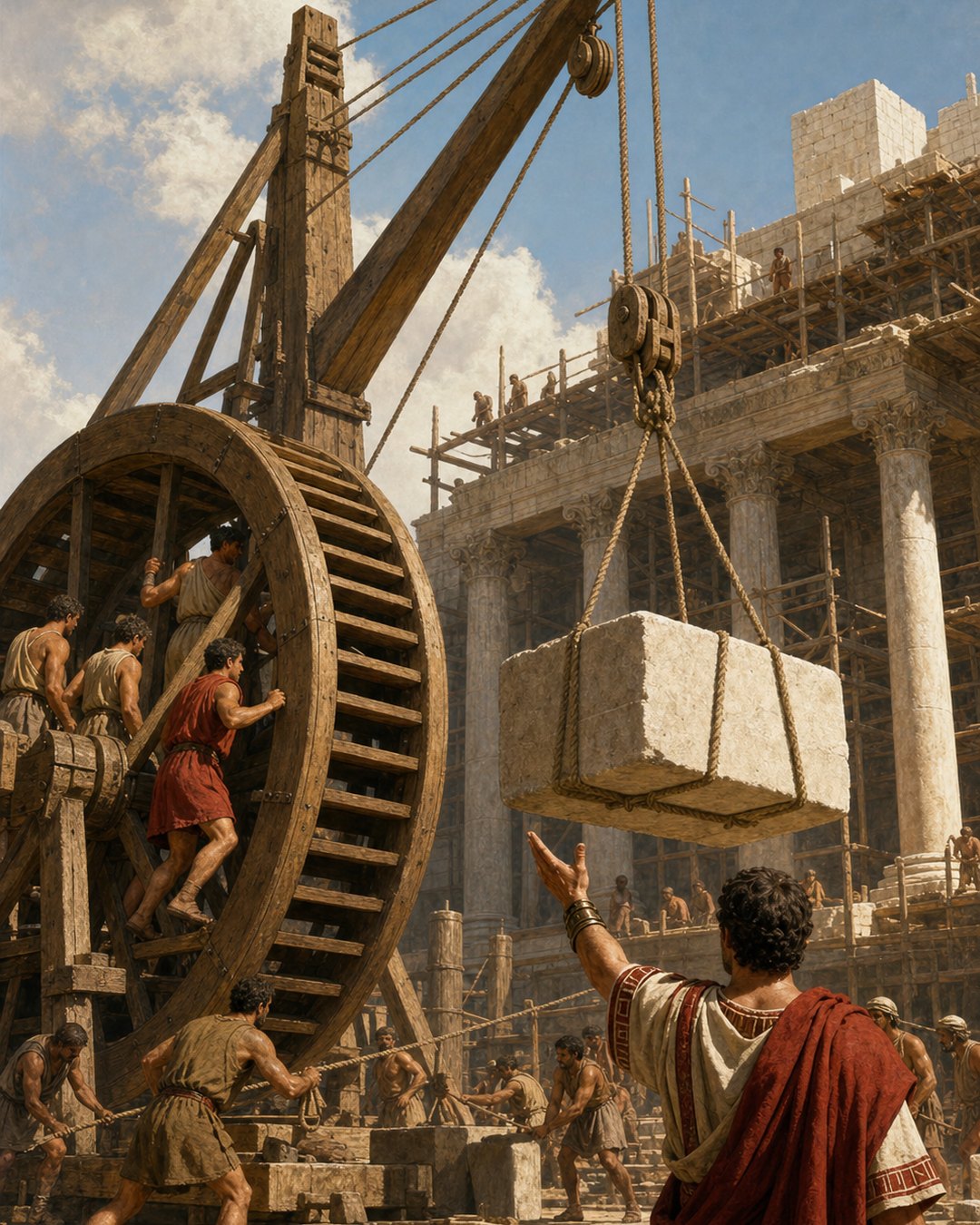
A massive Roman stone did not rise because a workforce suddenly became stronger. It rose because timber, rope, and rotation rearranged what human effort could do. Men turned a windlass, pushed a capstan, or walked inside a tall wooden wheel. Far above their feet, a block left the ground a little at a time.
The crane made monumental height repeatable. Its achievement was not effortless lifting but controlled conversion: many ordinary steps became turns of an axle; turns wound rope; pulleys multiplied force; guide lines restrained the suspended load. Roman cranes turned human movement into vertical power, then handed the last dangerous inches back to masons.
Vitruvius treated lifting as a system
Book 10 of Vitruvius’s On Architecture begins by distinguishing machinery from smaller tools. His concern is organized power. A machine joins parts so that workers can move a weight or produce an effect beyond the direct reach of one hand. Timber geometry, rope, and rotation belong to one design.
His lifting devices use paired beams, pulley blocks, drums, windlasses, and hauling lines. The descriptions can feel dense because every rope has a route. That density is the point. A crane worked only when force passed through the frame in a planned sequence rather than pulling loose pieces against one another.
The vertical members needed bracing, the pulley block needed a secure suspension, and the rope needed to meet the drum without slipping or cutting across itself. A failure anywhere changed the whole machine. Roman engineering was not a single ingenious wheel but the management of connected stresses.
This makes the crane different from a crowd simply pulling upward. The machine defined where workers stood, which direction they moved, and how their effort reached the load. It converted a construction site into a temporary mechanism with people operating inside its logic.
Pulleys exchanged distance for force
A rope passing over one fixed pulley changes direction but does not by itself make the load lighter. Add moving pulley blocks and the weight is supported by several rope segments. The workers must pull more rope, yet each pull carries a smaller share of the force required to lift the stone.
Vitruvius describes systems with different numbers of pulleys. A relatively simple block could serve a modest load; multiplied arrangements answered heavier work. The names and layouts mattered to builders because choosing too little advantage exhausted crews, while excessive complexity slowed movement and added rope, friction, and places to fail.
The trade was visible on site. A block might climb only a short distance while workers hauled many arm-lengths of rope. Speed surrendered to control. Monumental construction benefited from that patience because a stone lifted too quickly was not useful if it swung, struck scaffolding, or passed its landing course.
The principle links Roman cranes to the mechanical discipline inside Roman artillery. Both systems stored or redirected human effort through prepared materials. Their purposes differed, but neither machine produced power from nothing; each made force travel by a more useful route.
Windlasses and treadwheels made effort repeatable
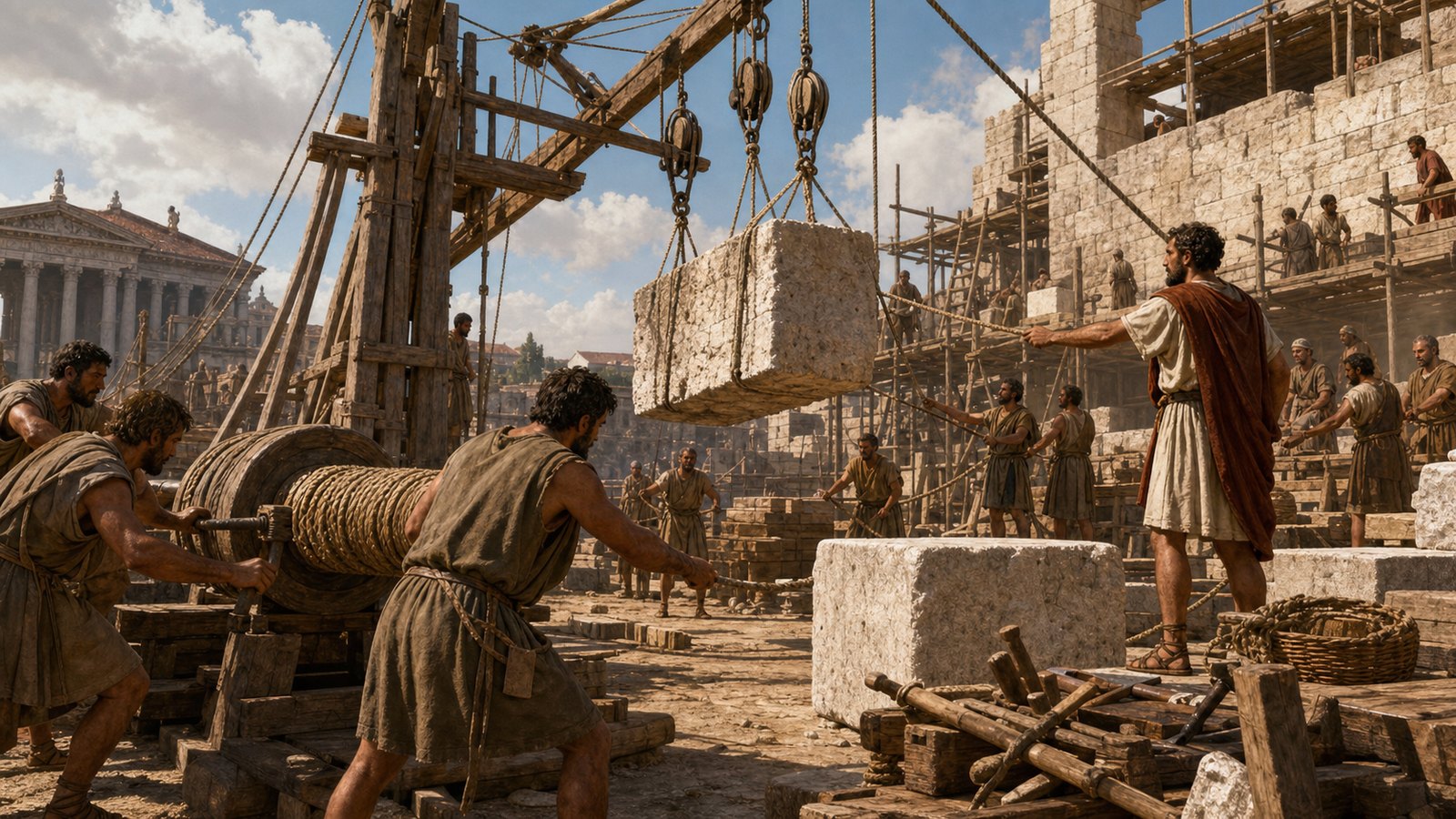
Workers could haul a rope directly, but a windlass wrapped it around a rotating drum. Bars or handles allowed repeated turns while the rope accumulated neatly on the axle. A capstan placed the axis vertically; workers walked around it, maintaining a steady rhythm without needing a long clear pulling lane.
A treadwheel enlarged the radius dramatically. Men walking inside the wheel applied their weight and steps far from the axle. The wheel’s slow rotation wound the rope with substantial leverage. The worker did not lift the stone in one heroic action. He kept walking while the mechanism converted distance into torque.
The wheel also created danger. A sudden shift, slipping rope, broken member, or uncontrolled reverse motion could throw operators or drop the load. Brakes, pawls, careful winding, and communication mattered. The most impressive machine on the site remained dependent on routine inspection and disciplined starting and stopping.
Picture the cadence: feet press wooden treads, the axle groans, hemp rope tightens, pulley sheaves turn, and dust falls from the rising block. The load moves inches while the walkers cover yards. Monumental height emerges from that imbalance between repeated motion below and slow ascent above.
Attaching stone required its own engineering
A crane could pull only through a secure connection. Builders used slings, clamps, lifting tongs, or lewis devices fitted into prepared holes. Each method placed stresses differently. A badly cut recess could split at the edge; an insecure sling could slide; a clamp could grip poorly if the stone’s shape resisted it.
Dressed blocks therefore carried traces of handling as well as shaping. Holes and cuttings sometimes reveal where lifting gear engaged the stone. These marks are small compared with the building, but they preserve the moment when quarry product became suspended load and the crane’s abstract force met a particular piece of rock.
Attachment also affected placement. Gear had to remain secure until the block rested, then be removed without damaging surrounding work. Masons planned access to the connection and the sequence of release. A device perfect for raising could become awkward if trapped beneath the stone at the destination.
This precision belonged to the same construction culture that made Roman concrete support ambitious forms. Concrete, brick, and cut stone solved different structural tasks. The crane did not choose among them; it made selected components available at the height where the design required them.
The last metre demanded more than strength
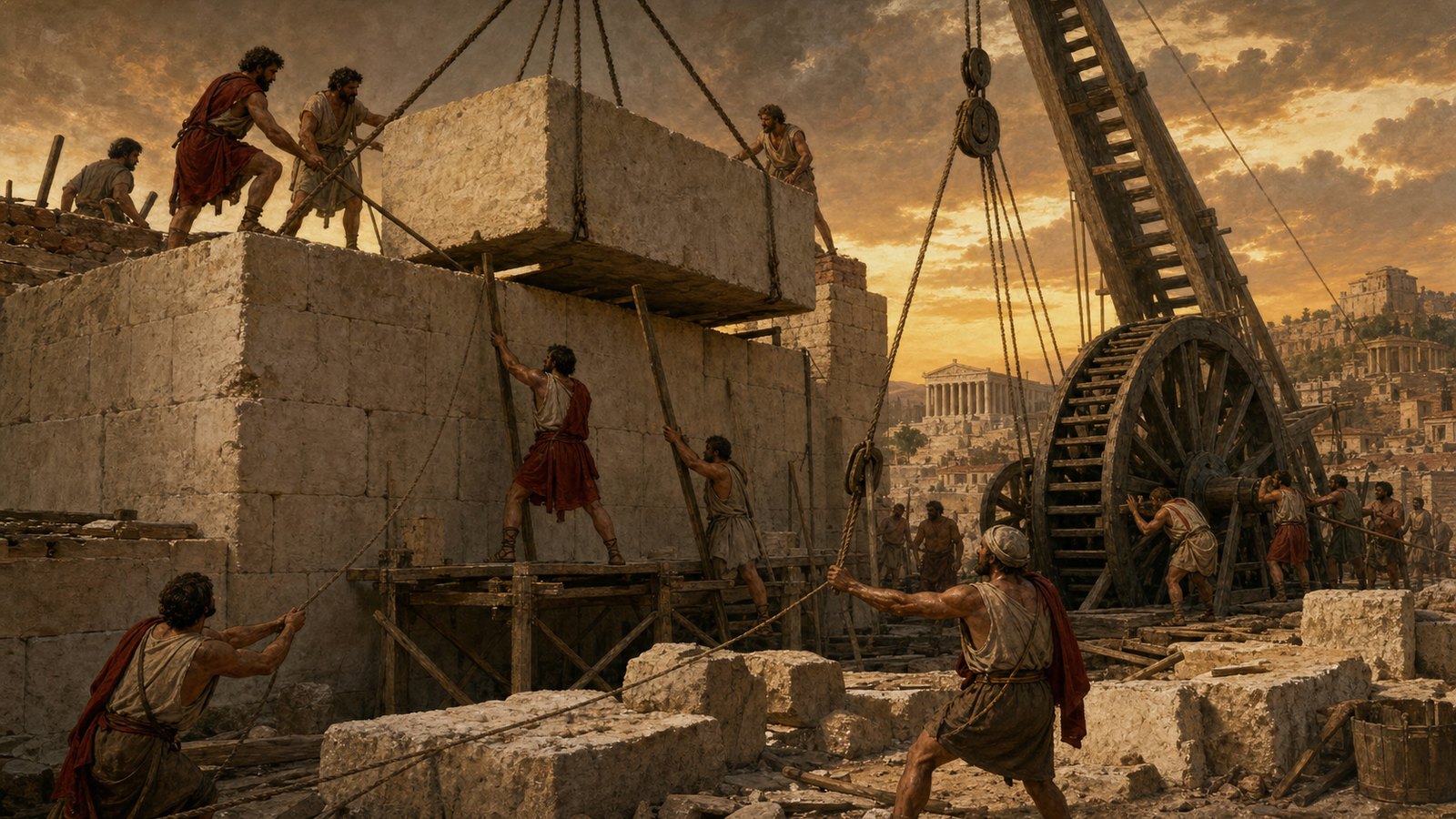
A suspended block was not finished when it reached the correct elevation. It could rotate, sway, or approach the wall at the wrong angle. Workers with guide ropes controlled orientation from safer positions, while masons near the course watched clearances and signaled corrections to the operators below.
Communication crossed the site. The men inside a treadwheel might not see the landing surface. A foreman or chain of signals connected their steps to the mason’s hand. “Raise,” “hold,” and “lower” had to become immediate mechanical consequences. Delay could crush fingers, strike scaffolding, or chip an expensive finished edge.
Once near the bed, levers and small adjustments mattered more than great lifting force. Masons eased the stone onto mortar or prepared contacts, checked alignment against neighboring work, and released tension carefully. The crane delivered capacity; craft delivered fit. Monumental walls depended on both scales of control.
The scene exposes why machines did not eliminate labor. Quarrymen extracted the block, transport crews moved it, carpenters built the crane and scaffold, rope makers supplied lines, operators raised it, and masons set it. Mechanical advantage reorganized work instead of making workers disappear.
A temporary machine left permanent height
Roman cranes were usually temporary presences beside permanent architecture. Timber frames rose as courses climbed, shifted position, or were dismantled when work ended. The finished temple, arch, or upper wall concealed the apparatus that had made its height possible. Visitors saw stone order rather than construction disorder.
That disappearance can make ancient building seem magical. Columns appear too heavy, cornices too high, and blocks too exact for a world without engines. Vitruvius supplies the missing middle: not modern motors, but combinations of wood, rope, pulleys, drums, leverage, and trained crews.
The crane also imposed limits. Timber strength, rope condition, anchor points, weather, available space, and the mass of each block shaped what could safely rise. Roman builders responded by dividing loads, preparing ramps, changing machines, or redesigning sequences. Ingenuity worked inside material boundaries rather than abolishing them.
Roman cranes turned footsteps into lifting power because rotation let effort accumulate. A worker’s stride vanished into the wheel, but the axle remembered it as wound rope and the block answered by climbing. The building preserved that converted movement long after every beam of the crane had been taken away.
Sources & Further Reading
- Vitruvius, On Architecture, Book 10
- Roman engineering overview and references
- Ancient Roman construction overview