
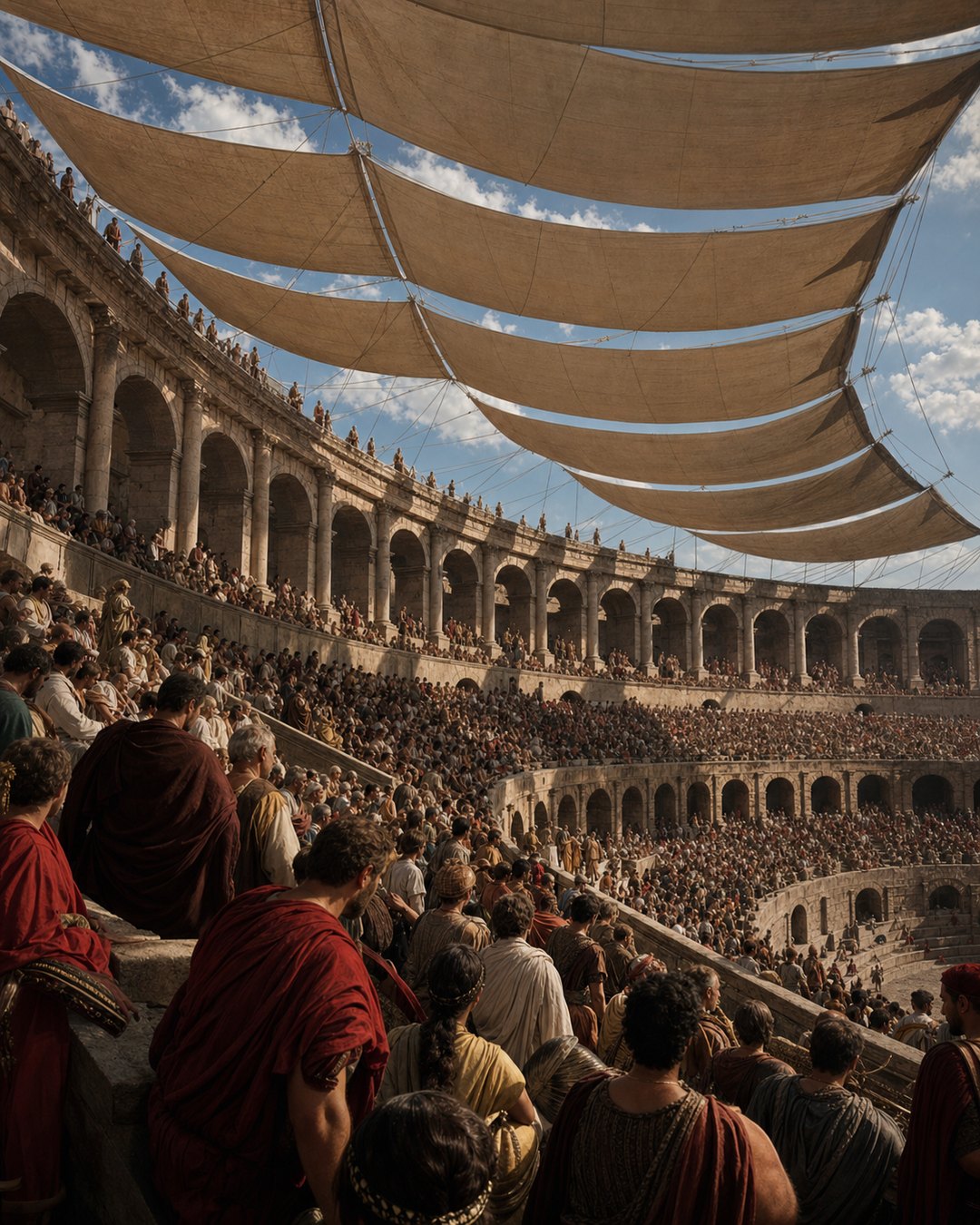
Before a Colosseum crowd looked down toward the arena, many spectators looked up. Masts ringed the highest level. Ropes crossed open sky. Vast sections of canvas pulled outward, caught the light, and cast broad moving bands of shade across stone seats packed with tens of thousands of bodies.
The velarium was not a lid placed over the amphitheater. It was a temporary balance among cloth, timber, rope, wind, sun, and trained crews. Making shade at this scale became part of the spectacle: the empire that organized the games also seemed able to rearrange the summer sky above its audience.
An open amphitheater created a problem of scale
The Flavian Amphitheatre was dedicated under Titus in 80 CE and held a crowd often estimated around 50,000. Its open center admitted daylight to the arena, but the same design exposed ascending banks of spectators to hours of sun. A stone seat could become an instrument of heat long before the program ended.
Crowding intensified the experience. Bodies sat close, movement through aisles was controlled, and social rank determined where many people belonged. Leaving for relief meant navigating a packed structure and perhaps surrendering a view. Shade was therefore not a decorative luxury. It affected endurance, attention, and the mood of a huge audience.
The challenge could not be solved by roofing the entire building with heavy permanent construction. A roof spanning the central opening would demand extraordinary support and could darken or obstruct the arena. The velarium answered with something lighter: tensioned canvas projected inward from the perimeter while leaving an opening above the action.
This solution complemented the Colosseum’s architecture of ranked seating. Stone fixed spectators into social bands; canvas altered the physical conditions over those bands. The audience encountered hierarchy below and organized weather protection above.
Masts turned the rim into a rigging platform
At the top of the amphitheater, stone supports and sockets held a ring of tall wooden masts. These poles extended the structure into the air, creating elevated points from which ropes and canvas could be controlled. The upper wall was not merely a finished façade. It was the base of a working machine.
Each mast had to carry tension without tearing free from the masonry. The pull was not only downward. Ropes drew inward toward the awning and outward toward anchors, while gusts could change direction quickly. The ring distributed these forces around the oval instead of asking one central support to bear the whole span.
The masts also multiplied tasks. A single enormous sheet would have been nearly impossible to handle and disastrous if torn. Segmented sections allowed crews to manage portions of the awning, adjust coverage, and leave a central opening. Division turned an overwhelming surface into coordinated units.
From below, the structure transformed the skyline. The Colosseum’s familiar arcades ended not in bare stone but in poles, rope angles, folds, and moving cloth. Engineering remained visible. Spectators could watch the protection over their heads tighten, slacken, and change shape.
Naval skill moved onto dry land
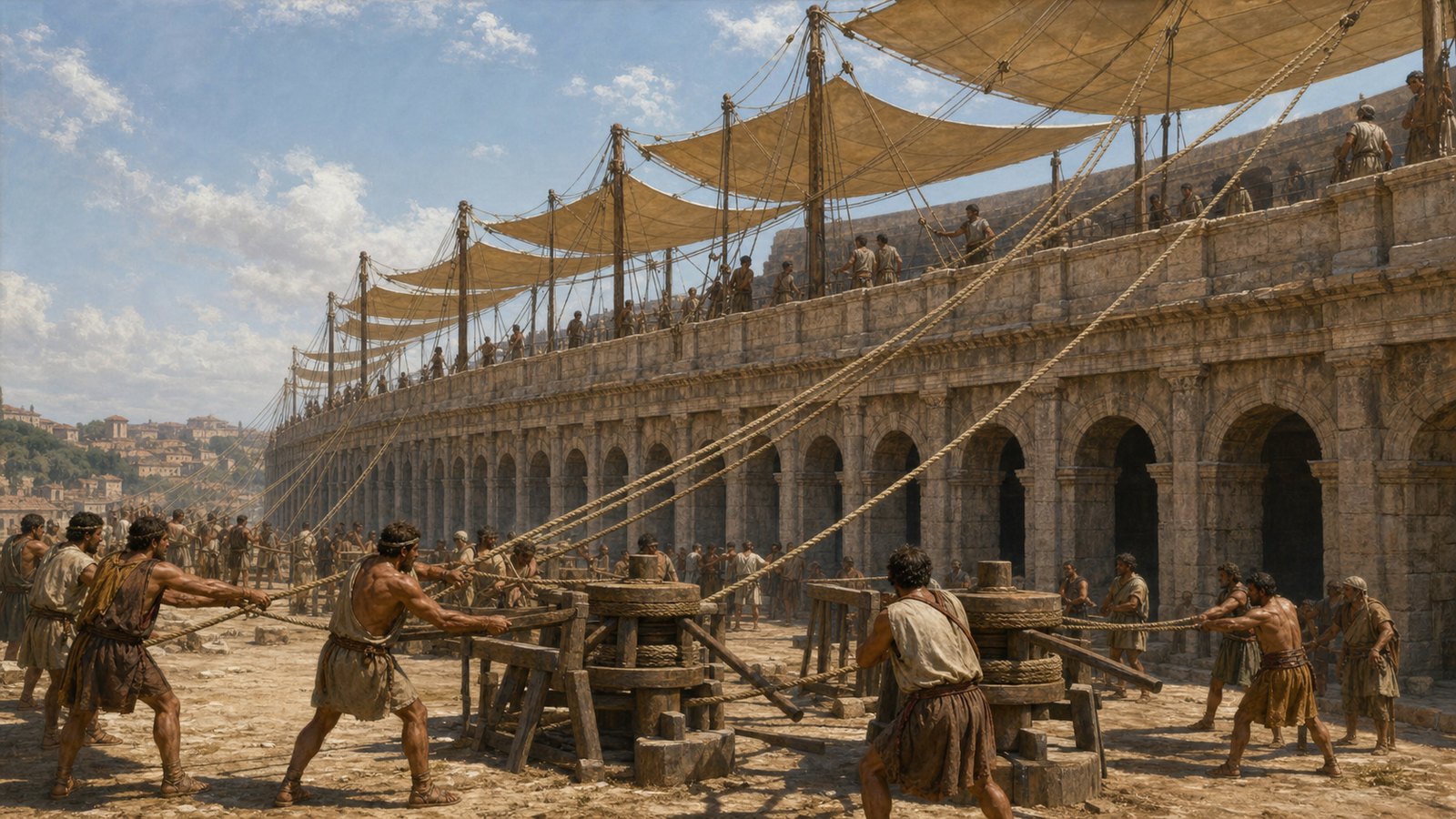
Ancient and later traditions associate the velarium crews with sailors, particularly men linked to the fleet at Misenum. The assignment makes practical sense. Sailors understood large areas of cloth under wind load, complex rope systems, knots, coordinated hauling, and commands that had to be obeyed before conditions shifted.
The amphitheater was not a ship, yet the working vocabulary overlapped. Canvas had to be spread without uncontrolled flapping. Lines needed clear routes. Tension had to be shared rather than concentrated at one weak point. A crew had to know when a gust made further deployment dangerous.
Capstans outside the building could give hauling teams leverage. Men walked around the vertical drum as rope wound in, pulling a distant section tighter. Other crews watched from the upper gallery, communicated changes, and handled local lines. The audience saw canvas; the system depended on workers distributed around and above them.
The labor connects the velarium to Rome’s naval infrastructure on shore. Naval expertise did not end at the waterline. Rope handling, carpentry, supply, and disciplined crews could be reassigned to a civic spectacle whose weather behaved like a difficult sea.
Shade moved because the system remained alive
The velarium provided partial shade, not a uniformly dark roof. Sun angle changed through the day. Canvas sections projected over some seats more fully than others, and the central opening remained exposed. A spectator’s comfort could improve or worsen without changing places as bands of shadow traveled across the cavea.
This motion was unavoidable and useful. A rigid covering would resist every gust with its full area. Adjustable sections could be tensioned, eased, or withdrawn as conditions required. The system survived by responding. Its temporary character was a form of strength rather than evidence of incomplete design.
Imagine the physical change when a panel reached working tension. Harsh light softens. The cream cloth glows overhead. Stone loses some of its glare, and thousands of faces pass into shadow. A breeze runs beneath the high canopy while the arena remains bright enough for the crowd to follow movement below.
The effect was political even without a written message. Games advertised the provider’s generosity, and comfort extended that gift beyond the program itself. The state did not merely assemble spectacle; it demonstrated concern for the conditions under which citizens watched, while displaying the manpower required to produce relief.
Wind could turn comfort into danger
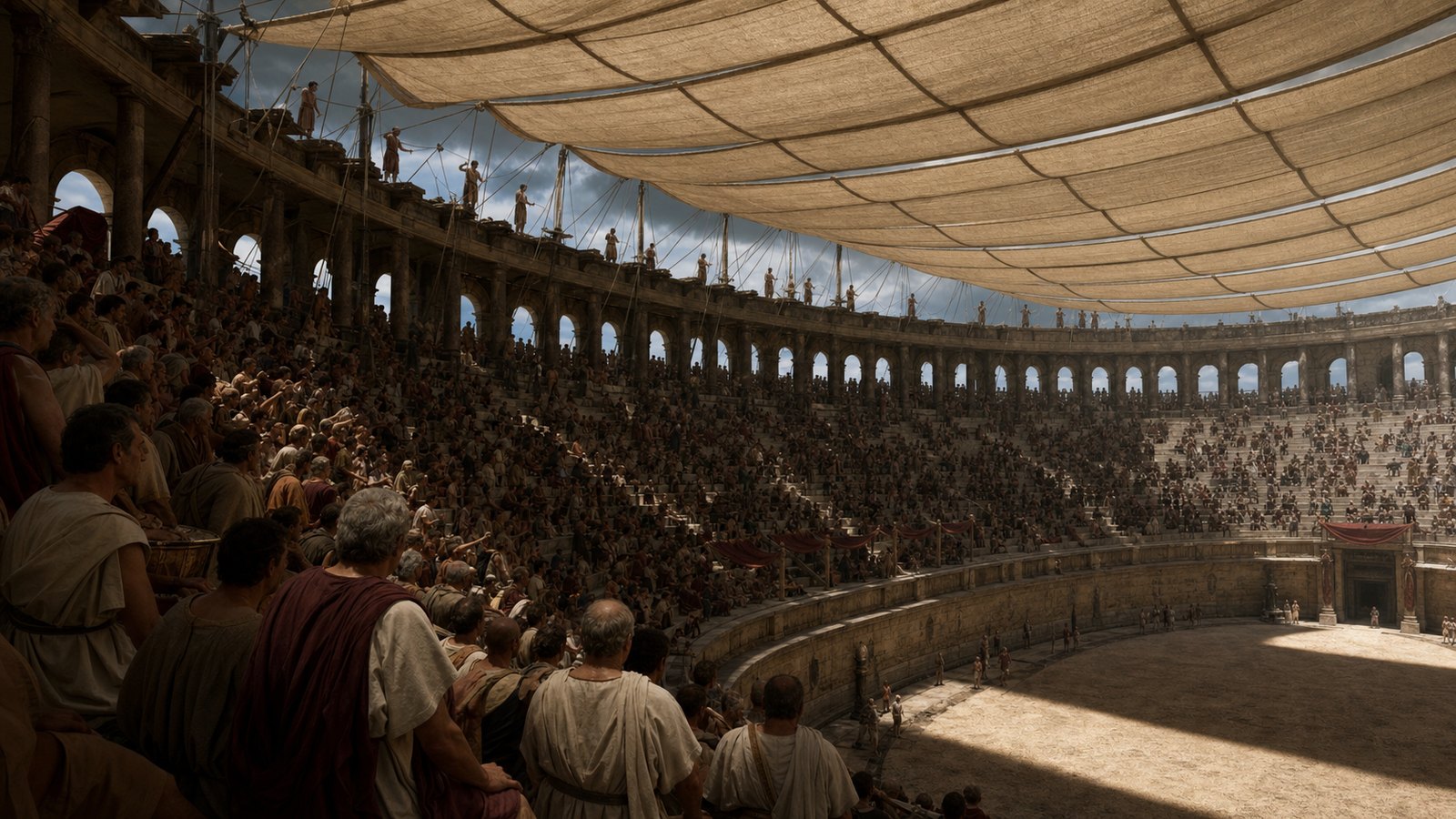
Every awning is also a sail. A broad canvas surface can pull violently when wind enters beneath it, and the Colosseum offered enormous exposure. Sudden gusts threatened cloth, ropes, masts, anchor points, and anyone working near a loaded line. Deployment required judgment, not a fixed ceremonial schedule.
Rain posed another problem. Water collecting in a slack section added weight and changed the cloth’s shape. Drainage, pitch, and tension mattered, while a storm could make retraction safer than persistence. The velarium moderated weather but could not abolish it. Nature remained a participant whose force the crew had to read.
Rope condition was equally important. Fibres stretched, abraded against guides, and weakened through use. Knots and attachments required inspection. A snapped line could whip through a work area and transfer load abruptly to neighboring parts of the system. Maintenance happened before spectators benefited from a single patch of shade.
These constraints correct the fantasy of effortless Roman technology. The awning was impressive because it managed risk repeatedly, not because it ignored risk. Its safe appearance to the audience depended on sailors, carpenters, rope makers, supervisors, and laborers anticipating failure out of sight.
Audience comfort became visible organization
The Colosseum concentrated Roman society into one oval. Senators, equestrians, citizens, women, foreigners, and poorer spectators occupied differentiated zones. The velarium crossed those divisions as a shared physical presence, yet its moving shade could still benefit sections unevenly. Even relief arrived through geometry and position.
When crews deployed the canvas successfully, the operation offered its own prelude. Capstans turned outside, commands passed upward, ropes tightened, and panels advanced across the sky. The transformation told the waiting crowd that many trained people and expensive materials had been coordinated for this one day’s gathering.
Afterward, the fabric could be drawn back, repaired, dried, and stored. Unlike the amphitheater’s stone, the working parts did not survive simply by remaining in place. Their absence today makes reconstruction difficult, but sockets, supports, texts, comparisons, and mechanical logic preserve the outline of the system.
The Colosseum velarium made shade a public performance because comfort arrived through visible coordination. Canvas changed the sun only provisionally, and everyone beneath it could see the ropes holding that change together. Imperial power appeared not only in what happened on the arena floor, but in the moving shadow above the seats.
Sources & Further Reading
- World History Encyclopedia, Colosseum
- Encyclopaedia Britannica, Colosseum
- Velarium overview and references