
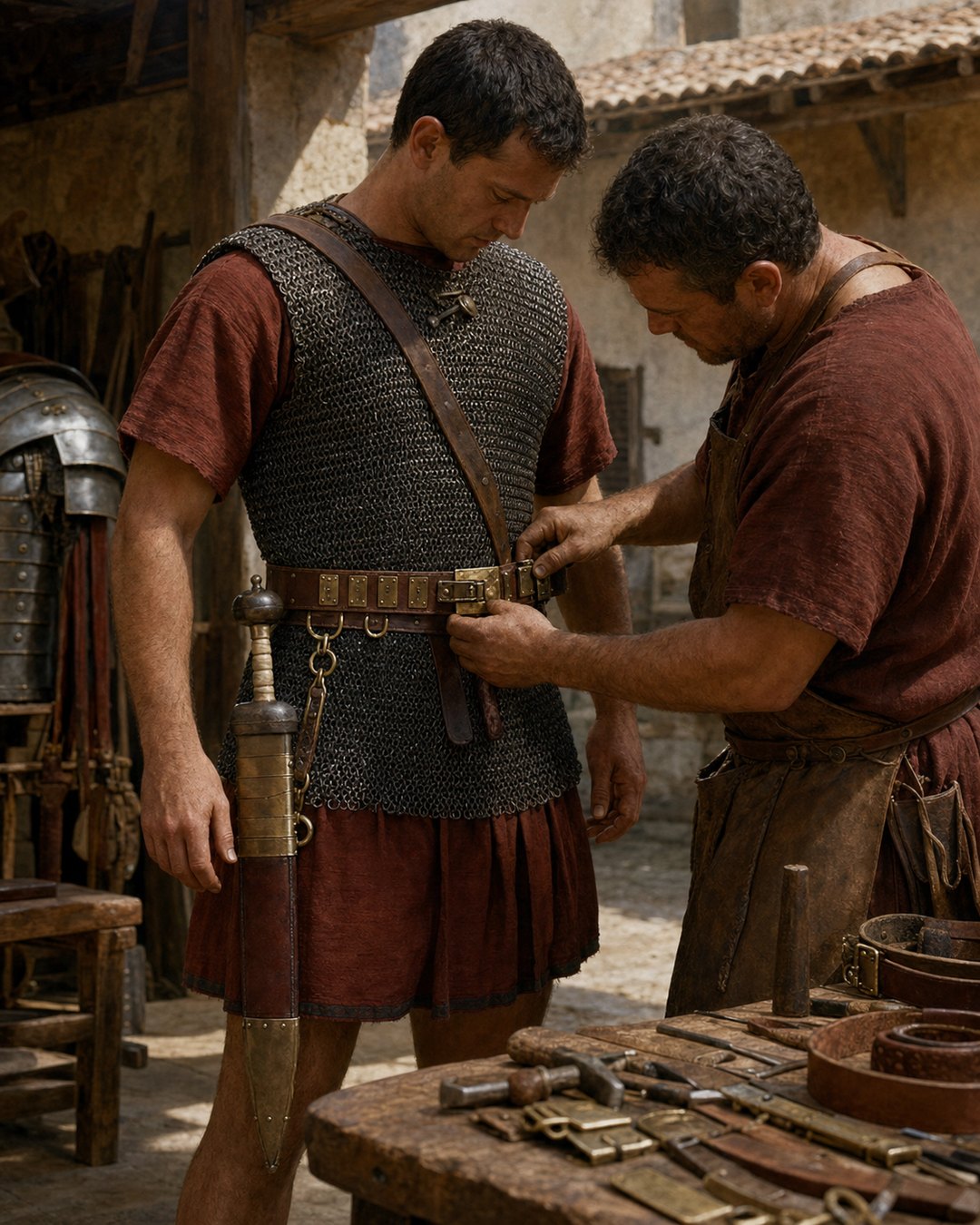
A Roman soldier could remove his helmet and put down his shield, but the belt still organized the equipment closest to his body. Leather circled the waist or crossed from the shoulder. A buckle fixed the fit. Suspension points controlled sword and dagger, while metal plates made the assembly conspicuous even when it carried little ornament beyond repeated geometry. Every step tested it: scabbard against thigh, buckle against tunic, load shifting as the body turned.
The military belt is easy to flatten into costume. Reconstructed plates shine, dangling straps catch attention and modern names promise one standard object. Ancient use was less tidy. Forms changed across centuries, sword suspension moved between waist and shoulder arrangements, and organic components often disappeared while isolated metal fittings survived. The useful question is not which single belt every legionary wore. It is how leather and hardware made carried weapons behave like part of a moving body.
A belt converted loose equipment into a body system
A sword in a scabbard remained a long, rigid weight. Held in the hand, it occupied fingers needed for work, shield or climbing. Hung carelessly, it swung into knees and doorways. The belt solved this by giving the scabbard a repeatable position relative to hips and torso. Its purpose was not to eliminate movement but to limit movement to a range the wearer understood.
That attachment turned the body into part of the suspension. Weight traveled from scabbard through rings, straps and fittings into leather, then around waist or across shoulder. A narrow pressure point became painful over distance, so width, lining, tunic folds and adjustment mattered. The assembly had to remain tight enough for control without restricting breathing under armor.
The relationship was dynamic. Running made a sword bounce; sitting changed its angle; mounting, digging and carrying loads brought other objects into the same space. Soldiers learned small habitual corrections—steadying a scabbard with one hand, shifting it before kneeling, checking a fastening after a climb. Equipment became wearable through those routines as much as through its original manufacture.
Leather carried the load, metal controlled the weak points
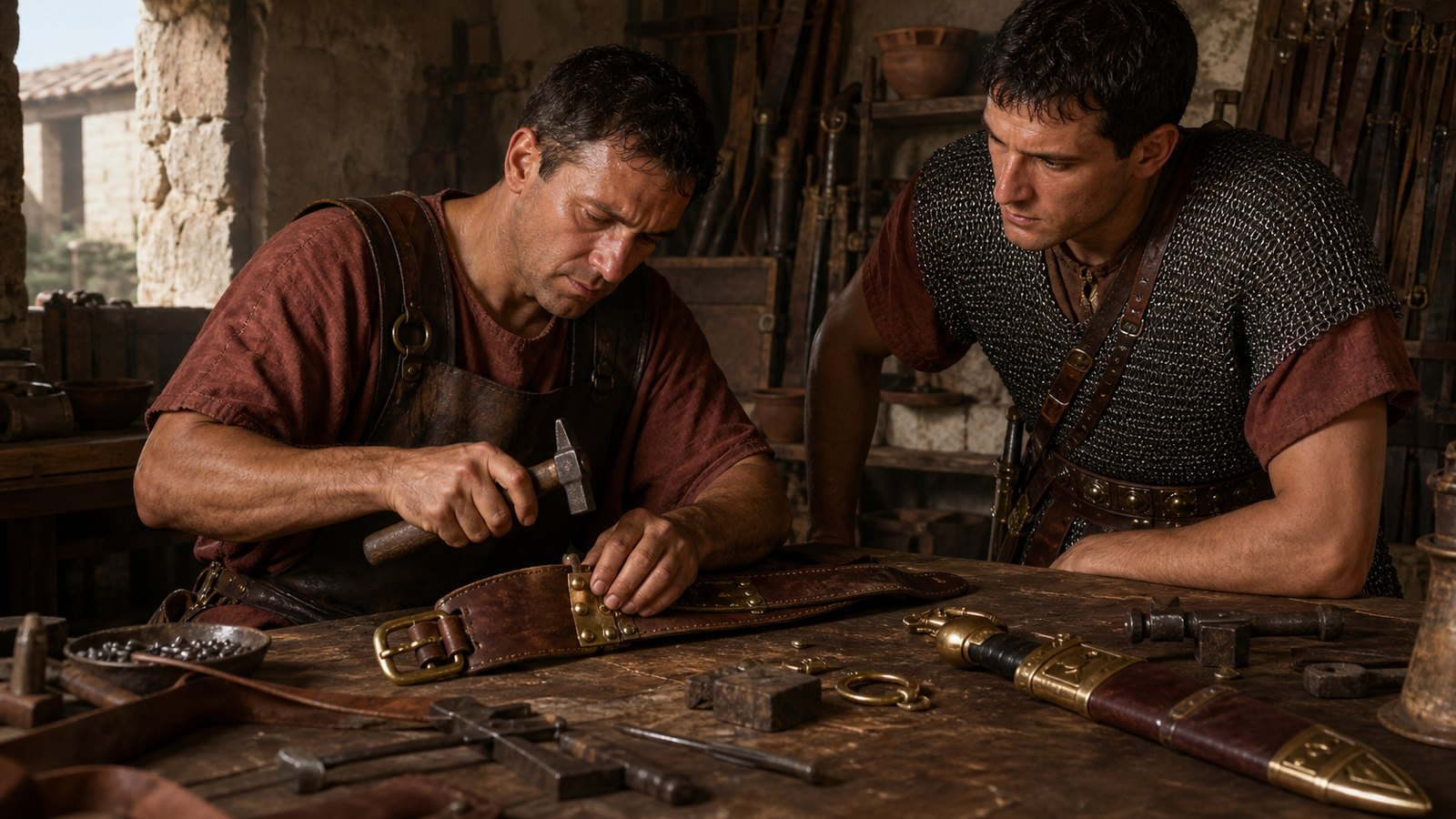
The broad visible band was generally leather, a material strong in tension but vulnerable to moisture, stretching and cuts. Metal appeared where forces concentrated: buckle, tongue, strap ends, suspension loops and decorative plates. A buckle translated a pull into adjustable fit. Reinforcement around its attachment prevented the leather from tearing exactly where repeated fastening imposed stress.
Metal fittings survive in graves, forts and settlements after the connecting hide has decayed. Their positions can suggest an assembly, but an isolated plate does not explain every strap once behind it. Archaeologists must reconstruct missing organic relationships from rivets, wear and comparisons. The most visually durable part is not necessarily the part that bore most weight.
This preservation pattern resembles the Roman helmet, whose metal shell often outlasts lining and ties. In both objects, vanished soft material made hard material usable. A buckle without leather is only hardware; a helmet bowl without padding is an incomplete interface. Roman equipment joined substances with different lifespans because the living body demanded both strength and accommodation.
Sword suspension had to permit one clean draw
The sword’s position mattered at the instant of use. A scabbard hung too low lengthened the draw; one too loose moved when the blade was pulled. Suspension straps established height and angle while allowing enough flexibility for the wearer to walk. Different periods and roles used different arrangements, including waist belts and shoulder baltei. Variation was a response to equipment, habit and fashion rather than evidence of indifference.
The Roman term balteus could refer to a belt or a shoulder strap associated with carrying a sword. A shoulder route spread weight diagonally across the torso, while a waist arrangement kept control close to the hips. Neither system operated alone: tunic, mail, shield edge and baggage straps competed for the same surfaces. What looked balanced in a workshop had to be tested with the complete load.
The scabbard itself protected the blade and the wearer, but its fittings created leverage on the belt whenever the rigid case struck something. A good suspension absorbed small shocks without tearing free. A failed ring made an intact sword awkward or dangerous to carry. Maintenance therefore followed the chain from leather stitching to rivet, not only the prestigious blade.
Plates made repeated structure visible
Metal plates could cover parts of the belt in repeated rows. They reinforced selected areas, but their visual effect exceeded their contribution to load. Reflection, spacing and regularity made the waist readable as military equipment. In the first century CE, some belts also carried studded leather straps hanging at the front, the apron-like feature familiar from many reconstructions.
Those straps should not be projected unchanged onto every century. Belt fashions altered, and Roman soldiers across a vast empire did not freeze one parade image forever. Dates, find contexts and attachment evidence matter. A plate set that suits an early imperial representation cannot automatically equip a later frontier soldier. Chronology is part of functional accuracy because changing sword types and clothing changed suspension needs.
Visible hardware still had social force. Like hobnails under military footwear, repeated fittings connected a practical object to group identity. Civilians could use belts, but the particular combination of hardware and weapons marked a military body. Service became recognizable around the waist before anyone inspected a discharge record.
The belt needed attention after the battle ended
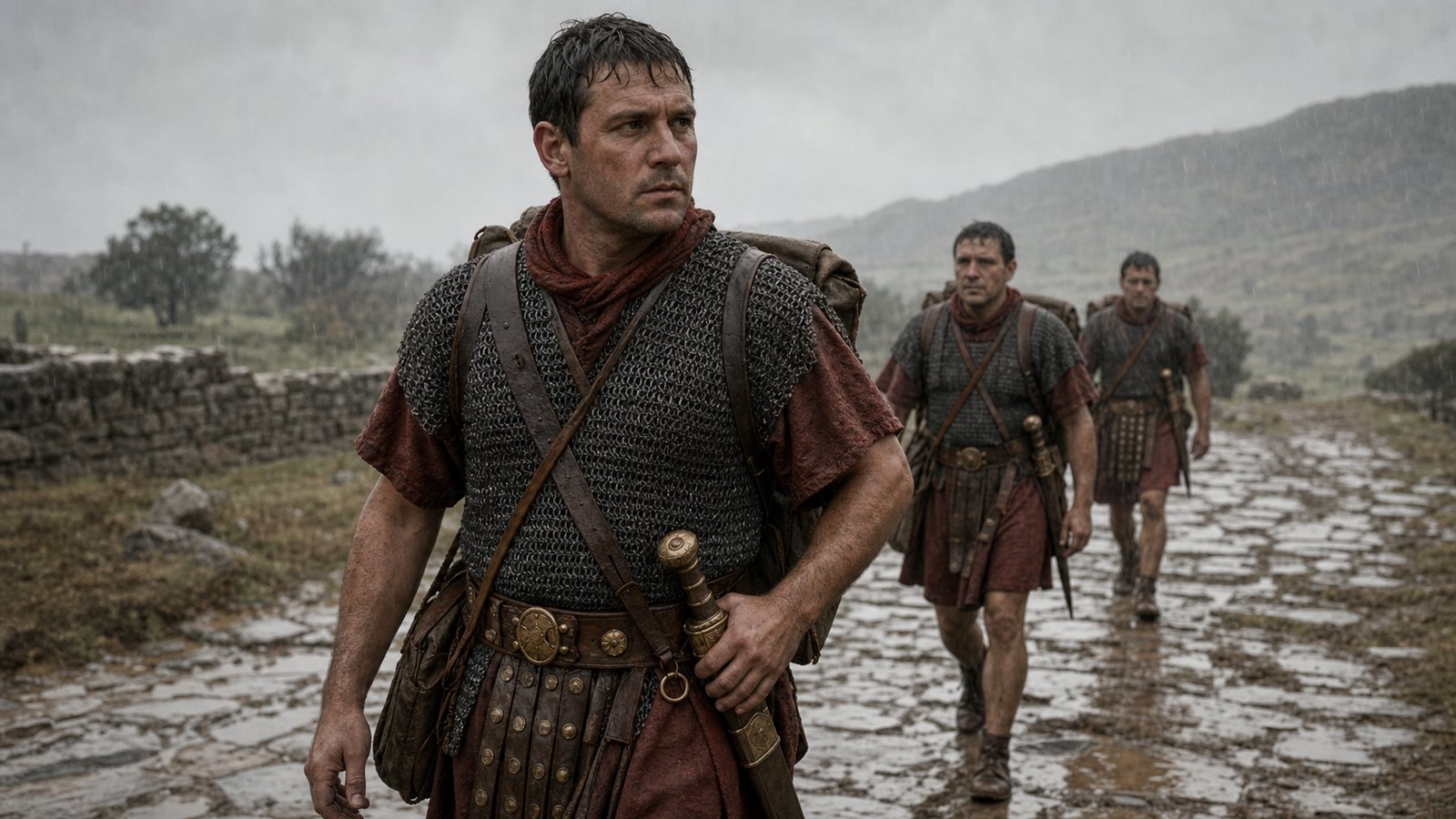
Leather absorbed sweat and rain. Rivets loosened, buckle holes stretched and suspended metal rubbed at contact points. A soldier checking his belt looked for small failures with large consequences: a cracked strap near the buckle, a ring pulling through leather, a scabbard tie beginning to part. Drying too near heat could harden the material; neglecting wet leather encouraged deformation and decay.
Roman service made those checks communal as well as personal. Tent mates and armorers could notice a twisted hanger or failing rivet before inspection, because one loose scabbard was visible and audible during work. Reliability grew from shared attention to ordinary wear, not only formal issue.
Repair did not always restore showroom uniformity. A serviceable replacement strap or mixed fitting could extend an older assembly. Roman supply joined centralized demand to local workshops, reuse and field maintenance. The belt’s changing surface recorded this economy. Bright new plate, dark older buckle and patched leather could all cooperate as long as the load remained controlled.
Display worked because the hardware had work to do
The belt’s military meaning was strongest when equipment hung from it. Sword, dagger and fittings converted decoration into readiness. This differed from a legionary standard, which organized collective identity above the ranks. The belt operated at the scale of one body. It marked the wearer while managing the objects that allowed him to function inside the larger formation.
The Roman soldier’s belt was a working tool, not just decoration, because every visible plate depended on a hidden problem of force. Leather distributed load; buckles adjusted fit; suspension held rigid weapons near moving joints; repairs kept the chain intact. Ornament made the solution legible, but it did not replace the solution. A belt looked military because Roman service repeatedly asked it to survive marching, weather, work and sudden access to a blade. Its authority sat precisely where weight met the body.
Sources & Further Reading
- Cingulum militare
- Smith Dictionary, Balteus
- Roman military personal equipment