
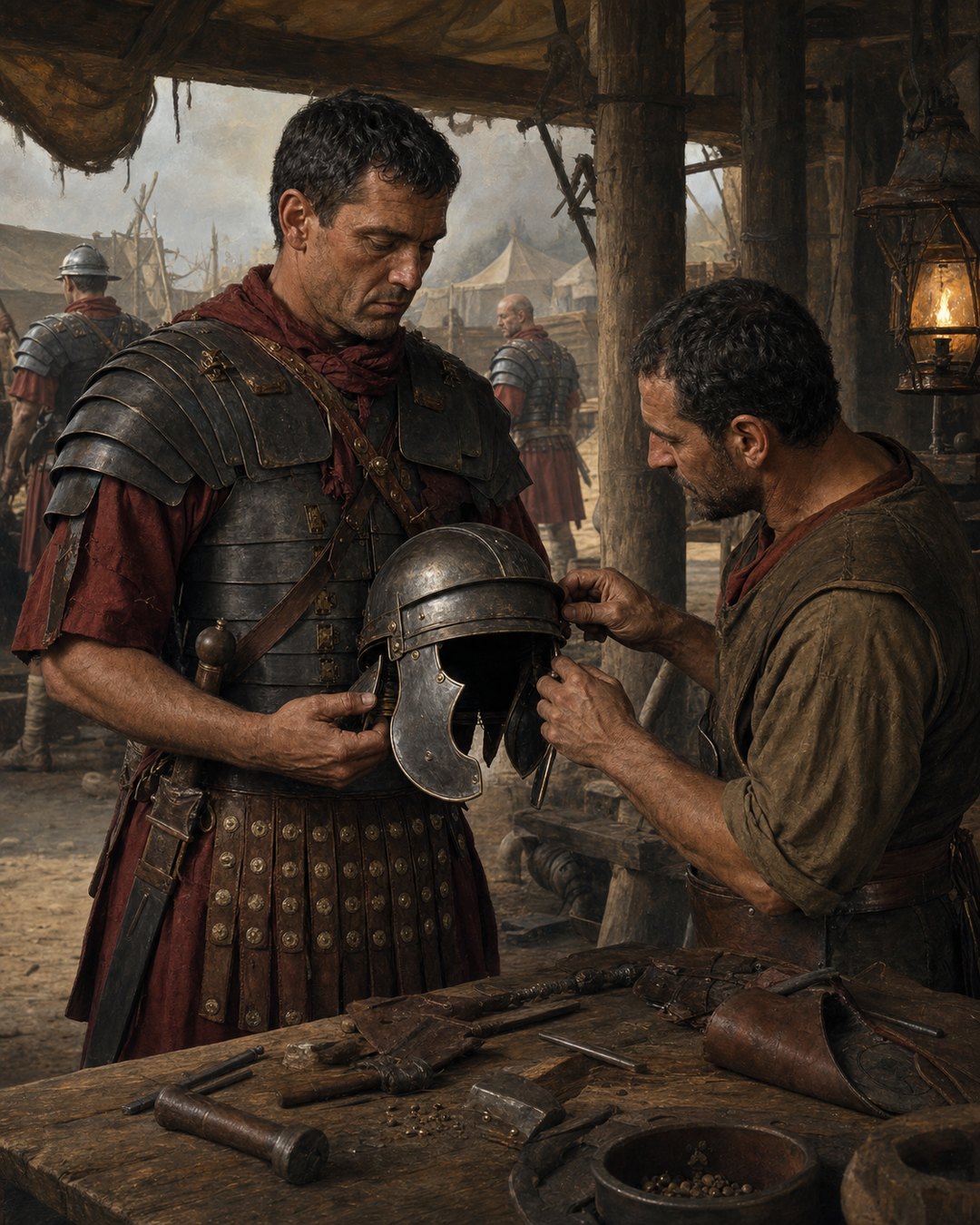
A helmet that stops a blow but prevents a soldier from hearing an order has solved only half the problem. Roman warfare asked the head to survive impact while the eyes followed uneven ground, the ears found a command inside noise and the lungs managed heat under load. The galea therefore protected by leaving deliberate openings. Metal covered crown, cheeks and part of the neck, yet face, ears and lower jaw could not simply disappear behind a sealed shell.
The familiar silhouette was a collection of compromises. A shaped bowl spread contact. Hinged or tied cheek pieces guarded the sides of the face while moving enough for the wearer to put the helmet on. A rear projection sheltered the neck without locking the head upright. Lining made hard metal wearable. These parts mattered together, and every added plate also changed weight, balance, sound and awareness.
The bowl turned a sheet of metal into a shell
A flat plate resists contact differently from a curved bowl. Roman armorers shaped iron or copper alloy so the crown presented rounded surfaces rather than one broad plane. Curvature stiffened relatively thin metal and encouraged some strikes to glance. It also spread force around the shell instead of asking one small patch to bear everything, although no ancient helmet could make a powerful impact harmless.
Making the bowl demanded controlled hammering and repeated judgment. Metal thinned or stretched as it moved, and an uneven wall could create a weak place. The finished form then needed an edge that did not cut its wearer, attachment points that did not tear free and enough room for lining. Like Roman chain mail, the helmet turned many workshop decisions into protection that looked simple only after completion.
Iron and copper-alloy examples remind us that “Roman helmet” names a family across centuries, not one immutable issue pattern. Material affected color, corrosion and repair, while form reflected different workshops and periods. An excavated bowl may survive after organic lining and ties vanish, leaving modern viewers with the hardest component but not the complete worn object. Reconstruction must restore that missing interface before judging how the helmet sat.
Cheek guards protected without closing the face
Separate cheek pieces brought metal down beside the eyes and jaw. Their outlines varied, but their purpose reveals the central design problem: a soldier needed side protection without losing the facial opening through which he saw, breathed, shouted and recognized companions. Articulation let the pieces move during fitting and then settle against padding or ties when the helmet was secured.
The gaps were as important as the plates. A guard placed too far forward narrowed peripheral vision; one pressing the ear distorted commands and trapped heat. Too little coverage exposed bone and blood vessels at the side of the head. The armorer was not drawing an abstract profile. He was arranging metal around a living face that had to turn quickly while a shield, weapon and neighboring bodies already constrained movement.
Individual fit complicated standard supply. Faces differed, and a cheek piece comfortable for one soldier could rub another raw. Ties and padding allowed adjustment, but only within the geometry established by metal. During issue or repair, the practical test was movement: open the mouth, turn the head, look down, raise the shoulder and listen. Protection that passed inspection on a bench could still fail once the rest of the equipment surrounded it.
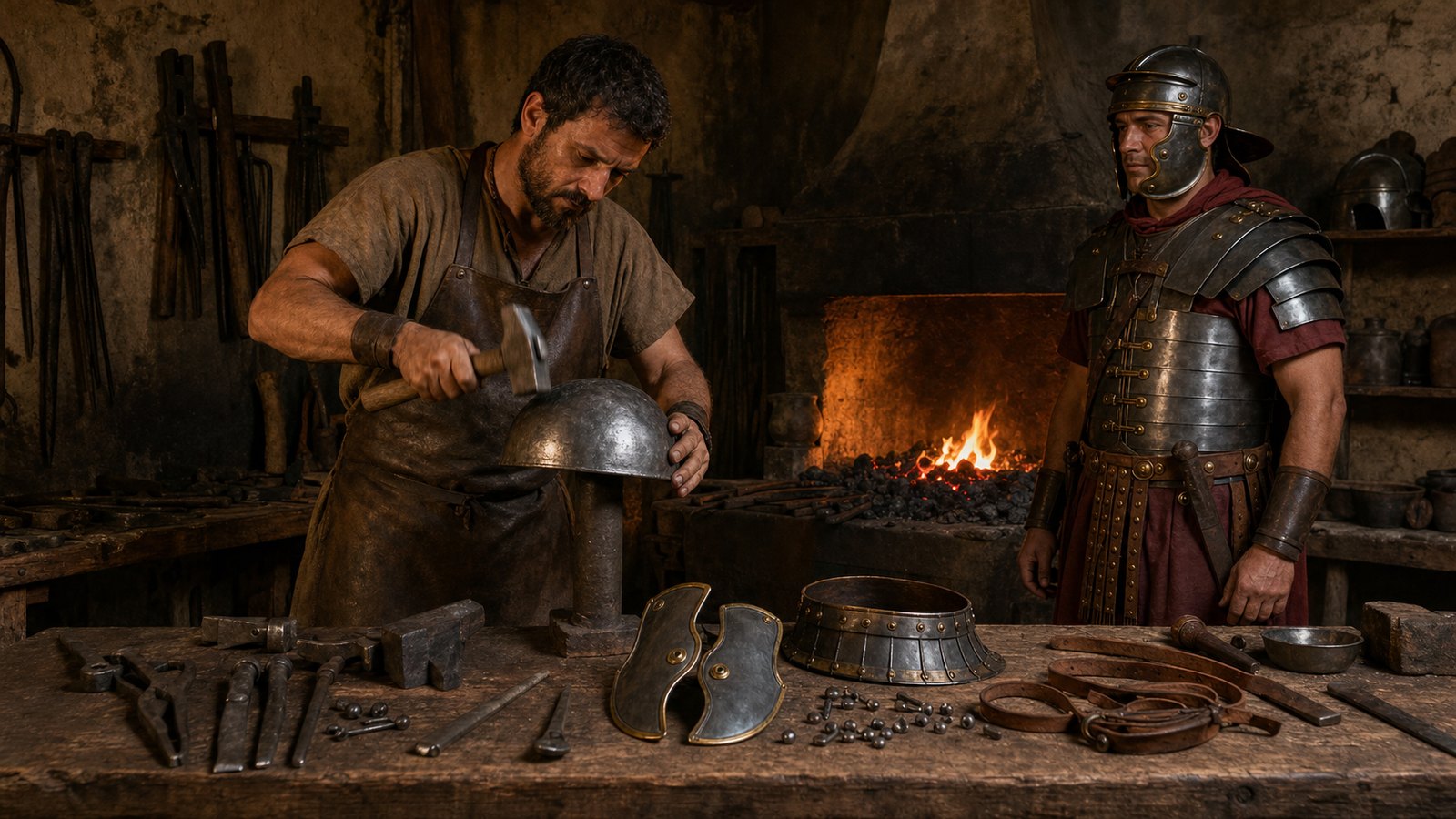
The rear guard followed danger toward the neck
A projecting neck guard extended protection behind the bowl. It offered a sloping metal surface above the vulnerable upper neck and could help shed rain or a descending strike. The feature changed over time and should not be treated as identical on every Roman helmet, but its persistence shows that protection had to continue beyond the crown where an exposed edge would invite contact.
Projection created leverage as well as shelter. A guard that extended too far could catch against armor or a pack when the soldier looked upward. One too short left a dangerous gap. The relationship with the curved scutum was practical: shield, shoulder, mail and helmet occupied the same crowded zone, and each had to move without jamming the others during an advance.
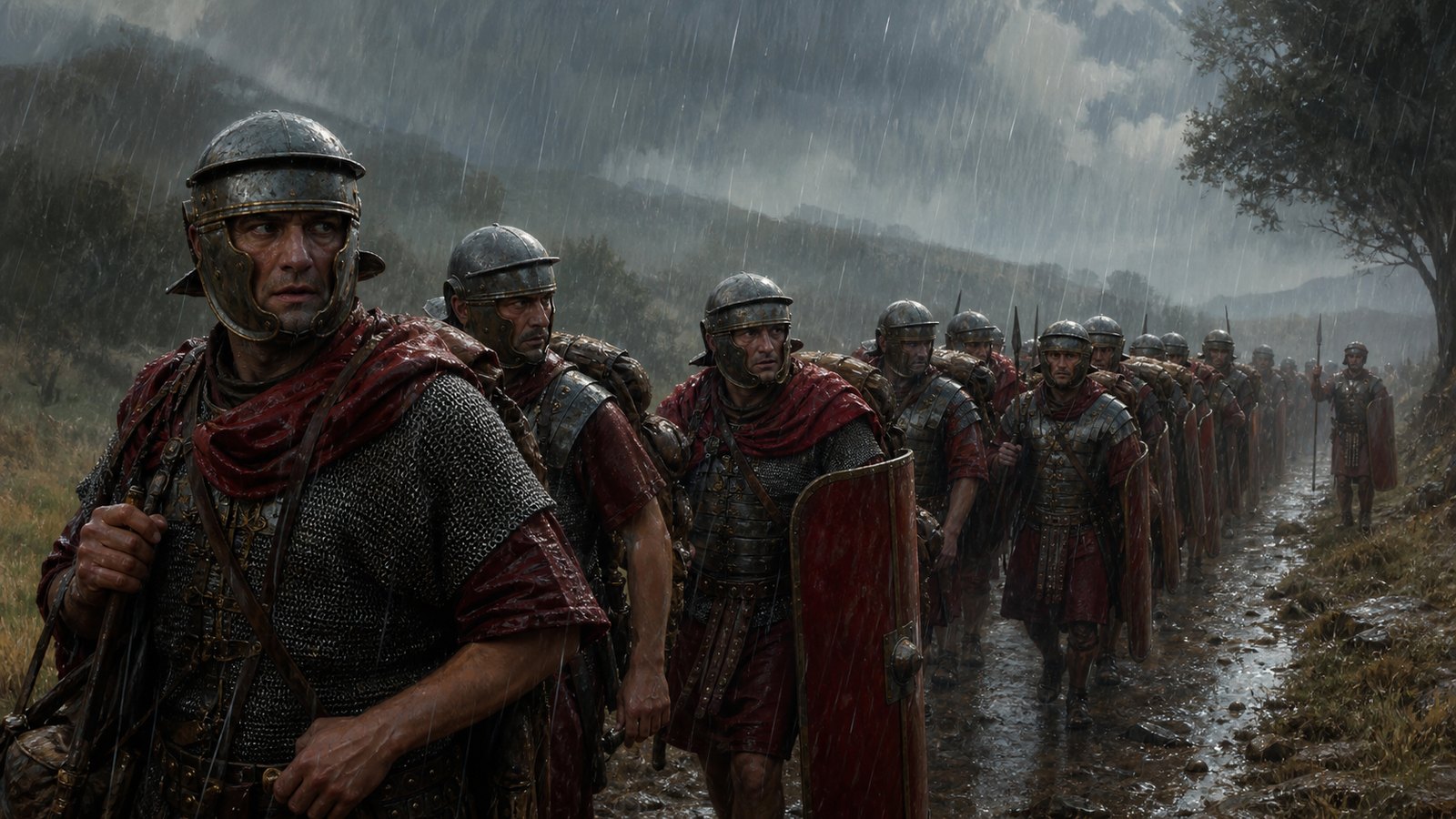
Rain exposed the value of overlap. Water striking the crown could run toward the rear projection rather than directly down the collar, although wind and movement defeated any perfect shelter. The same surface that redirected a descending edge redirected weather during far more hours of service. Roman equipment earned usefulness in these ordinary exposures; a guard carried on every wet march mattered before it ever met a weapon.
Fit turned hard metal into wearable equipment
The visible shell was not meant to rest directly on the skull. Padding or lining distributed pressure, reduced movement and softened ordinary knocks. Fit mattered before battle: a loose helmet shifted across the eyes when a soldier ran, while an undersized one created painful points that became harder to ignore with every mile. Sweat changed the feel, and wet organic lining could deteriorate out of sight.
Balance also affected endurance. Weight high on the head taxes the neck, especially when a soldier repeatedly looks down at rough ground and up toward a signal. Rome’s practical military equipment rarely worked as isolated pieces. The hobnailed footwear described in the caligae article preserved footing below; the helmet had to protect above without making that moving body clumsy.
Crests belonged to context, not every march
Modern images often let a dramatic crest define the Roman helmet. Ancient evidence supports crests and mounting fittings, but their use varied by period, rank, role and occasion. Display could help identification or ceremony, yet a conspicuous high attachment also added weight and changed the outline. A practical marching or combat helmet should not automatically be imagined with the same parade treatment shown on monuments.
This caution extends to modern type names. Archaeologists classify surviving helmets through bowls, brow features, neck guards, cheek pieces and manufacture, creating useful families for comparison. Those labels help organize evidence but do not prove that a legionary used the same terminology. Roman soldiers encountered repaired, inherited and locally supplied equipment across time; visual uniformity was an achievement to approximate, not a factory guarantee.
Small fittings decided whether protection stayed in place
A sound bowl could outlast a failed hinge. Cheek guards relied on attachment points; lining needed securing; edges and decorative fittings could loosen. Dents were evidence to interpret rather than marks to admire. An armorer had to decide whether metal had merely changed appearance or had folded, cracked or pulled around a rivet in a way that endangered the next use.
Roman helmets balanced protection with awareness because the army needed surviving heads that still participated in formation. Bowl, cheek pieces, neck guard and lining managed different threats, while openings preserved sight, speech, hearing and heat loss. The object did not remove danger. It redistributed risk around the senses a soldier required to obey, orient himself and keep pace when iron, rain, dust and shouting made the world harder to read. Its success belonged as much to the unarmored openings as to the surviving metal: each gap was a calculated admission that protection had to serve perception rather than replace it.
Sources & Further Reading
- Galea, helmet
- Smith Dictionary, Galea
- Roman military personal equipment