
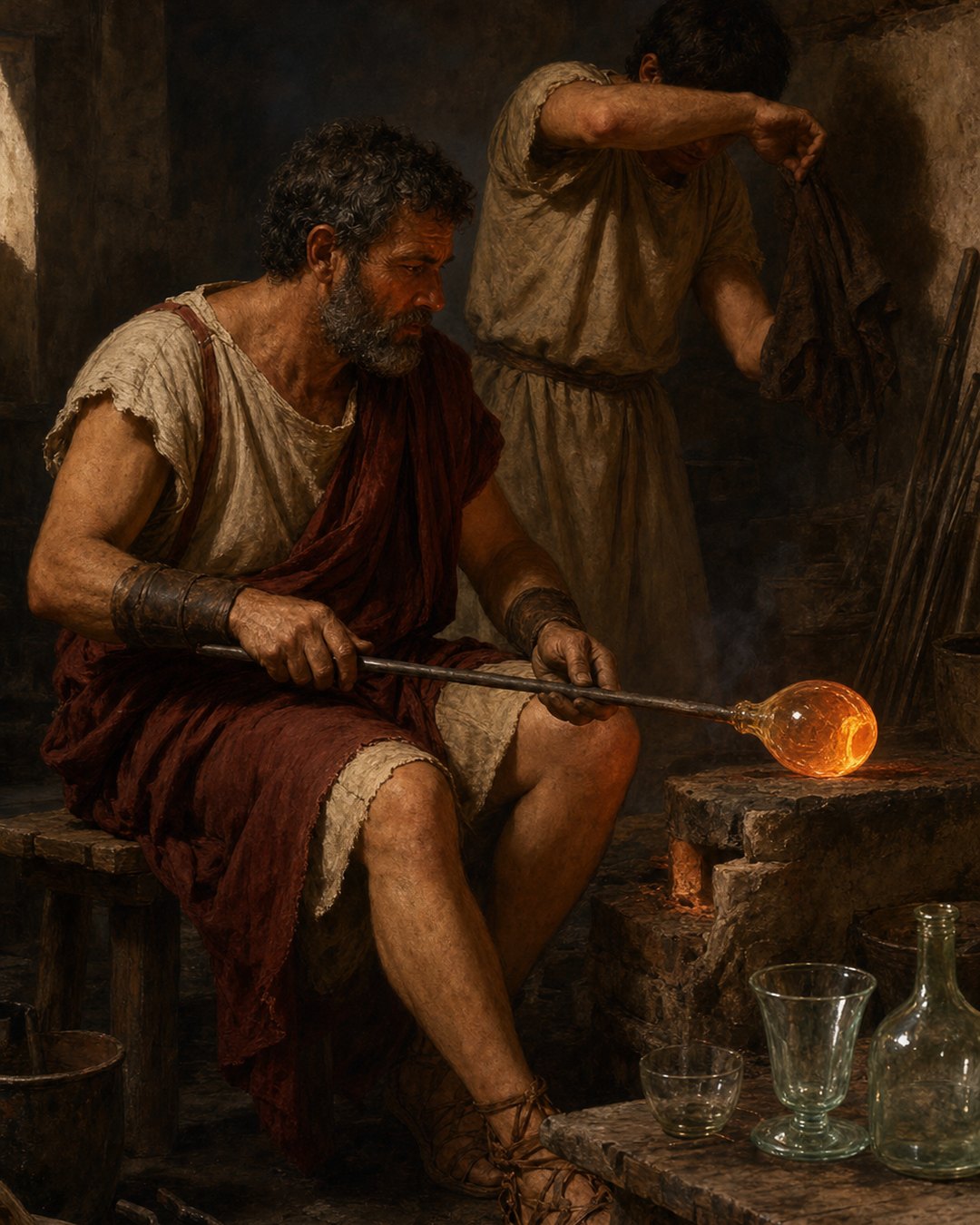
A glass vessel begins with a problem that seems almost unfair to the material. The worker must persuade a glowing, heavy liquid to become a thin hollow wall before heat escapes and rigidity returns. In Roman workshops, the decisive tool was not a press or a wheel but a hollow iron tube. One end entered the furnace; the other carried a measured breath. Between them, a gather of softened glass became a bubble that could be enlarged, turned and disciplined into a cup, bottle or jar.
The breath supplied expansion, but it never worked alone. Gravity pulled the hot mass downward. Rotation kept it centered. A mold could impose a repeated surface, hand tools could narrow or open an edge, and gradual cooling could preserve work that sudden temperature change would ruin. Glassblowing was therefore a chain of timed controls. Its achievement was not simply making glass hollow. It was keeping a fragile wall balanced through every transformation from furnace to table.
The blowpipe joined furnace heat to human breath
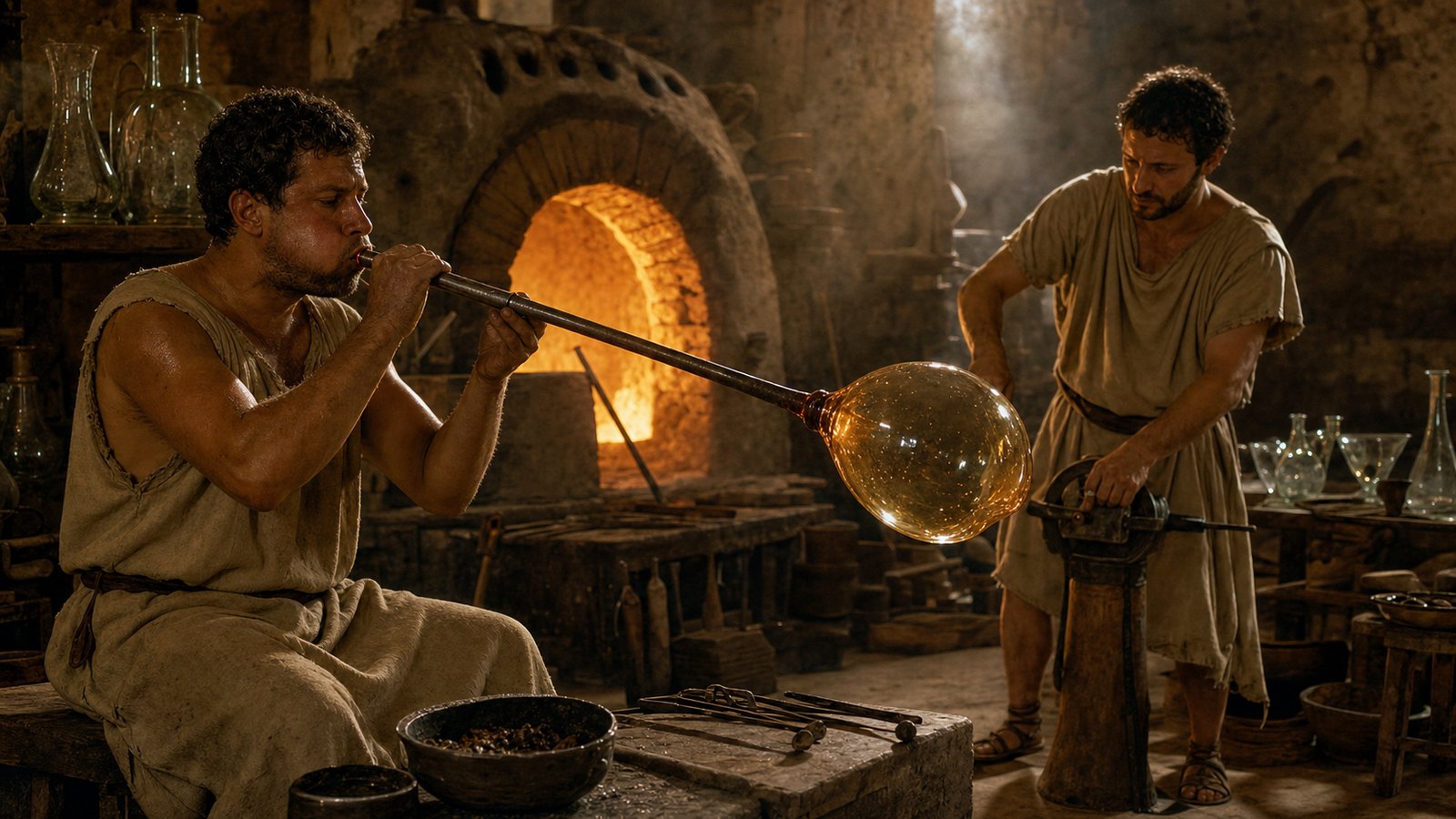
A hollow pipe gave the craftsperson two abilities at once. Its working end could collect a gather from the furnace, while its open end remained a route for air. The gather adhered because the glass was hot and plastic. A breath then increased pressure inside the soft mass, pushing it outward around an empty center. The vessel’s defining space was made by air rather than carved away afterward. This economical move distinguished blowing from methods that depended on shaping a solid core or pressing a compact mass.
The pipe also kept the hands at a necessary distance. The worker could hold and turn the tool while the luminous glass remained beyond direct touch. Heat still governed every decision: too cool and the wall resisted expansion; too soft and it sagged or collapsed. Returning the piece toward the furnace restored workability, but each reheating cost time and risked distortion. The craft lived in repeated judgments about viscosity that could be read from movement, glow and response.
The earliest spread of blowing in the Roman world, after its emergence in the Syro-Palestinian region around the middle of the first century BC, depended on that close partnership between material and tool. The innovation was the controllable hollow interior: the pipe let a worker enlarge volume without adding another core or carving away mass.
Rotation kept the growing bubble on its axis
Once air entered the gather, symmetry was not guaranteed. Gravity always favored the lowest part, and a stationary bubble could thicken on one side while thinning on another. Turning the blowpipe distributed that pull around the circumference. The worker rolled the pipe steadily while watching the profile, using rotation as a correction that operated over the whole vessel rather than at one point. A centered gather gave the next breath somewhere predictable to go.
This explains why blowing was skilled coordination rather than forceful exhalation. Breath altered volume; rotation controlled where the softened wall settled; the bench and simple tools supported the pipe and refined the outline. The finished transparency could hide that muscular sequence. A thin Roman cup may look almost weightless, yet its regularity records the worker’s success in managing a hot material that was constantly trying to leave the intended axis.
Rotation also gave assistants a shared rhythm. One person could prepare tools or manage the furnace while the blower kept the piece moving on the bench. Stopping to explain every correction was impossible once glass softened, so workshop coordination followed the object’s thermal state and the steady turning needed to prevent one heavy side from taking over.
Free blowing let one bubble become many forms
In free blowing, the vessel was shaped without being expanded against a complete enclosing mold. The worker could lengthen the bubble, flatten a base, narrow a neck or widen a mouth while turning the pipe. Paddles, shears and other tools touched the exterior only while heat made change possible. The same basic inflation could therefore lead toward markedly different containers. Variety came from the sequence of breaths, rotations, reheatings and local adjustments rather than from a separate rigid form for every outline.
The spread of this technique through the Roman world made hollow glass part of a broader material landscape. Blown containers could stand beside the oil lamps that extended work after dark and the pottery used in kitchens and shops. Glass did not replace those materials everywhere. It offered different combinations of visibility, wall thinness, color and shape, while demanding fuel, prepared raw material and workers fluent in a narrow thermal window.
Roman blown glass survives in varied colors and forms, evidence that the basic bubble was a starting point rather than a fixed product. A container’s usefulness depended on proportions: a stable base, a neck suited to pouring or closure, and walls thin enough to be economical but strong enough to survive handling after annealing.
A mold traded improvisation for repeatable surfaces
Mold blowing began from the same hot bubble but used a prepared enclosure to control its exterior. As the worker blew, glass expanded until it met the mold wall. Relief, ribs or a repeated body shape could then appear without being formed entirely by hand on each vessel. The mold did not eliminate skill: the gather still had to contain enough material, enter at the right temperature and inflate without folding or leaving weak areas.
Repetition mattered in a market where recognisable forms could be made again. It connected vessel production to the organized labor explored in Roman workshops. Yet a mold-blown body still required finishing after it emerged. Seams, base, neck and mouth could reveal the order of manufacture. Standardization was a guided stage inside the process, not a modern machine delivering a complete object at one stroke.
Mold walls could also carry repeated relief that remained legible after cooling. That possibility made the mold part of surface design as well as volume control. Free-blown and mold-blown vessels should not be treated as rival inventions; both used inflation, and makers could choose how much geometry came from breath, tools and an enclosing form.
The mouth had to be finished from the opposite end
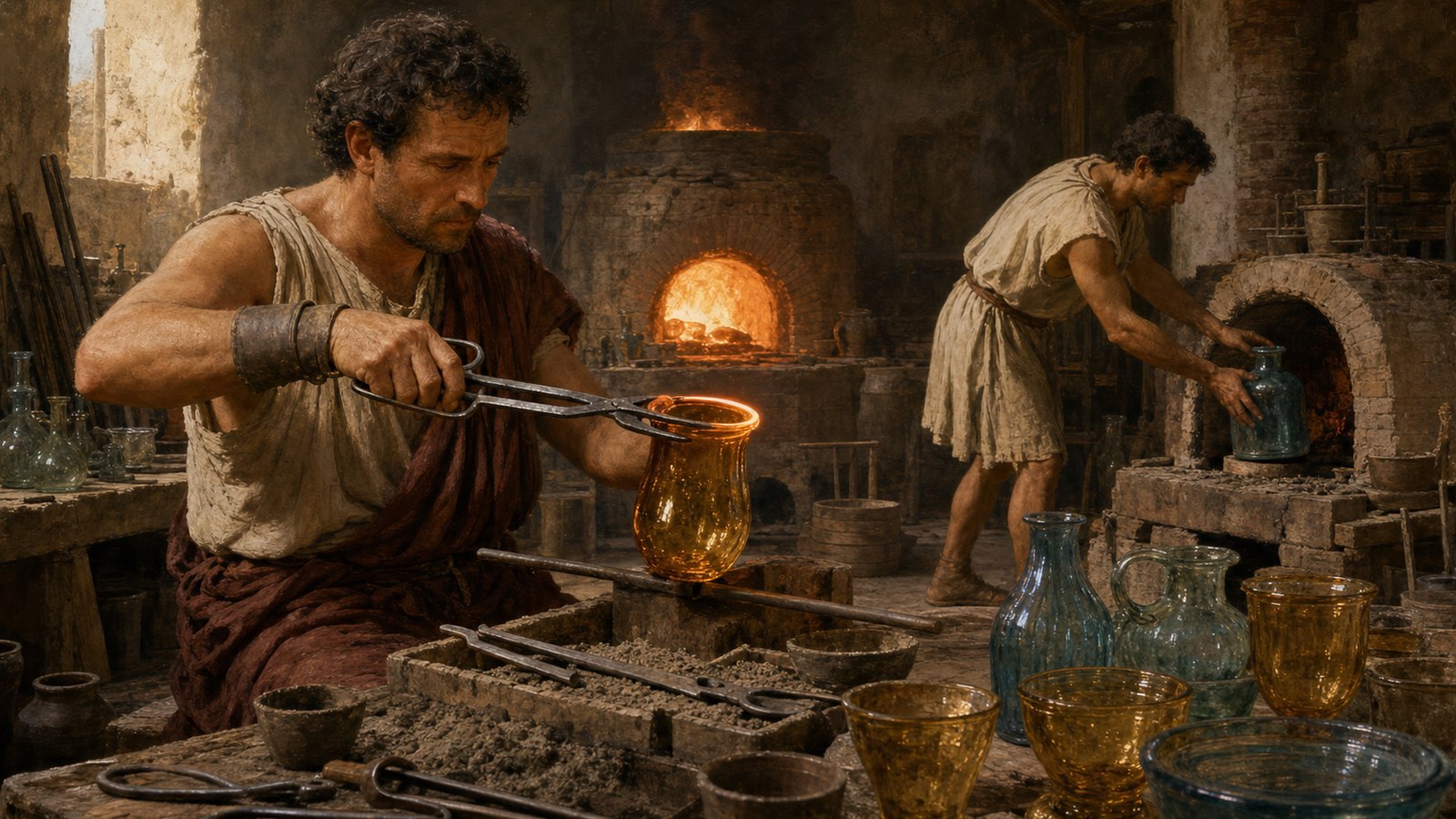
A vessel attached to the blowpipe could not have its open rim completed while that pipe occupied the mouth. Glassworkers solved the sequence by transferring the body to a pontil, a holding rod fixed to the base. The piece could then be separated from the blowpipe and its opening reheated. Tools widened, trimmed or smoothed the rim while the pontil carried the vessel. The object changed orientation because access to its unfinished edge mattered more than keeping one attachment throughout.
This transfer concentrated risk near completion. A weak connection could drop the vessel; too much local heat could deform the body; a rough break at the mouth required careful correction. The pontil mark left on many vessels is therefore not random damage but evidence of handling. It points back to the moment when a closed bubble became an open container capable of receiving, pouring and being cleaned.
The opening determined daily use. A bottle neck restricted flow and accepted closure; a broad bowl gave access; a drinking rim needed comfortable smoothness. Finishing therefore translated a successful bubble into a specific vessel. Until the mouth was opened, reheated and corrected, the hollow form had not yet become practical tableware or storage.
Slow cooling decided whether the shape would survive
Glass that looked finished could still contain destructive stress. The outer surface and inner wall did not cool at identical rates, especially where thickness varied. Annealing reduced that danger by allowing the vessel to cool gradually through the temperature range in which stress accumulated. The dramatic acts happened near the furnace mouth, but controlled cooling completed the craft. A cup removed too abruptly could fail after all the visible shaping was done.
The distinction from Roman window glass is now clear. Both depended on heat and cooling, but the blown vessel was organized around an enclosed volume, a rotating pipe and a finished mouth. Breath created the void; practiced motion distributed the wall; tools and molds gave it use; annealing kept it whole. The light object on a table was the final, cooled record of pressure, gravity and timing held in balance.
Annealing also preserved earlier labor against delayed failure. Internal stress is invisible, so a vessel could appear sound when it left the pipe and crack later if cooled badly. Controlled temperature descent was the final test of workshop discipline: after rapid, visible shaping, makers had to accept a slower stage in which restraint protected the result.
Sources & Further Reading
- Glassblowing
- Glassblowing process
- Roman glass