
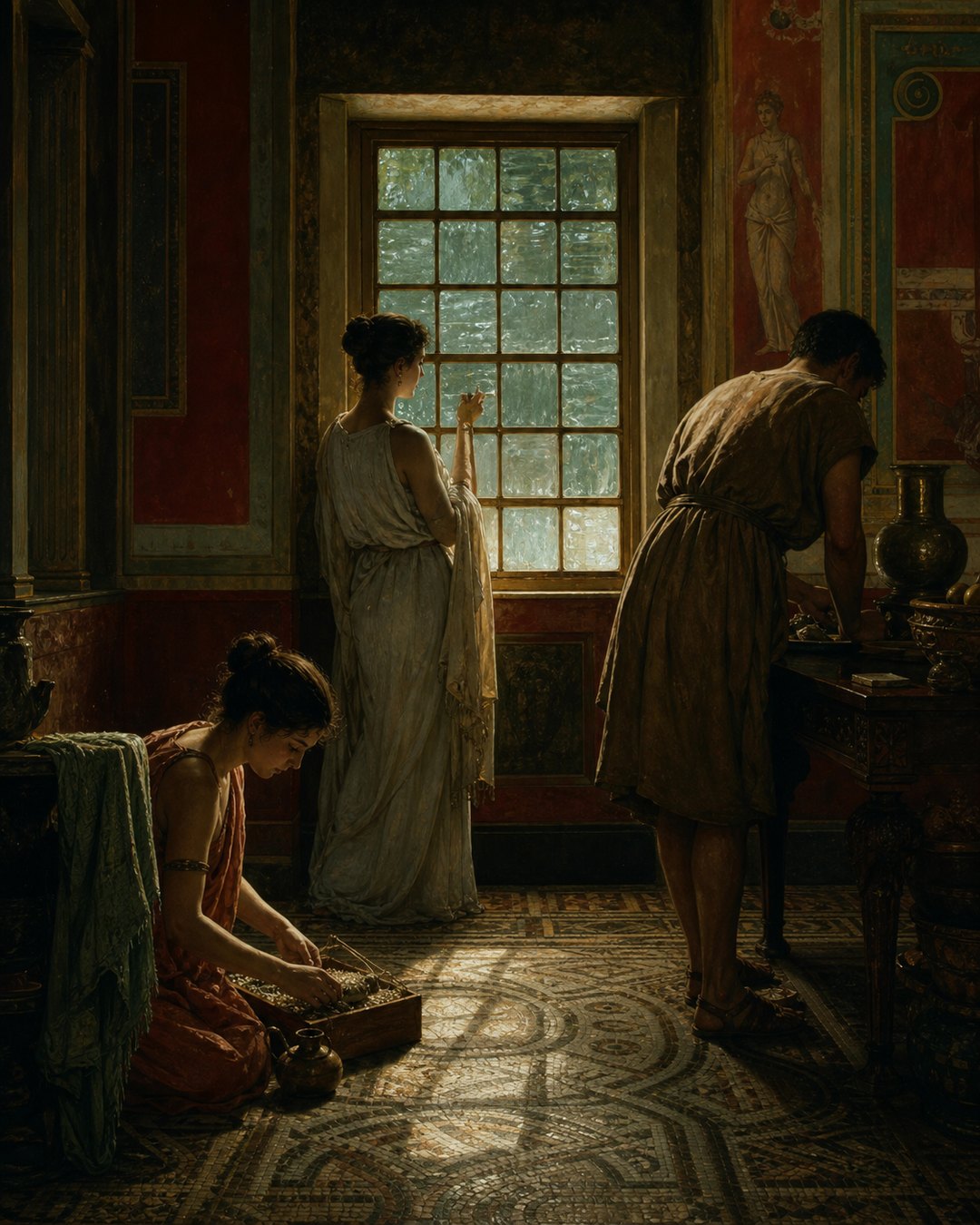
A Roman window pane did not have to show a perfect landscape to change a room. Pale blue-green glass, cloudy with bubbles and ripples, could turn hard sunlight into a diffuse glow. The wall remained closed against a gust or shower, yet the interior no longer depended entirely on an open doorway, courtyard, lamp, or smoke-blackened shutter.
This was a new architectural bargain. An opening had once forced a sharper choice between light and enclosure. Glass let builders negotiate. Small panes in a frame admitted day while preserving more warmth, security, and separation than an empty hole. Their imperfections were not failures beside modern plate glass; they were the physical record of a difficult material being asked to perform as wall.
A pane began as minerals and furnace discipline
Roman glass depended on a mixture dominated by silica, combined with flux and stabilizing ingredients that allowed it to melt and remain useful after cooling. Raw materials did not resemble a finished window. Heat had to turn granular matter into a workable liquid without filling it with ruinous contamination.
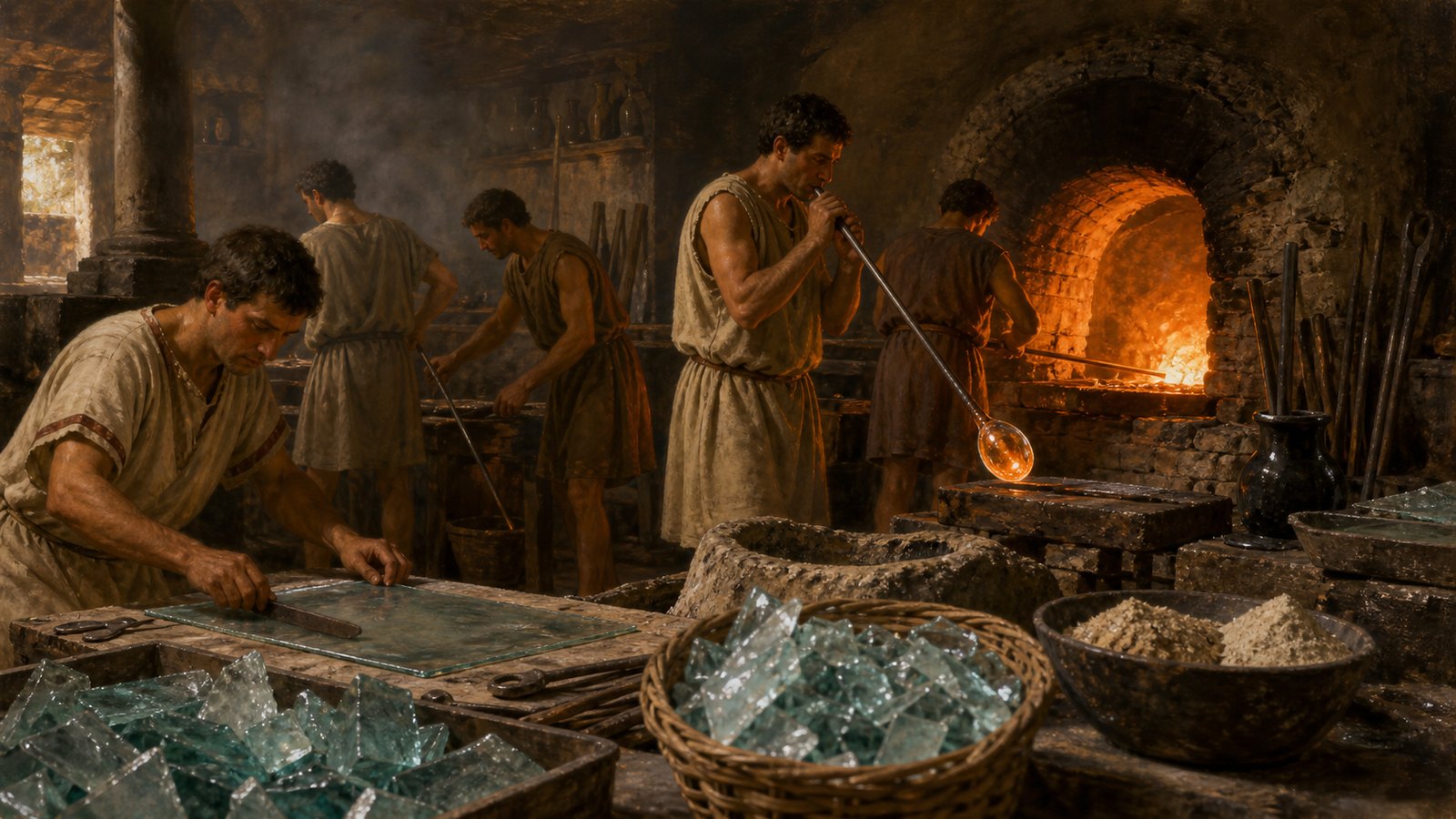
The furnace demanded fuel, airflow, refractory surfaces, and workers able to judge color and viscosity. Glass could be too stiff to shape, too fluid to control, or shocked into cracking by uneven cooling. Every surviving pane therefore records heat managed over time, not simply sand becoming transparent.
Natural impurities often gave Roman glass a blue-green cast. Decolorizing and coloring practices could alter appearance, but architectural panes did not need jewel-like purity to transmit light. A cloudy sheet could still transform an interior by replacing darkness with a visible daytime rhythm.
Broken glass retained value because cullet could be collected and remelted. Recycling lowered part of the material cost and tied workshops to networks of scavenging and transport. A shattered vessel or pane could return to the furnace as feedstock rather than ending its economic life.
Workers had more than one route to a flat sheet
Roman window glass did not emerge from one universal technique. Some panes were cast as thick sheets and then worked; blown methods could also produce flatter pieces from a formed cylinder or opened bubble. Each route left characteristic surfaces, edges, thickness changes, and tool marks.
Casting could make a pane whose two faces differed, with one side carrying contact traces from a surface or mold. Grinding and polishing improved transmission but added labor. A builder had to decide how much clarity justified how much finishing.
Blown glass exploited the flexibility of a bubble. A worker gathered molten material on a pipe, inflated it, and manipulated the hot form before cutting and flattening selected sections. Timing mattered because glass moved only within a narrow temperature range.
These methods place window production beside the Roman effort to make building components repeatable. Neither brick nor pane was perfectly uniform, but standardized intentions allowed many separate objects to become one planned wall.
Small panes made imperfection buildable
A large flawless sheet magnifies every weakness in material and cooling. Roman builders often avoided that demand by dividing an opening. Frames, bars, or lattices held multiple smaller pieces, allowing one wall to gather light from panes that no single artisan had to produce at monumental scale.
The grid also localized damage. One cracked piece could be replaced without discarding the entire opening. Joints and frames still leaked more than a modern sealed unit, but they converted fragile glass into maintainable architecture.
The view through such a window was secondary to illumination. Ripples, bubbles, thickness, color, and the lattice broke the scene outside into fragments. Movement might register as shadow and color rather than a crisp face. Privacy and light could therefore coexist more readily than modern transparency suggests.
A person standing inside read the glass through effects: a bright patch on plaster, softened glare on mosaic, the outline of a passerby, rain striking without entering. The pane was experienced less as an invisible absence than as a luminous material surface.
Bathhouses gave glazing a demanding job
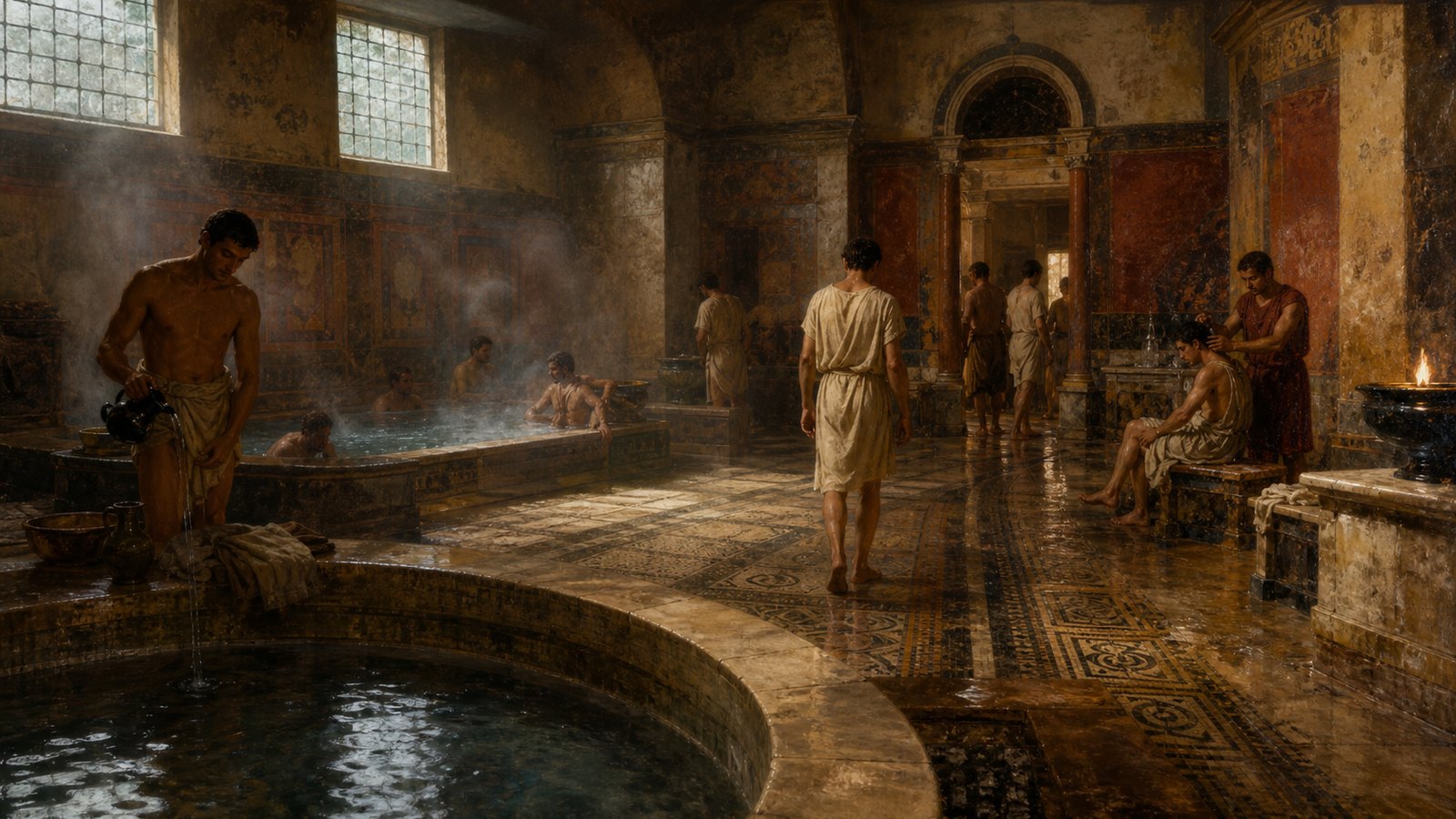
Warm bath rooms needed daylight, but a completely open window surrendered heated air and admitted winter wind. Glass could close an opening while letting the sun and sky remain useful. In a building that consumed fuel continuously, limiting heat loss had practical value.
Moisture made the task harder. Frames sat amid steam, condensation, masonry, and changing temperatures. Water gathered on panes and joints. Maintenance crews had to watch cracked glass, decaying wood, loosened fittings, soot, and mineral deposits that reduced the light the window was meant to provide.
High placement could protect panes and bathers while distributing illumination over pools and vaults. The glass did not create modern thermal insulation, yet it improved the choice available to designers: warm enclosure no longer required total darkness.
This complements the social machinery of Roman baths. Furnaces, water, attendants, schedules, and architecture made collective bathing possible; glazing helped the rooms feel open to day without being open to weather.
A glazed room announced controlled resources
Window glass was not equally available in every house or district. It required materials, furnace work, finishing, transport, framing, and replacement. A glazed opening therefore condensed several supply chains into one quiet architectural detail.
Installation added another craft boundary. Masons had to leave an opening true enough for a frame; carpenters or metalworkers divided it; glazing material secured brittle edges without forcing the pane to carry the wall. A poor fit could rattle in wind, admit rain, or concentrate stress until a corner cracked. The successful window was therefore a collaboration rather than a glassmaker’s isolated product.
Owners could use that investment to separate themselves from street dust, noise, wind, and intrusion while retaining light. The benefit was practical, but it also marked a building whose occupants could afford a more selective boundary between inside and outside.
Public buildings spread the impression differently. A bath, basilica, or elite reception room with glazing made controlled brightness part of civic or patronal display. Visitors encountered technology not as a portable luxury but as an atmosphere surrounding them.
The social effect should not be exaggerated into universal glass cities. Many Romans still lived with shutters, curtains, small openings, courtyards, and lamps. The significance of glazing lies in expanding the architectural menu, not replacing every older solution.
The wall learned to admit light selectively
Glass ages badly in some soils and survives brilliantly in others. Fragments can be mistaken for vessel pieces until edges, surfaces, thickness, and find context point toward architectural use. A shard near a window opening tells a different story from one beside a dining service.
Its color also changes modern expectation. Museum cases often display Roman glass under direct light, where aqua tones appear beautiful and obvious. Installed in a dim building, the same material worked through restrained illumination, shadow, condensation, and the repeated geometry of its frame.
The technology mattered even when no person admired the pane itself. Work continued longer in daylight. Steam stayed more contained. Rain stopped at a luminous barrier. Rooms could be watched, warmed, or decorated under conditions that an uncovered opening could not provide.
Roman window glass changed what a wall could do because it separated functions that had once arrived together. Light no longer required the same amount of wind, rain, and access. An imperfect pane made enclosure selective—and that modest ability reshaped the feeling of interior space.
Sources & Further Reading
- World History Encyclopedia, Roman Glass
- Smith Dictionary, Vitrum
- Roman glass overview and references