
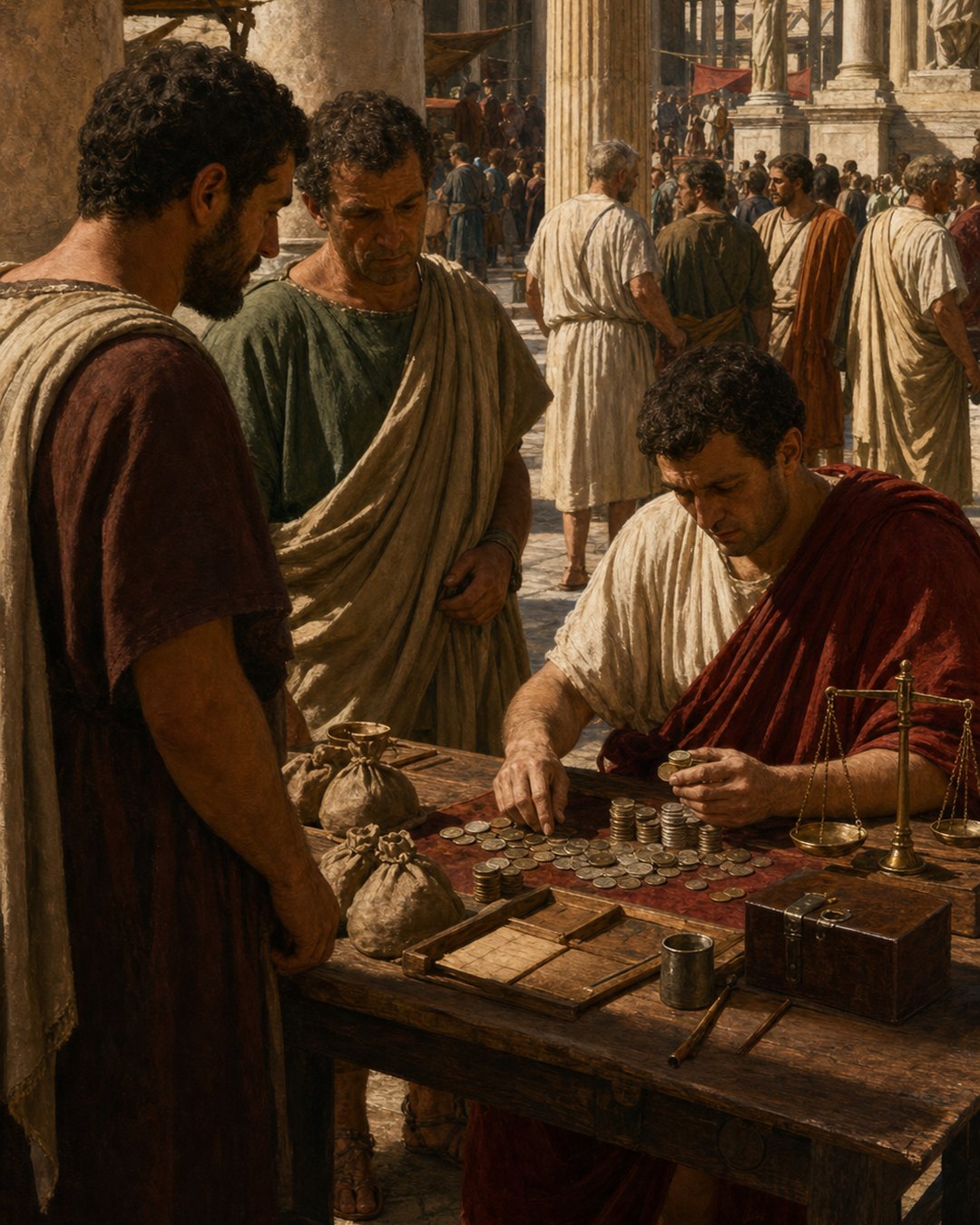
A Roman banker could make confidence visible with ordinary objects. Coins landed on wood. A small balance tipped. A stylus opened a pale line in wax. Sealed purses, witnesses, account names, and the banker’s location gave a transaction a shape that memory alone could not provide.
The argentarius did not make risk disappear. He made it manageable enough for strangers and delayed promises to enter commerce. At his table, worn coins became weighed value, a deposit became a written obligation, and an auction purchase could be settled without every participant carrying the full price in one bag. Trust became procedure performed in public.
Coins had to be judged before they could be counted
Roman money arrived in mixed condition. A coin could be clipped, worn, plated, foreign, old, newly issued, or unfamiliar to the person receiving it. A stamped face promised authority, but everyday acceptance still depended on metal, weight, denomination, and confidence that someone else would take it next.
A money specialist examined surfaces, listened, weighed, compared, and counted. Scales and known weights translated suspicion into a repeated test. The result was not modern laboratory certainty, yet it was stronger than an untrained glance at a crowded handful.
Exchange added another layer. Merchants and travelers encountered different issues and units across the empire and beyond it. Converting one acceptable form into another required rates, fees, knowledge, and a willingness to hold coins whose next buyer might judge them differently.
The banker’s table made these judgments observable. A client could watch pieces separated and weighed. Rivals could learn a local rate. Reputation accumulated around consistency: the argentarius who accepted bad metal or manipulated measures endangered more than one transaction.
A deposit converted possession into a claim
Handing coins to a banker changed the form of control. The depositor no longer possessed each piece physically. Instead, he held a claim supported by the banker’s records, assets, reputation, and legal obligations. Convenience arrived together with dependence.
Deposits reduced the need to carry money through crowded streets or keep every reserve in a house. They also allowed payments to be made from an account. When two parties used compatible arrangements, a balance could move through notation rather than sacks crossing the Forum.
The abstraction still rested on material acts. Coins had to enter somewhere; names and sums had to be recorded; instructions had to be recognized; disputes required evidence. Wax tablets, witnesses, seals, and repeated dealings gave an invisible balance physical anchors.
This was trust with failure built into it. A banker could misrecord, lend badly, become insolvent, deny an instruction, or disappear. Clients therefore judged not only promises but location, associates, longevity, and whether other respected people continued to use the same table.
Account books gave memory an adversary
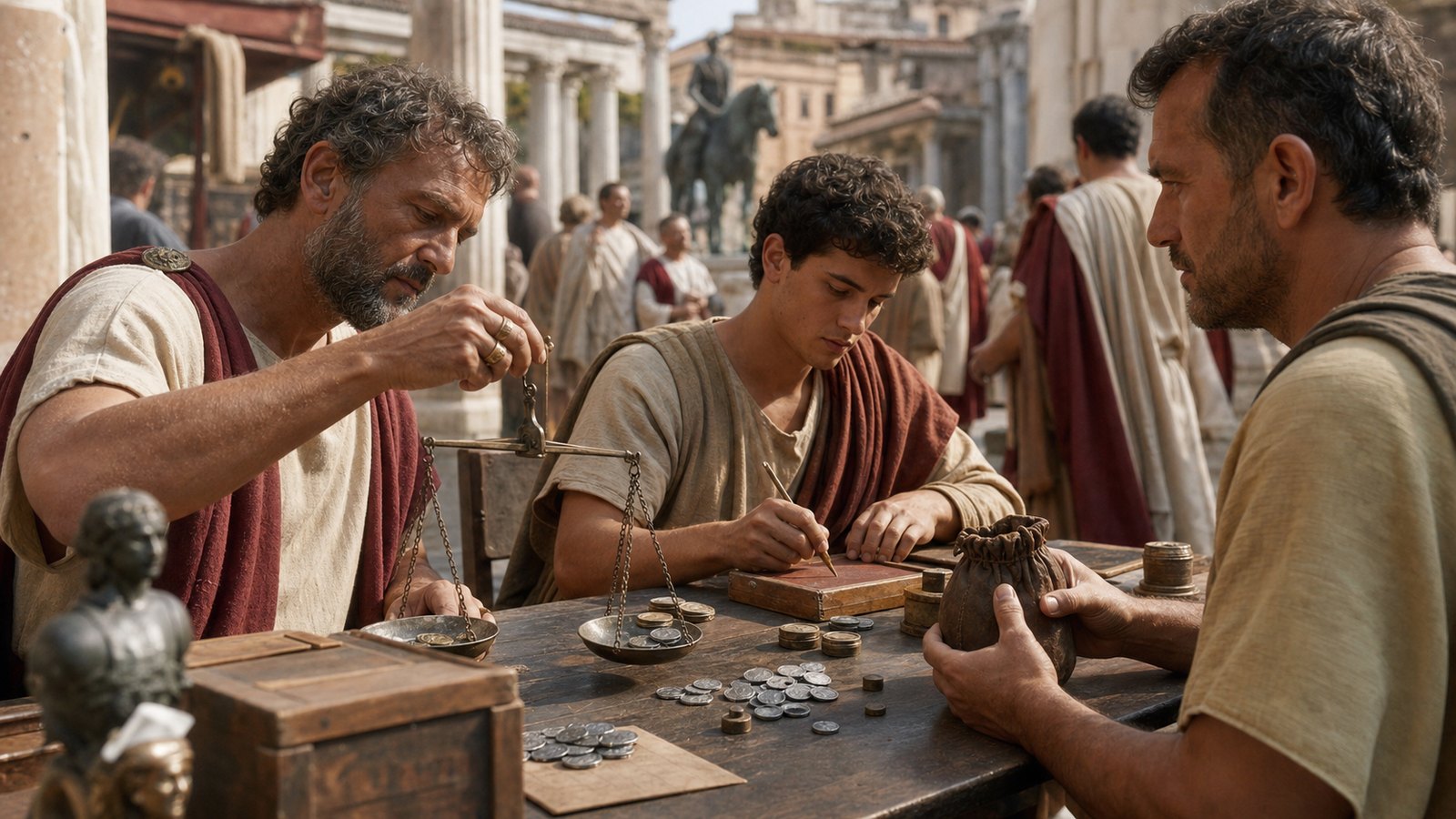
Commercial memory is vulnerable because each participant remembers the favorable version. Written accounts created a separate object that could be produced, checked, copied, or challenged. The banker’s record did not guarantee truth, but it narrowed the range of plausible stories.
Entries had to connect people, sums, dates, instructions, and outcomes. One mistaken name could redirect value; one omitted payment could manufacture debt. Clerical discipline was therefore part of finance, even when later writers preferred to discuss wealth as possession rather than handwriting.
Records also extended transactions through time. A loan made today could specify an obligation after a voyage, harvest, or sale. The account held the interval while people and goods moved elsewhere. Credit was a way of organizing waiting with consequences.
That mechanism complements the wider Roman reliance on archives. A state record made offices remember beyond one official; a banker’s account made a commercial relationship resist the convenient forgetting of either party.
Auctions joined public bidding to private capacity
At an auction, the loudest bid did not complete the sale. Someone still had to identify the buyer, calculate the amount, settle commissions or obligations, and turn a spoken promise into payment. Argentarii could work where this conversion was needed.
The auction setting concentrated uncertainty. Goods might come from estates, debts, contracts, or public action. Bidders compared value under time pressure while rivals watched. Credit could let a buyer act before assembling every coin, but it transferred immediate certainty from cash to the standing of buyer and banker.
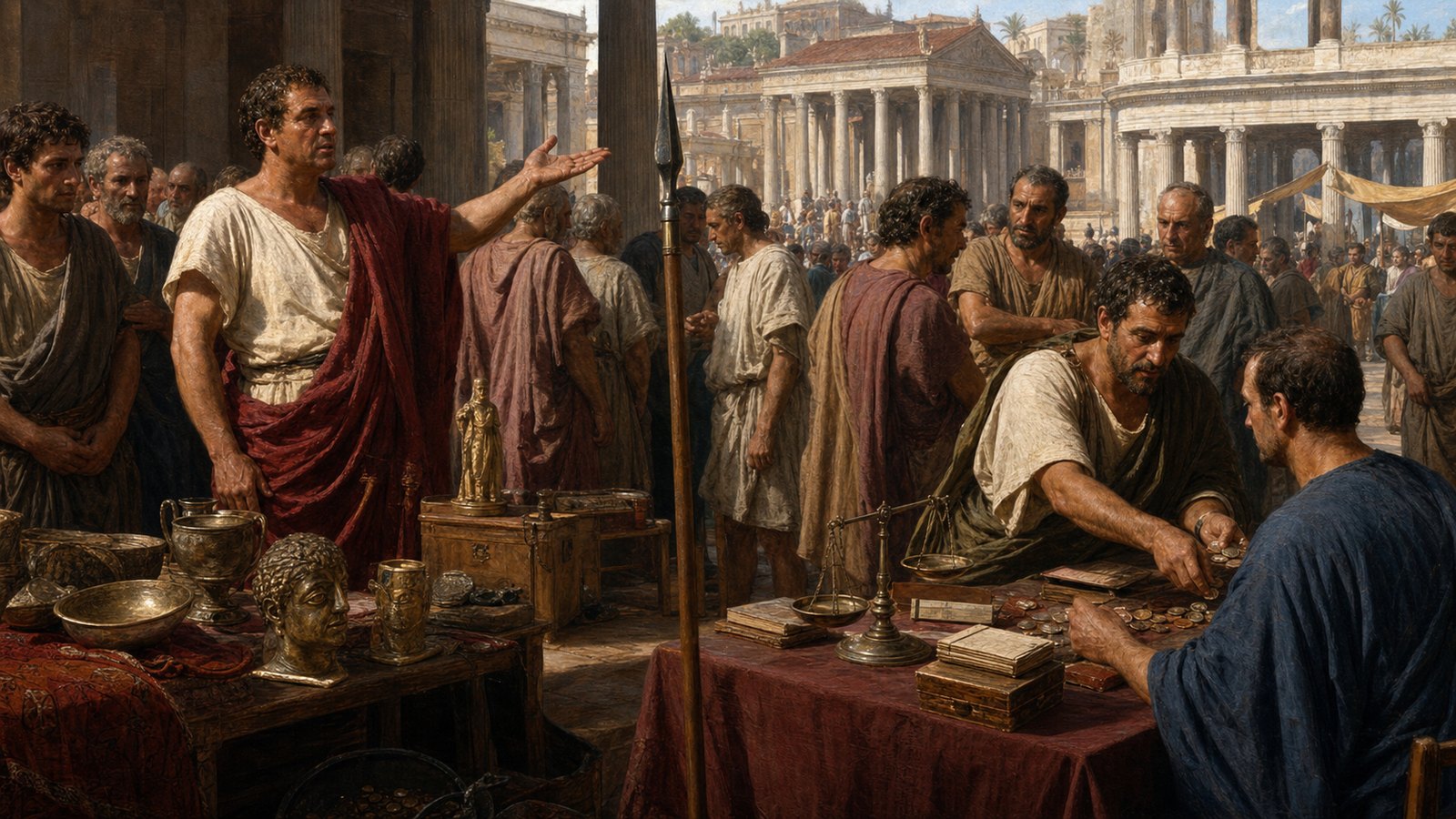
This placed finance beside the spear and ceremony of Roman auctions. The spear signaled recognized authority; the account table handled the quieter question of whether the winning words would become settled value.
A mini-scene reveals the sequence. The auctioneer closes the bid. The buyer pushes through the crowd. Coins appear, but not enough for the full sum. A banker checks a tablet, recognizes a balance or credit, records the obligation, and lets the transaction move from shouted competition into enforceable aftermath.
Long trade routes enlarged the need for financial memory
Roman commerce linked ports, farms, mines, workshops, warehouses, and cities. Goods moved slowly and faced storms, theft, spoilage, tolls, and changing prices. Payment made entirely at one instant could not fit every journey or partnership.
Partnerships could divide capital, labor, information, and exposure among several people. One participant might remain in Italy while another traveled with cargo or worked through an agent abroad. Financial records did not erase disagreement, but they gave the partners a shared sequence of advances, expenses, receipts, and expected returns to contest.
Credit distributed time across that network. A merchant could obtain goods before final resale, finance transport, or settle through associates. The same flexibility multiplied failure points because success in one city might depend on a ship, debtor, harvest, or correspondent somewhere else.
Bankers did not command the Mediterranean, but they helped commercial actors express obligations in forms that could outlast a meeting. Accounts and recognized relationships gave distant movement a local point of reference.
This is why coin piles alone cannot explain Roman trade. Coins were essential, but procedure determined when they moved, who accepted them, and what happened when they were absent. Finance connected the metallic present to an uncertain commercial future.
Public visibility disciplined an invisible business
A deposit balance cannot be inspected like an amphora. Clients needed indirect evidence that the banker remained reliable. A known table, regular opening, familiar clerk, careful measure, orderly record, and continued use by others made financial capacity socially legible.
Visibility could also invite pressure. Disputes occurred near witnesses and competitors. A damaged reputation might spread through the same commercial crowd that supplied customers. Public location converted gossip into a rough enforcement mechanism alongside formal legal remedies.
The table itself anchored identity. A client knew where to return with an instruction, a question, or a complaint. Regular presence reduced the anonymity that makes a promise cheap. Even when the banker acted through clerks, the fixed place connected a name to observable conduct over many market days.
Status remained unequal. Wealthy clients could negotiate, diversify, use networks, and survive delay. Small depositors were more exposed to one failure. The professional vocabulary of finance did not make every participant equally informed or protected.
Roman bankers made trust visible at a table because their most important product could not be seen directly. Solvency, memory, and future performance had to be inferred from tools, records, location, witnesses, and repeated conduct. The table was modest furniture, but around it coins became claims and promises entered the economy.
Sources & Further Reading
- Smith Dictionary, Argentarii
- Banking in ancient Rome overview
- World History Encyclopedia, Trade in the Roman World