
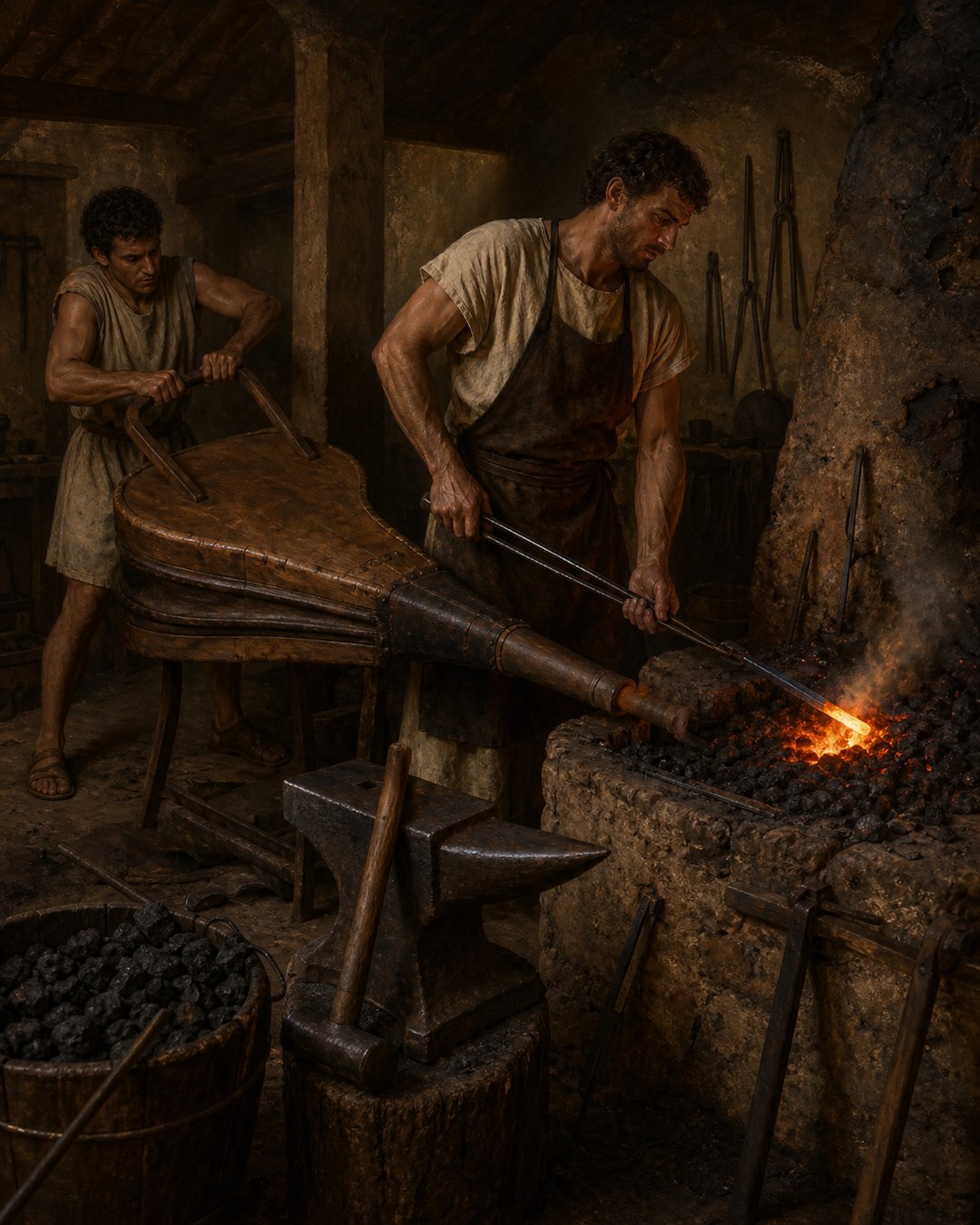
A Roman smith did not need every coal in the workshop to burn with equal violence. The useful place was smaller: a fiercely heated working zone where iron could be brought back from dark red toward a heat suitable for shaping. Fuel alone could not reliably maintain it. The fire needed moving air, delivered repeatedly and aimed beneath or into the fuel rather than scattered across its surface.
That task belonged to two connected devices. Bellows gathered and compressed air; a tuyere carried the resulting blast into the hearth. Vitruvius treated the blacksmith’s bellows as such an ordinary machine that he listed it among familiar devices requiring no explanation. Its familiarity should not hide its precision. Each expansion, valve movement, compression and outlet position helped turn an open charcoal fire into a controllable metallurgical tool.
The bellows made a stored breath from ordinary air
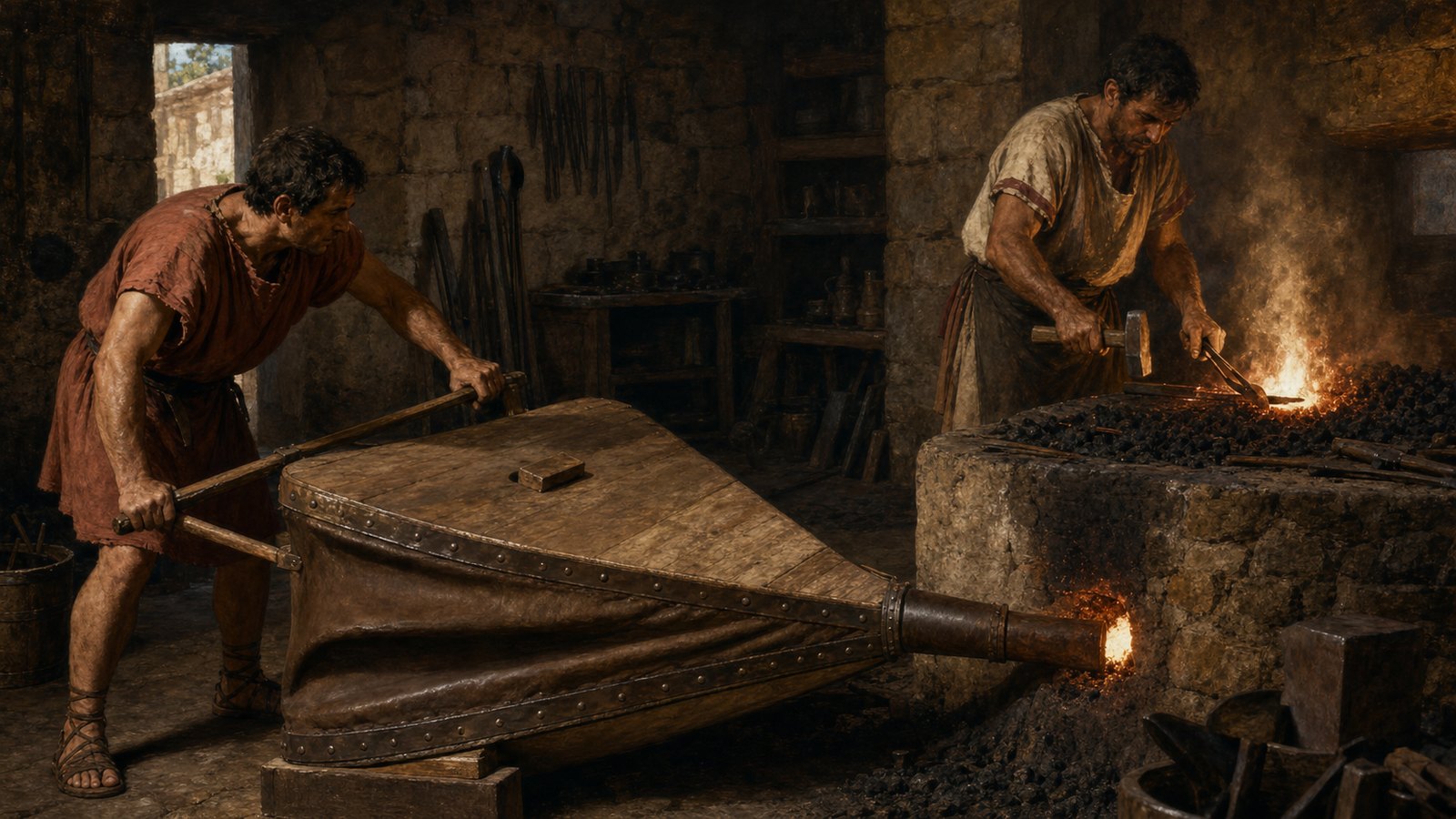
A simple bellows enclosed a flexible cavity between rigid boards, commonly represented as boards joined by leather sides. Pulling the handles apart increased the cavity’s volume and admitted air through a valve. Pushing them together reduced that volume. The captured air then had only the intended outlet available, so a broad hand movement became a narrower stream. The smith’s helper was not creating air, but packaging and redirecting it.
The valve divided the cycle into intake and delivery. On the opening stroke it allowed the cavity to refill instead of drawing exhaust backward through the nozzle. On compression it discouraged air from escaping by the easy route through which it had entered. This one-way behavior made repeated strokes useful. Without it, much of the operator’s effort would merely shuttle air in and out of the same opening.
Bellows therefore converted a sequence of slow, manageable motions into intermittent pressure. The operator could change cadence, shorten a stroke or pause, and the fire answered after air reached it. That relationship was practical rather than theoretical. A worker learned the resistance of the handles and the response of the coals, using movement as a control that could be adjusted while the smith watched the metal.
The tuyere put the blast where charcoal mattered
Air leaving the bellows still needed a route into the hearth. The tuyere—simply a tube, nozzle or pipe in functional terms—provided that final passage. It protected a defined airway through the hearth wall or edge and established the direction from which the blast entered. Instead of fanning the top of the fire, the system delivered moving air into a chosen region of the fuel bed.
That placement made the forge uneven on purpose. The fire became hotter in front of the blast than it would have been without forced air. Coals near the tuyere formed the active zone; coals farther away could burn less fiercely. The smith could place the part of an object needing heat near the active zone while keeping another part outside it, concentrating fuel and effort rather than heating the entire workshop indiscriminately.
The same attention to directed furnace conditions appears in the archive’s account of Roman glassblowing, although glass and iron demanded different operations. In both crafts, heat was not a background element that happened by itself. A furnace or hearth had geometry, an opening and a working position. The tuyere gave the smith’s fire a fixed point around which those decisions could be organized.
More air made fuel react faster, not fuel last longer
Bellows raised heat output by supplying additional air to the fuel and increasing the rate of combustion. The immediate benefit was a hotter working zone, but the cost was equally real: charcoal consumed more quickly when driven harder. A stronger blast could not multiply the energy stored in a basket of fuel. It released that energy at a greater rate, exchanging duration for intensity whenever the operator worked the handles.
This distinction explains why control mattered more than maximum effort. A relentless blast could waste charcoal while the smith repositioned a piece, judged its color or prepared to strike. Too little air let the active zone weaken. Useful operation lay between those extremes and changed through the job. Bellows allowed the air supply to follow the work instead of forcing every stage to accept one unchanging fire.
Charcoal was especially important in Roman smelting and forging, and it was made from wood. Its place in the forge joined woodland labor, transport and storage to the moment at the anvil. The bellows operator handled only the final release of a longer fuel economy. Each unnecessary stroke had a material cost, even if that cost disappeared visually as sparks, flame and a shrinking bed of coals.
The return stroke was part of the work, not a pause
In a simple bellows, compression delivered the stream and expansion refilled the cavity. The outward stroke could therefore feel unproductive because no comparable blast reached the hearth, yet it prepared the next delivery. A steady fire depended on both halves. Rushing the refill could limit the air available; delaying it lengthened the interval before the next pulse. Rhythm linked the operator’s body to the behavior of the fire.
The pulses also meant that “steady heat” did not require perfectly continuous airflow. Fuel and the hot hearth retained heat between strokes, while regular operation refreshed combustion before the working zone faded too far. The operator’s task was to keep those fluctuations within a useful range. Consistency came from repetition: similar movements at intervals the fire could absorb, altered when the smith called for more or less heat.
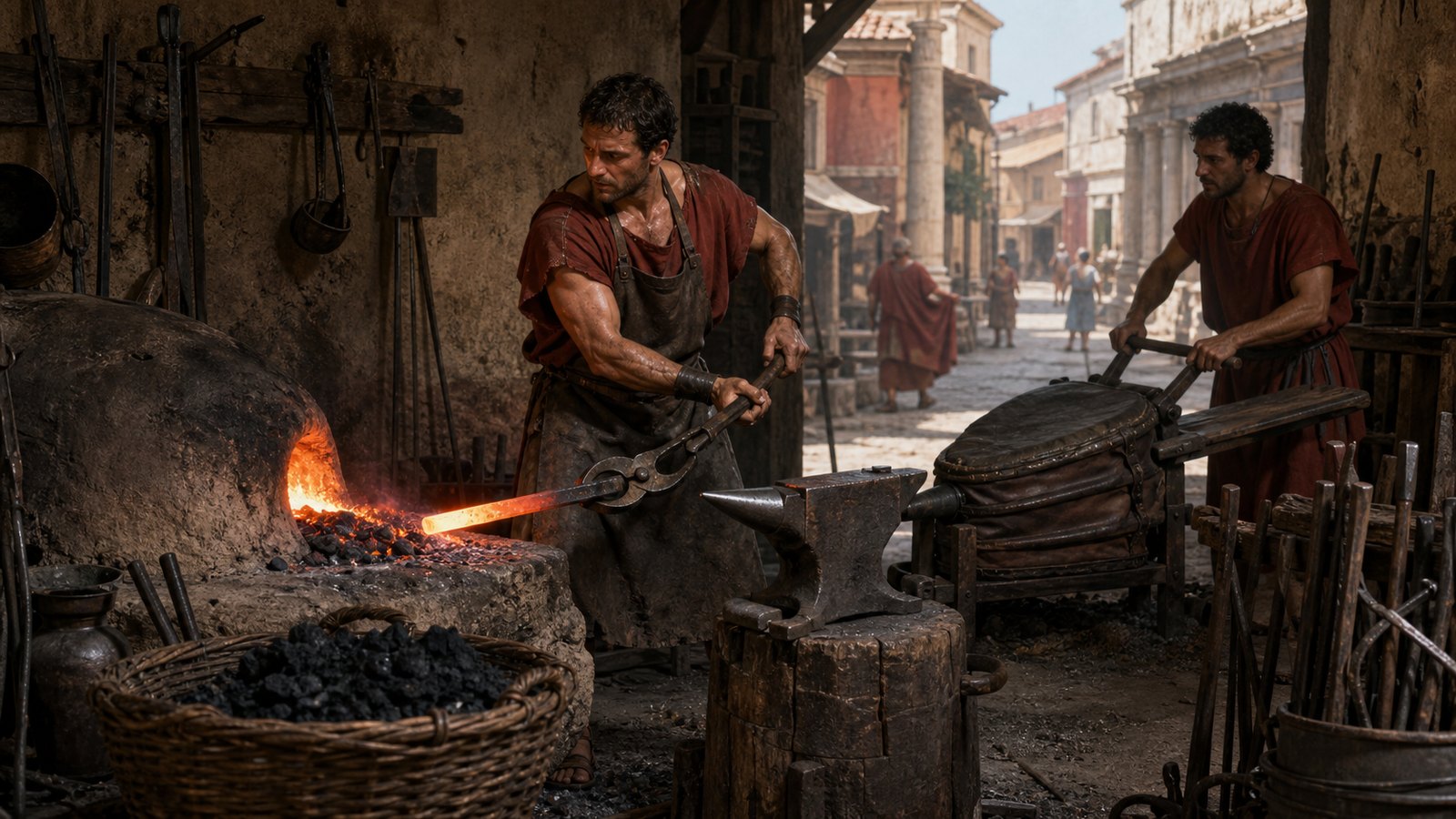
This was coordinated workshop labor. One person could watch the iron and command its position while another maintained the blast, or a smith could operate a suitable arrangement while working. The archive’s discussion of Roman workshops places craft within spaces visible to customers and neighbors. At a forge, the recurring movement and sound of bellows made otherwise invisible air control part of that public performance.
The hottest point was also the system’s vulnerable point
The tuyere ended where conditions were harshest. Its mouth faced the intensified combustion created by the air it carried. Ash, fragments of fuel and slag could interfere with the opening; damage or a poor connection could let the blast escape before reaching the intended zone. A bellows might continue moving normally while a blocked or leaking delivery path produced disappointing heat at the coals.
Diagnosis therefore followed the whole chain. Was the cavity filling? Did the valve behave? Did compression send air through the outlet? Was the connecting passage sound, and was the tuyere mouth clear? Weak heat did not identify a single cause. The coupled system worked only when intake, seal, stroke, tube and hearth opening all cooperated, making maintenance a matter of tracing air from room to fire.
Archaeology treats metalworking residues with similar attention to relationships. A fragment, a patch of slag or a burnt feature gains meaning from context rather than from dramatic appearance alone. Bellows made from organic materials are less likely to survive than fired, vitrified or mineral waste. Vitruvius’s casual reference is therefore valuable: it confirms that a machine easily lost in the ground could still be commonplace in Roman daily practice.
Combustion control continued all the way to the hammer
The bellows-and-tuyere system did not finish an object. It prepared a temporary condition in the metal, and the smith had to use that condition before the piece cooled. Iron moved between hearth and anvil repeatedly as different areas required heating and shaping. Air control, placement in the coals, withdrawal and hammering belonged to one loop rather than to separate jobs performed once each.
That loop distinguishes forging from Roman lost-wax casting. Casting pours molten metal into a prepared void; forging repeatedly heats and mechanically reshapes solid metal. Both depended on careful heat, but the forge’s directed blast supported return after return to a localized working temperature. Bellows made those returns responsive instead of leaving them entirely to the natural draw of an open fire.
A Roman forge breathed only as metaphor, but the comparison catches the sequence: intake, compression, directed exhalation, response. The engineering lay in separating those stages and joining them with a valve and a tuyere. Charcoal supplied stored energy; the operator chose how quickly it was released; the nozzle chose where. The hammer gets the memorable sound, yet controlled air made the iron ready to answer every blow.
Sources & Further Reading
- Vitruvius, On Architecture, Book X
- Bellows
- Tuyere
- Roman metallurgy