
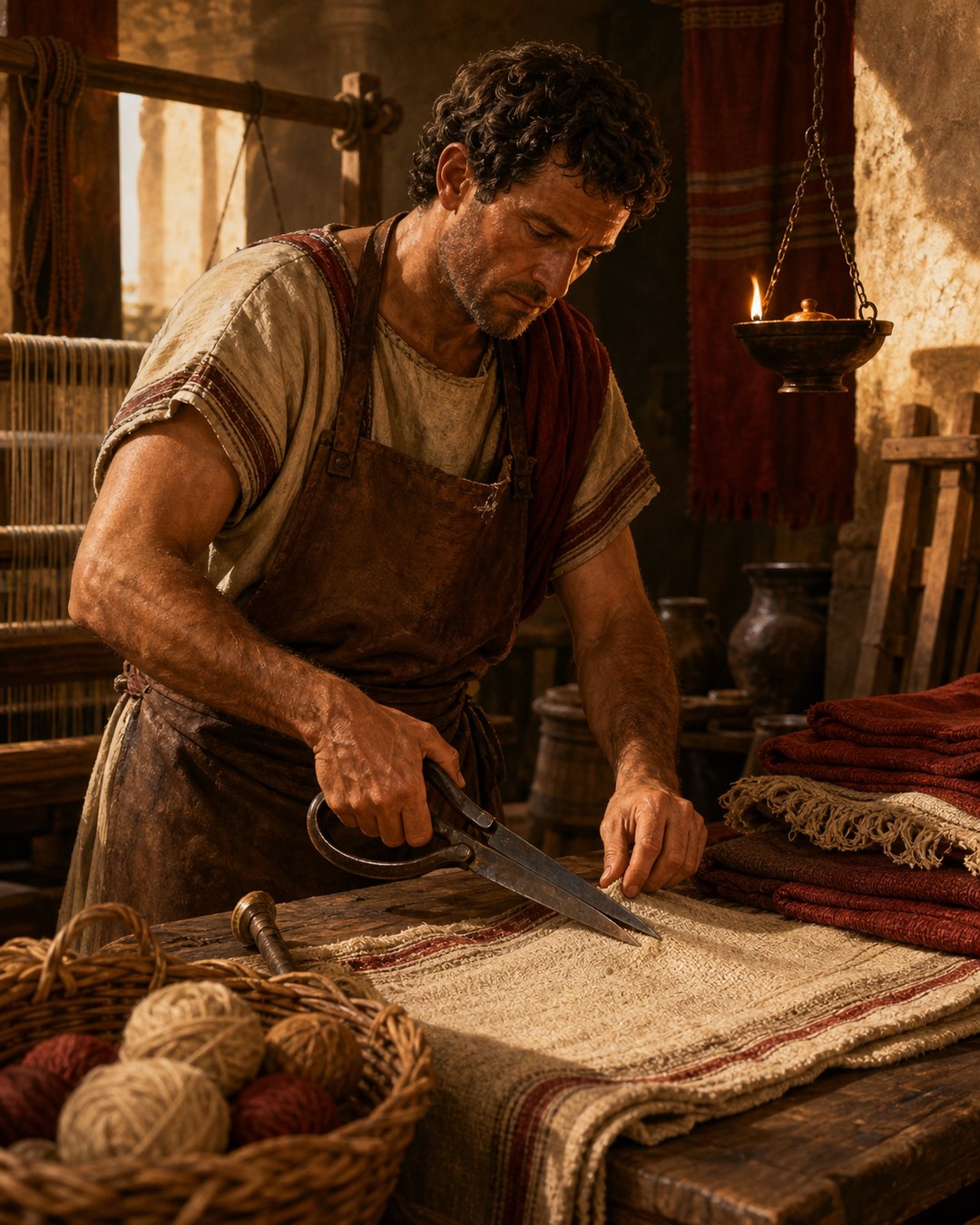
A single blade depends on a backing surface or on the material’s own resistance. Pair two edges and the problem changes: each becomes the other’s support. As a Roman shear closed, its edges passed side by side, trapping fibres along a moving line. Wool, cloth or hair did not have to remain rigid. The tool supplied opposition and force in one hand-held action.
Calling every such tool ‘pivoted scissors,’ however, pushes the evidence too far. The Getty definition reserves scissors for blades joined at a central pivot. The celebrated Roman-period pair in the Metropolitan Museum instead has a spring bow joining its two arms. Roman texts securely describe shearing, wool, goat-hair fabric and barbers, but they rarely diagram the implement. The useful history lies in the paired cut—and in keeping a flexible spring joint distinct from a central rivet.
Two edges created one moving cut
The geometry is demanding. Two sharp edges must approach closely enough to grip fibres, yet pass rather than collide. Hand pressure closes the blades; their inner faces guide each other; the crossing point advances toward the tips. Material ahead of it bends, compresses and separates. Paired blades bring the resisting surface with them, controlling a cut through something loose or difficult to hold flat.
Getty’s vocabularies preserve a useful modern distinction. Scissors have two bevel-edged blades, handles and a pivot in the centre. Shears is broader: two blades act simultaneously on opposite sides of what they cut. Roman vocabulary, translations and museum labels do not always map cleanly onto those categories. A Latin reference to clipping proves the operation more readily than it proves whether the worker held a bow spring, a riveted joint or another paired tool.
Whether opening force came from finger loops or a curved spring, the decisive action occurred where the edges crossed. The user made short bites and repositioned the material. Compared with a knife, the cut required less backing and exposed less free edge. For cloth beside a hand, fleece beside skin or hair beside a face, control mattered as much as sharpness.
The Roman survivor opens with a spring
The Metropolitan Museum’s pair is an unusually elaborate survivor. The catalogue places it in the Roman Period, perhaps in the second century AD, and records a possible origin near Trabzon. At 23.7 centimetres high, it is not a tiny sewing accessory. The listed materials—bronze or copper alloy, silver and possibly black copper—also separate it from an anonymous iron workshop tool. Its preservation gives us a real paired-blade object, not merely a word in a farming manual.
Its form matters more than the temptation to call it modern scissors. Two long arms descend into a rounded U-shaped bow. Squeezing brings the blades together; releasing lets the bow push them apart. There is no central screw with finger loops beyond it. The bow is joint, return spring and handle at once, storing the energy that prepares the next opening.
Decoration makes the object visually exceptional, but it cannot identify every task it performed. The Met calls it shears, not specifically a tailor’s, barber’s or sheep shear. Its copper-alloy construction and ornament are poor grounds for assigning it to a barn merely because Varro discusses sheep. The safest claim is narrower: a sophisticated Roman-period paired cutter existed, its blades were coordinated by a spring bow, and its catalogue data do not supply one exclusive use.
Wool made cutting seasonal work
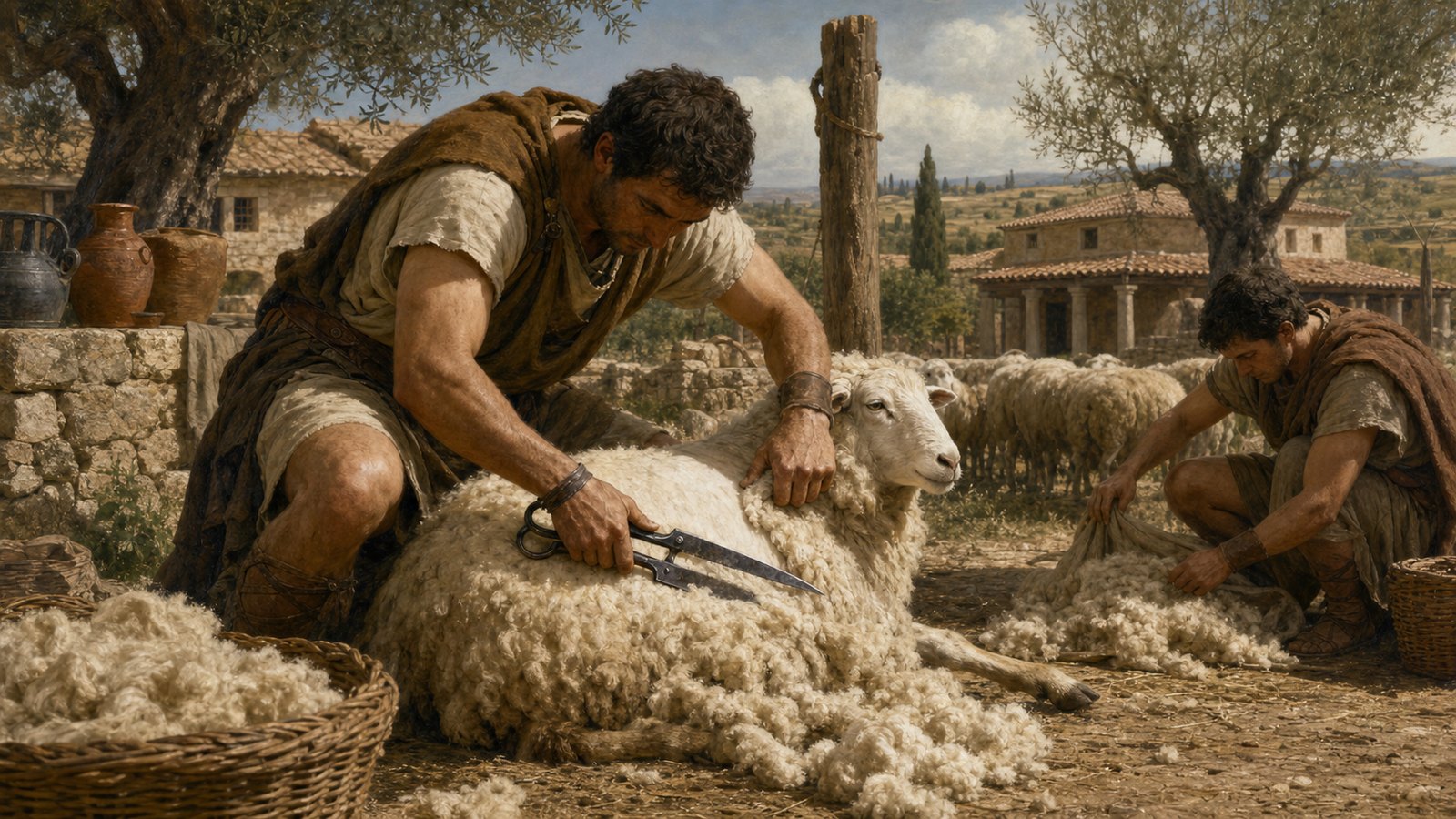
Varro gives the cutting operation an agricultural calendar. He places normal shearing between the spring equinox and the summer solstice, after sheep began to sweat. Coarse-fleeced animals could be shorn around the barley harvest, or elsewhere before hay cutting. The schedule tied tool work to weather, animal condition and other farm labour. Shearing was not simply ‘done in summer’; the writer describes choices within a crowded sequence of pasture, grain and fodder tasks.
The cut had economic consequences. Careful farmers, Varro says, spread cloths beneath the animal so wool would not disappear into dirt. In Hither Spain, some sheared every six months because they believed two harvests yielded more. Collected fibre still needed the tension of a Roman loom. Shears began the textile chain by separating a valuable coat without pulling the fleece out by hand.
The blade also carried risk. Varro instructs the farmer to inspect sheep for sores before shearing and to smear soft pitch on an accidental cut. That detail places the edge immediately beside living skin and shows why repeated short closures demanded restraint. A long blade could cover ground, but force alone was not skill. The worker had to hold the fleece under enough tension to admit the edge while keeping folds of skin away from the advancing crossing point.
From fleece to fabric, the scale changed
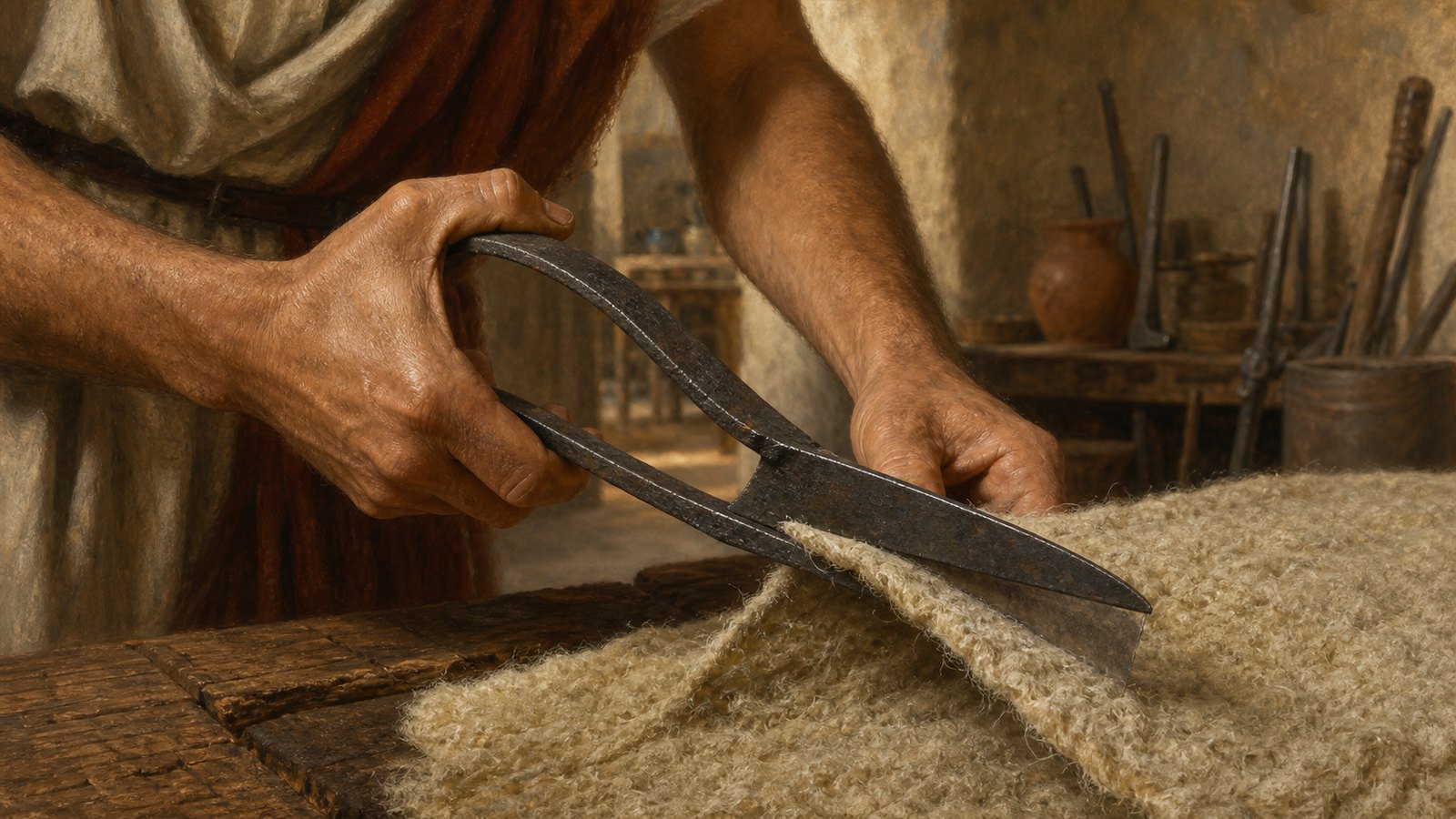
Shearing produced raw material, not a finished garment. Wool had to be sorted, cleaned, prepared, spun and woven before another cut could shape cloth. At that later stage the same paired-edge principle met a flatter but still flexible target. Woven threads resist differently from fleece: the tool must cross warp and weft without dragging the textile out of line. A close blade fit turns each closure into a bounded segment, allowing a worker to follow an edge or divide a panel progressively.
No source used here proves that the ornate Met pair cut a particular tunic. The association should remain functional, not biographical. Varro explicitly says sheep provide wool for clothing, while the museum preserves a Roman-period shear capable of coordinated paired cutting. Between those facts stood specialist labour, including the washing and finishing represented by Roman fullonicae. A tool type could move among stages; an individual object’s task requires context that this catalogue entry does not provide.
Goat hair widened the material range. Varro says long-haired goats were clipped across much of Phrygia and that their hair became cilicia, hair-cloth and related fabrics. He also associates goat hair with nautical uses, military engines and workmen’s equipment. This was not merely fine dressmaking. A paired cutter could begin a chain ending in coarse, hard-wearing material, while the final cloth might demand cutting again for fitting, repair or assembly.
Hair brought the blades close to a face
Varro turns from fleece to grooming in the same discussion, reporting a tradition that barbers came to Italy from Sicily 453 years after Rome’s foundation under Publius Titinius Mena. The chronological claim is ancient testimony, not a modern date stamp for the invention of scissors. It does establish that Romans connected cutting hair with a recognisable occupation. A barber’s practice included social performance as well as technique, the world explored in Roman barbers and their public theatre.
Hair shares fleece’s flexibility but changes the tolerances. The target is smaller, the desired line more visible and the skin more exposed. Paired blades let one hand hold and measure a lock while the other makes short closures. Yet neither Varro’s barber passage nor the Met catalogue states that this surviving pair trimmed a person. Function must be reconstructed at the level of the cutting principle, not converted into an unsupported ownership story.
The surgical evidence sharpens that warning. A 2025 British Journal of Surgery article is devoted to the absence of jointed scissors in Greco-Roman surgery. Its very subject shows why a familiar modern silhouette cannot be projected into every ancient cutting scene. Romans had blades, shears and specialised grooming, but a central-pivot instrument must be demonstrated rather than presumed. Paired edges are the secure common denominator; the exact joint is an archaeological question.
The missing pivot changes the story
A central rivet and spring bow solve related problems differently. The rivet fixes two members at one rotational point, with handles controlling leverage beyond it. The bow joins the members, guides their return and keeps the tool ready to close again. Both coordinate two edges, but distribute stress and opening force differently. Calling a spring shear ‘pivoted’ hides the feature that makes its repeated bite possible.
This distinction also protects the evidence from a seductive invention story. The Met object proves a Roman-period spring-linked pair, possibly from Trabzon; Varro proves organised shearing, wool for clothing, clipped goat hair and a Roman tradition about barbers. Getty explains what modern cataloguers mean by scissors and shears. None of those sources, separately or together, securely turns the Met tool into centrally jointed tailor’s scissors. The recent surgical study makes the evidential gap impossible to ignore.
The stronger conclusion is more interesting than a false first. Roman cutters learned to make one hand command two opposed blades and to place their crossing point beside skin, fibre or fabric. The tool’s unity came not from one edge being sharper, but from alignment: each blade constrained the other, the spring restored their opening, and every closure moved the cut forward. Rome’s paired shears worked as one instrument precisely because their two blades never worked alone.
Sources & Further Reading
- The Metropolitan Museum of Art, ‘Shears,’ accession 39.2.2
- Varro, On Agriculture, Book II.11, LacusCurtius
- Getty Art & Architecture Thesaurus, ‘scissors’
- Getty Art & Architecture Thesaurus, ‘shears (cutting tools)’
- Daoulas et al., ‘Reflections on the absence of jointed scissors in Greco-Roman surgery,’ British Journal of Surgery