
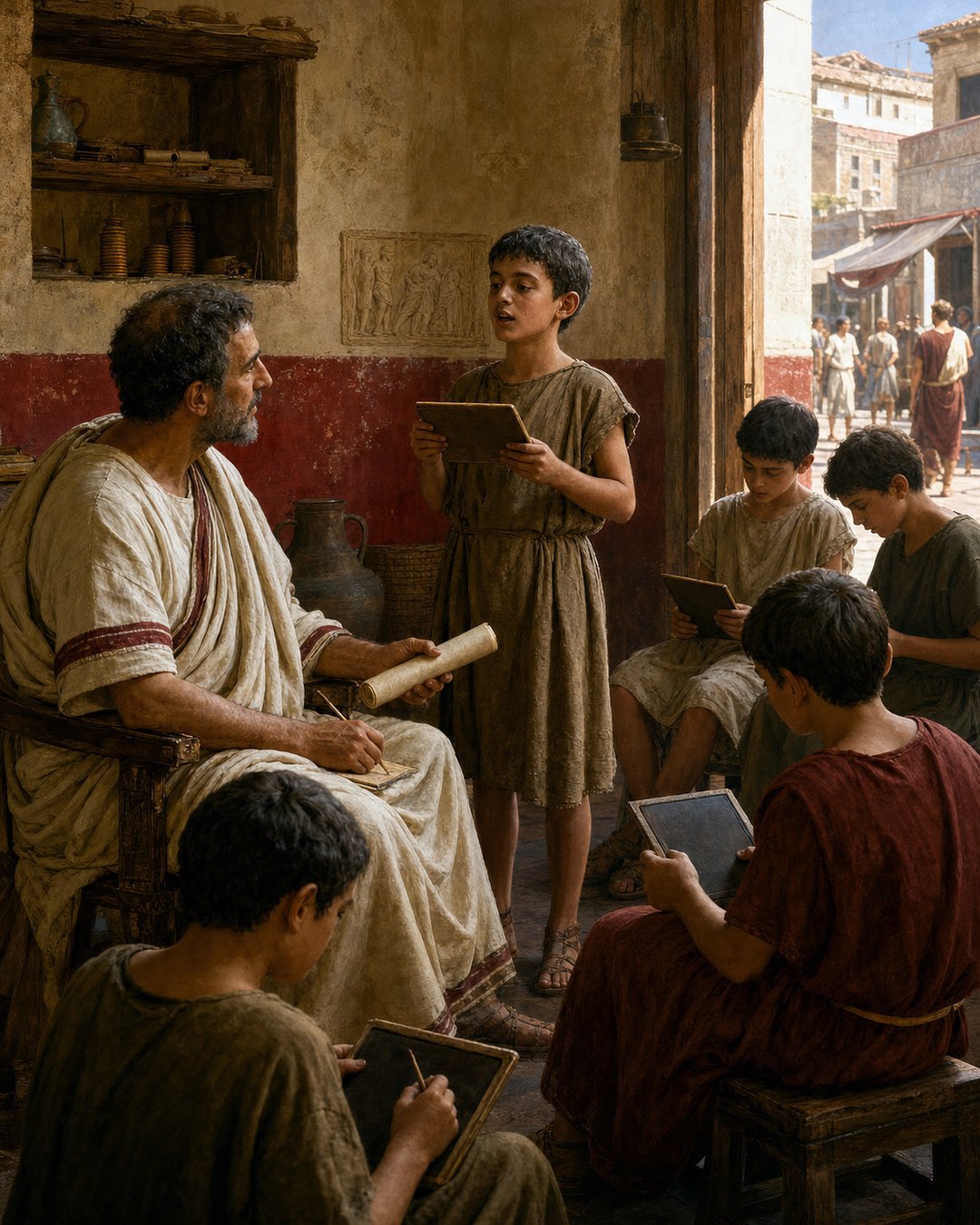
A Roman schoolroom could be easy to miss. It did not need a purpose-built campus, a bell tower, or rows of identical desks. A teacher might work in a rented room or a space open to street noise, while pupils carried small writing surfaces and sat close enough to hear every correction. The essential machinery was human: a teacher’s voice, a pupil’s memory, and the uncomfortable requirement to perform the lesson aloud.
That modest scene prepared some Roman children for unusually public futures. Literacy mattered, but elite education did not stop when a boy could recognize letters or copy a line. Families with money and ambition could move a pupil through increasingly demanding teachers, from elementary reading and calculation to Greek and Latin literature, and finally to rhetorical exercises. The destination was not a certificate. It was a voice that could survive scrutiny in a court, council, or political gathering.
The route was selective. Rome never created universal compulsory schooling, and access depended on wealth, place, sex, family choice, and status. Yet the surviving educational ideal is revealing because it shows what Romans thought cultivated authority sounded like. A polished speaker was made through years of repetition long before he stood before an audience.
The First Lesson Was Small Enough to Hold
Elementary teaching began with letters, syllables, reading, writing, and basic reckoning. The tools could be compact: a waxed tablet accepted marks from a stylus and could be smoothed for reuse, while ink and papyrus served work meant to last. These objects did not create education on their own. They made correction visible. A hesitant line, reversed character, or badly spaced word sat beneath the teacher’s eye until the pupil tried again.
Reading in antiquity was closely tied to sound. A pupil learned to recognize and pronounce sequences, not merely to scan them silently. Recitation exposed uncertainty immediately. Memory also mattered because texts were costly compared with modern books and because oral performance remained central to public culture. The room therefore had a rhythm of demonstration and return: teacher, pupil, correction, repetition.
This daily discipline connects naturally with Rome’s wider writing world. The reusable surface described in our account of Roman wax tablets was as useful for practice as it was for business. Education began by making the hand answer to the eye and the voice answer to both.
Not Every Child Climbed the Same Ladder
There was no single state curriculum imposed across the empire. Some children learned at home from parents, household members, tutors, or enslaved pedagogues. Others attended fee-charging teachers. Many received little formal instruction, and labor could claim childhood early. Girls could be educated, especially in prosperous households, but the long rhetorical course was chiefly designed around the public careers available to elite males.
The traditional sequence is useful as a map rather than a universal timetable. The elementary teacher, often called a litterator or ludi magister, handled foundational skills. A grammaticus led more advanced pupils through language and literature, often in both Latin and Greek. The rhetor then supervised exercises in persuasive speaking. A pupil might leave at any stage, and countless Roman lives never entered this ladder at all.
That inequality is part of the mechanism, not a footnote. Extended education required years in which a family could spare a child’s labor and pay for instruction. Fluency in prestigious texts and speech therefore advertised resources as well as talent. The voice trained in school carried traces of the household that had financed it.
The Grammarian Turned Literature into an Exercise
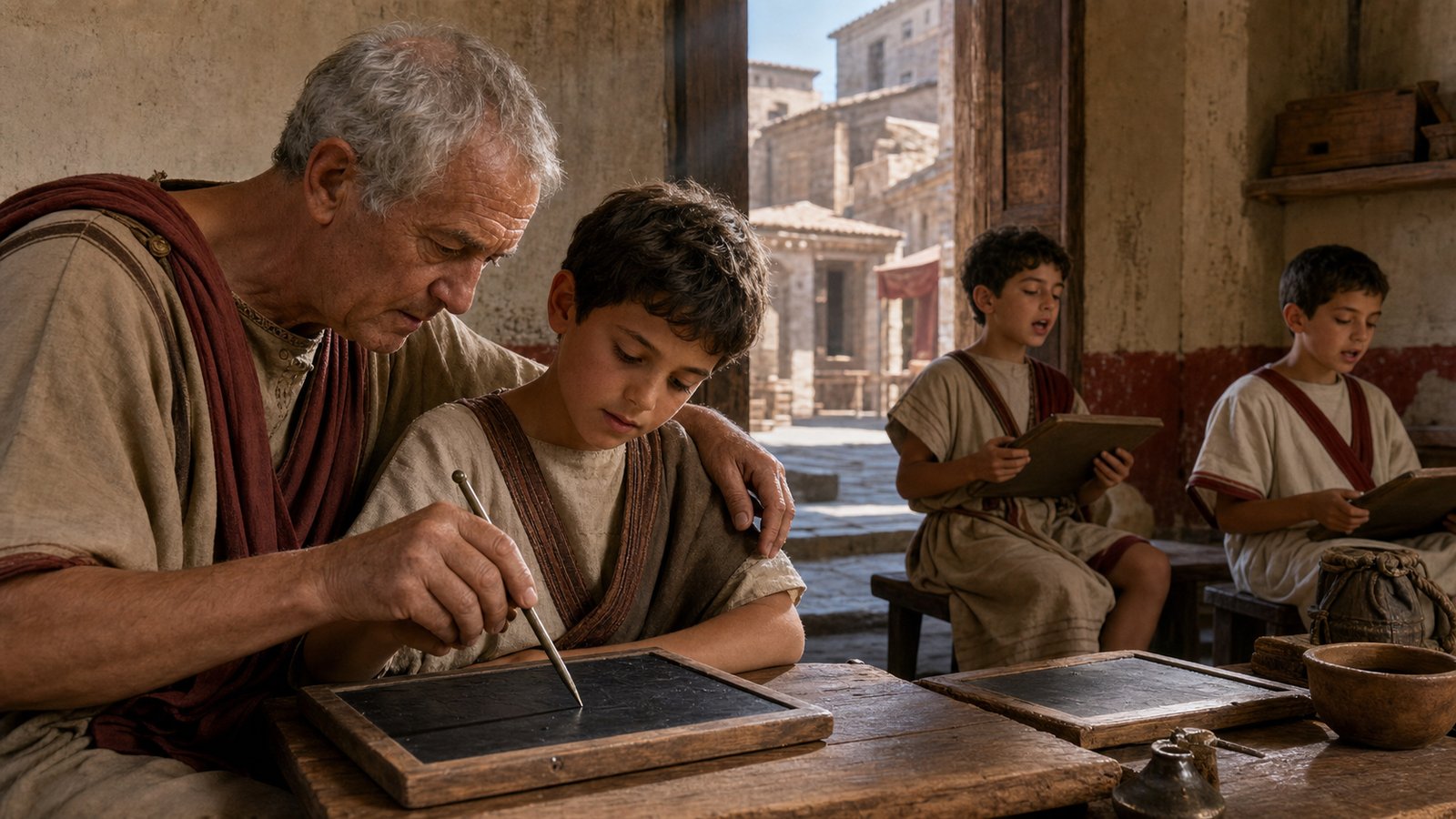
With the grammaticus, a text became more than a story. Pupils studied vocabulary, meter, figures of speech, mythology, history, and questions of interpretation. Greek learning retained high prestige, so bilingual competence could be part of an ambitious education. Reading an author meant explaining difficult passages and noticing how the language achieved its effect.
The surviving books do not let us reconstruct one identical classroom hour across every century and province. They do show an educational culture that treated admired writing as material for dissection and imitation. A pupil encountered exemplary phrases, identified their construction, and attempted controlled versions. The aim was not free self-expression. It was command gained by close attention to proven forms.
Libraries supported that culture without making it democratic. As our article on Roman libraries explains, collected texts gave memory an institutional setting. The schoolroom converted that stored memory into habits carried by a person: quotations ready for recall, stories ready for comparison, and verbal patterns ready for use.
Quintilian Wanted Training Without Humiliation
The first-century teacher Quintilian provides the fullest ancient discussion of the orator’s education. In the opening book of the Institutio Oratoria, he begins before formal rhetoric, considering nurses, companions, early language, reading, writing, and the character of teachers. His scope makes a sharp point: eloquence was not a trick added at adulthood. It was the accumulated result of an environment.
Quintilian opposed corporal punishment for pupils and argued that a teacher should understand differences in ability and temperament. This was advice, not proof that Roman classrooms were gentle. Its existence shows the problem clearly enough. Shame and fear could inhabit instruction, and Quintilian believed they damaged the kind of confidence and character an orator required.
He also treated moral formation as inseparable from speaking. His famous ideal was the good man skilled in speech. Whether Roman public life met that standard is another question. As an educational program, however, it joined technique to conduct: memory, diction, judgment, and credibility were supposed to mature together.
Declamation Built a Courtroom Before the Case Existed
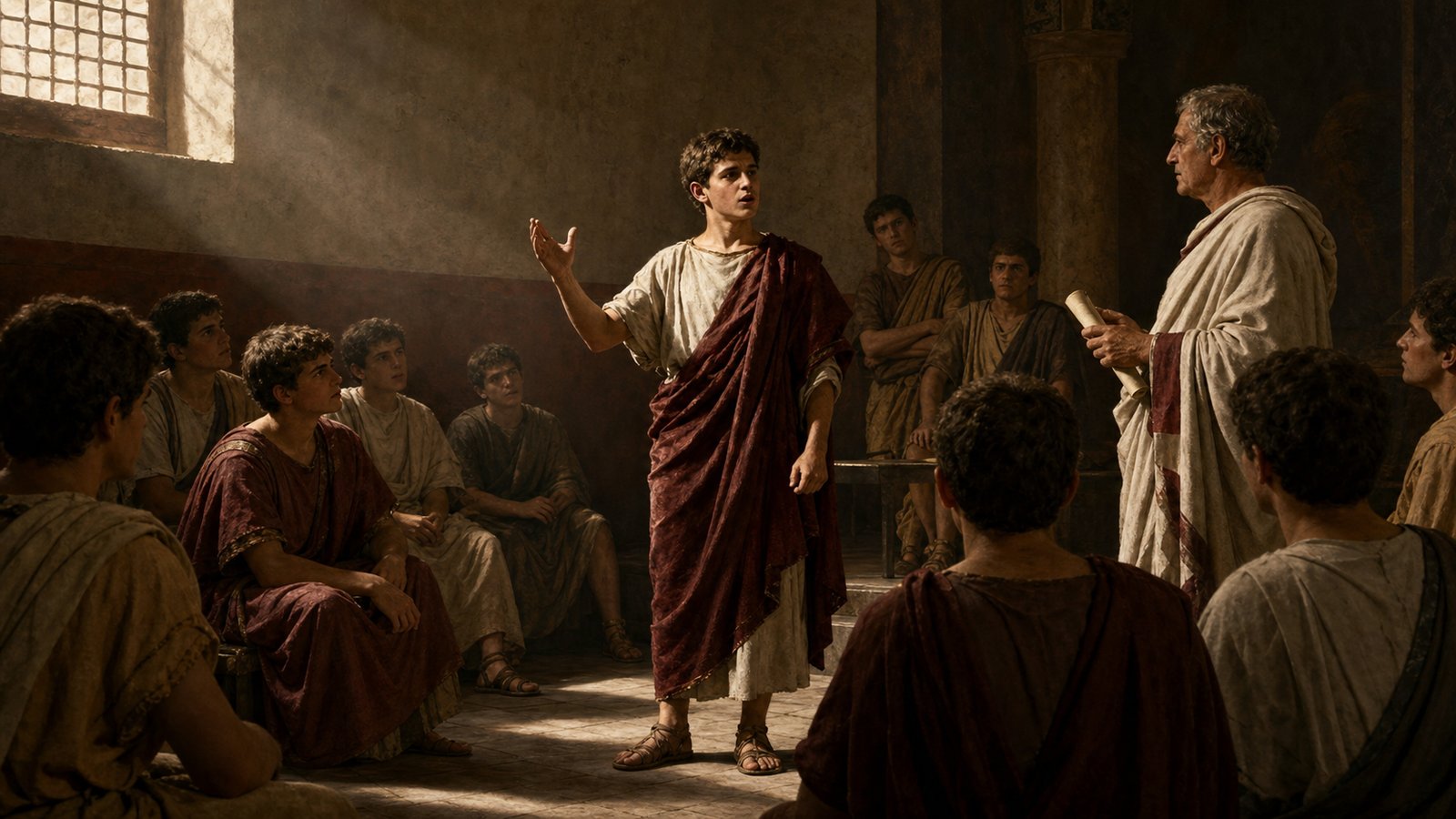
At the rhetorical stage, pupils practiced constructed disputes. In suasoriae they advised a historical or legendary figure facing a decision. In controversiae they argued imaginary legal cases shaped by compact rules and dramatic complications. The facts could be artificial, but the demands were real: choose a position, arrange material, anticipate objections, and deliver with force.
A declamation room created public pressure in miniature. A pupil had to stand, remember an organized case, control pace and gesture, and make an audience follow. Failure could be heard. So could improvement. Repetition turned the body into part of the argument, training breath and posture alongside invention.
Critics complained that school problems could drift far from actual courts. The complaint itself confirms declamation’s prominence. Romans debated whether the simulation prepared a speaker for reality because so many ambitious students passed through it. The exercise was a rehearsal space where words acquired consequences before a magistrate or client depended on them.
The Finished Product Walked Out of the Room
A Roman education left no single universal endpoint. For one pupil, literacy helped with accounts or correspondence. For another, literary study marked cultivated leisure. For the narrow group pursuing advocacy and office, rhetorical training furnished tools for a public career. The same ladder could therefore produce practical skill, social distinction, or professional ambition.
What united its advanced stages was disciplined reuse. Letters became syllables; passages became models; model speeches became arguments delivered under pressure. The schoolroom’s humble surfaces and repeated sounds accumulated into something hard to see but easy to hear: confidence shaped by correction.
The Roman world placed unusual weight on spoken authority. Courts, assemblies, patronage, administration, and ceremony all rewarded people who could hold attention. That is the schoolroom’s larger historical importance. It did not merely transfer information. For those allowed to remain inside it, it trained a voice to enter public life already carrying the cadence of education.
Sources & Further Reading
- Encyclopaedia Britannica, “Education in Ancient Rome”
- The Metropolitan Museum of Art, “Education in the Roman World”
- Quintilian, Institutio Oratoria, Book 1
- World History Encyclopedia, “Roman Education”