
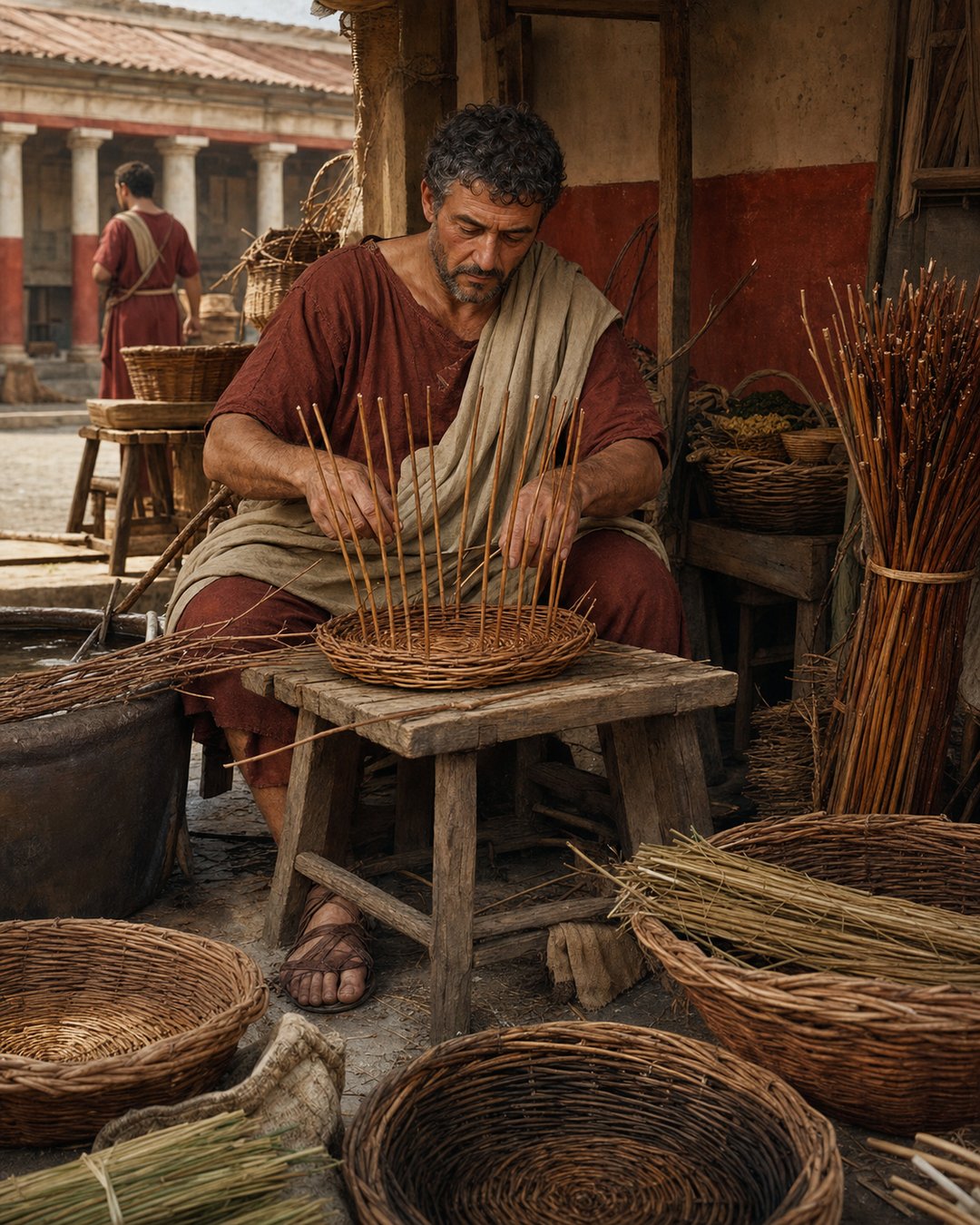
A Roman market could not run on amphorae and wooden chests alone. Fish arrived wet, fruit bruised, bread needed air, wool had to be carried, and tools followed workers into fields and workshops. A basket answered many of those jobs while weighing little more than the plants from which it was made.
The craft looks simple because its logic is visible. Stiffer rods form a skeleton; more flexible strands pass over and under them; each crossing restrains the next. Yet a useful container demands decisions about harvest, moisture, thickness, spacing, shape, rim and handle. A rod that bends today may split tomorrow if it was cut at the wrong season or allowed to dry unevenly.
Most ancient baskets vanished into soil, fire or reuse. Their importance survives indirectly in impressions, rare waterlogged finds, images and the objects they carried. That imbalance makes basketry easy to overlook. Roman daily life depended heavily on containers whose greatest advantage—their organic lightness—also made them least likely to enter a museum.
The Material Was Harvested for the Bend It Could Survive
Willow, reeds, rushes, cane, grasses and split woody materials offered different combinations of length, stiffness and flexibility. Basketmakers selected what grew locally and matched it to the object. A fine tray required different strands from a heavy field basket; a fish container faced moisture and abrasion that indoor storage might avoid.
Young straight growth reduced knots and irregular grain. Rods could be sorted by thickness and length before weaving, while bark might be left, stripped or treated according to the desired surface. Color differences in ancient images need not indicate one exact species, but they remind us that basketry used prepared material rather than an undifferentiated bundle of twigs.
Plant knowledge connected craft to season. Cut too green, material could shrink and loosen as it dried. Allowed to become too dry, it resisted tight curves and snapped. The basketmaker managed moisture so each element bent during construction and then settled into a structure strong enough for repeated use.
Soaking Returned Flexibility to Stored Rods
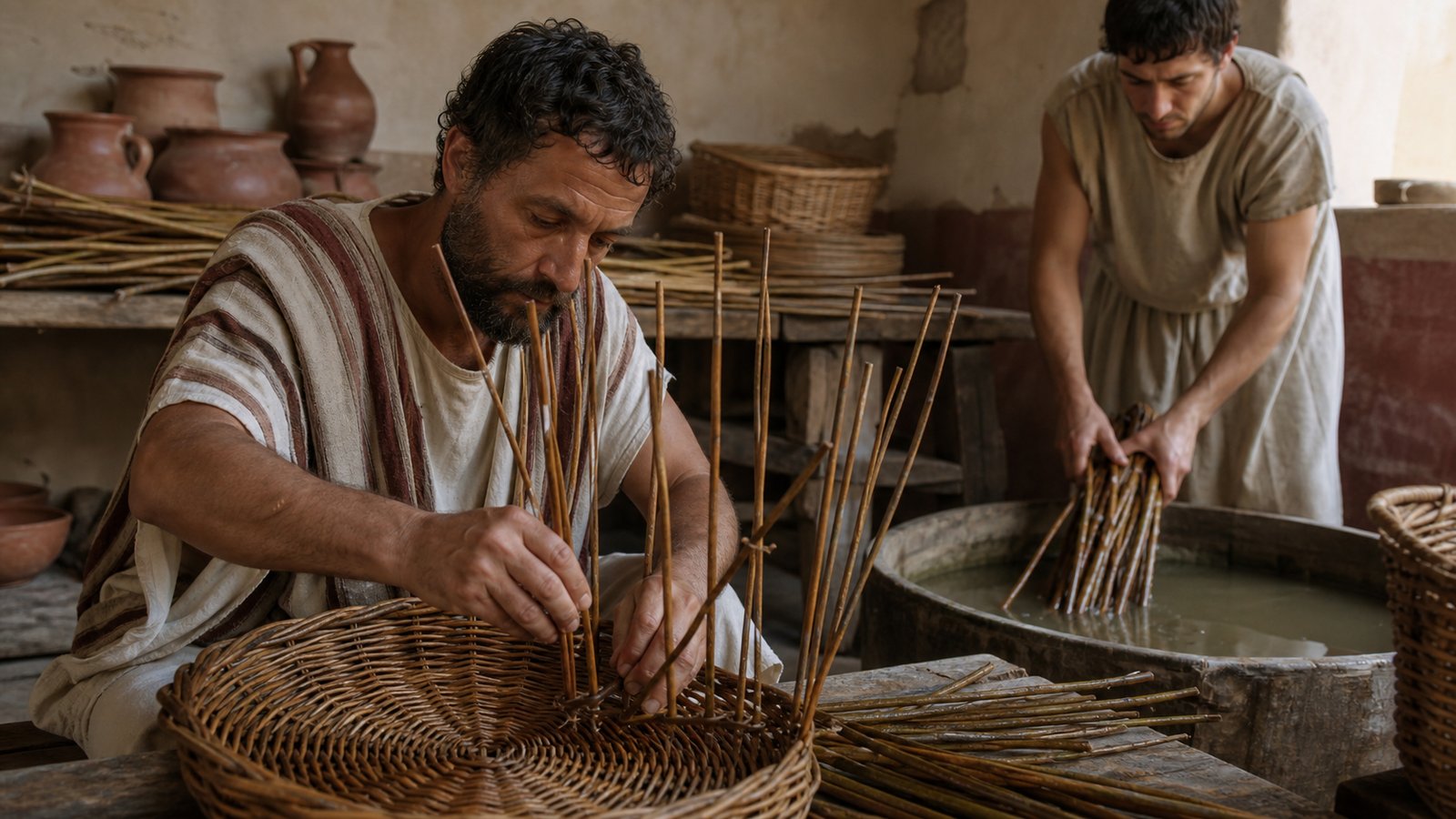
Dried rods could be soaked before work. Water softened fibers and allowed tighter bends around stakes without immediate fracture. The maker judged readiness by feel: the surface had to yield without becoming pulpy, and thicker pieces needed more preparation than fine weavers. There was no single soaking time for every species, diameter and season.
This temporary flexibility created a working window. Rods taken from water gradually stiffened again, so the maker prepared manageable bundles rather than exposing all material at once. Damp cloth, shade and repeated wetting could keep strands workable. The process turned stored plant growth back into a shapeable material for a few critical hours.
The transformation differs from the permanent wet forming of clay on a Roman potter’s wheel. A basket strand is not a paste; its fibers remain continuous and remember stresses. The craft succeeds by bending within those limits and using neighboring strands to hold the curve after moisture leaves.A prepared rod also changed across its own length. The thicker butt resisted sharply curved work while the tapering tip could disappear neatly into a crowded row. Makers oriented and paired those differences rather than pretending each strand was uniform. Material selection continued with every reach into the damp bundle.
Stakes Defined the Shape Before the Walls Existed
A round basket could begin with rods crossed at the base, while other forms used paired or arranged stakes suited to an oval or rectangular plan. These structural elements established diameter, spacing and future wall direction. If they were uneven at the start, later weaving amplified the error rather than hiding it.
The first interlacing locked the center. As weaving spiraled outward, the maker spread stakes at controlled intervals. Raising them changed a flat base into walls. That transition required firm bends and often careful pressure with hands or a simple tool, because one cracked stake threatened the geometry above it.
The skeletal logic resembles the way a loom organizes threads before cloth exists. In both crafts, an ordered set of relatively stable elements receives a second moving set. Basketry differs by building in three dimensions: the frame must become floor, corner and wall without a rigid mold remaining inside.
Over and Under Made Weak Strands Support One Another
The working strand passed alternately in front of and behind successive stakes. Another row reversed the relation, preventing the stakes from simply falling inward or outward. Variants used paired strands, twining and changes in spacing to add strength or decoration. The essential advantage came from distributing load across many crossings.
Tension had to remain even. Pull too loosely and contents pushed the wall out of shape; pull too hard and the basket narrowed, distorted or broke a stake. The maker packed rows together so gaps suited the intended load. Grain demanded tighter work than firewood; ventilation helpful for produce could be disastrous for small objects.
Ends were joined without leaving a weak bulge. A new strand overlapped or tucked where the structure could share the transition. The finished surface therefore concealed many beginnings and endings. What appeared to be one continuous spiral was often a carefully managed succession of finite rods.
The Rim and Handle Carried the Most Concentrated Stress
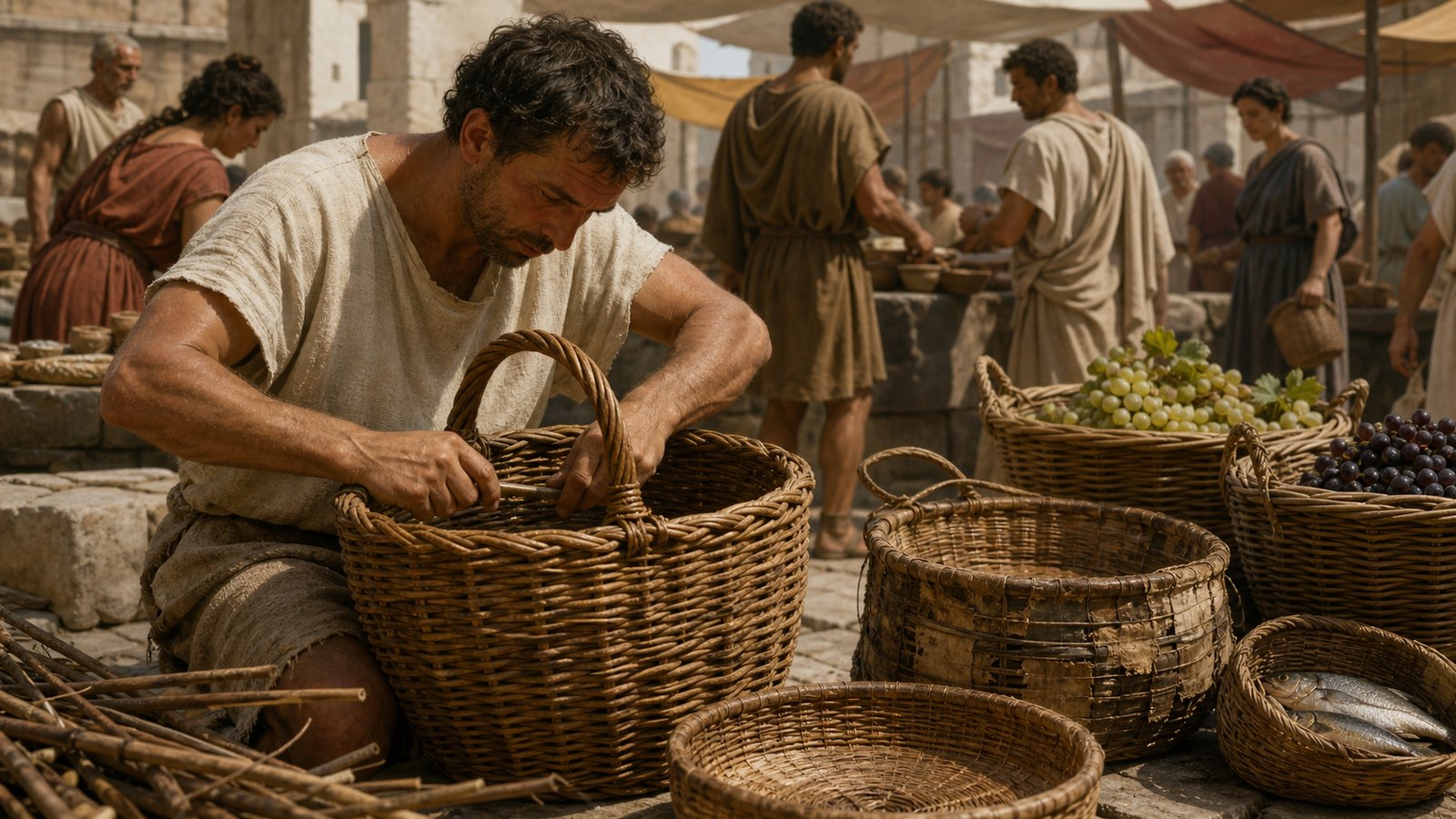
At the top, stakes could be bent, braided and tucked into a border that stopped the wall from unraveling. The rim endured hands, stacking and impacts, so it needed more than a decorative finish. A robust border distributed pressure around the circumference and protected exposed rod ends from catching clothing or cargo.
Handles concentrated the weight of the entire load into a few attachment points. Strong rods had to descend far enough into the body or wrap through the border so a heavy basket did not tear at the lip. Grip size mattered as well: a harvest basket carried on an arm, a small covered container and a burden basket suited to two hands required different solutions.
The visible exchange in Roman street shops depended on this quiet engineering. A seller could carry, display and measure goods because the container survived lifting. Basket capacity was never as standardized as an official weight, but familiar forms helped buyers and workers estimate what a load meant.
Repair and Decay Kept Baskets in a Short Material Cycle
A broken weaver did not always end the basket. New material could be tucked across a damaged patch; a handle could be reinforced; a worn base could receive extra rods. Repair made sense because the object contained skilled labor even when its raw plants were cheap. Marks of mending would have been ordinary signs of use, though few survive directly.
Eventually moisture, abrasion, insects and repeated flexing defeated the structure. A basket might be repurposed for rougher work, dismantled for kindling or discarded into conditions that destroyed it completely. Ceramic amphorae leave great archaeological drifts because fired clay persists; baskets often disappear precisely because their material returned quickly to the environment.
That loss distorts the Roman world toward stone, metal and pottery. Images of agricultural and market labor restore some proportion: people constantly handled woven containers. The basketmaker built useful volume from mostly empty space, making a portable wall out of crossings rather than boards. One flexible rod was slight; hundreds arranged around a frame became part of the infrastructure of food, work and trade.
Sources & Further Reading
- Encyclopaedia Britannica, “Basketry”
- Wikipedia, “Basket Weaving”
- The Metropolitan Museum of Art, basket collection record
- World History Encyclopedia, “Food in the Roman World”