
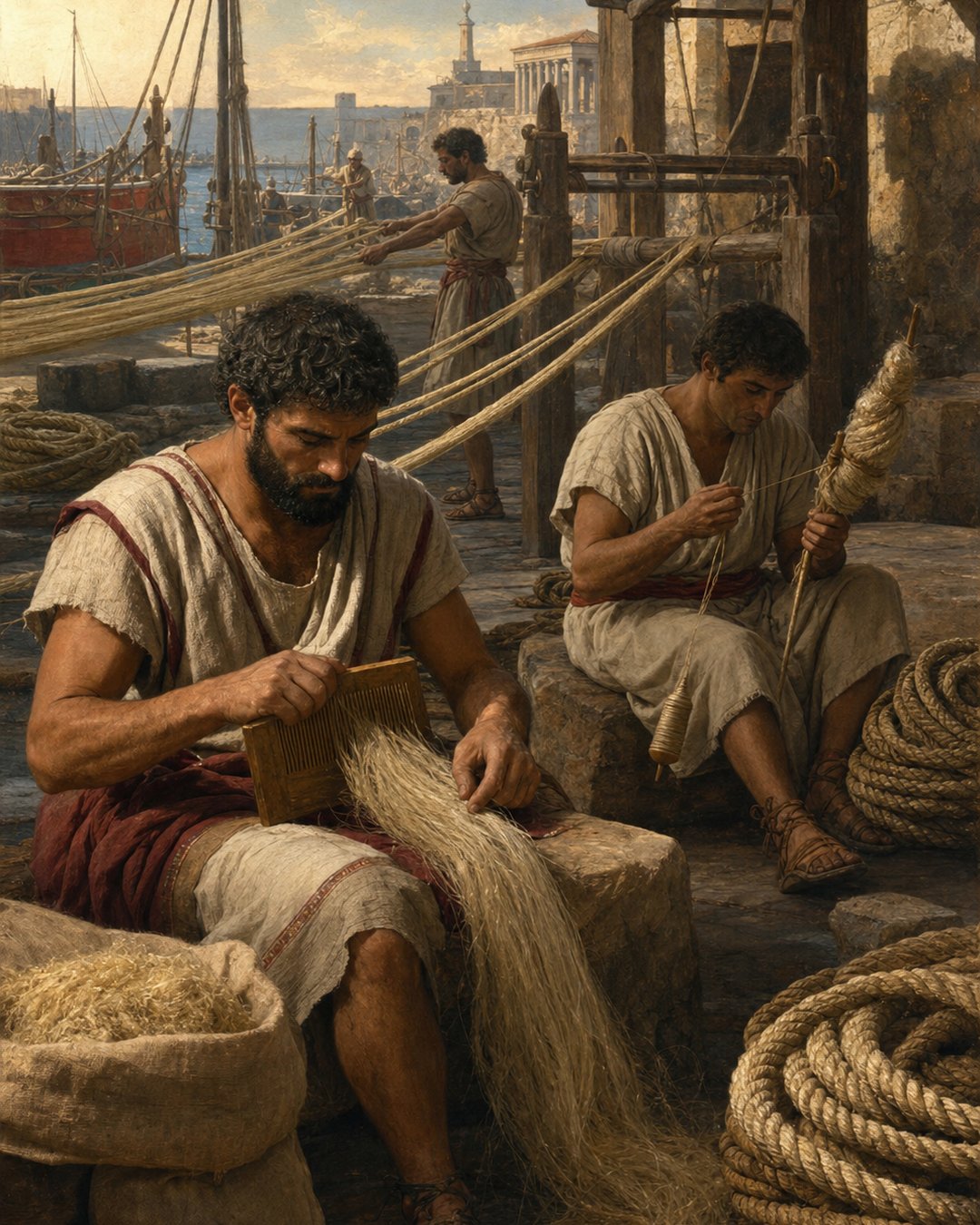
A Roman harbor was full of ropes doing different kinds of work. One held a ship to stone, another carried a sail’s pull, another passed through a lifting tackle, and smaller cord bound cargo or repaired equipment. They looked like continuous lines, yet every one began as short plant fibers that could be pulled apart by hand.
Rope makers solved that contradiction through hierarchy. Fibers were cleaned and aligned, spun into yarns, combined into strands and laid into rope. The direction of twist changed between stages. That reversal mattered because the finished strands tried to unwind against one another, creating a stable structure that shared tension instead of returning immediately to loose fiber.
The result was essential and perishable. Salt, water, grit, sunlight, sharp bends and overload weakened cordage. A rope could look substantial while damage advanced inside it. Making therefore continued into inspection, splicing, drying and replacement. Roman movement on land and sea depended on craftspeople who understood when a line could still be trusted.
The Raw Fiber Determined the Rope’s First Limits
Flax, hemp, esparto and other plant materials could supply cordage in the ancient Mediterranean. Each differed in fiber length, strength, flexibility, resistance to moisture and local availability. The strongest material was not automatically best for every use. Fine line, a thick mooring rope and cord exposed to constant bending demanded different compromises.
Processing separated useful fibers from stems, leaves, dust and tangled waste. Retting or other preparation loosened plant tissues; beating and combing freed and aligned fibers. The exact chain varied by plant. What mattered mechanically was converting irregular growth into bundles whose many elements could overlap in the same direction.
Ancient agriculture and trade supplied this hidden input to maritime power. A fleet required timber and metal, but it also consumed fields, harvest labor and fiber-processing time. The navalia that maintained Roman ships relied on cordage stocks as surely as they relied on hull repair.Different grades could emerge from the same supply. Longer, cleaner fibers justified demanding line, while shorter or rougher material could enter coarse cord and packing. Sorting protected critical rope from hidden weak bundles and prevented high-quality fiber being wasted where an ordinary lashing would do.
Spinning Made Short Fibers Behave Like a Long Line
A single plant fiber was shorter than most useful cords. Spinning overlapped many fibers and twisted them into yarn. Friction along the overlaps resisted sliding when the yarn was pulled. New fiber could be fed into the narrowing bundle, extending the line far beyond the length of any one element.
Consistency mattered. Thick lumps changed stiffness and distributed load unevenly; thin places became likely failures. The spinner controlled feed and twist by hand and simple tools, judging tension continuously. This work resembled textile spinning, but rope yarn could prioritize strength and service over the smooth surface expected in fine cloth.
Twist also came with a cost. Too little left fibers able to slip; too much shortened and stiffened the yarn or damaged fibers. The maker aimed for enough compression and friction to make the bundle act together. Strength emerged from repeated contact, not from melting the material into one solid piece.
Opposite Twist Stopped the Finished Rope from Escaping Itself
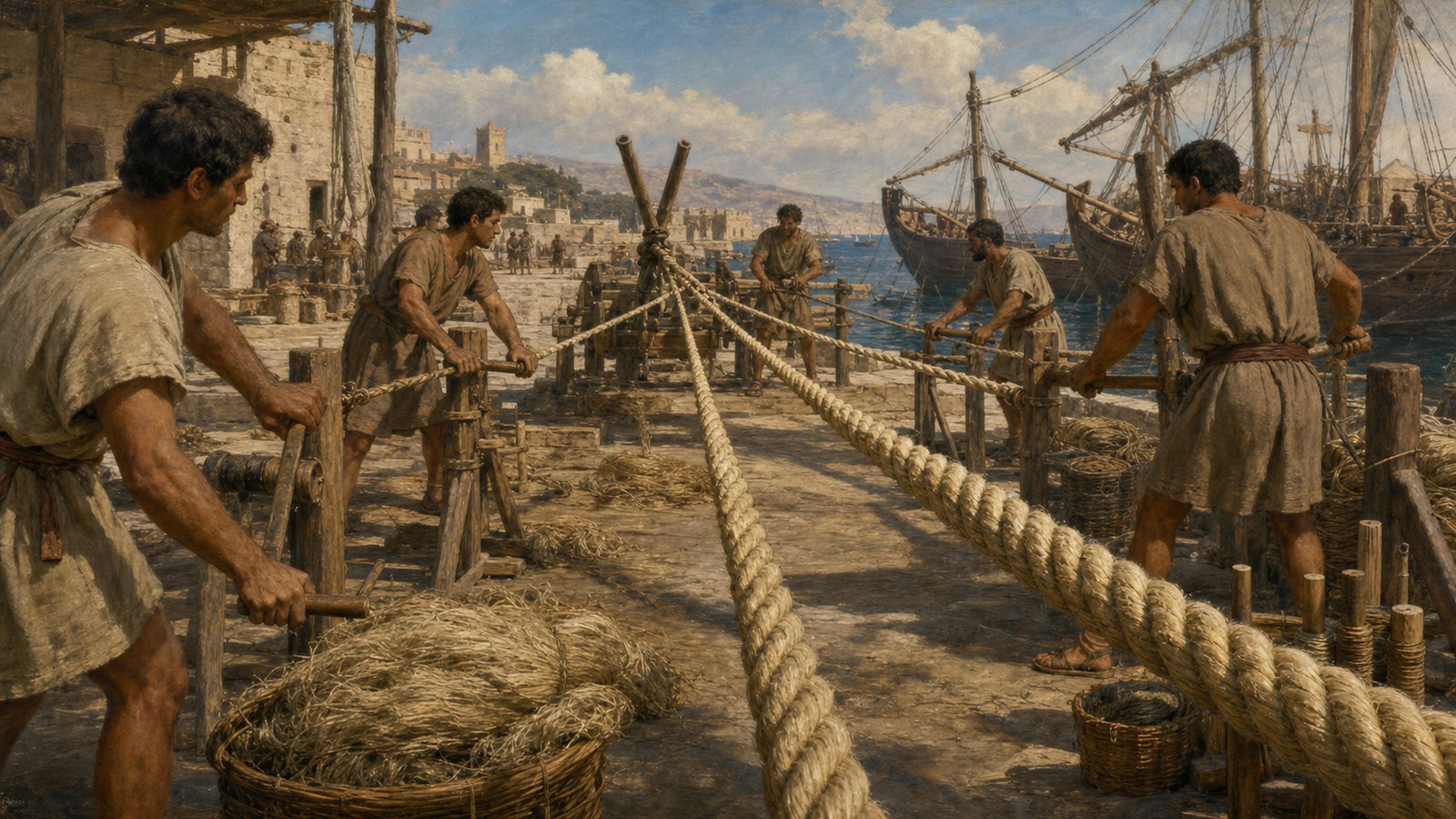
Several yarns twisted together formed a strand. Several strands then formed rope. Rope makers commonly reversed the lay direction between stages: yarns twisted one way were combined in the other. Under tension, the tendencies to unwind opposed one another, helping the finished line remain balanced.
This is the central mechanism hidden in the familiar spiral. If every level encouraged rotation in the same direction, the line would kink and open more readily. Opposing torque made each strand restrain its neighbors. The rope could flex because it was not a rigid bar, yet its elements were forced to share the same general path.
The twisted cord powering Roman torsion artillery exploited deformation to store energy. Ordinary rope making pursued a different outcome: a stable tensile line for pulling and holding. The shared fact of twist should not erase that distinction between a spring-like engine bundle and working cordage laid for length.
A Long Rope Required Space, Rhythm, and Even Tension
Long ropes were laid out over extended working space, often described in later periods as a ropewalk. Workers or rotating hooks twisted separated groups while another guided them together. The strands had to approach at similar tension; one slack strand contributed less until the rope stretched enough to load it, while one tight strand carried too much too early.
As twist entered, the material shortened. Makers anticipated that contraction when measuring yarn and strand lengths. They controlled the closing point so the strands met in an orderly helix rather than tangling. A simple-looking length of rope therefore required coordinated movement across a distance far greater than a small craft bench.
Diameter had to suit the job and the fittings. A rope too thick for a pulley groove chafed at the edges; one too thin concentrated pressure and offered inadequate strength. The treadwheel crane’s mechanical advantage still ended in cordage whose manufacture and condition limited the safe load.The finished line could be served or wrapped where repeated rubbing was expected. Crews also coiled it in the direction favored by its lay so storage did not introduce stubborn kinks. Handling practice preserved the geometry established during manufacture; careless coiling could make a sound rope fight the people trying to deploy it.
Knots, Splices, and Surfaces Changed Working Strength
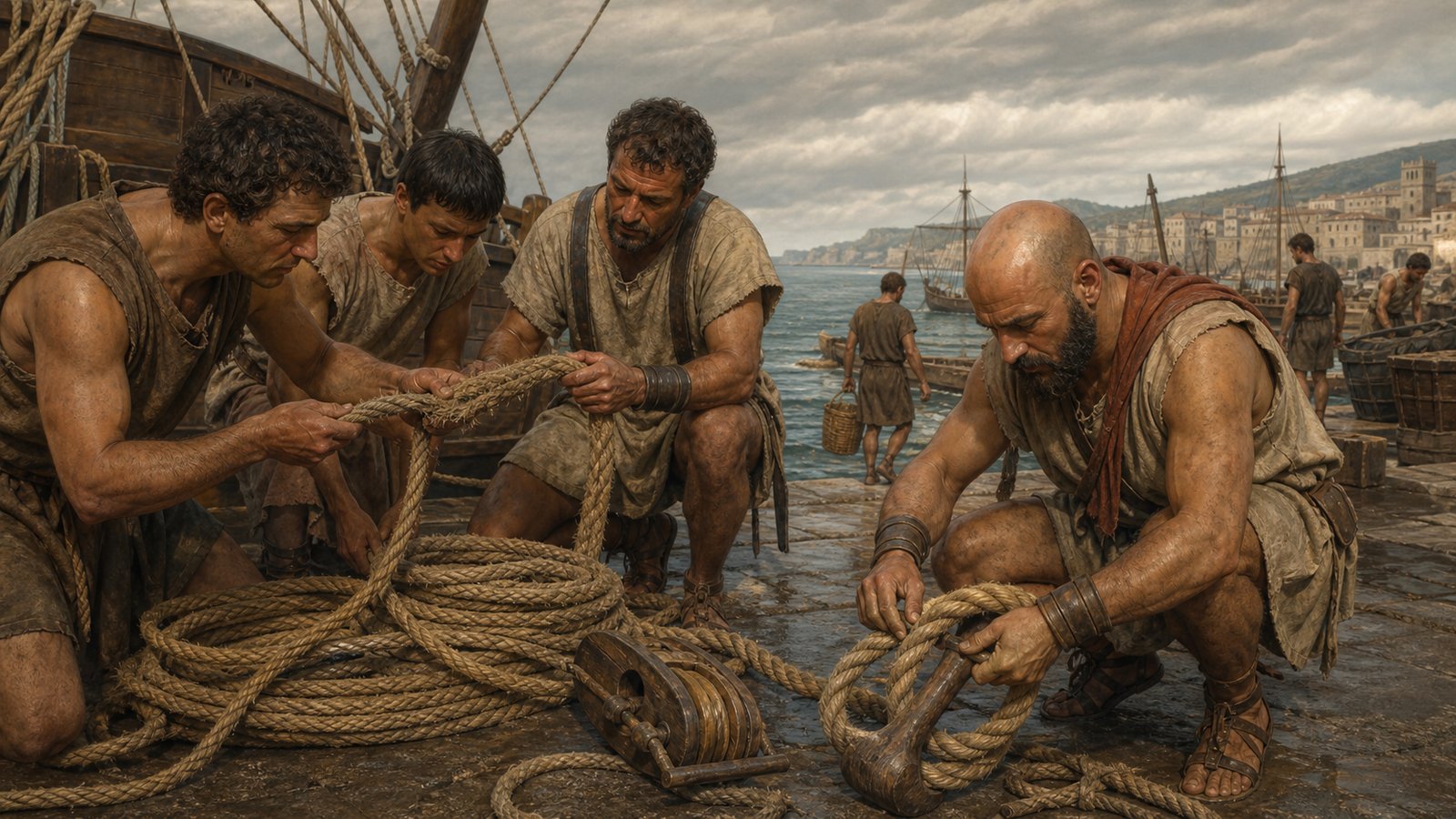
A rope seldom worked as an untouched straight line. It bent around posts, drums and sheaves; it ended in loops; it joined another length; it received knots. Every bend rearranged stress across fibers. A tight knot could weaken the line by forcing a small radius and crushing part of the structure even while making a useful attachment.
Splicing opened strands and interwove them with another rope or back into the same line. A well-made splice spread the transition over a longer distance than a compact knot and could form a strong eye. It demanded knowledge of the rope’s lay because inserted ends had to follow rather than fight the existing structure.
Tar or related treatments could protect some cordage from moisture and biological decay, especially in maritime use, though treatment also changed handling and did not make rope immortal. Dry storage, ventilation and keeping lines away from grit mattered. Preservation was a routine of reducing damage, not one coating that ended maintenance.Terminations revealed the craft at its most compact. An eye around a post or fitting carried force from the standing line through tucked strands and back again. If the transition was abrupt, a few fibers accepted the load first. A gradual splice let tension enter more of the rope before reaching its tightest curve.
Inspection Decided Whether the Rope Still Shared Its Load
Working ropes announced some damage through broken outer yarns, flattening, discoloration, stiffness or changes in diameter. Other weakness remained internal. Salt crystals and sand abraded fibers; repeated bending fatigued them; wet storage encouraged decay; sudden overload could leave damage after the visible crisis passed.
Crews learned to feel as well as look. A suspicious section could be unlaid for inspection, shortened away or removed from critical service. Old cordage might descend through less demanding uses before becoming lashings, packing or waste. Replacement consumed material and labor, but failure under a sail, anchor or suspended stone cost more.
The rope described in Roman anchoring connected ship, crew and seabed only while every fiber continued sharing strain. Cordage made Roman movement possible because it remained flexible enough to route force around a complex world. Its strength was collective: no fiber crossed the whole distance, but careful overlap and contrary twist made thousands act as if they did.
Sources & Further Reading
- Encyclopaedia Britannica, “Rope”
- Wikipedia, “Rope”
- Wikipedia, “Roman Navy”
- World History Encyclopedia, “Roman Navy”