
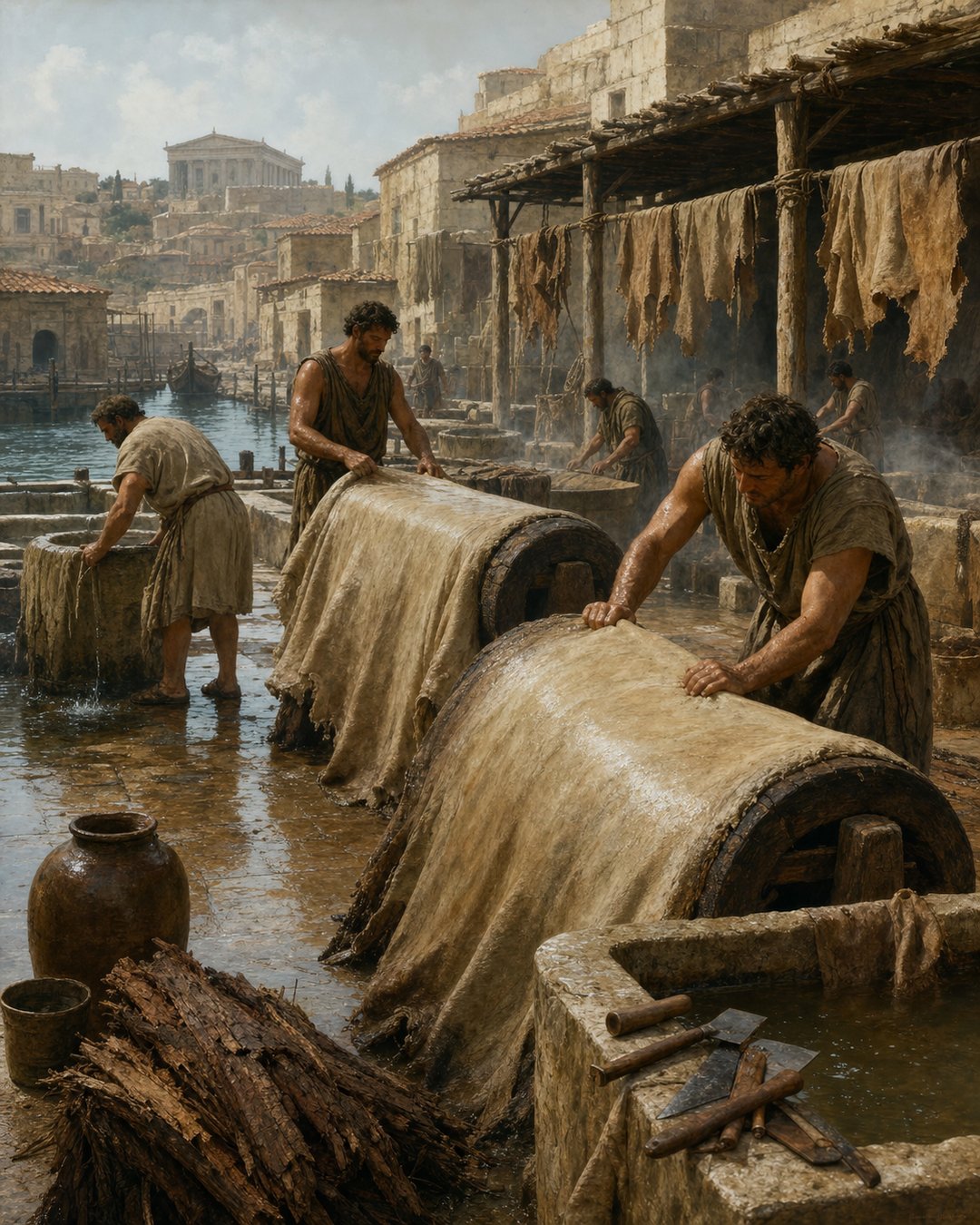
A fresh hide carried the shape of an animal and the certainty of decay. Left wet, it putrefied. Dried too quickly, it hardened into a board. Roman tanners had to keep the useful collagen layer while removing hair, flesh, fat and the conditions that allowed rot to begin.
The solution was not one bath. Hides moved through soaking, alkaline treatment, scraping, washing, tanning liquor, drying and mechanical working. Each stage prepared the next. A hide damaged by an early knife cut could not be restored by a stronger final bath, and a thick center that received too little tannin remained vulnerable inside.
Leather stood everywhere once the unpleasant work was finished: shoes, harness, belts, bags, shield fittings, tents and containers. The clean object preserved no obvious memory of pits, wet hair, bark liquor or scraping beams. Tanning’s success was measured partly by how completely the final surface concealed its origin.
A Hide Arrived as Food for Decay
Skin is built around collagen fibers but reaches a workshop with blood, dirt, flesh and fat still attached. Microorganisms exploit moist organic material quickly, especially in warm weather. Salt, drying or rapid processing bought time between slaughter and the first serious preparation, yet those measures did not by themselves create flexible finished leather.
Sorting began immediately. Species, age, thickness, scars and knife damage affected the product a hide could become. Calf or goat skin behaved differently from a thick cattle hide. The tanner could adapt cutting and duration, but no treatment supplied strong fibers where disease, abrasion or careless flaying had already destroyed them.
Soaking restored moisture to salted or partly dried hides and washed away soluble dirt. Water grew foul as it received blood and loosened tissue. It had to be changed or managed, because cleaning in a saturated bath merely redistributed contamination. The wet hide also became heavy, slippery and awkward to lift.
The trade belonged outside comfortable domestic display. Odor, waste water and animal remains encouraged concentration near water and away from prestigious rooms. This does not mean every Roman tannery followed one city plan, but the physical needs of repeated washing and disposal shaped where the work could be tolerated.
Alkaline Baths Loosened Hair by Attacking Its Hold
After washing, hides could enter lime-rich or otherwise alkaline liquors. The treatment swelled the skin and weakened structures around hair roots, making hair easier to remove. It also began opening the collagen fiber network for later penetration. Time and concentration had to be controlled because the same chemistry that assisted the tanner could damage the hide.
A worker tested progress by rubbing or pulling a small patch. Hair that released cleanly signaled readiness; stubborn roots required more time, while an overtreated surface became weak and harsh. Temperature changed the pace. A vat that behaved one way in cool weather could move dangerously faster in summer.
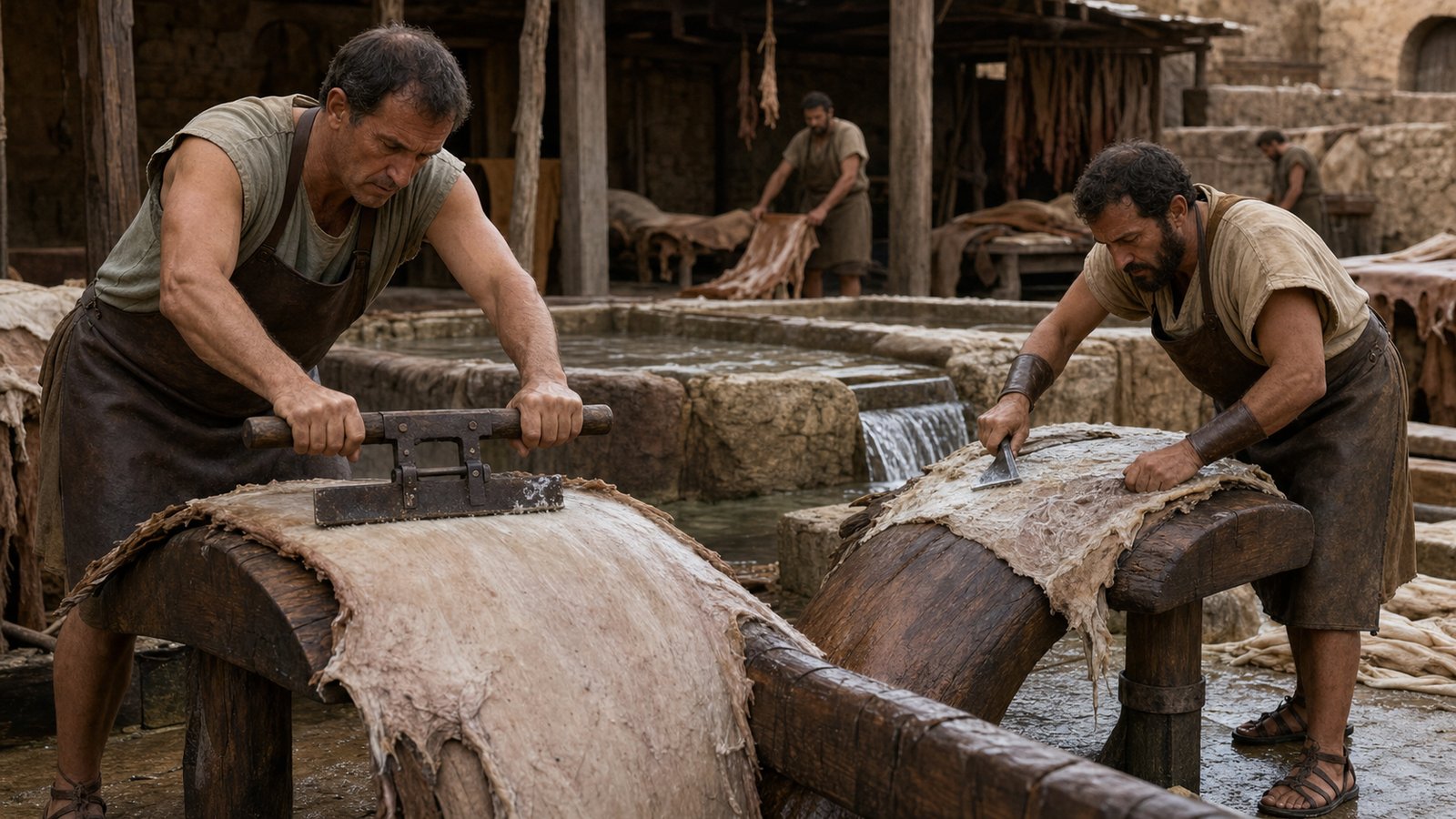
Unhairing took place over a curved beam. With the grain side outward, a blunt-edged tool pushed loosened hair away without slicing deeply into the skin. The worker leaned body weight into repeated strokes. Wet hair gathered below, and the emerging surface showed scars and insect bites that fur had hidden.
Lime was already familiar to Roman builders through kilns and mortar, as described in the article on Roman lime. Tanning used alkaline material toward a different end: not to bind stone, but to alter a biological surface enough that hair and unwanted tissue could be separated.
Fleshing Preserved the Useful Layer by Removing the Rest
The inner side of a hide retained membranes, fat and pieces of flesh. These did not tan like the collagen layer and encouraged decay if left in place. A fleshing knife scraped them away over the beam. Its edge had to push and shave without cutting through the valuable sheet beneath.
This was a datable workshop mini-scene repeated with every hide: lift the cold wet weight, drape it over the curved timber, brace one end and drive the two-handled tool down the pale inner face. Fat rolled ahead of the blade. A moment of poor angle opened a hole whose value could never be scraped back.
After liming and fleshing, washing reduced residual alkali. Later tanning liquor depended on access to fibers, and uncontrolled alkalinity interfered with the desired treatment. Historical methods varied, including softening and deliming practices that used organic materials, but the secure sequence is preparation before true tannin penetration.
Waste had possible secondary uses, yet recovery did not make the tannery clean. Hair, trimmings, fleshings and exhausted liquor accumulated continuously. Water carried material away from the hide but placed the burden elsewhere. The finished leather economy began with organized handling of substances most consumers preferred not to see.
Plant Tannins Changed Collagen from the Surface Inward
Vegetable tanning uses polyphenolic compounds found in bark, wood, leaves or galls. Extracted into water, tannins interact with collagen and make the material more resistant to putrefaction and heat while preserving useful strength. Roman regions had access to different plant sources, so liquor color and behavior were not universal.
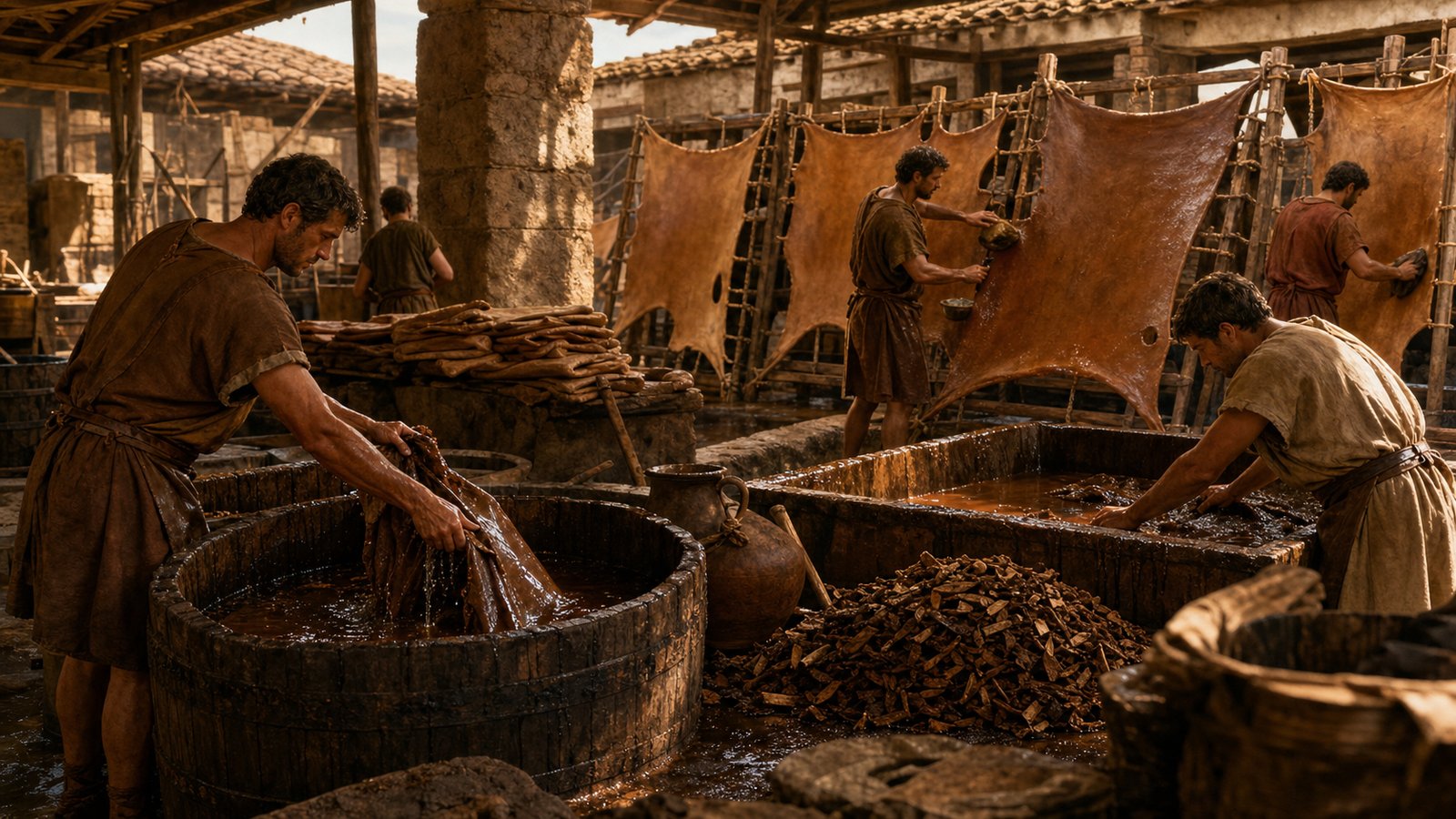
Penetration took time. A thick hide placed immediately in very strong liquor could tan the surface faster than the center, producing an outside that looked finished around an underprocessed core. Moving hides through pits or vats of changing strength allowed tannin to advance more evenly through the cross-section.
Workers turned and shifted hides so folds did not shield one area. They watched color at cut edges and felt changes in body. A pit was not passive storage: concentration weakened as hides absorbed active compounds, and new bark extract or a transfer to another liquor restored the process.
The transformation was microscopic but its evidence was practical. Prepared hide lost the slick vulnerability of raw skin and gained the firm, fibrous character of leather. The smell and color of the tanning material remained. The tanner read progress through the whole thickness, because a preserved surface could disguise a center still able to rot.
Drying Could Ruin What the Pits Had Preserved
Leather emerged saturated with water. If left to dry without control, collagen fibers could stick in a rigid arrangement and the sheet could shrink or distort. Workers stretched, smoothed and worked the material during drying, keeping fibers mobile enough for the intended balance of firmness and flexibility.
Oils or fats added during finishing lubricated fibers and improved suppleness and water resistance. Scraping and rubbing adjusted thickness and surface. Some leather needed a strong sole; some a foldable upper, strap or bag. Finishing translated one preserved material into grades suited to different loads and movements.
Dye and surface treatment could change appearance, but color did not substitute for sound tanning. A polished face might conceal weakness until a strap stretched or a shoe flexed. Buyers tested thickness, feel and tearing at an edge. The workshop’s invisible achievement was durability under repeated bending.
This stage connects directly to Roman caligae. A shoemaker cut and nailed leather that someone else had already saved from decomposition. The marching shoe’s performance began in tannery pits long before an iron hobnail met the sole.
Leather Carried Roman Life Because It Could Bend and Endure
Roman leather survives unusually well in waterlogged or very dry archaeological settings. Footwear from forts and settlements shows stitching holes, repairs, sole layers and sizes; other finds include harness, tent fragments and containers. Ordinary organic equipment becomes visible when burial conditions interrupt the decay tanning only slowed.
No single surviving shoe represents an empire-wide recipe. Tanners adjusted species, thickness, plant supply, climate and customer. Archaeological analysis can identify manufacturing marks and sometimes tanning chemistry, but confident reconstruction separates evidence from later craft traditions that may resemble ancient practice without proving every step.
The final objects crossed social and institutional boundaries. Soldiers needed belts and shoes, drivers needed harness, households needed bags, and workshops needed flexible fittings. Leather supplied a combination difficult for wood, textile or metal alone: it could wrap a body, carry tension, accept holes and survive repeated movement.
Roman tanners stopped hides from returning to rot by managing vulnerability stage after stage. Water cleaned, alkali loosened hair, steel or iron tools removed tissue, plant tannins stabilized collagen, and finishing restored controlled movement. The leather strap looked simple because the tannery had already solved the complex problem of preserving flesh without preserving its stiffness.
Sources & Further Reading
- Encyclopaedia Britannica, “Leather”
- Wikipedia, “Tanning (leather)”
- Wikipedia, “Leather”
- Wikipedia, “Caligae”