
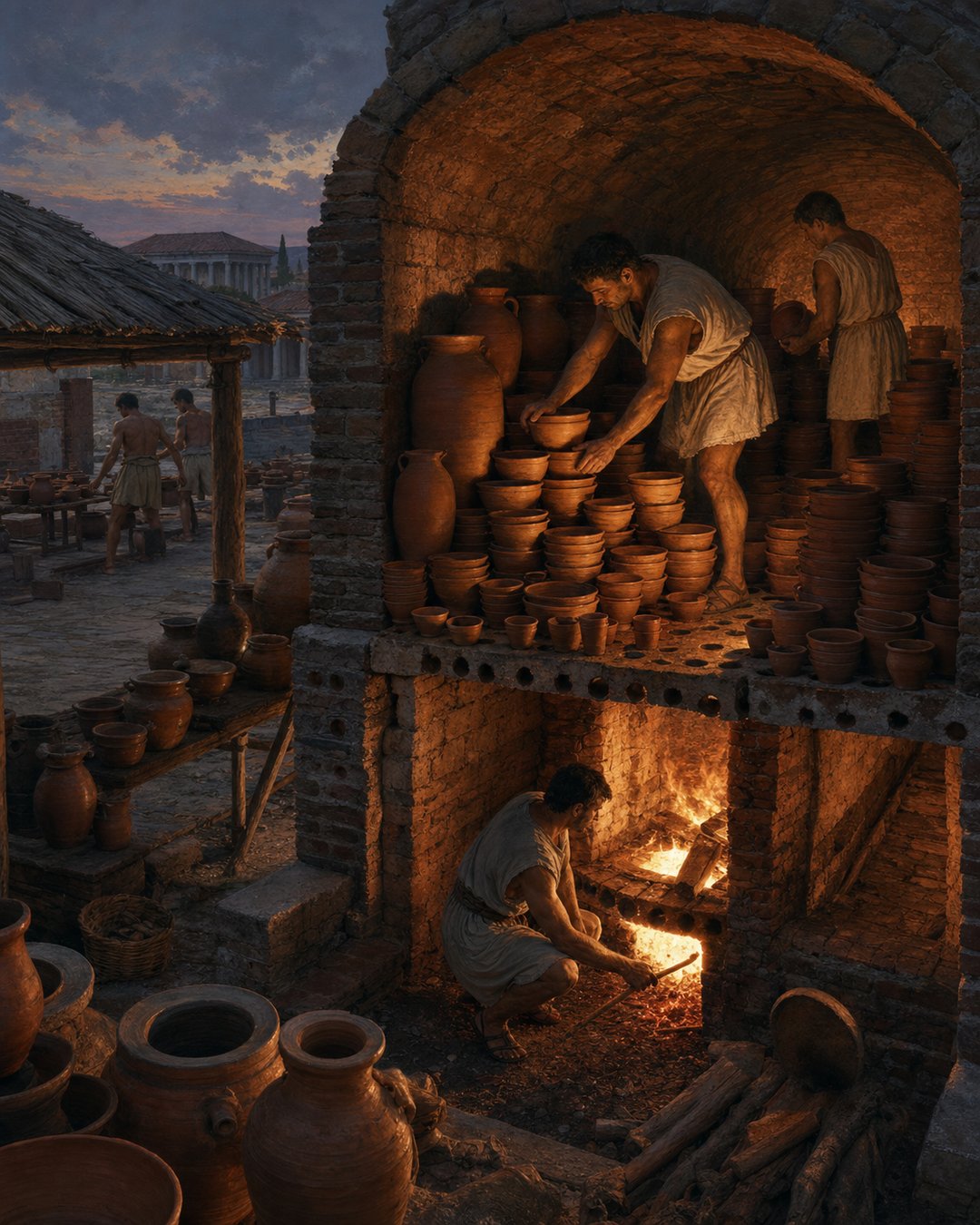
A Roman pot could survive shaping, trimming and days of drying, then fail in the last few hours. Trapped moisture burst walls. A vessel placed too near a hot channel warped. Smoke altered a surface. One rushed opening cracked a load that had endured the full fire.
The kiln made this risk manageable by separating fuel from pottery. In a common updraft arrangement, wood burned in a lower firebox. Hot gases passed through openings in a raised floor, circulated among stacked vessels and escaped above. The pots met heat and atmosphere rather than lying directly in a bonfire.
That architecture turned firing into a collective event. Dozens or hundreds of vessels shared one chamber and one temperature history. A successful load rewarded weeks of labor at once; a bad load multiplied the loss. The kiln master had to read flame, draft, smoke and time without seeing every pot inside.
Dry Clay Had to Be Truly Dry Before It Met Fire
Freshly formed clay contained free water between particles. Air drying removed much of it, but thick bases, handles and enclosed shapes could retain damp centers after surfaces felt dry. Heated too fast, that water became steam and expanded inside a body with no easy exit, opening cracks or blowing fragments into neighboring vessels.
Pots waited in a sheltered drying area where air moved without hard sun scorching one face. Workers turned pieces and checked color and touch. Large jars needed more time than cups; joined handles needed careful attention because two thicknesses dried at different rates around the attachment.
The earlier article on Roman potters’ wheels follows clay while it is plastic and responsive under the fingers. Kiln preparation began after that freedom ended. Once leather-hard trimming and decoration were complete, correction became limited and every hidden flaw traveled toward the fire.
Loading only dry ware was the first temperature-control decision, made before fuel was lit. No skill with vents could safely accelerate a wet center beyond the rate at which vapor escaped. The patient days outside the kiln protected the expensive hours inside it.
A Raised Floor Turned a Firebox into an Updraft Machine
A common Roman kiln form placed a combustion chamber below a ware chamber. An arched or pillared support carried a perforated floor. Fuel burned at the stoke opening and in the lower space; draft pulled hot gases through the perforations, across the pottery and toward an upper vent.
The separation did not make temperature perfectly even. Openings nearest the strongest flow received more heat, chamber walls absorbed energy and tightly packed vessels blocked circulation. Kiln builders shaped channels and supports so the floor remained stable while offering many routes upward.
This arrangement protected pottery from direct contact with logs and reduced local flame impingement. Ash could still travel, and a tongue of flame might reach through a hole, but the raised chamber let heat be distributed around a load rather than around one open heap.
Archaeological kilns often survive below floor level because fireboxes, flues and supports were dug or built into the ground while upper domes collapsed. Those remains record the route gases took. A circle of scorched clay and a perforated support can reveal workshop engineering even when every removable pot has vanished.
Stacking Created a Temporary Architecture of Vessels
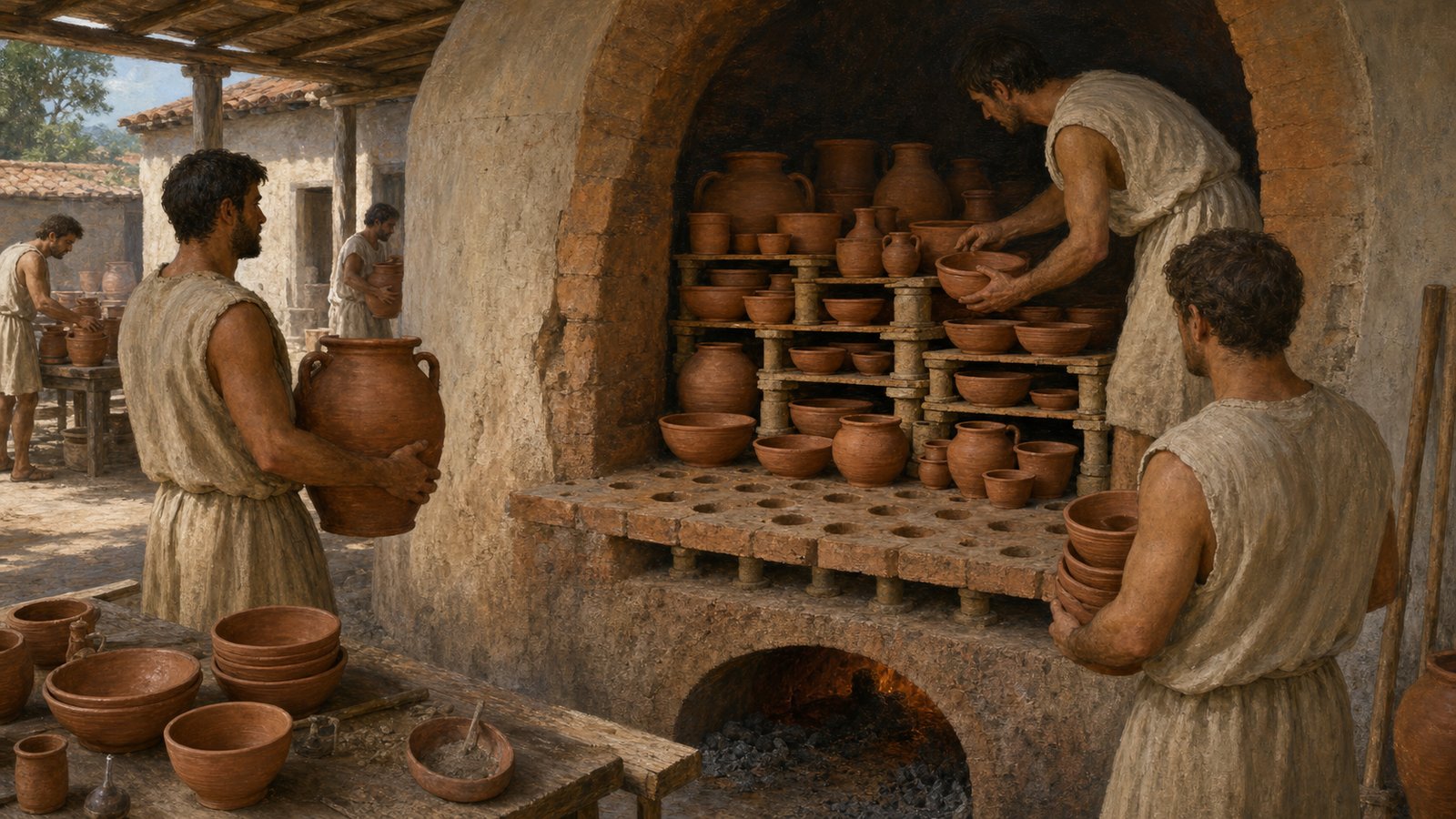
Potters loaded the largest or most heat-tolerant pieces where they could support weight and accept stronger conditions. Smaller vessels nested or occupied gaps only when contact would not fuse surfaces or block circulation. Kiln furniture, spacers and supports separated delicate wares and stabilized stacks.
Every pot displaced hot gas. A dense load used fuel efficiently but risked cold pockets; a loose load improved circulation but reduced output and allowed stacks to shift. The loader imagined invisible currents through handles, bowls and narrow spaces, leaving channels from the floor perforations toward the exit.
Surfaces could not always touch safely. Slips and glazes responded to heat, and a vessel leaning against its neighbor might leave a scar or fuse. Even unglazed wares could acquire pressure marks. Standardized shapes helped production because workers learned how repeated forms nested and where each tolerated the kiln best.
The mini-scene occurred before dawn or whenever a firing began: one worker lowered a bowl through the opening, another steadied the growing column, and the kiln master rejected a tilted base. When the chamber was sealed, hands lost access. The arrangement had to endure fuel additions, expansion and hours of moving gas without being adjusted.
Fire Changed Clay in Stages, Not at One Magic Temperature
The first heating remained gentle so residual physical water escaped. As temperature rose, chemically bound water left clay minerals and organic material burned away. At higher heat, particles began sintering into a harder ceramic body. The transformation was progressive and depended on clay composition as well as peak temperature.
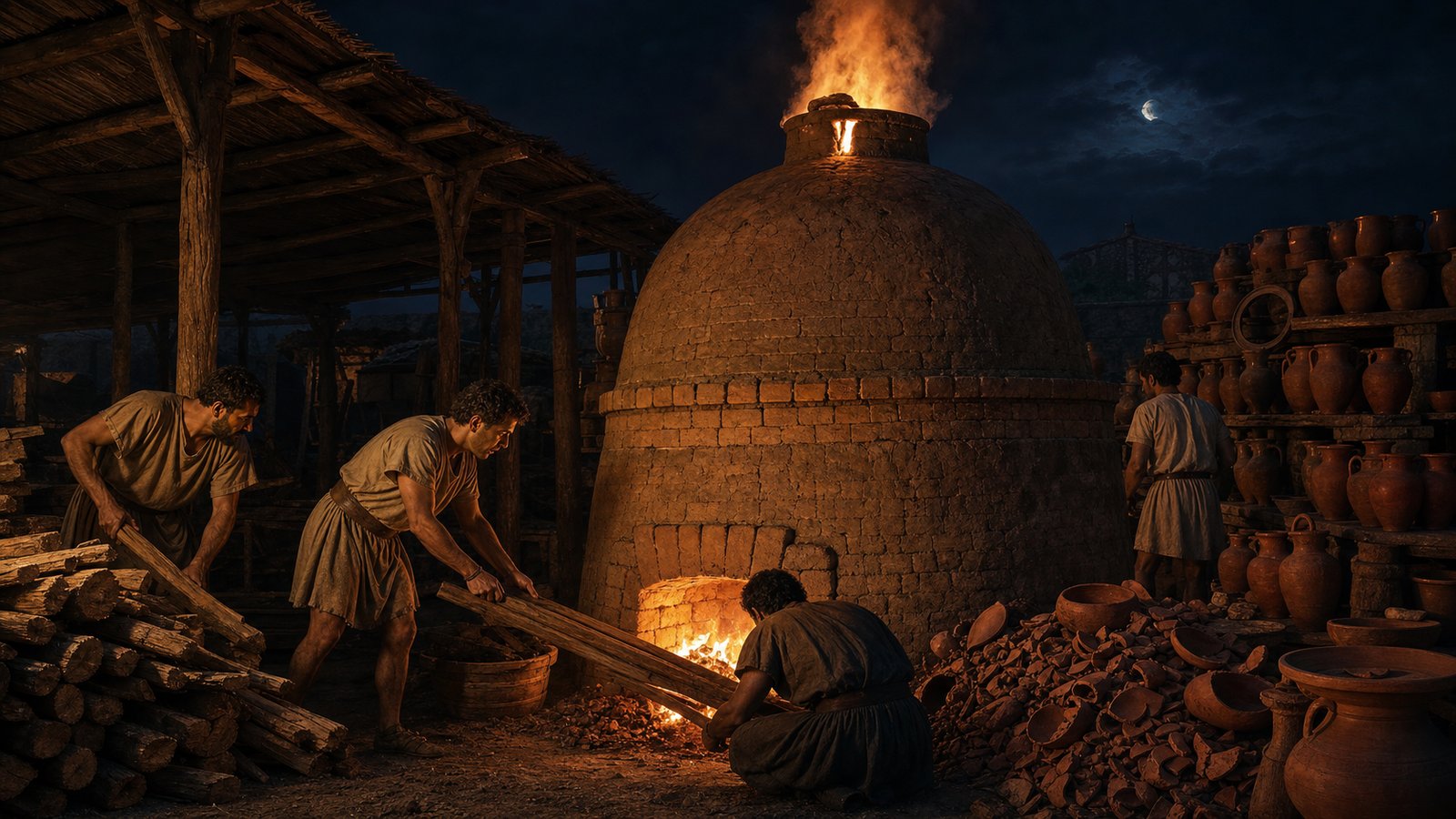
Fuel was added at the firebox in a rhythm. A sudden large charge cooled parts of the chamber with fresh wood before producing a stronger flame; too little let temperature fall. Stoke-hole color, flame at vents, smoke and the sound of draft gave indirect signs. Modern thermometers were absent, so experience translated those signs into decisions.
Thermal expansion punished unevenness. A thick base lagged behind a thin rim, while the exterior of a large jar heated before its core. Slow early firing reduced gradients. Once sintering advanced, the ware became stronger, but rapid temperature change could still create stress.
Firing made a Roman mortarium hard enough to grind food and made transport jars resistant enough for handling. Shape supplied function only after heat changed the clay body. The kiln completed properties the wheel could not provide.
Oxygen Helped Decide Whether Iron Fired Red or Dark
Clay often contains iron compounds whose fired color responds to kiln atmosphere. With abundant oxygen, iron commonly contributes red or orange tones. Under reducing conditions, where oxygen is limited and combustion draws it from available compounds, surfaces and bodies can become darker. Reintroducing air during later stages can change the result again.
Potters controlled atmosphere by balancing fuel, stoke opening, vents and seals. A smoky fire did not automatically guarantee a uniform reduction through a packed chamber. Gas had to reach surfaces, and leaks admitted air unevenly. Color across one load could therefore map differences in circulation.
Roman fine wares and coarse wares used varied clays, slips and firing regimes. Samian or terra sigillata production required disciplined preparation and oxidizing firing for its characteristic red appearance, while black-surfaced wares depended on different atmospheric sequences. One generic Roman firing recipe would erase these deliberate differences.
The kiln master read emissions as evidence. Clearer exhaust, dense smoke, flame length and color at an opening indicated changing combustion. These observations were practical rather than mystical: each showed how much fuel, heat and oxygen moved through a chamber that could not be opened for inspection.
Cooling Was the Final Part of the Firing
When the desired firing had been reached, stopping fuel did not finish the cycle. Pots and kiln walls stored heat. Opening the chamber immediately admitted cool air against hot ceramic, creating sharp contraction differences and cracks. Vents were closed or managed while the load cooled gradually.
Waiting tested the workshop because the result was complete but invisible. Hours of cooling occupied kiln space and delayed sorting, yet haste could destroy saleable ware at the threshold. The same mass that helped stabilize firing now slowed release of heat.
Unloading produced the verdict. Potters tapped vessels for a clear sound, inspected color, checked warping and separated wasters from good pieces. Underfired clay remained weak or porous; overfired pieces slumped, blistered or fused. Wasters discarded near kilns now help archaeologists identify production sites and reconstruct firing failures.
A Roman pottery kiln kept flames away from pots so heat could be distributed, measured indirectly and repeated at scale. Drying, stacking, draft, fuel, oxygen and cooling all entered the result. The finished cup looked like one simple object, but it had survived a temporary architecture in which every neighboring vessel shared its risk.
Sources & Further Reading
- Encyclopaedia Britannica, “Pottery”
- The Metropolitan Museum of Art, “Roman Pottery”
- Wikipedia, “Kiln”
- Wikipedia, “Ancient Roman pottery”