
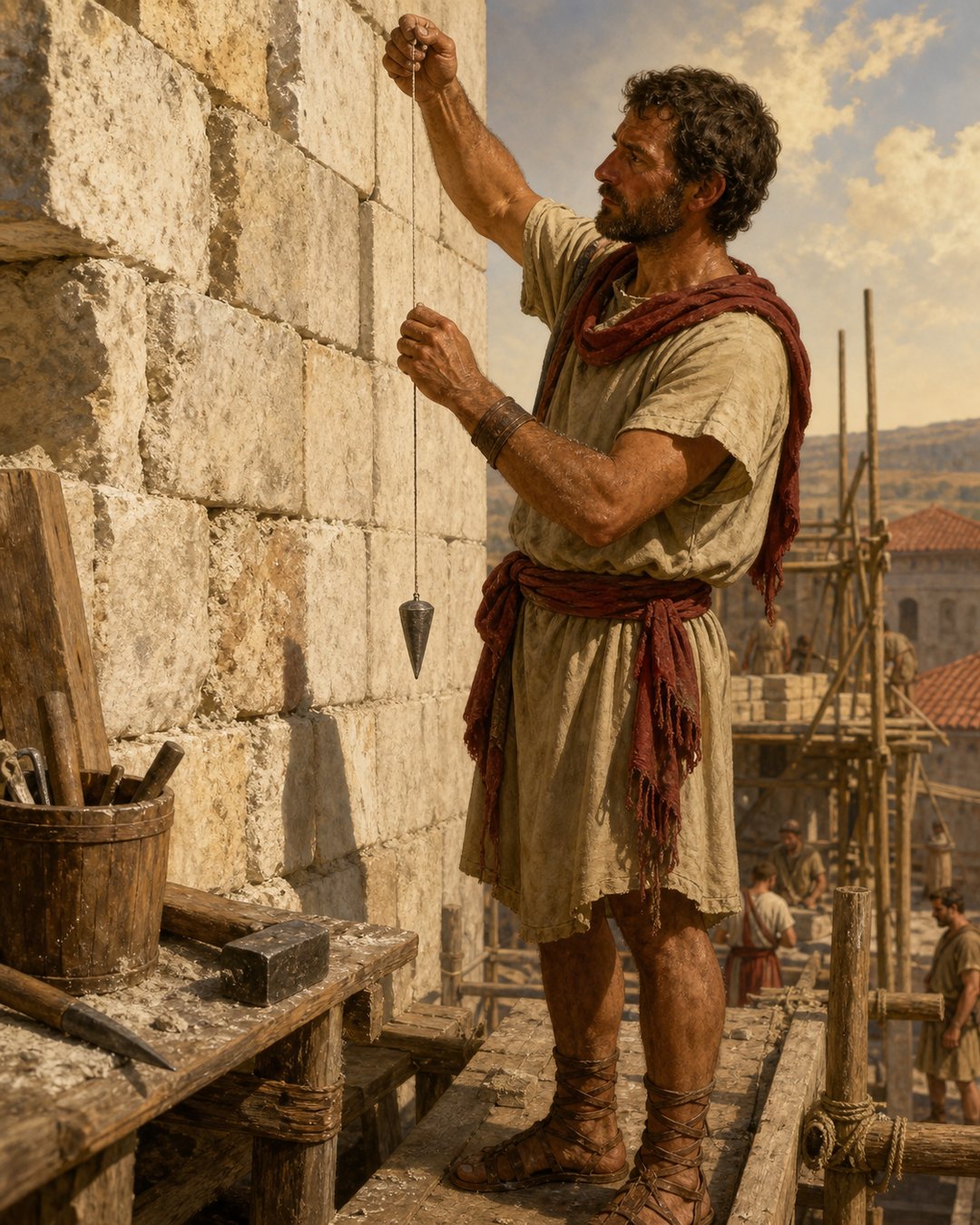
A Roman wall could look upright at knee height and still lean dangerously by the time it reached a roof. Each course offered a fresh chance to move a little outward. Mortar thickness varied, stone faces were irregular, and the ground beneath the mason was rarely a perfect reference. The higher the work rose, the more expensive a small early mistake became.
The corrective instrument was almost absurdly small: a cord and a dense weight. Suspended freely, the weight pulled the cord into the direction gravity demanded. The builder did not need the floor to be level or the wall to agree with his eye. He needed enough still air for the line to settle and enough patience to compare masonry with it.
A Roman lead plumb bob excavated at Holt in Wales weighs 186 grams and measures only 42 millimetres long. That surviving object makes the mechanism tangible. Monumental vertical order could begin with something that fit inside a hand, because the authority came not from size but from a force every stone already obeyed.
Gravity Supplied a Reference the Building Could Not Negotiate
A plumb bob is a pointed weight suspended from a string to establish a vertical direction. The cord becomes a reference line because the free weight settles below its support. Unlike a straight timber, which can warp, or a finished wall, which may already contain error, the hanging line continually renews its relationship with gravity.
The distinction between straight and vertical mattered. A dressed edge could be straight while leaning. A wall face could be smooth while moving outward one finger-width per course. The plumb line answered a narrower, harder question: does this feature remain above the same point as it rises? That question was enough to expose cumulative drift.
The article on Roman surveyors and measurable boundaries follows instruments that carried alignment across land. The plumb bob worked at a more intimate scale. It turned the invisible downward direction beside one pier, jamb or wall face into a line a mason could see, measure from and return to.
A Pointed Weight Made Comparison Precise
The bob’s mass kept the cord taut, while a pointed lower end indicated where the vertical axis met a surface below. Stone, wood, lead and other metals can serve as weights, but lead places useful mass in a compact body. A compact bob is easier to hold close to work without requiring a bulky object beside the wall.
The Holt example is conical, 37 millimetres at its maximum diameter and 42 millimetres long. Museum Wales records two iron rectangles attached to its upper surface, with a central gap between their ends. Whatever the exact surviving attachment arrangement, the object joins dense lead to a provision for suspending it on a line.
The point did not magically prove an entire wall. It made repeated comparisons possible. A builder could hold the support at a known offset, let the bob settle, then measure the gap between cord and masonry near the top and bottom. Matching gaps meant the face followed the same vertical plane; changing gaps revealed the direction of correction.
The Most Important Moment Came Before the Mortar Set
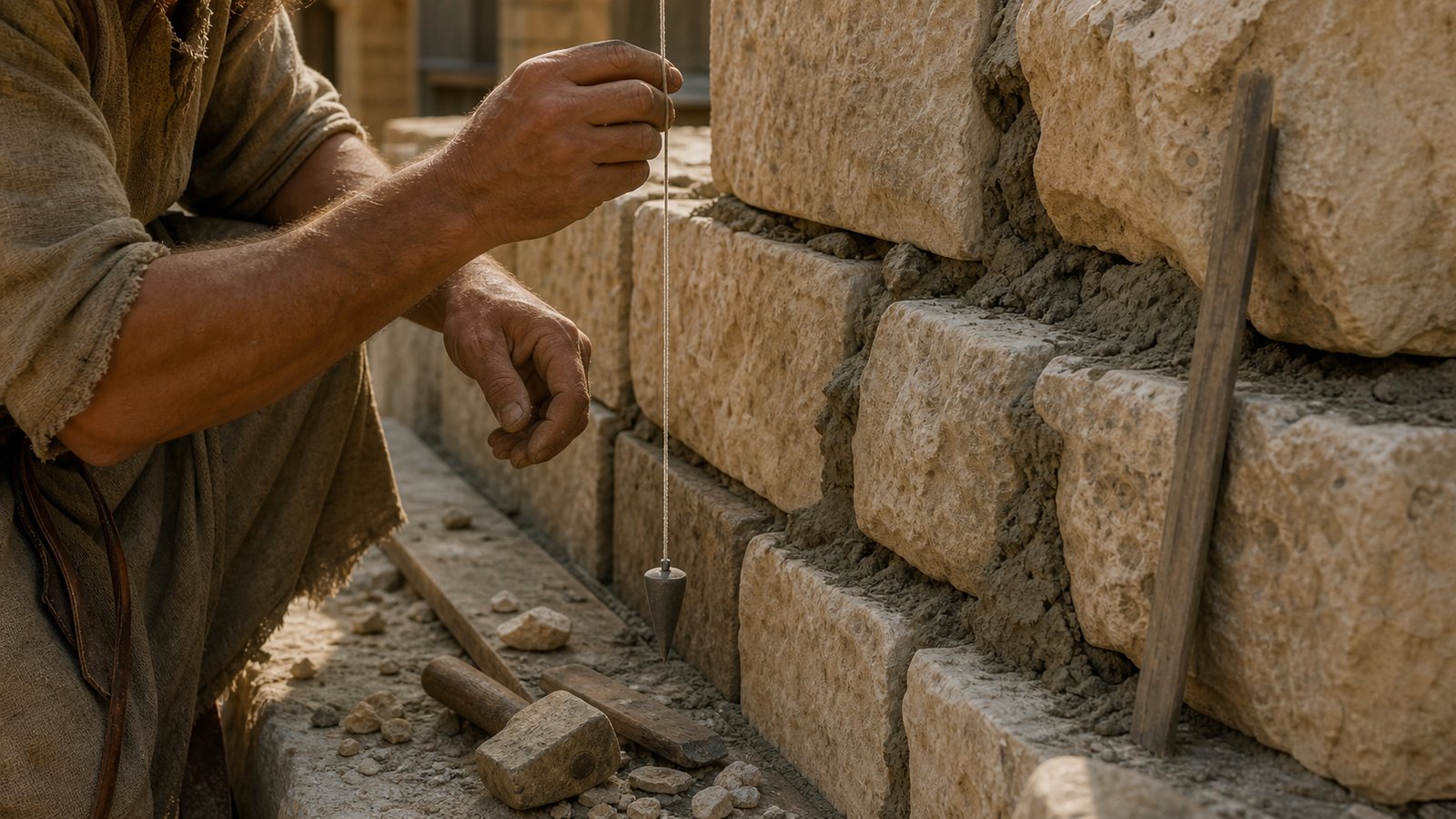
Imagine a new course pressed into mortar. One block sits slightly proud because a chip remains beneath it. The mason hangs the line beside the face. At first the lead weight swings in a small arc, crossing and recrossing the edge. When the motion fades, the cord stands clear at the bottom but nearly touches near the top.
That unequal gap translates an impression into an action. The upper stone can be tapped inward, lifted and rebedded, or its neighbor adjusted while the mortar remains workable. The line is checked again. Correction at this stage costs minutes. The same lean discovered after several courses might demand dismantling, concealment or acceptance of a structural weakness.
This is why the instrument belonged to process rather than final inspection. Verticality was not applied to a finished building like decoration. It was renewed as the work rose. Every successful check prevented a small deviation from becoming the starting point for the next layer.
Wind, Swing and Offset Could Mislead an Impatient Mason
A hanging weight needs time to settle. Wind pushes the cord, a hand transmits tremor, and a bob released sideways becomes a pendulum. Reading it during motion substitutes one passing position for the true resting line. The builder therefore had to control the setup as carefully as the stonework being judged.
The cord also needed clearance. If the bob touched the wall, friction could hold it away from the vertical. If the support point shifted between readings, the reference moved even when the building did not. A consistent offset block, marked support or fixed bracket made separate checks comparable along one face.
The instrument’s simplicity did not remove judgment. Rough masonry offered high points and hollows, so the mason had to decide which finished plane mattered. The line revealed geometry, not intention. Craft lay in placing the reference, waiting for it and translating the gap into a correction without chasing every harmless surface irregularity.
Small Datums Helped Separate One Error from Another
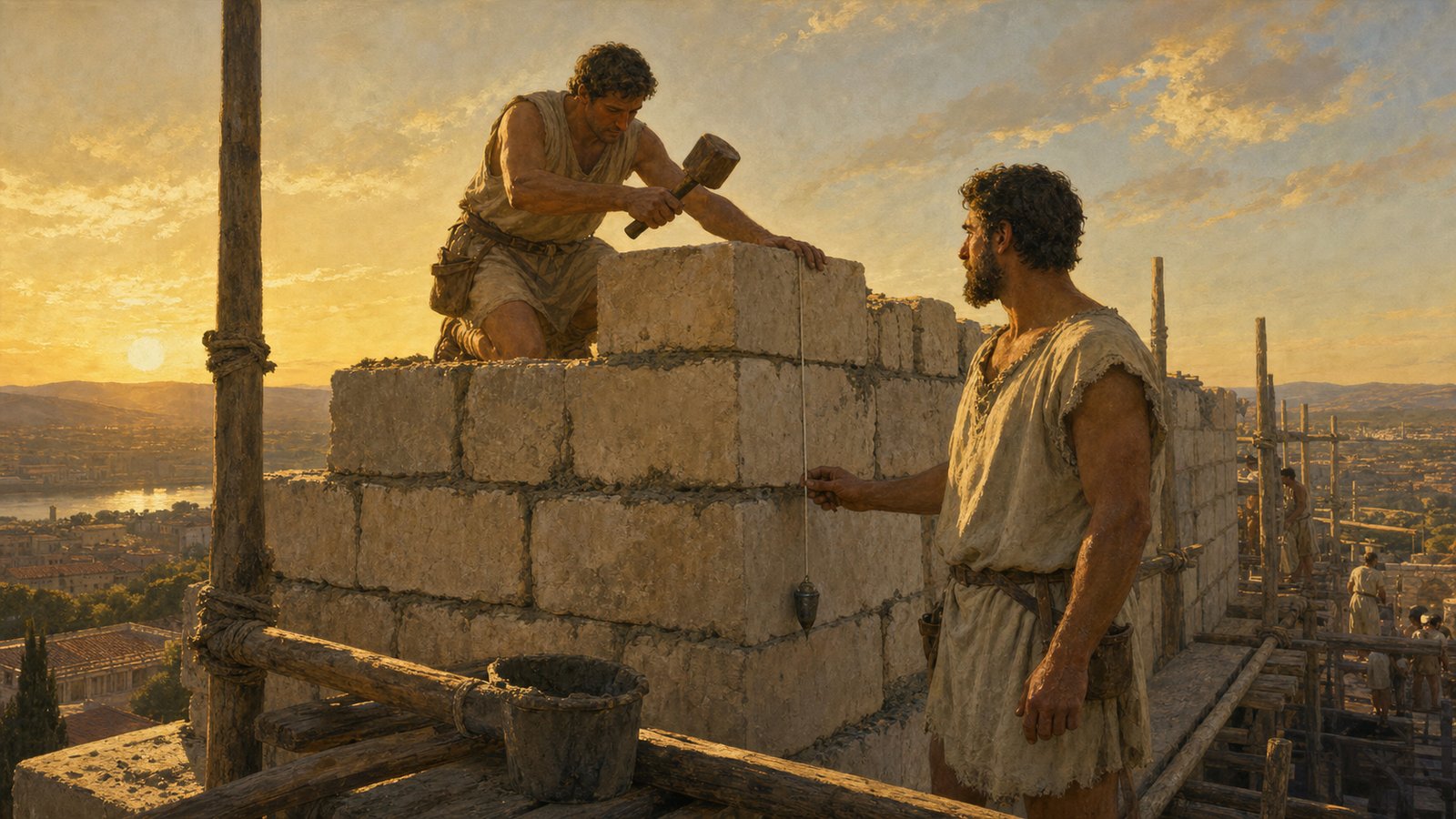
Builders needed both level and plumb, but the two tests diagnosed different mistakes. A horizontal course could be level while the wall above it leaned. A wall could be vertical while individual courses climbed unevenly. Treating each reference separately let a crew correct height across a course without losing the upright plane through the whole elevation.
This division of labor resembles the archive’s Roman crane. The crane supplied controlled lifting but did not tell workers where the stone belonged. The plumb line supplied direction but moved nothing. Monumental building depended on modest tools whose separate answers were coordinated by people.
Jambs, columns, piers and wall corners made especially useful checkpoints because they organized adjoining work. Once a vertical edge was established, strings, rods and sight lines could extend relationships across the building. A 186-gram bob did not lay out an entire structure, but it could anchor the local truth from which a larger order grew.
The Surviving Tool Restores Scale to Roman Precision
Museum Wales records the Holt bob as an excavation find from work undertaken between 1907 and 1915, though its precise context was unrecorded. Its battered lead surface has been scraped back to metal in two places. Those details resist the fantasy that ancient precision required pristine instruments. A working reference could be scarred and still let gravity do its job.
The object also corrects the way Roman construction is remembered. Finished arches, walls and aqueducts dominate photographs, while the repeated checks disappear with the scaffolding. The article on Roman aqueduct control describes large systems; the plumb bob reveals the hand-sized discipline beneath their masonry.
The surviving tool therefore records a habit as much as an object. Someone had to pause production, suspend the cord, watch its swing diminish and accept correction from a device that did no building itself. That repeated interruption separated measured confidence from visual guesswork.
A hanging weight argued with every rising wall in the same language: down. The mason could ignore it, misread it or use it well, but could not persuade it that a lean was vertical. Roman precision emerged when workers repeatedly allowed that quiet line to interrupt confidence before confidence hardened into stone.
Sources & Further Reading
- Museum Wales, “Roman lead plumb bob”
- Wikipedia, “Plumb bob”
- Encyclopaedia Britannica, “Plumb bob”