
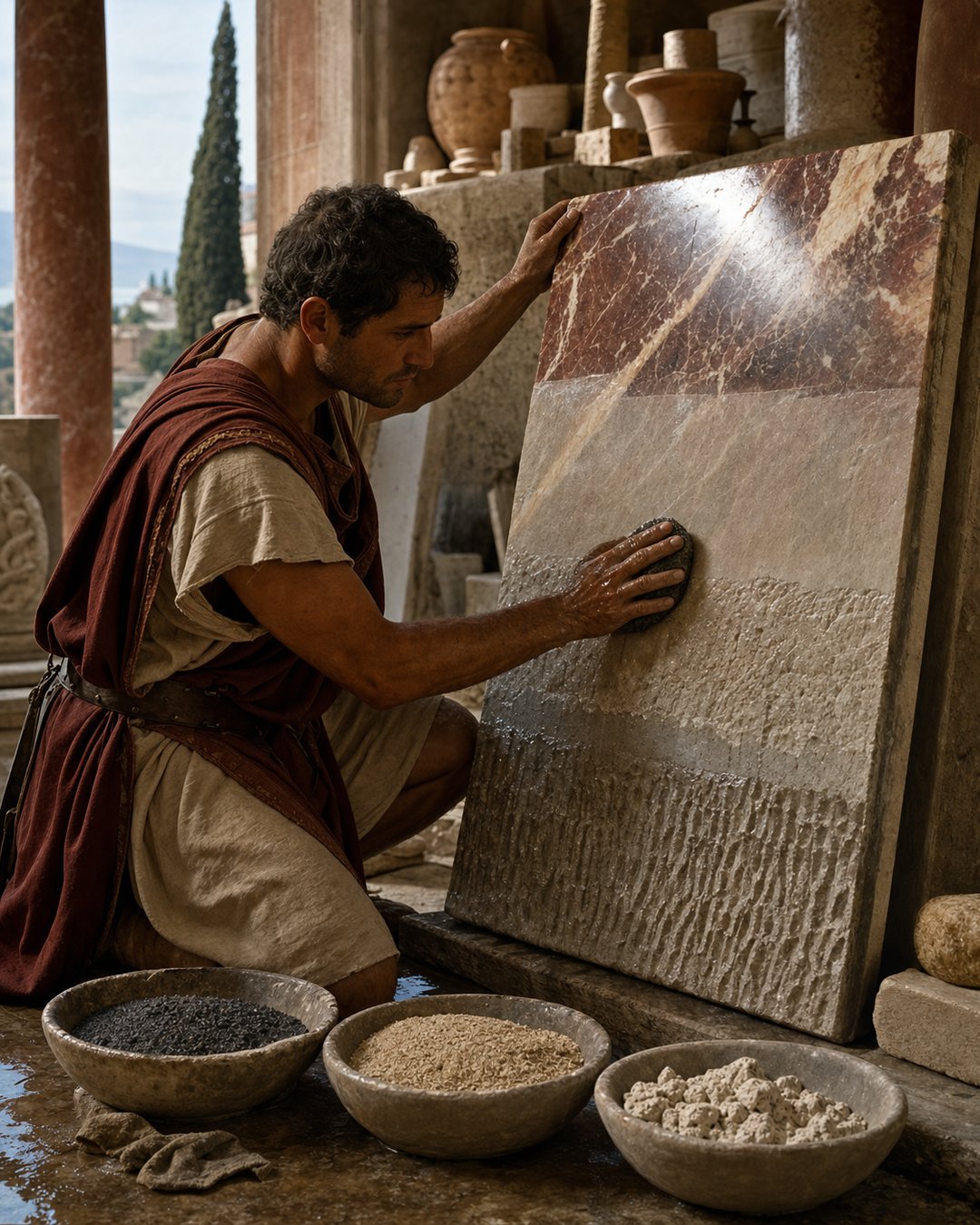
Polish looks like something added to stone. In Roman carving it was often the opposite: a long sequence of removals so small that the final surface returned light instead of obvious tool marks. Emery, sandstone and pumice did not paint marble. They ground away its high points and replaced one scale of scratches with another.
Art of Making describes abrasives ranging from coarse hard emery to softer sandstone and pumice. Carvers rubbed them across stone, usually with water, and moved from rough grades toward finer ones. A soft abrasive could create a matte finish. High gloss required a much longer descent through increasingly fine material.
The sequence mattered because a fine abrasive cannot efficiently erase every deep scar left by carving. Each stage prepared the next. The finished sheen was therefore a record of correct order even though the order itself had disappeared from sight.
Emery and Pumice Belonged to Different Moments
Art of Making places emery at the coarse, hard end of the working range and sandstone or pumice among softer materials. Those names do not describe interchangeable powders. Hard coarse particles attack pronounced ridges; softer or finer abrasives refine the shallower texture that remains.
A carver beginning with the finest material would spend effort gliding over deep chisel lines without removing them effectively. Beginning coarse accelerates leveling, but stopping coarse leaves a visibly scratched or dull surface. The sequence solves both problems by matching particle action to the current scale of roughness.
The stone itself also matters. A grain that cuts one material efficiently may wear, roll or clog on another. Roman polishers needed practical knowledge of both abrasive and workpiece rather than a universal recipe detached from geology.
This continued the correction described in Roman files. Files could regularize form and remove local errors. Abrasives then addressed a finer problem: not where the surface should be, but how its remaining microscopic relief should handle light and touch.
Water Turned Loose Grit into a Working Layer
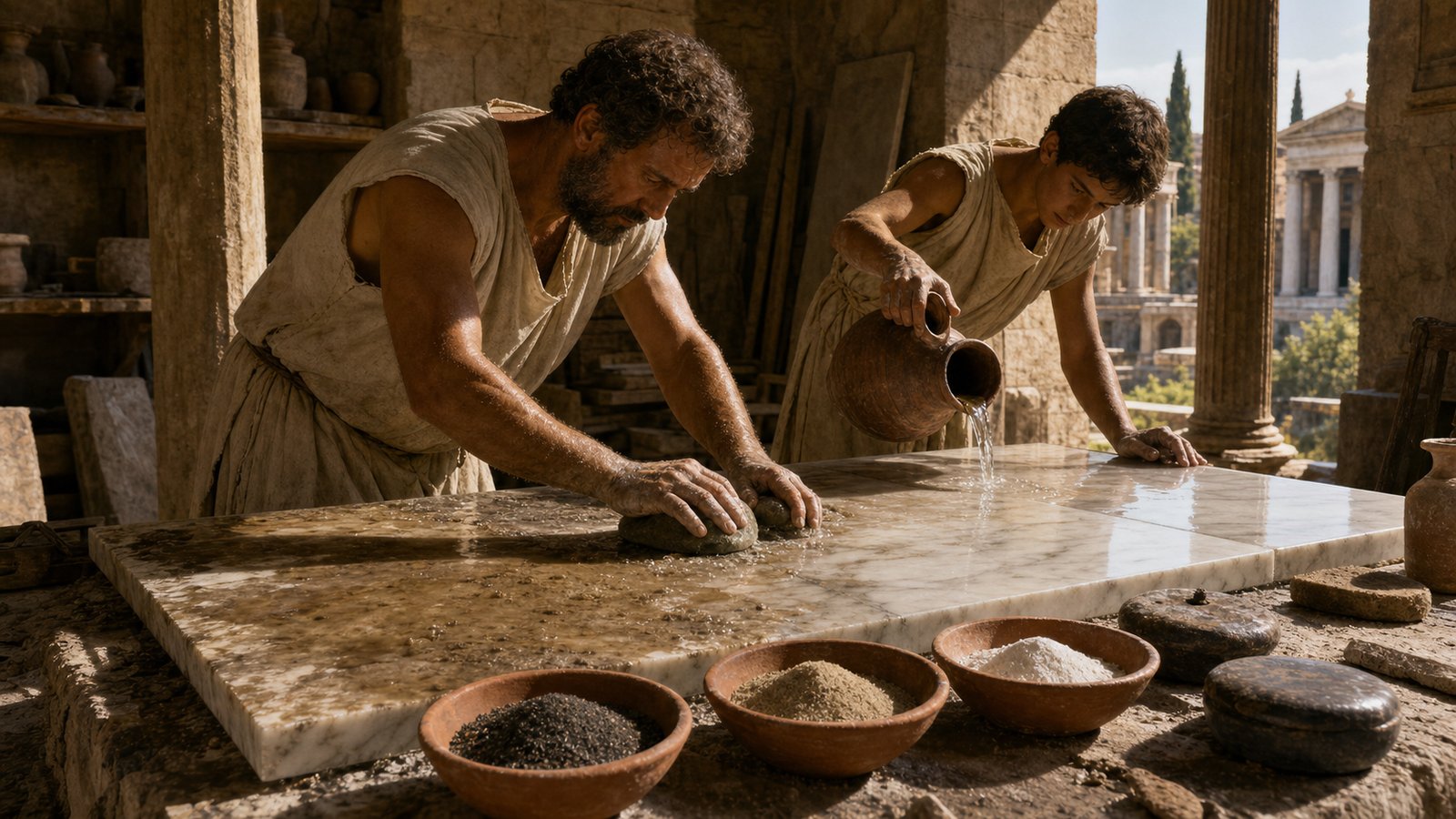
The research project notes that abrasives were usually rubbed with water. Water helps distribute loose particles across the contact, lets the worker renew the mixture and carries some powdered stone away. It creates a mobile layer rather than leaving dry grains piled at the first point of pressure.
The slurry changes while work continues. Abrasive grains fracture or become rounded; stone dust joins them; water spreads or evaporates; the mixture thickens. A worker must add, rinse or replace material when the layer stops cutting predictably. Wetness is therefore a variable under observation, not merely workshop mess.
Pressure also changes the result. Heavy rubbing can make coarse grains bite rapidly but increases the risk of local hollows or persistent scratches. Lighter, broader passes help unify a nearly finished surface. Hands, pads or rubbing stones must travel far enough to blend one treated area into the next.
The same wet-abrasive principle appears in Roman hard-stone sawing, scheduled earlier in this series. In the saw kerf, a flat blade transports grit through a line. During polishing, the worker spreads abrasive across a plane or curved form. One slurry opens stone; the other refines what cutting leaves.
Every Finer Stage Had to Erase the Previous One
Coarse abrasion leaves scratches large enough for the next grade to attack. The next grade replaces them with more numerous, shallower marks. Repetition continues until the remaining texture falls below the visual scale chosen for the object. Polish is built through substitution, not one final miraculous pass.
This makes cleaning between stages essential in principle. A single coarse grain carried into a finer operation can draw a fresh deep line across work that has already consumed hours. Separate containers, rinsed surfaces and inspection under changing light protect the progression.
Raking light is unforgiving. Held low across stone, it reveals ridges and scratches that frontal illumination hides. Water can temporarily darken the surface and alter what the eye sees, so the worker must inspect both wet action and the emerging dry finish.
Curves complicate the sequence because pressure concentrates on high points. A face, fold or moulding cannot be treated exactly like a flat pavement slab. The abrasive must reach recesses without flattening deliberate edges, and the carrier must conform without cutting an unintended new shape.
Matte and Gloss Were Different Endpoints
Art of Making explicitly distinguishes finishes. Softer abrasives can provide a matte surface, while a really high gloss needs a wide range of grades down to the finest. The decision to stop is therefore aesthetic and functional, not simply evidence that a worker ran out of patience.
Matte stone scatters light across minute irregularities. A more highly polished surface reflects it in tighter highlights and deepens the visual contrast of colored or veined stone. On sculpture, that can change how volume reads; on architectural facing, it can make rare material announce itself across a room.
Gloss also exposes defects. A remaining scratch interrupts reflection, and an uneven hollow bends a highlight. The closer the surface moves toward polish, the more conspicuous isolated failures become. Final stages can demand greater care even while removing less material.
This concern with reflected light parallels Roman metal mirror polishing. Bronze and stone are different materials, and their abrasive routines should not be collapsed into one. Yet both show that reflection depends on controlling surface irregularity rather than applying an image to the object.
Polish Could Separate Material, Flesh and Cloth
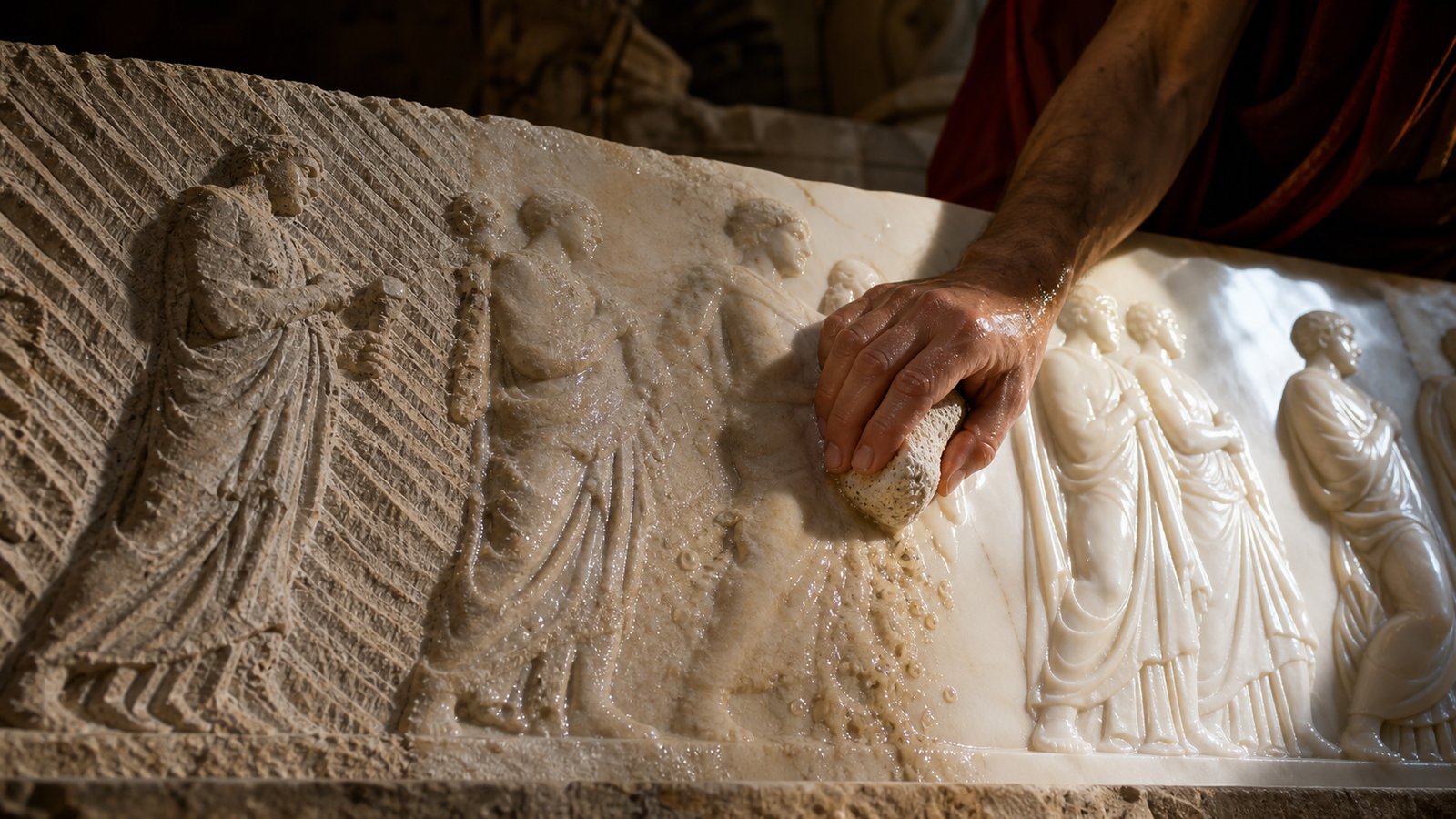
A sculptor did not have to give every part of an object the same finish. More polished stone can suggest taut skin, wetness or expensive cloth; a matte passage can soften light or preserve texture. The abrasive stage could therefore participate in representation after the main carving already existed.
That freedom also carried risk. Overworking an edge blunts it. Repeated rubbing across shallow detail can erase the very distinction the carver established with a chisel. The polisher must know when refinement becomes loss.
Architectural stone poses another scale. A thin revetment panel may seek broad visual continuity, while a relief contains changing depths and protected recesses. Emery, sandstone and pumice are materials, but skilled sequencing turns them into decisions about where light should break.
Roman mosaics offer a related public encounter with prepared surfaces. In the archive’s mosaic article, color and imagery organize a visitor’s reading of a room. Polished stone panels could work at a larger scale, making geological color and veining appear continuous and deliberate.
A Finished Shine Was an Invisible Inventory of Labor
No single scratch tells the whole polishing sequence. The coarse marks are erased by medium ones; medium marks disappear beneath fine ones; the finest traces merge into the chosen sheen. Successful labor systematically destroys its own earlier evidence.
The expendable materials disappear too. Abrasive breaks down, powdered stone washes away, water dries and cloth or rubbing surfaces wear. The durable object survives precisely because many less durable participants were consumed against it.
That is why a polished Roman surface should not be imagined as the natural face of marble waiting to be uncovered. Quarrying exposed rock, saws divided it, chisels corrected it and abrasive grades negotiated the last distance between worked stone and visual finish. Each stage left a problem for the next.
Roman polishers built sheen one grain size at a time. They began with scratches large enough to see, exchanged them for scratches harder to see and stopped when light behaved as intended. The final surface seemed effortless because the workshop had removed every obvious sign of the route.
Sources & Further Reading
- Art of Making, “Tool: Abrasives”
- Wikipedia, “Abrasive”