
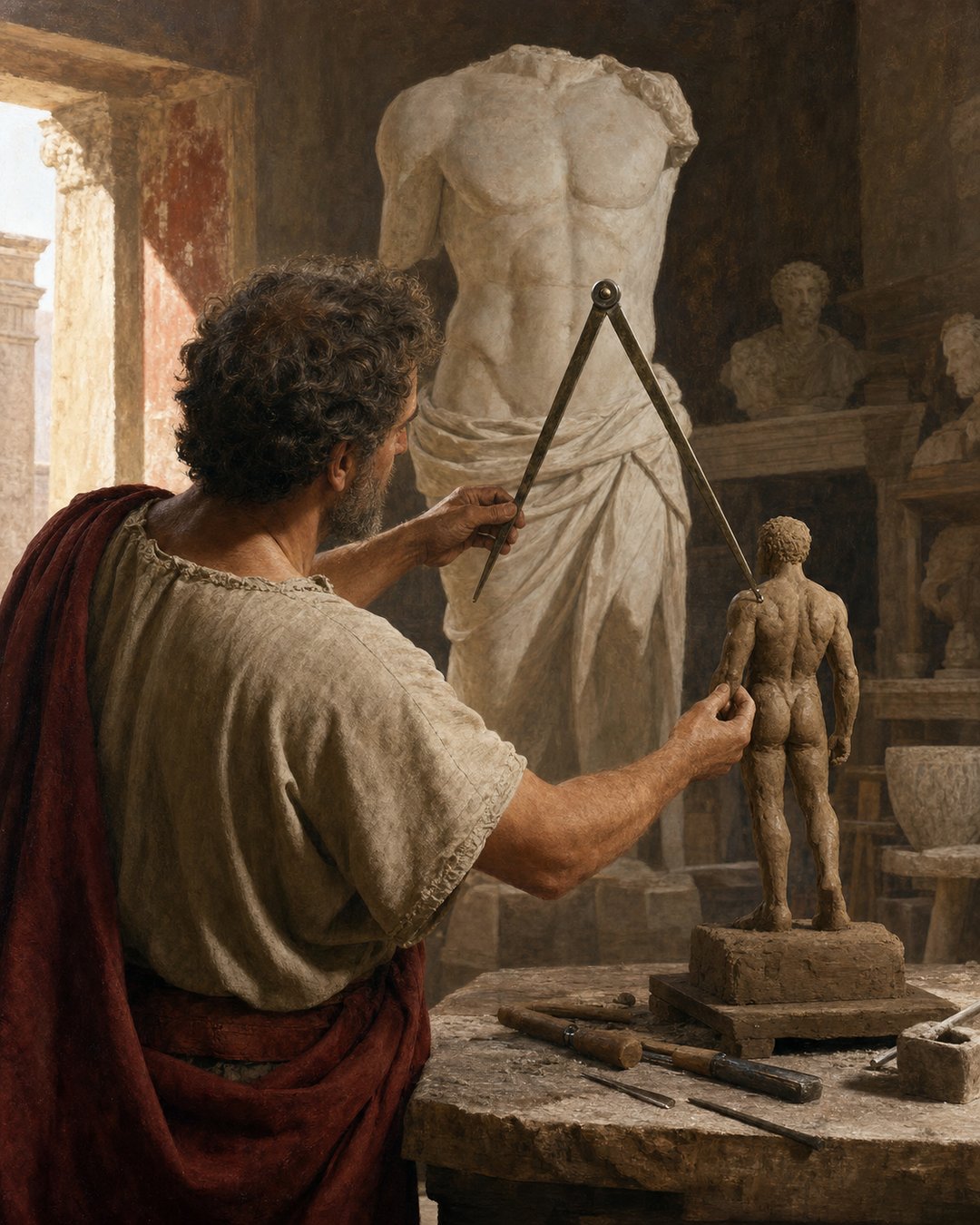
A Roman sculptor could carry a distance without writing it down. Open the callipers across a model’s shoulder, keep the legs fixed, then move the tool to the block: the empty gap between the points had become a portable instruction. Nothing had been marked with a numeral, yet one object could now answer another.
The Art of Making project identifies callipers as the usual instrument for basic and more complicated measurement in stone carving. A carver could take dimensions from a model, sketch or set of guidelines and apply them to the work, enlarging or reducing them by chosen multiples. The tool made proportion practical at the bench.
This was not the same job as drawing a line. A line tells the eye where a boundary may run; callipers test whether two surfaces remain the right distance apart. Their value appeared repeatedly, as rough mass became torso, limb, fold and face under checks that could be made, moved and made again.
An Empty Gap Could Preserve One Exact Decision
Callipers consist conceptually of two points joined so their opening can be held. The material between those points is only air, but the separation is stable enough to compare one place with another. A carver does not need to name the interval in inches or digits for the tool to preserve it.
That distinction matters in a dusty workshop. A spoken estimate can be forgotten, and a cord can sag or twist. The calliper opening offers a direct physical comparison. If both points touch the model, the interval has been captured; if they touch corresponding places on the stone, the comparison has arrived.
The tool therefore turns measurement into a yes-or-no encounter. A gap at the stone means too little material has been removed at that span. A tool that cannot pass over a swelling meets too much. Contact gives feedback before the eye has to judge every proportion unaided.
The archive article on Roman dividers follows a related portable interval, but its mechanism centers points laying out distance on a surface. Callipers address thickness, breadth and three-dimensional separation. The family resemblance makes their different workshop roles easier to see.
A Model Became a Storehouse of Retrievable Distances
Art of Making states that measurements could be taken from a model. That makes the model more than a picture of the desired result. It becomes a physical reservoir of widths, depths and relationships that can be sampled whenever the stone begins to drift from the intended form.
A shoulder can be checked against a chest, a head against a torso, or one side against its partner. The tool does not interpret anatomy on its own. It lets the craftsperson return to a chosen relationship instead of rebuilding that relationship from memory after every sequence of blows.
This repeated retrieval protects the project from accumulated error. A small excess left at one stage can distort the next feature built around it. Checking early keeps a local mistake from becoming the new reference for the rest of the figure.
The model also separates design from irreversible removal. Clay, wax or another preparatory form can be adjusted; stone cannot be put back once cut away. Callipers make the revisable object speak to the permanent one at many points before the chisel commits too far.
Sketches and Guidelines Could Govern More Than a Flat Outline
The source also names sketches and sets of guidelines. A drawing offers proportions even when it does not reproduce the final object at full scale. Callipers can take an interval defined on that guide and carry its relationship into work whose surface is still emerging.
The carver must decide which points correspond. A measured span is useful only if both ends refer to the intended landmarks. Moving one point from the edge of a cheek to the shadow beside it can produce a precise measurement of the wrong thing.
Guidelines impose sequence. Major breadths can be established before small details, and the same set of reference intervals can be revisited as the stone approaches final form. The tool helps keep a broad plan present during many local acts of carving.
This differs from the flat chisel’s control of impact. A chisel determines how stone leaves beneath a blow. Callipers do not cut at all; they decide whether enough has left and where the next cutting decision should be reconsidered.
Multiples Let a Small Design Command a Larger Block
Art of Making explicitly notes that measurements could be increased or decreased by set multiples. A small model did not need to match the final monument one-for-one. Its intervals could be translated through a consistent scale, preserving relationships while changing total size.
Scaling demands discipline because each interval must obey the same rule. Doubling one breadth while treating a neighboring depth casually produces a figure that is larger but no longer proportional. The multiplier must govern the whole network rather than a few conspicuous features.
The arithmetic may be simple, yet the physical operation remains demanding. The carver has to set or interpret the enlarged opening, identify corresponding points, and check a rough surface whose final boundary may still lie beneath projecting stone.
A set of proportions is therefore not one master number. It is a web of selected distances. Callipers allow that web to be tested one span at a time, which makes enlargement manageable without pretending that the entire body can be verified in a single glance.
Repeated Contact Put Measurement Inside the Carving Rhythm
Measurement was not only a ceremony at the beginning. Roughing changes the block, and every change creates new opportunities to check. The callipers belong between cutting episodes: remove, brush dust, compare, turn the work, then decide where another controlled removal is safe.
The points had to touch gently enough not to damage a model or deceive the hand. Pressure can make a soft model yield, while a tilted tool changes which surfaces are being compared. Consistency belongs to the operator as much as to the hinge.
On symmetrical forms, comparison can happen within the work as well as between model and stone. One side can be checked against the other, exposing a swelling or hollow before finishing makes the discrepancy harder to correct.
The process joins sight and touch. Eyes choose landmarks and read the overall figure; the tool tests a particular interval through contact. Neither mode replaces the other. The callipers are strongest where visual judgment needs a narrow, repeatable question.
Proportion Survived Because It Could Be Checked Locally
A finished Roman statue presents one continuous body, not a catalogue of measurements. The unity can hide how often the maker had to stop and divide that body into testable spans. Each local check protected a larger visual relationship.
The callipers did not guarantee beauty. They could faithfully transfer a poor model or preserve a mistaken landmark. Their contribution was accountability: a chosen proportion could be recovered, compared and corrected rather than depending entirely on confidence.
This practical portability explains why Art of Making calls the tool simple and effective. It required no written scale on the stone and left no necessary decorative trace. Its evidence lies in the controlled relationships of the object and in the tool tradition used to make them.
The gap between the points was temporary, but the proportion it governed could remain for centuries. Roman carvers made empty space do workshop labor, moving an interval from model to block until stone held the same relationship without needing the callipers beside it.
Sources & Further Reading
- Art of Making, “Tool: Callipers”
- Wikipedia, “Calipers”