
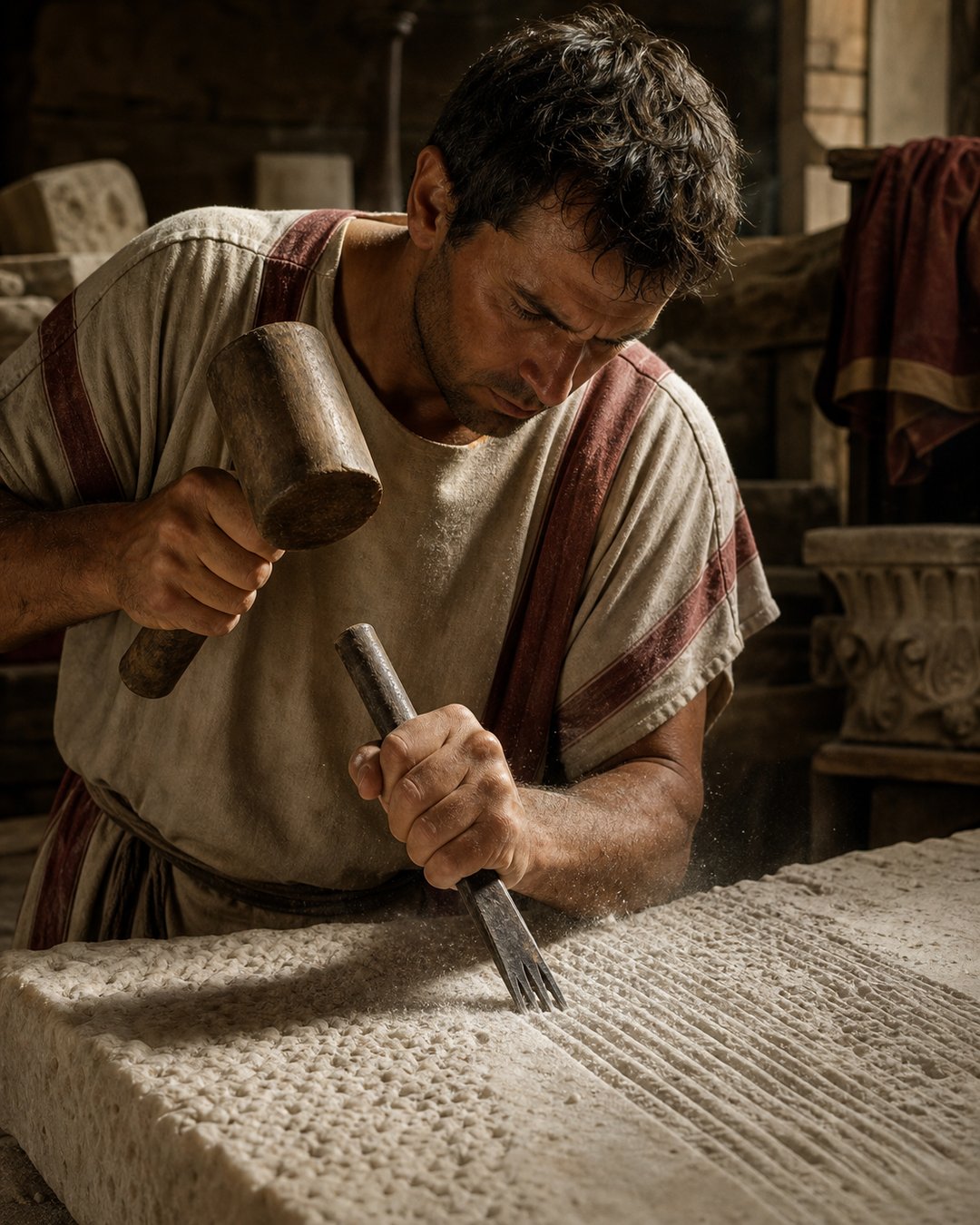
Roman carvers sometimes struck stone with three teeth at once. A typical tooth chisel had three to five teeth across an edge only part of a centimetre to ten centimetres wide. Each hammer blow divided itself into neighboring contacts, leaving shallow parallel lines instead of one isolated pit.
The Art of Making project places the tool between roughing and finishing. It cleared the irregular traces of a point chisel and prepared stone for finer work with a flat chisel. Its marks were not a failure to finish. They were an organized middle state, easier to judge and control than the surface that came before.
Tool sequence is the hidden subject. Roman carving did not advance from block to polish in one heroic gesture. Different edges created different kinds of order. The tooth chisel’s contribution was to make a rough surface regular enough that the next tool could know where it stood.
Three to Five Teeth Shared One Hammer Blow
Art of Making describes a metal hand tool with a shaft sixteen to twenty-two centimetres long and one to two centimetres in diameter. At one end sat a toothed cutting edge, usually between half a centimetre and ten centimetres wide. The other end received hammer or mallet blows.
The cutting edge normally carried three to five teeth, though a two-toothed variant existed. Instead of concentrating impact at one point or spreading it along one continuous flat edge, the tool distributed force through several separated tips.
Each tooth enters or scrapes a narrow path. Together they remove multiple strips while leaving ridges and lines between contacts. A broad arrangement covers surface quickly; a narrower one can approach smaller forms with less risk of crossing an intended boundary.
The result is mechanical punctuation. One blow becomes a row of related marks. Repeated at a stable angle, those rows overlap into a texture whose direction and depth are easier to read than scattered point strikes.A damaged or uneven tooth would announce itself repeatedly. Because all the projections share one edge, a missing tip changes the rhythm of every pass and leaves a stripe unlike its neighbors. The surface acts as a diagnostic record: regular grooves confirm that the teeth meet stone together, while an odd channel sends the tool back for inspection or reshaping.
The Tool Entered After the Point and Before the Flat Edge
The project identifies the tooth chisel as an intermediary instrument. A point chisel removes rough mass but leaves pronounced pits and ridges. The tooth chisel clears those rough marks, while a flat chisel later addresses the shallower, more regular surface.
This order matches tool geometry to the current problem. A flat edge applied too early may bridge high spots or catch against irregular relief. Teeth can enter that uneven ground independently and reduce it without demanding continuous contact across the whole edge.
Once the tooth marks become consistent, the next tool receives information. Deep isolated hollows remain visible between parallel passes, showing where roughing damage has not yet been brought into the common plane.
The sequence continues through Roman flat-chisel work and then coarse-to-fine abrasion. Each stage removes the previous stage’s characteristic traces while creating a finer set of its own.
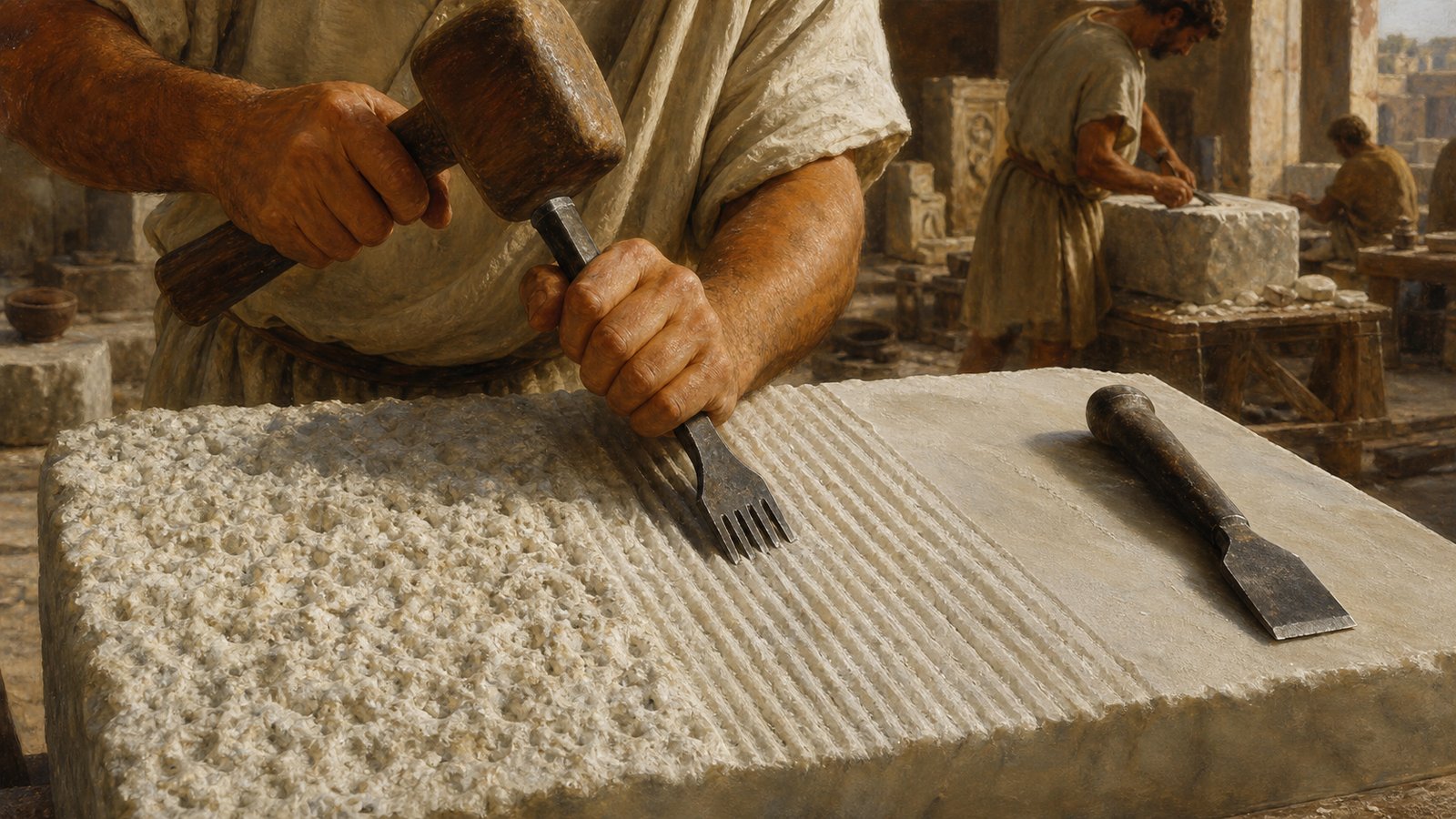
Thirty-Five to Sixty Degrees Turned Impact Across Stone
Art of Making gives the usual working angle as roughly thirty-five to sixty degrees to the surface. At that oblique range, the teeth can travel across high points and leave shallow parallel lines rather than simply punching vertical holes.
Angle and force interact. A shallower controlled stroke encourages lateral removal; a steeper strike enters more directly. The carver adjusts according to stone, edge condition, remaining relief and proximity to a vulnerable corner.
The hand holding the shaft supplies orientation between blows. It keeps the teeth aligned with the intended pass and prevents one end of the edge from diving. The striking hand supplies renewed energy, but geometry turns that energy into useful texture.
When held closer to vertical, the source says, the chisel cuts more into the stone and its marks become less regular. The changed trace is evidence of changed use. Tool marks preserve angle as well as tool identity.
Pointed Teeth Favoured Marble, Blunter Teeth Limestone
Tooth shape mattered. The source distinguishes pointed or squared forms and notes that sharper teeth were preferred for marble, while blunter ones suited limestone. “Tooth chisel” therefore names a class rather than one universal edge.
Different stones answer concentrated pressure differently. A sharp point can enter marble cleanly when used with control, but edge durability and fracture behavior change in softer or coarser material. A blunter tooth distributes contact differently and may survive or work more predictably in limestone.
Resharpening changes the profile over time. A workshop has to preserve not merely the existence of teeth but their spacing, shape and relative projection. One tooth standing proud can take more of every blow and score a deeper line.
This material matching contradicts the idea that Roman carving skill consisted only of striking harder. The useful question was which edge, at which angle, against which stone, at this stage of the sequence.
Granite Could Break the Teeth Before They Ordered the Surface
Art of Making states that tooth chisels were not used on granite because their teeth would break. The exclusion is as informative as the recommended uses. A tool efficient on marble or limestone could be mechanically wrong for a harder stone.
Several narrow teeth create multiple vulnerable projections. Granite can resist them strongly enough that the edge fails before a controlled texture develops. The craft response is not stubborn repetition but a different tool system suited to the material.
Tool limits shape surviving marks. The absence of tooth-chisel lines on a granite surface should not automatically imply less refinement; it may reflect an alternate sequence demanded by stone hardness.
The same principle appears in hard-stone sawing, where loose abrasive, not a toothed blade, performed the cutting. Roman workshops changed the contact mechanism when the material made a familiar edge ineffective.
Parallel Lines Could Be Preparation or the Intended Finish
The characteristic trace is a set of shallow parallel lines. Usually those lines were temporary, destined for flat-chisel finishing. Occasionally, however, Roman carvers used tooth chisels to create texture, especially across broad flat areas where smooth finish was unnecessary.
The same mark can therefore mean two things: work paused between stages, or a deliberate surface chosen as complete. Context, consistency and neighboring finishes help distinguish preparation from intention.
Leaving texture saves labor, but it can also manage light. Parallel grooves break reflection and separate a background or broad field from smoother adjacent forms. An intermediary tool becomes a finishing tool when its trace serves the design.
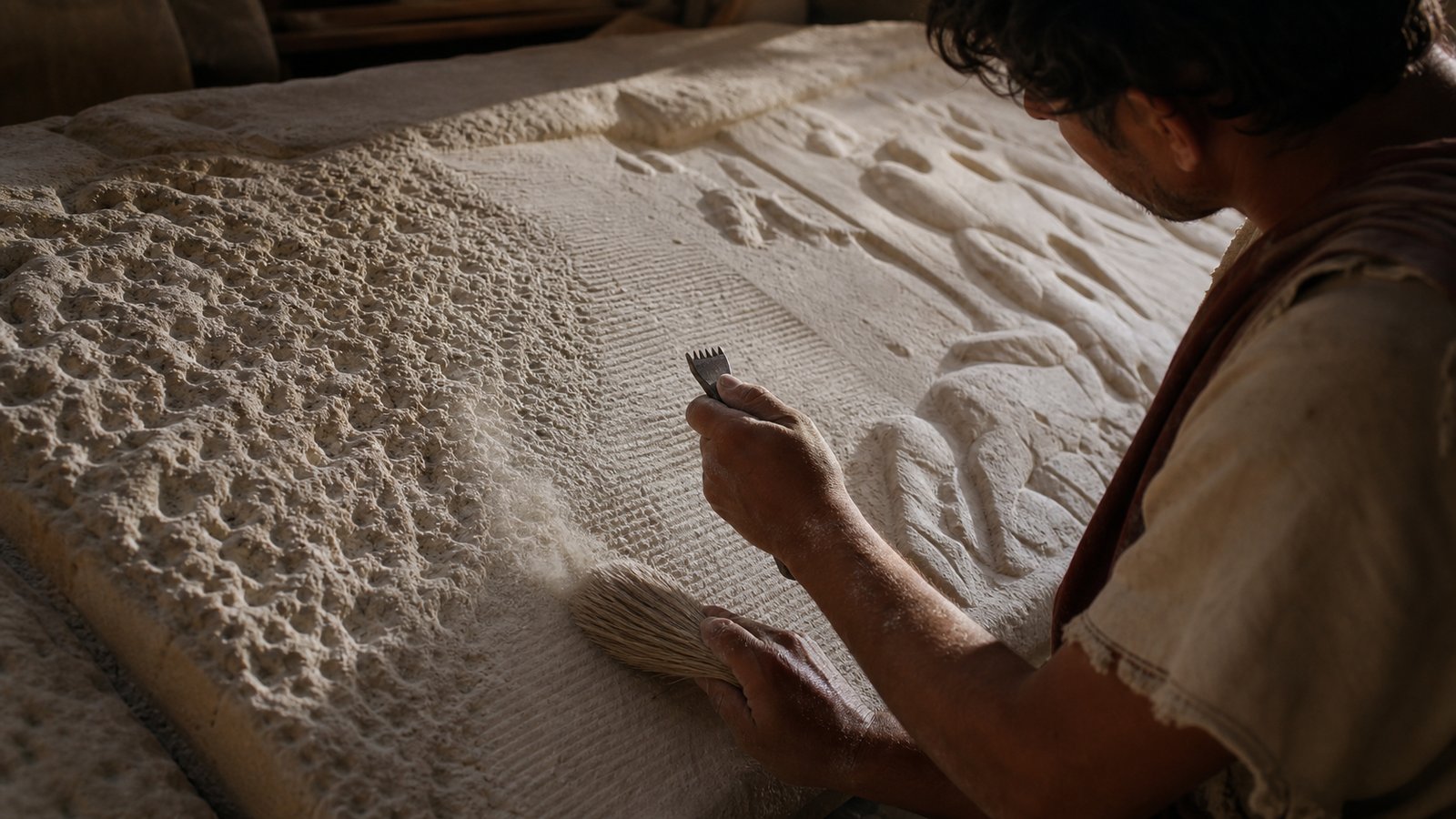
Roman carvers used three, four or five teeth to make roughness orderly. The tool’s success was not measured only by the marks it erased. It created a readable surface on which the next decision—smooth further or stop—could finally be made with confidence.Raking light made that decision sharper. Cast across the grooves, it turns high ridges bright and leaves deeper channels dark, exposing an area that still stands proud or a stroke that entered too steeply. Dust can soften the contrast, so brushing the stone becomes part of reading the work. The texture was not merely debris from effort; it was visible feedback about the next pass.
Sources & Further Reading
- Art of Making, “Tool: Tooth Chisel”
- Wikipedia, “Chisel”