
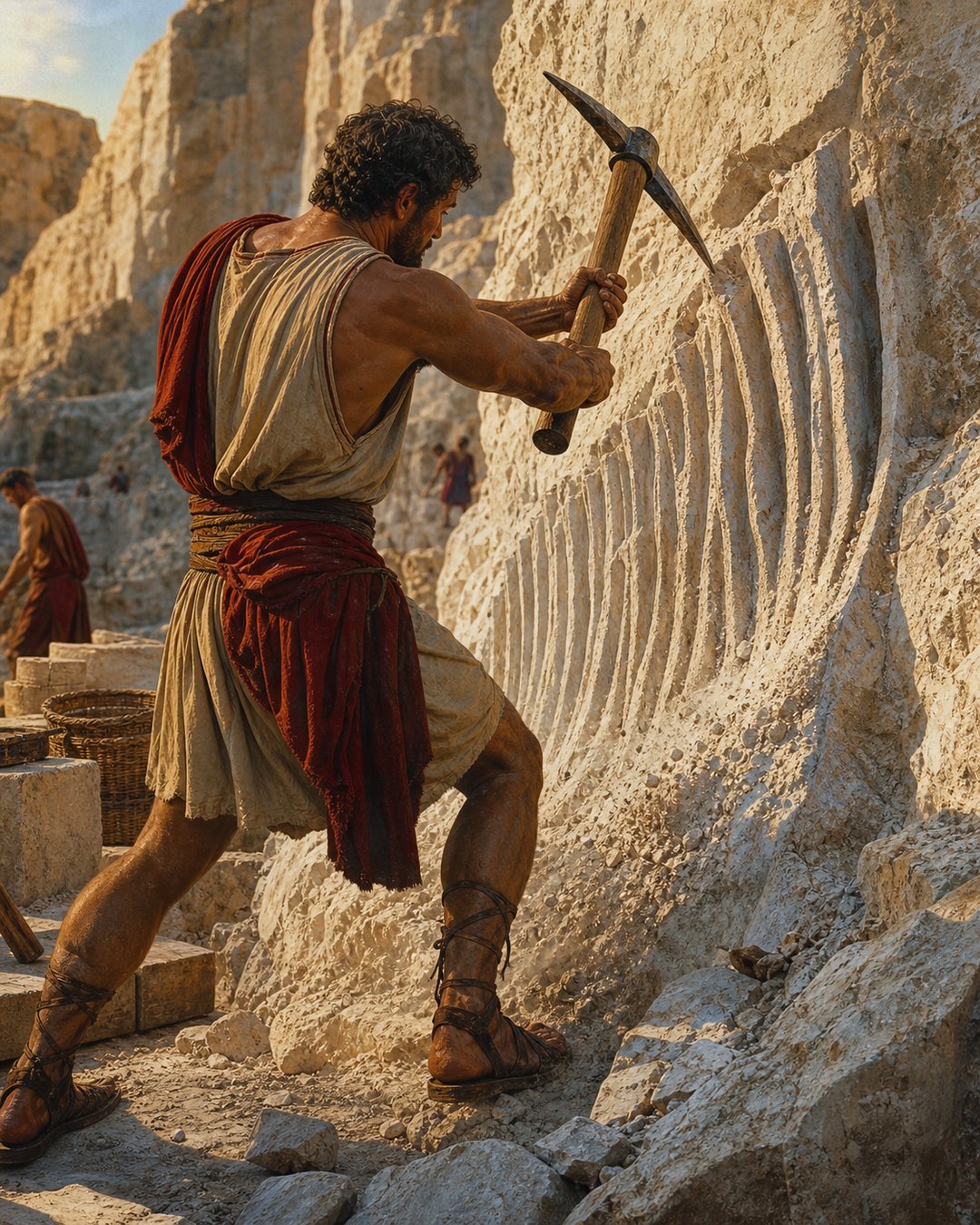
A Roman quarryman could reach the stone with a point chisel held in one hand, or he could put the point at the end of a wooden handle almost as long as his arm. The second arrangement changed the bargain. A quarry pick with a handle up to seventy or eighty centimetres long delivered far more force, but it surrendered the fine control of a hand-held tool.
The Art of Making project describes the pick as a primary quarrying tool: a wooden handle, a metal head, and a point on one or both ends. Its scars survive as long, often curved lines where workers struck the same place repeatedly before advancing parallel to the rock face. Those marks preserve rhythm as clearly as they preserve impact.
The tool was not merely a larger chisel. It organized labor around momentum, stance and acceptable waste. Roman workers used it to attack quarry faces, square blocks and hollow sarcophagi. In the imperial period, a heavier version appears to have increased power again, even while smashing away more usable stone.
Seventy to Eighty Centimetres Turned a Point into a Swing
The quarry pick’s wooden handle could reach seventy to eighty centimetres. That distance gave the worker room to accelerate the metal head through an arc before contact. The hand did not simply push a point into stone; shoulders, back, hips and gravity contributed to a moving mass that arrived with speed.
At the head, one or two points concentrated that motion into a small contact. Art of Making compares each point to a point chisel. The similarity lies at the stone, but the delivery differs: the hand chisel receives a separate hammer blow, while the pick’s point and striking mass travel together at the end of the handle.
The worker therefore managed a trajectory rather than placing an edge with fingertip precision. Stance set the distance. Grip set the radius. The returning tool had to clear the body and the quarry face before the next stroke could fall into the developing cut.
This explains why the pick belongs beside, not inside, the story of Roman quarry separation. Wedges exploit a prepared line to force a fracture. The pick spends repeated impacts creating access, reducing mass and shaping the working face before or around that decisive split.
Greater Force Arrived with Less Control
Art of Making states the exchange plainly: the long handle allowed much more force with every stroke, though with less control. The point could break away a useful quantity quickly, but it could not be guided as delicately as a short chisel held close to the intended surface.
Less control did not mean random work. A quarryman still selected an area, angle and repeated path. It meant that the smallest correctable unit was larger. A slightly misplaced hand chisel mark might be refined away; an overcommitted pick blow could remove a chunk that the finished block needed.
The sensible use of the tool was therefore stage-specific. Early in extraction or hollowing, much unwanted stone remained and force had high value. As the intended boundary approached, the cost of an error rose. The worker had to shorten the ambition of each stroke or hand the surface to a more controllable edge.
The archive’s tooth-chisel sequence begins after rough irregularity already exists. The quarry pick creates exactly the kind of energetic surface that later tools must read, regularize and eventually conceal.
Curved Scars Recorded Repetition Along the Face
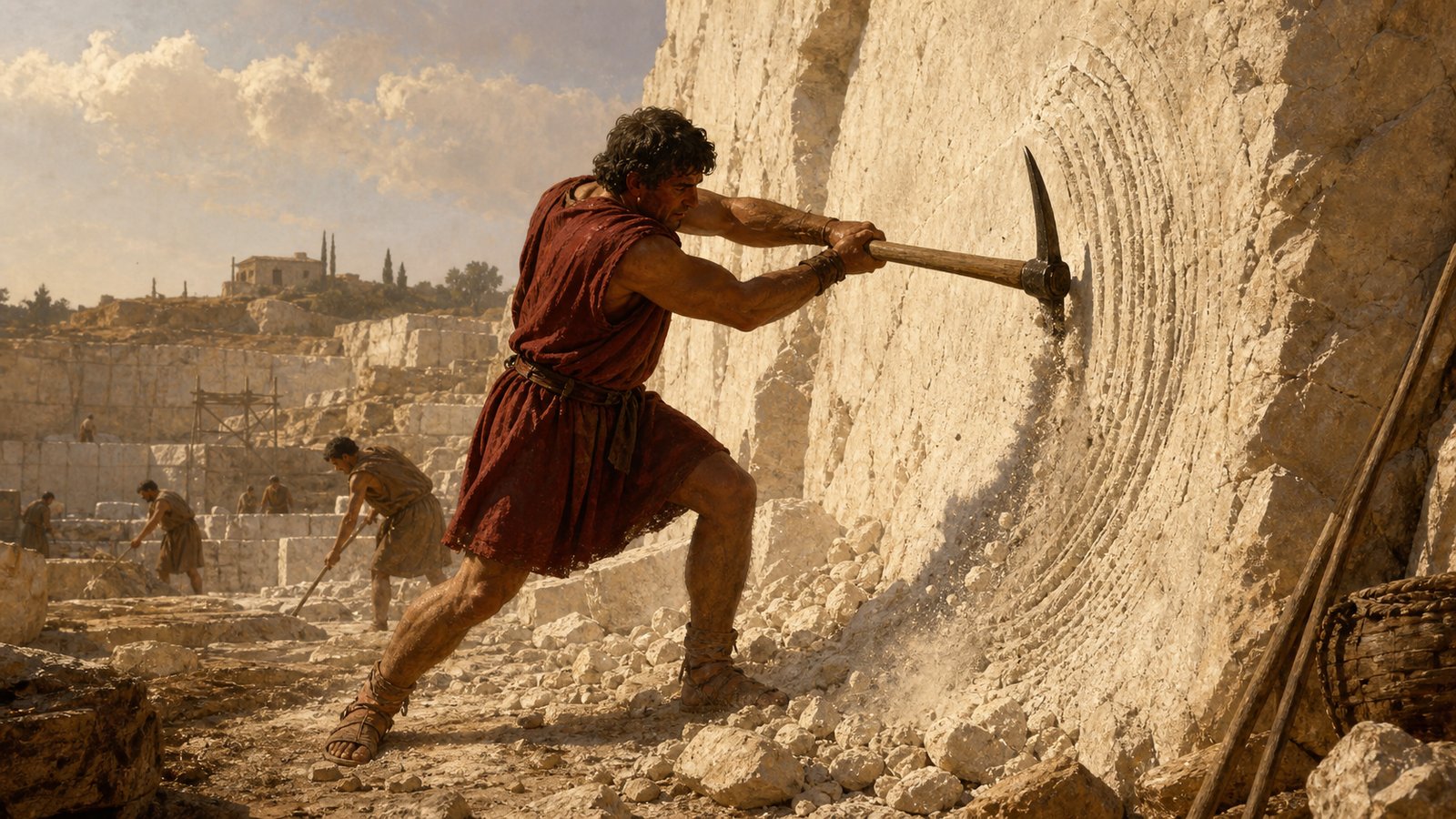
Quarry-pick marks are identifiable as long and often curved lines. The curve follows the swinging motion of the handle, while the length records repeated contact rather than a single isolated puncture. Tool geometry and human movement become visible together.
Art of Making notes that quarrymen struck the same spot repeatedly before moving on. One impact begins a depression; later impacts exploit and lengthen it. The worker does not ask every blow to start fresh stone, but lets a developing groove concentrate the next effort.
After deepening one place, the quarryman moved along while working parallel to the rock face. Parallel progress converted many local blows into a managed band of removal. The quarry wall became a ledger of where the swing had already done enough and where resistance remained.
Raking light would make such traces particularly legible. High ridges catch brightness while curved recesses hold shadow. Even when the worker who made them is absent, their repeated direction distinguishes systematic working from an accidental break or a single test blow.
Imperial Weight Bought Power by Wasting More Stone
The project reports that a heavier form of quarry pick seems to have appeared in the Roman imperial period. More mass in the head increased the energy arriving at the point when the swing was controlled. The quarryman could make resistant stone yield faster or attack larger work faces.
The improvement carried a disclosed cost: heavier picks made the process more wasteful because more stone was smashed away. Power widened the damaged zone around the point. Useful material could become chips and dust before the final block’s limits were secure.
Waste in this context is not simply incompetence. It can be an economic decision. If labor, schedule or access makes rapid removal valuable enough, sacrificing a margin of stone may be rational. The extracted block must only remain large enough for its intended destination after the rough damage is trimmed away.
The heavier pick thus changed planning upstream. Quarry workers needed to leave allowance around a desired form, and transport planners had to accept moving some sacrificial mass. Extra power at the face could shift work rather than abolish it, sending more squaring and dressing into the next stage.
A Rough Tool Could Still Square a Block
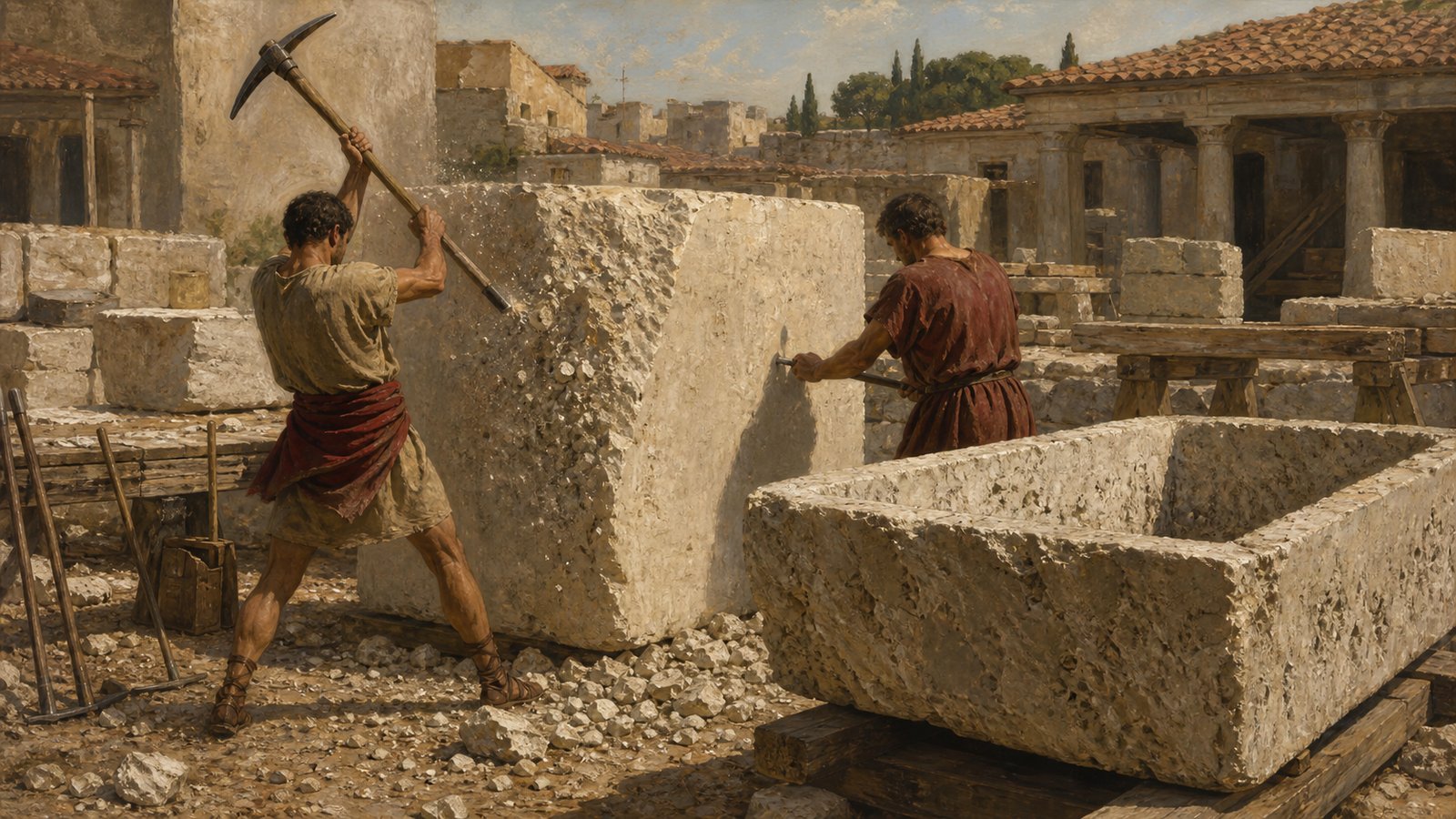
Art of Making includes squaring blocks among the pick’s uses. Squaring did not mean producing the final smooth architectural face with the pick. It meant reducing an irregular extracted mass toward manageable planes and corners before finer tools established the finished geometry.
The quarryman could work down projecting lumps that made the block unstable or needlessly heavy. Repeated parallel strikes brought the rough envelope closer to a transportable shape. Each removed projection reduced both awkwardness and the amount of stone later crews had to carry.
Yet the control problem remained. A finished corner is vulnerable to a swinging point, so pick work had to stop short. The tool could reveal the block, but the last allowance protected dimensions from its own strength. A later chisel could cross that safety margin with shorter, more accountable removals.
The process reverses the logic of callipers transferring exact spans. Callipers preserve an invisible limit; the pick approaches it through visible loss. Together they show why Roman stonework required both force that removed quickly and measurement that knew when to stop.
Sarcophagus Hollows Made the Pick Work Inside Stone
The same source records picks hollowing out sarcophagi. Here the target was not an exposed quarry face but the interior of a massive stone chest. Much central material had to disappear while the walls, base and rim remained thick enough to survive finishing and use.
A long-handled point could break the interior mass faster than delicate carving alone. The worker could establish depth in the centre, then expand the cavity while monitoring the remaining margins. Chips had to be cleared frequently so the next swing reached stone rather than loose debris.
Inside a hollow, movement becomes constrained. The wall can interrupt the arc, and a deepening cavity changes the angle at which the point meets the floor or sides. The quarryman must reposition body and block, or shift to shorter tools as the pick’s full swing becomes unsafe.
The Roman quarry pick earned its place by accepting imperfection early. Its long handle, repeated curved strokes and heavier imperial form made large removals possible, but every advantage depended on leaving enough stone for control to return later. The tool did not defeat resistance for free; it paid in waste, noise, dust and allowance.
Sources & Further Reading
- Art of Making, “Tool: Pick”
- Wikipedia, “Pickaxe”