
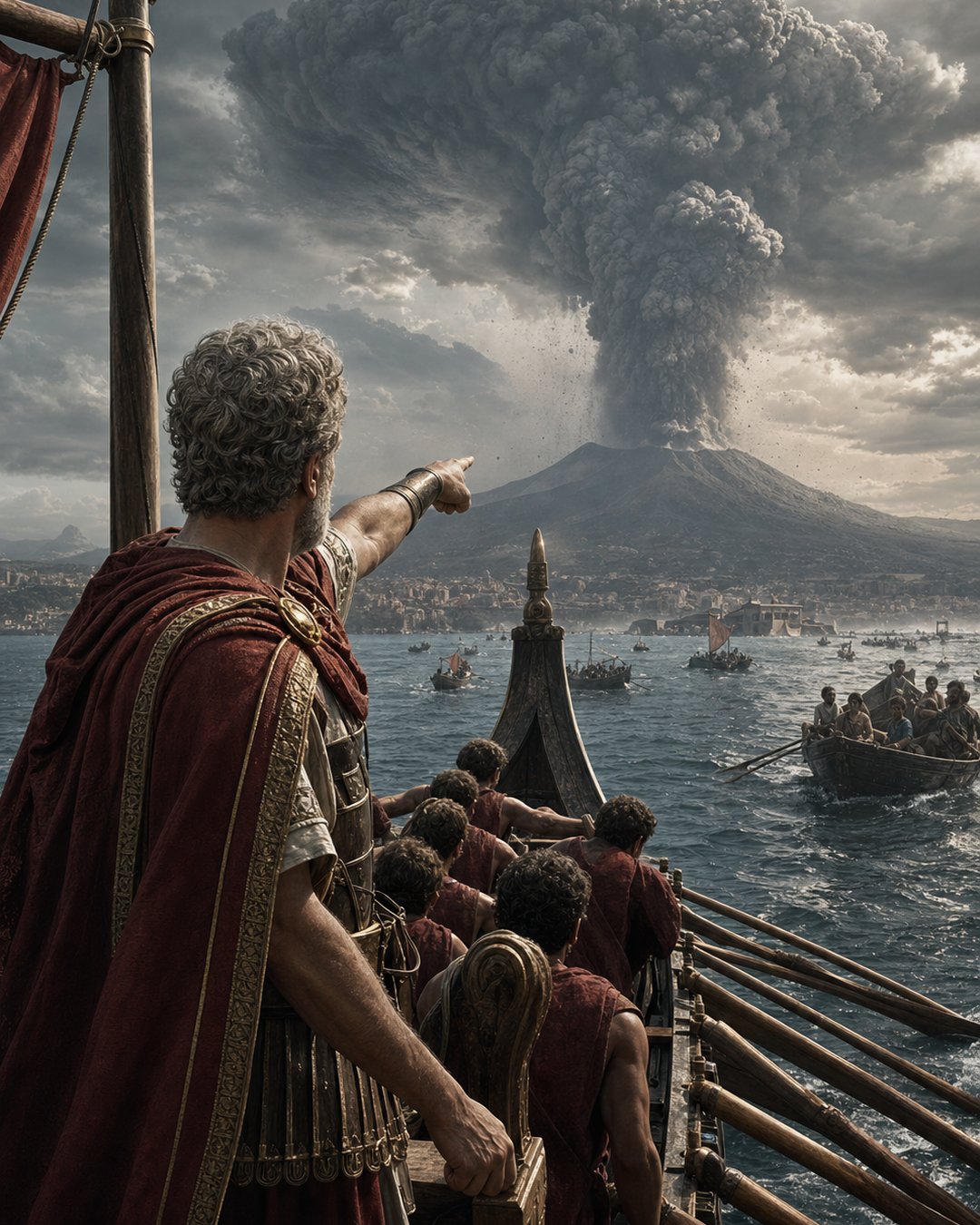
At Misenum on the afternoon of the Vesuvius eruption, Pliny the Elder was not standing at a villa window waiting to become a martyr to science. He commanded the Roman fleet. When an unfamiliar cloud rose across the Bay of Naples, curiosity sent him toward his writing tablets, but a message from a trapped friend changed the nature of the voyage. The observer became an admiral organizing a rescue.
The surviving account comes from his nephew, Pliny the Younger, who wrote to the historian Tacitus. It is intimate, admiring and carefully shaped, yet its physical details make the episode unusually vivid: a cloud like an umbrella pine, ash falling on decks, stones light enough to float, a shore blocked by wind, pillows tied over heads. Read as a sequence of decisions rather than a heroic anecdote, the letter shows Roman command meeting a disaster that refused to behave like war.
A Cloud Turned an Afternoon into an Investigation
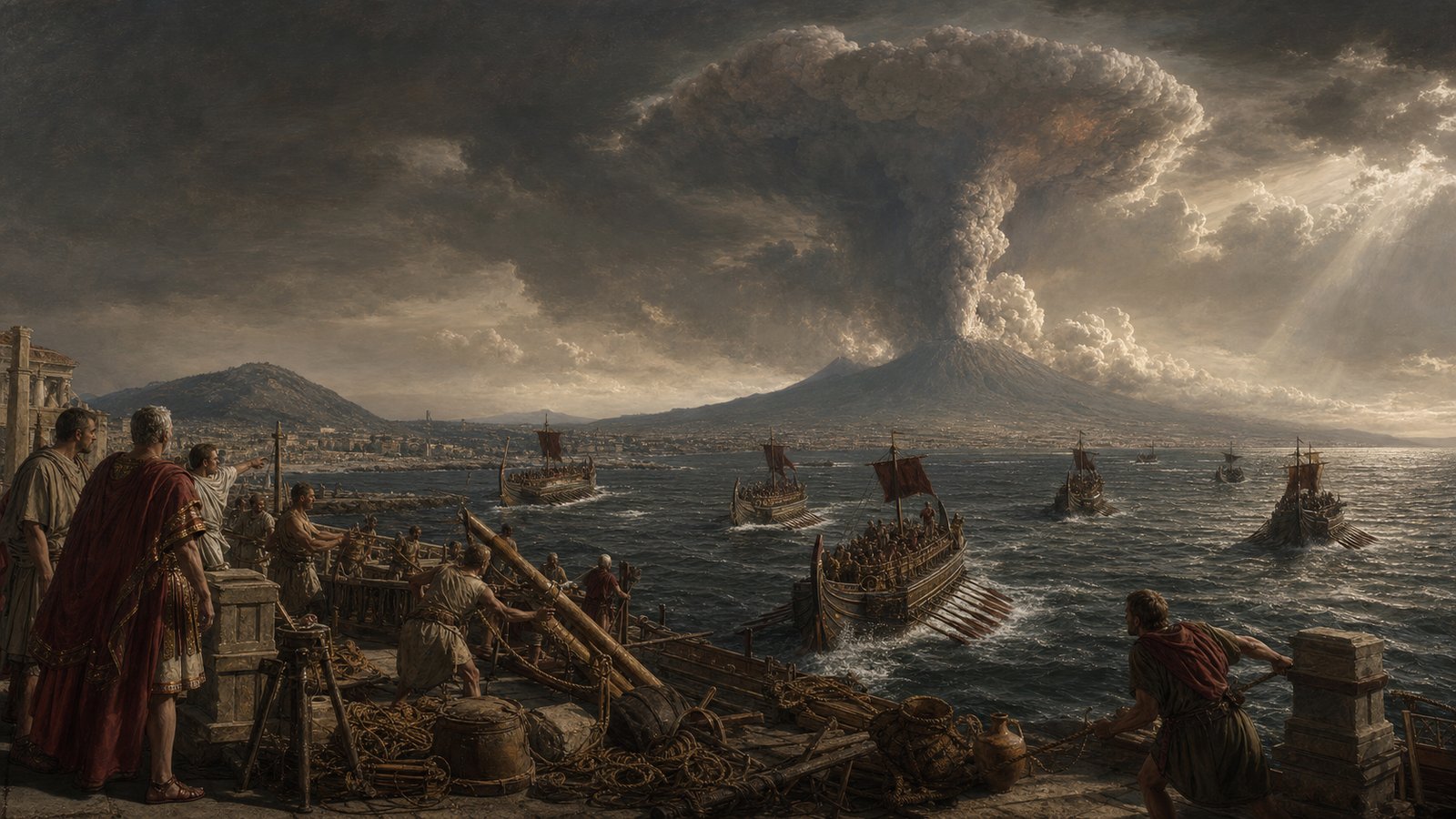
Pliny the Elder was at Misenum, where Rome’s western fleet had its base. According to his nephew, he had finished a cold bath, eaten, and begun working when the cloud was pointed out to him. Its source was too distant to identify immediately. Its long trunk and spreading crown reminded the younger Pliny of a pine tree, sometimes white and sometimes stained by the earth and ash carried upward.
That description matters because nobody at the base possessed a modern category such as “Plinian eruption.” The shape was evidence waiting to be interpreted. The elder Pliny ordered a light vessel prepared so that he could observe more closely and invited his nephew to come. The younger man stayed behind to continue an assignment. That ordinary choice is one reason the report survives: the witness who did not board later reconstructed the fatal voyage from those who did.
Pliny’s impulse also fits the working habits of a man who compiled an enormous Natural History. He collected reports, read constantly and dictated notes. Yet the voyage did not remain a private expedition. Before departure, a message arrived from Rectina, whose villa lay near the danger and whose escape by land was blocked. The narrow scientific mission widened at once.
One Message Changed the Size of the Fleet
The letter says Pliny changed his plan and launched quadriremes. That was a command decision: larger naval vessels and their crews could carry more people than the light boat first requested. He moved toward a populated coast from which others were sailing away. His nephew gives him the famous reply “Fortune favours the bold” when a helmsman warned him to turn back, but the practical point is stronger than the slogan. A fleet officer accepted risk because villas along the shore had no other route out.
As the ships approached, hot cinders and pumice fell thicker on the decks. Shoals formed where material accumulated, and parts of the shoreline were obstructed by debris. The crew had to decide repeatedly whether water, wind and falling stone still left a navigable route. Disaster reduced the admiral’s map to a series of shrinking options.
This was not an armada defeating a human opponent. Orders could move rowers and ships, but they could not clear a buried harbor or reverse an onshore wind. The episode resembles the practical street-level systems preserved at Pompeii, from raised crossings to public notices. Our account of Pompeii’s stepping stones shows a city designed around predictable flows. Vesuvius destroyed predictability itself.
Stabiae Offered Shelter but Not an Exit
Pliny eventually reached Pomponianus at Stabiae, on the southern curve of the bay. Pomponianus had placed baggage aboard but could not sail because the wind held his vessel against the shore. Pliny arrived with a favorable wind behind him, which meant the same wind that helped him enter made departure difficult. Geography had turned a successful approach into confinement.
His response was theatrical in a useful way. He embraced the frightened host, bathed and ate, displaying calm whether or not he felt it. Command often depends on making uncertainty bearable to other people. Broad flames appeared on Vesuvius during the night. Pliny explained them as abandoned houses burning, an interpretation intended to reduce panic even though the visible scene was worsening.
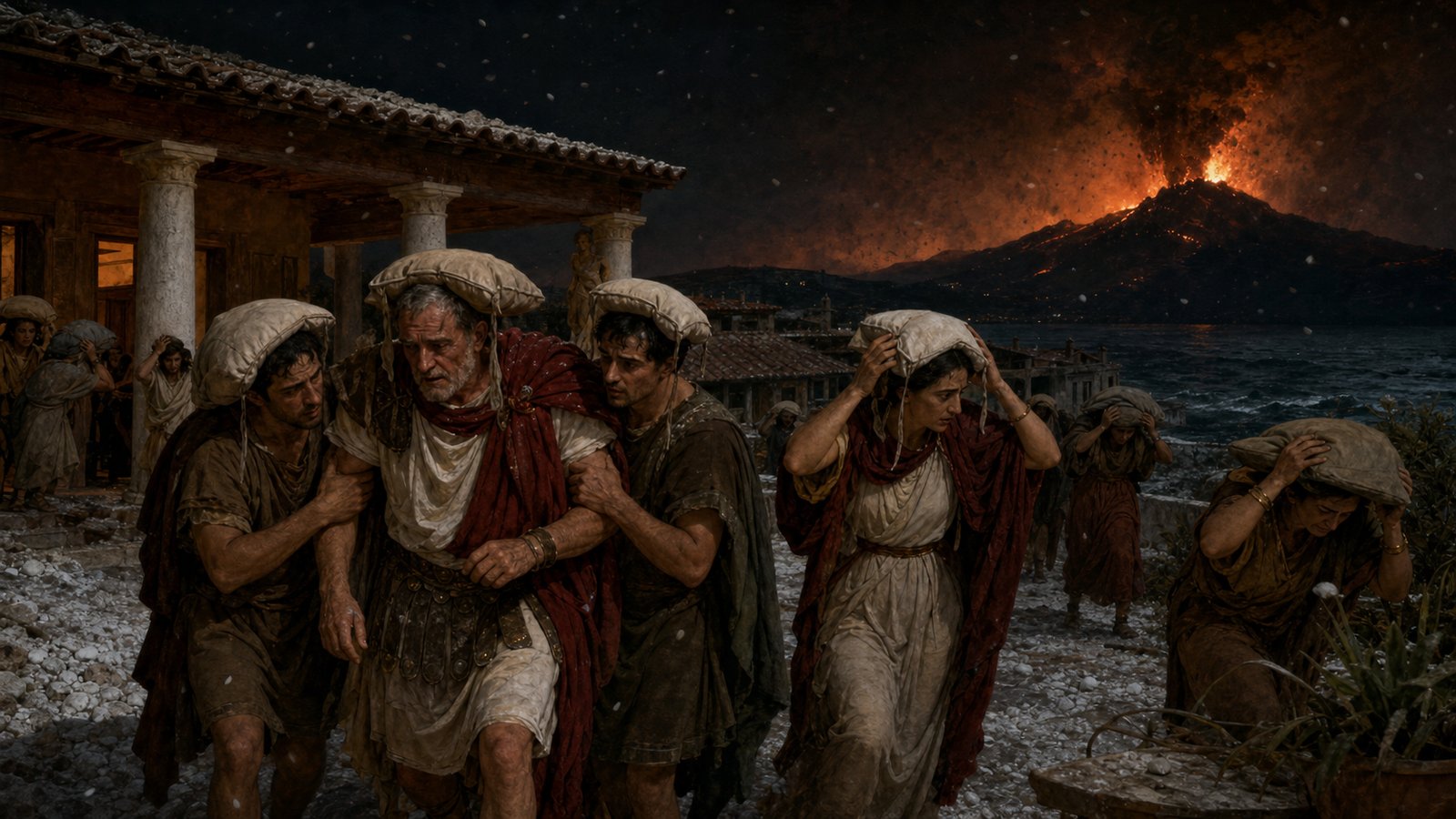
The group did not sleep normally. Ash and stone accumulated outside Pliny’s room so rapidly that delay might have sealed the door. Earthquakes shook the buildings. Indoors offered protection from falling pumice but created the danger of collapse; outdoors avoided walls but exposed heads to debris. The survivors chose the open and tied pillows over their heads with cloth. It is one of the letter’s most physical details: elite Romans and servants improvising the same crude helmet.
The Sea Refused the Final Escape
Morning did not restore normal light. The group went toward the shore and tested whether the sea allowed departure. It remained rough and hostile. Pliny lay on a sheet, asked twice for cold water and then tried to stand with assistance when flames and a smell of sulfur approached. He collapsed. His companions fled, and his body was found two days later, looking more asleep than injured in his nephew’s presentation.
The cause of death cannot be diagnosed securely from the literary account. The younger Pliny mentions that his uncle had a narrow airway and difficult breathing, while modern readers naturally consider toxic gases, ash and cardiovascular strain. The honest conclusion is limited: the account records collapse amid sulfurous air after a night of exertion and exposure. It does not provide a clinical finding.
That restraint matters because this story has often been polished into the “death of a scientist.” Pliny certainly went toward the cloud from intellectual curiosity. He also changed vessels, mission and risk after receiving a plea for help. The last documented phase was an attempted evacuation led by the officer responsible for the fleet at Misenum.
The Nephew’s Second Letter Completes the Disaster
Pliny the Younger later sent Tacitus another letter about his own experience at Misenum. Earth tremors grew so violent that carts seemed to move even when chocked. The sea withdrew, leaving marine creatures on exposed sand. A dense black cloud advanced across the bay, cut by flashes resembling lightning, and daylight collapsed into a darkness the witness compared with a sealed room.
He and his mother joined the crowd leaving the buildings. They moved away from the road so they would not be crushed in the confusion. Ash accumulated until they had to rise and shake it off. People called for relatives in the dark; some prayed, while others declared that the gods had vanished and the final night had arrived. These details place the admiral’s failed voyage inside a bay-wide human emergency rather than an isolated death scene.
The letters also help explain why Pompeii remains emotionally immediate. The site preserves walls and streets; the prose preserves uncertainty one decision at a time. For a broader look at how excavation creates that strange closeness, see why Pompeii feels both near and distant. Pliny’s narrative supplies what masonry cannot: the sound of people testing explanations as the familiar world disappears.
An Admiral’s Failure Can Still Reveal Competence
The rescue did not succeed, and heroic language should not conceal that fact. We do not know how many people Pliny’s ships reached, whether any embarked, or how coordinated the operation remained after landing. The surviving letter concentrates on one commander and one household. Its silence about most sailors and coastal residents limits every reconstruction.
Even so, the sequence is revealing. Pliny investigated an unknown phenomenon, accepted new information, enlarged his transport, sailed toward those without a land route, used composure to steady a frightened group, weighed the hazards of buildings against falling stone and repeatedly tested escape by sea. None of those actions required him to understand volcanology. They required command under changing evidence.
Rome celebrated commanders who imposed order on landscapes. Vesuvius presented the opposite lesson. Rank could launch quadriremes but not command wind; experience could select a shelter but not make it safe; courage could carry a rescue force across the bay but not guarantee a return. The most compelling part of Pliny’s last voyage is not that a famous scholar approached a volcano. It is that Roman institutional power reached the limits of its control in full view of the people it was meant to save.
Sources
Pliny the Younger, Letters 6.16 and 6.20; Project Gutenberg, Letters of Pliny; York University, Pliny Letters 6.16 and 6.20.