
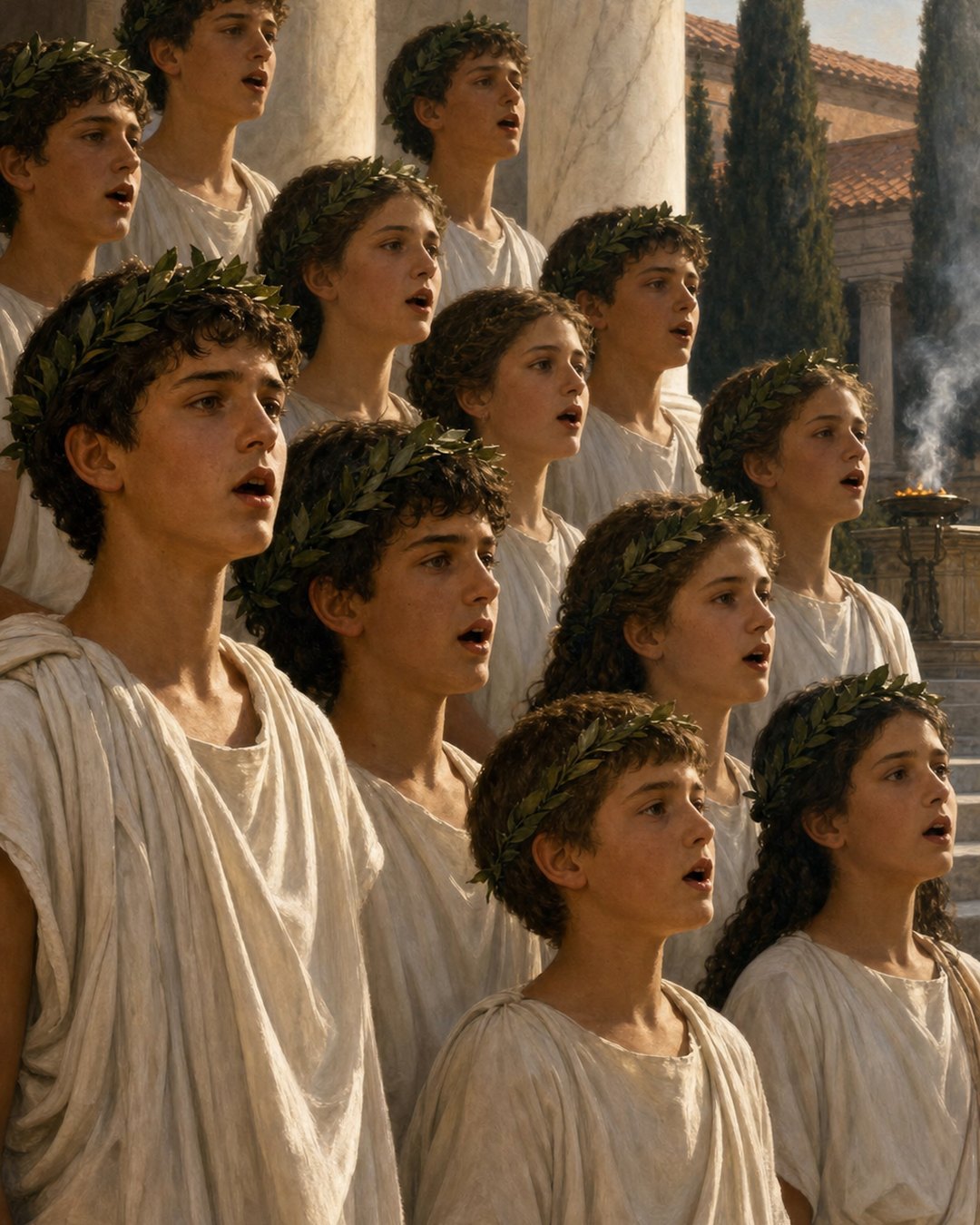
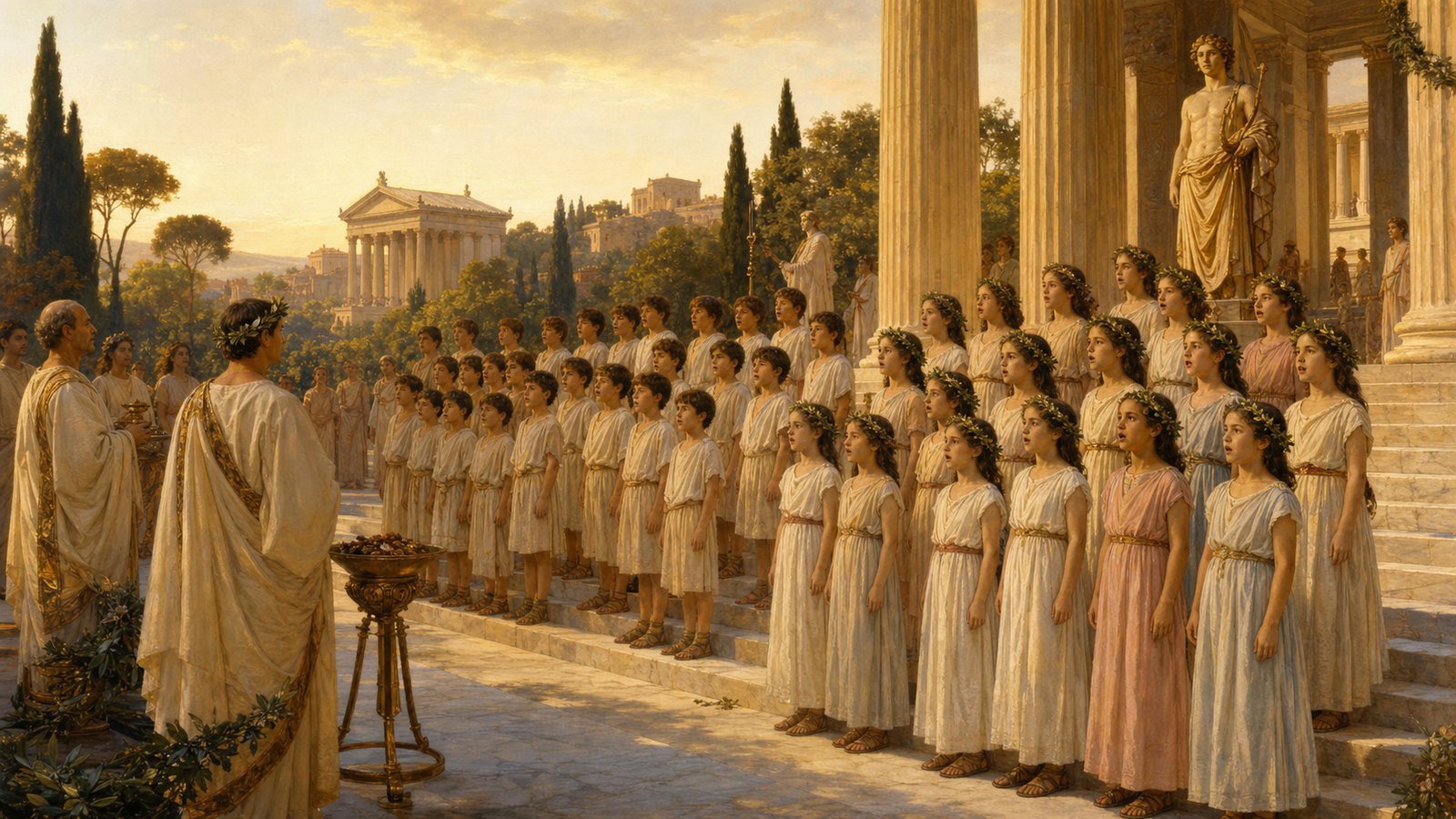
Near the end of Rome’s Secular Games in 17 BC, a carefully selected chorus climbed into the public memory of the city. Twenty-seven boys and twenty-seven girls stood on the Palatine after the sacrifices. Each had both parents still living. Together they sang a new hymn by Quintus Horatius Flaccus—Horace—then carried it to the Capitoline and sang again.
The performance lasted far less time than the nights of offerings, the days of ceremonies or the additional week of shows around it. Yet it gave the festival its clearest human form. Rome’s officials could calculate a cycle of 110 years, distribute purification materials and record prayers in stone. Fifty-four young voices made the promised new age sound present rather than theoretical.
The surviving inscription is unusually generous. It names dates, officials, ritual acts and the composer. Horace’s poem supplies the words the chorus addressed to Apollo, Diana, the Fates, Earth and the divine powers imagined as guardians of marriage, children, harvest and peace. Read together, stone and song reveal a performance engineered to turn chronology into hope.
A Festival Announced as a Once-in-a-Lifetime Sight
The Secular Games did not run on an ordinary annual calendar. Roman explanations treated a saeculum as the span of a human life, and the Augustan version justified a cycle of 110 years. Heralds invited the population to a spectacle no one had seen before and would see again. The claim was theatrical, but it also framed every participant as a witness at a boundary between ages.
Augustus revived the celebration in 17 BC after civil war had repeatedly unsettled Rome’s public life. Earlier Roman traditions connected the rites with nocturnal offerings at the Tarentum in the Campus Martius. The Augustan program preserved the darkness and the old location while redirecting the sequence toward deities of fate, birth and fertile earth. Daylight ceremonies answered from the Capitoline and Palatine.
The schedule made renewal something the city had to move through. Night did not simply precede day; chthonic ground near the Tiber alternated with elevated temples. Sacrifice was followed by performance. A ritual that claimed to enclose an age unfolded across distinct hours and places, requiring crowds to follow its transitions.
This scale depended on the same priestly machinery explored in the board that guarded Rome’s prophetic books. The quindecimviri organized the Games under Sibylline authority. Their administration gave the unprecedented spectacle a claim to ancient command rather than personal improvisation.
Torches, Sulphur and Grain Prepared the Audience
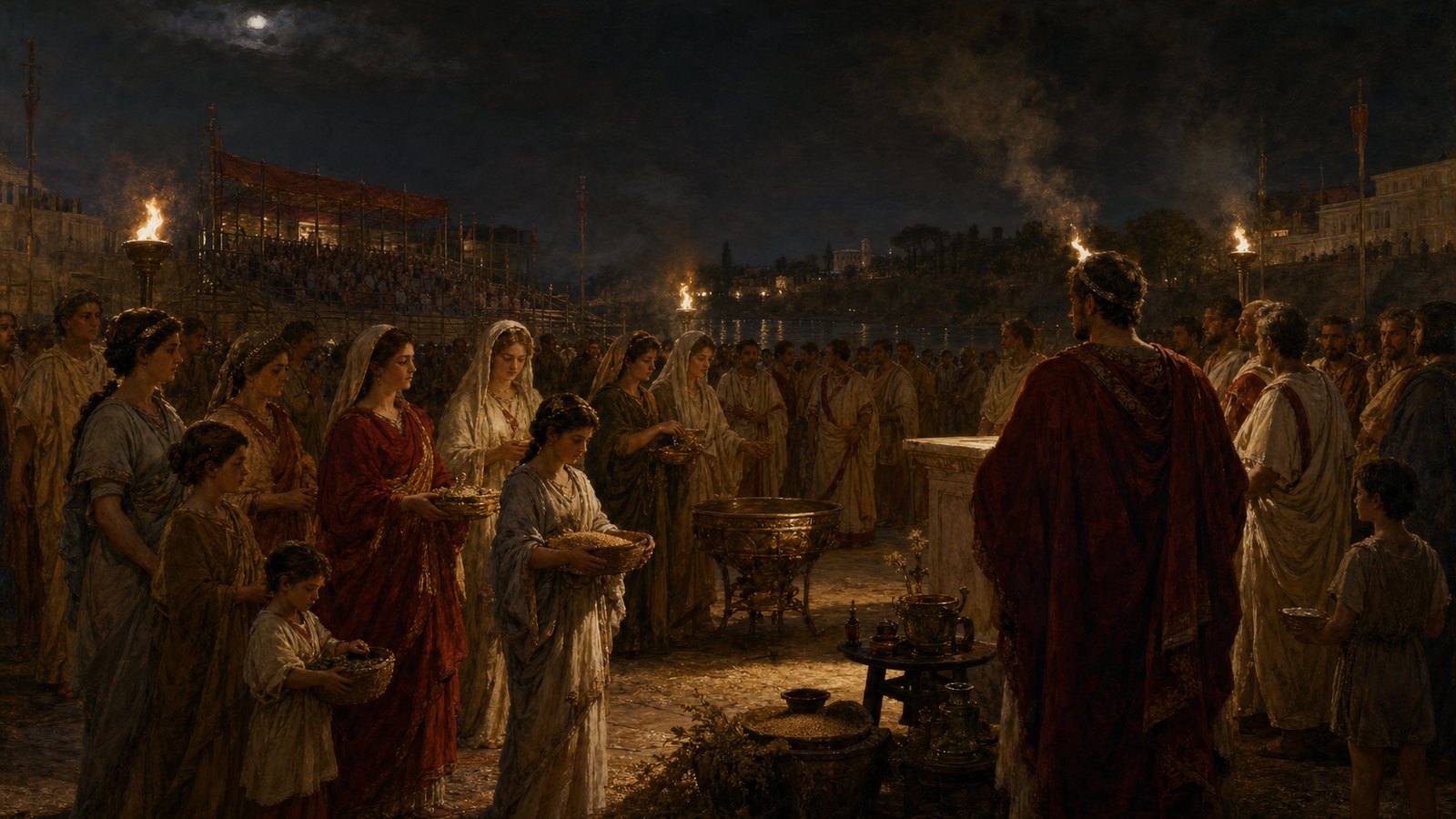
Before the principal ceremonies, the city encountered the festival through objects carried by ordinary hands. The board of fifteen announced that free people and their wives could collect fumigants on designated days. Torches, sulphur and asphalt were distributed for purification. The act extended preparation beyond priests and altars into households gathering what they would burn.
Wheat, barley and beans then moved toward official platforms as first-fruit offerings. The inscription records collection over successive days and instructions sent to participating matrons. These were not decorative preliminaries. The repeated distribution and receipt of materials taught the population how to approach the sacred interval.
Rome often made collective religion legible by giving it a route and a sequence. Public movement carried ritual through the streets; here, queues for purification materials and first fruits drew citizens into a choreography before the formal chorus appeared. The audience had already handled the festival’s vocabulary of cleansing, fertility and continuity.
The surviving record also preserves an insistence on correct attendance: which groups should assemble, where they should stand and when ceremonies would commence. Such precision did not drain the occasion of feeling. It created the shared timing that let thousands experience night fires, daytime altars and theatrical performances as parts of one civic action.
The Night Prayers Asked Rome to Continue
The principal nocturnal sacrifices addressed powers whose domains pointed forward. The Moerae governed allotted fate. The Ilythiae were invoked in connection with childbirth. Terra Mater received honour as fertile earth. Their sequence shifted the emphasis away from a simple encounter with an underworld past and toward the uncertain production of another generation.
Augustus performed the night rites, while Marcus Agrippa joined him in the daytime ceremonies. The distinction placed the leading men of the regime inside a liturgy larger than either man. Recorded prayers asked the gods to increase Roman power, protect the Roman people and accept offerings made according to the proper formula.
Horace translated those ritual concerns into the chorus’s language. His hymn asks the goddess of childbirth to protect mothers and nurture offspring. It invokes laws concerning marriage, then imagines the fixed cycle of ten times eleven years bringing back songs and games three times by day and three by night. Arithmetic becomes a promise carried in metre.
The poem also asks Earth to crown Ceres with grain, Jupiter to ripen the harvest and the gods to give virtue to the young, quiet to the old, children and wealth to Romulus’s people. These petitions explain why adolescents, rather than professional adult performers alone, mattered. The future being requested stood visibly before the altars.
Both Parents Living Was Part of the Message
The inscription specifies that the singers were previously designated boys and girls with both parents living. Roman ritual frequently treated children whose parents survived—patrimi et matrimi—as especially complete participants. In this festival, the qualification aligned family continuity with the larger claim that Rome itself had entered a renewed span of life.
The requirement also made selection public. These were not an accidental group of children gathered at the last moment. Officials had to identify households, confirm eligibility, assemble the singers and prepare a full chorus. Rehearsal joined administration to art: fifty-four individuals had to learn a newly composed Latin hymn and deliver it together in sacred space.
Horace divided attention between male and female voices without reducing either to scenery. Apollo is asked to listen to the boys; Luna or Diana is asked to hear the girls. The poem then speaks through a collective “we,” a chorus trained to praise both Phoebus and Diana. Difference is retained inside a single civic sound.
The number mattered because balance mattered. Twenty-seven boys and the same number of girls made two matched groups, while their living parents connected them backward to households and forward to possible families of their own. The festival’s promise of continuity was therefore not left in the mouth of Augustus. It was distributed among young Romans whose biographies were still unwritten.
From Apollo’s Palatine to Jupiter’s Capitoline
After the sacrifice on June 3, the chorus sang on the Palatine and then in the same manner on the Capitoline. The route joined two peaks of Augustan Rome. Apollo’s Palatine sanctuary had a close association with Augustus, while the Capitoline remained the city’s great civic and religious summit under Jupiter.
The hymn suits that movement. It begins by calling to Phoebus and Diana at a sacred time commanded by Sibylline verses. It remembers Aeneas escaping Troy, asks for peace and prosperity, and imagines Faith, Honour, Modesty and Plenty returning. Near its end, the chorus expresses confidence that Jupiter and all the gods intend a favourable answer.
That confidence was performed twice. A song first heard beside Apollo’s temple was not allowed to remain a Palatine possession. Repetition on the Capitoline carried it into Rome’s older civic centre. The children’s bodies turned a literary commission into a route linking the ruler’s favored divine association with the republic’s most established sacred height.
The official inscription names Horace as composer, a rare conjunction of administrative record and surviving poem. One source tells us who sang, where and under whose supervision; the other lets us hear what their ceremony said. Neither preserves the children’s individual voices. What survives is the design imposed upon them—and the reason Rome wanted fifty-four young people to sound like the beginning of an age.
The Secular Games continued with plays, racing and a hunt, and later emperors would calculate new anniversaries by competing systems. The chorus of 17 BC remains unusually sharp because its moment did not need permanence. The singers crossed two hills, joined family qualification to public hope and made a political theology audible. An empire claimed renewal; children supplied the breath.