
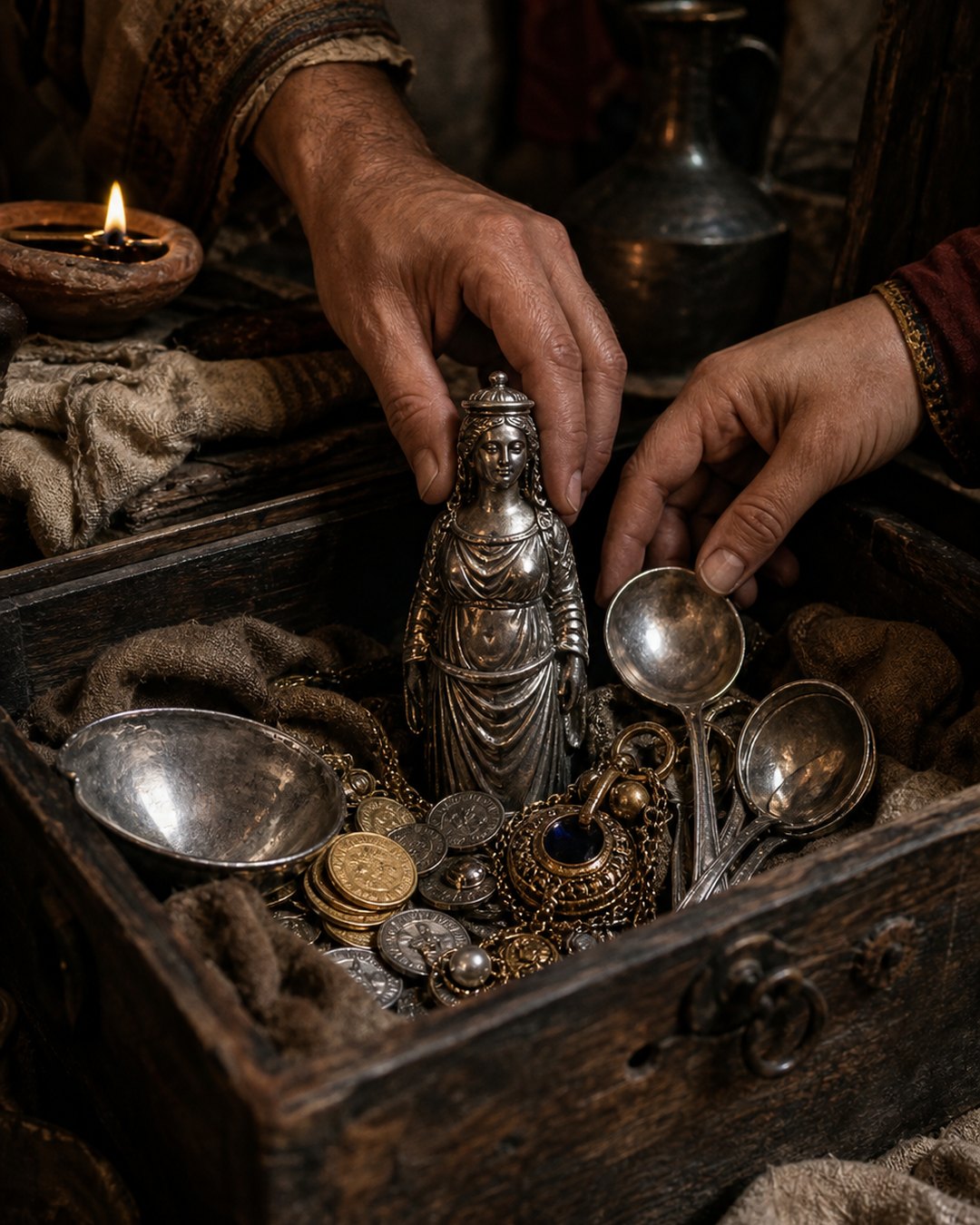
Peter Whatling had lost a hammer in a Suffolk field. On 16 November 1992, his friend Eric Lawes brought a metal detector to help find it. The signal that changed the search did not lead first to the tool. Lawes lifted silver spoons, gold jewellery and Roman coins from the soil—and then did the most important thing a finder of treasure can do. He stopped.
The next day, archaeologists excavated what became known as the Hoxne Hoard. They recovered 14,865 Roman coins, gold jewellery and roughly 200 silver objects from the decayed remains of an oak chest. Among them were four silver pepper pots. One, shaped as a richly dressed woman, became the hoard’s most recognizable object.
Treasure attracts attention through weight and value. Archaeology asks a harder question: what relationships survived between the objects? Because Lawes and Whatling reported the find promptly, Hoxne preserved more than precious metal. It preserved the outline of packing, concealment and hoped-for return at the end of Roman Britain.
A Lost Hammer Led to a Decision Not to Dig
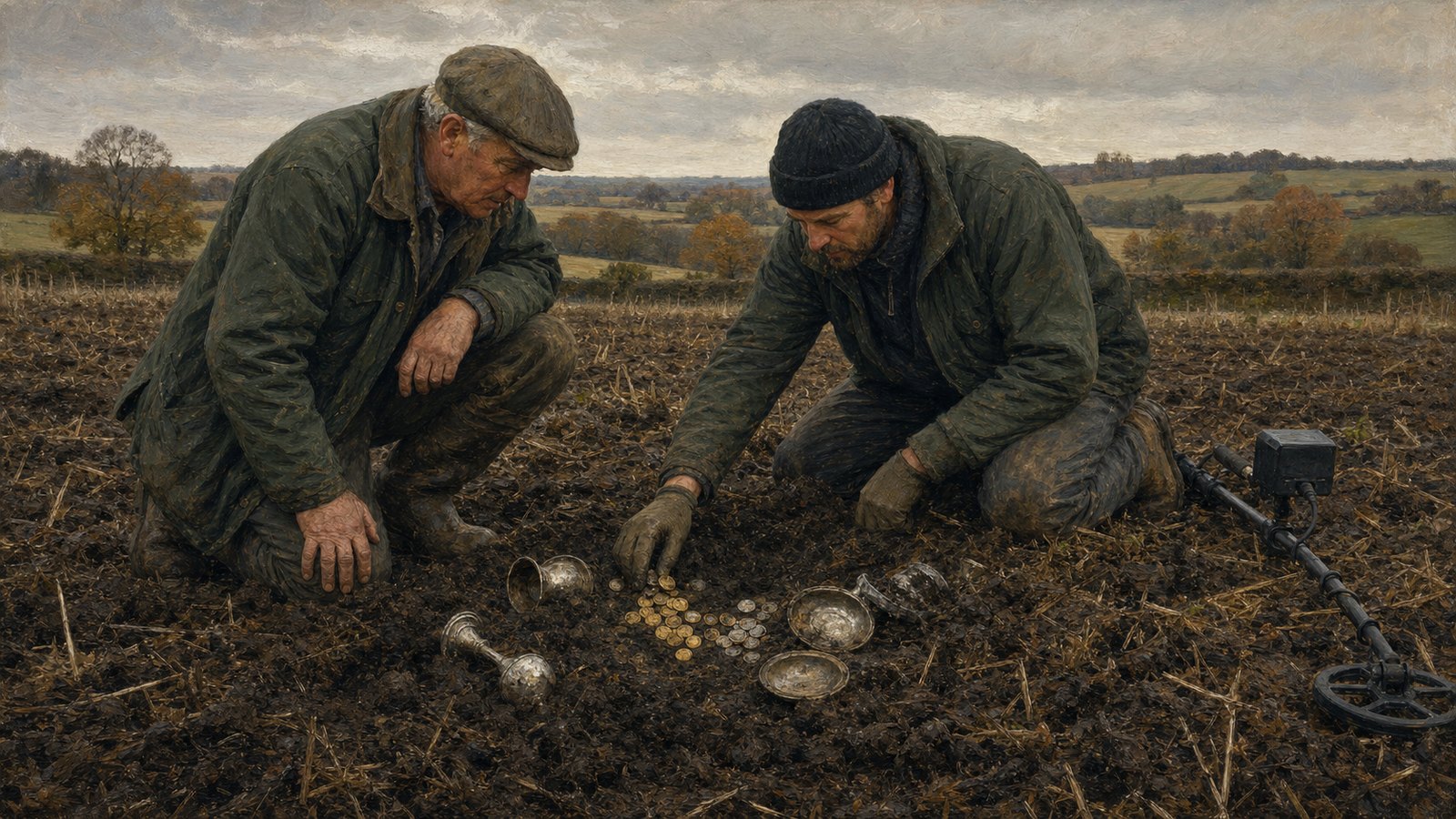
Whatling was a tenant farmer near Hoxne village. Lawes was a retired gardener and amateur detectorist. Their search crossed a ploughed field southwest of the village, an ordinary setting for a mechanical problem. Once gold and silver appeared, however, the task changed. They recovered only a small number of pieces before notifying the landowner, Suffolk County Council, and the police.
That pause protected context. Metal objects do not explain themselves when removed one by one. A coin can be dated in a cabinet, but its position beside a casket fitting, a stack of spoons or a concentration of jewellery may reveal how the deposit was assembled. Continued unsupervised digging would have increased the object count while destroying the arrangement.
The Suffolk Archaeological Unit began an emergency excavation the following day. The team removed the hoard in one day, including blocks of material that could be separated under laboratory conditions. A detector survey extended thirty metres around the find. Whatling’s missing hammer was recovered too and eventually entered the British Museum beside the Roman treasure it had indirectly revealed.
The sequence has become almost as important as the discovery itself: signal, a few lifted objects, notification, professional recovery. Hoxne helped demonstrate that detectorists and archaeologists did not have to meet as enemies. The finder’s restraint made expert excavation possible before weather, publicity or illegal searching could dismantle the site.
The Oak Chest Still Held an Order
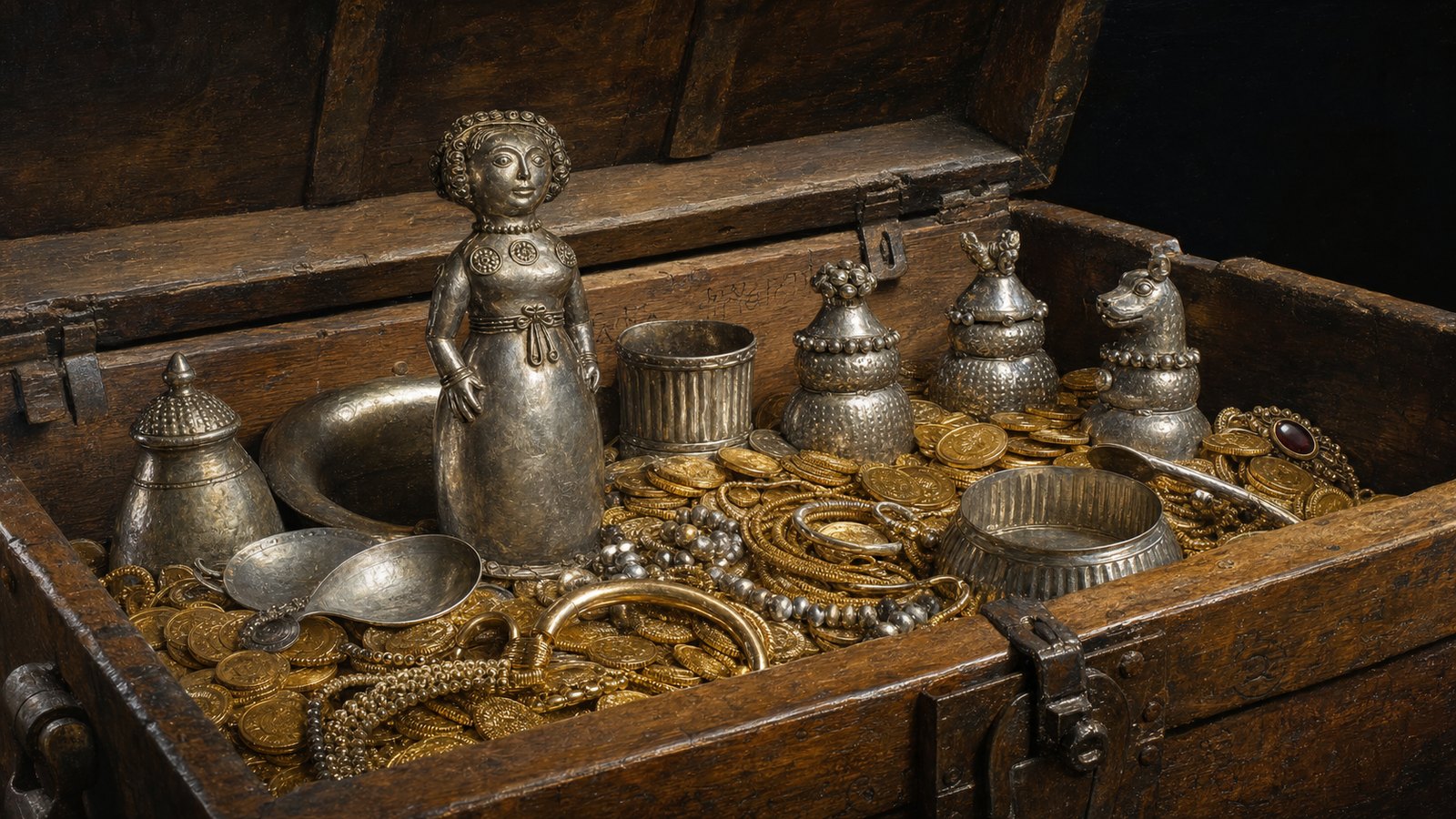
The wood had nearly vanished, but hinges, locks and decayed traces showed that the deposit had occupied an oak chest about sixty by forty-five by thirty centimetres. Inside, some objects had rested in smaller boxes made from woods including yew and cherry. Others had been wrapped in textile or packed with organic material. The container had become soil while its logic remained detectable.
Objects were sorted mainly by type. Ladles and bowls nested together. Coins occupied concentrated groups. Smaller caskets and bags separated possessions that had different uses or owners. Burrowing animals and ploughing caused some disturbance, yet the overall deposit remained coherent enough for excavators to reconstruct how the chest had been loaded.
This was not rubbish thrown into a pit. Someone selected portable wealth, organized it and concealed it in a container designed to keep categories apart. The missing large serving vessels and some common jewellery types suggest the chest may have held only part of one exceptionally wealthy household’s possessions. Burial did not erase ownership; it postponed access.
The arrangement gives Hoxne a different voice from the silver dining set concealed at Pompeii. Both preserve expensive household metal under pressure, but Hoxne belongs to a landscape without a nearby identified Roman building. The chest offers a household inventory without the house that once gave it rooms.
Four Pepper Pots Brought the Dining Room Underground
The hoard contained four silver-gilt pepper pots, or piperatoria. Their openings and internal mechanisms allowed expensive seasoning to be shaken or dispensed. The best known is often called the “Empress” pepper pot because its body takes the form of an elaborately dressed woman. The label is modern; her exact identity is unknown.
Her hairstyle, jewellery and clothing turn a table implement into a miniature social figure. Pepper would emerge from an object designed to be handled, noticed and discussed. Three companions show that this was not a single eccentric ornament but a small set of luxury vessels carried from dining into concealment.
The pots connect Hoxne with a much longer supply line. Pepper reached Roman consumers through Indian Ocean trade and credit. At one end were cargoes, customs and loans; at the other was a silver vessel small enough to stand beside food. The empire’s geography could arrive at dinner as a dark pinch released through precious metal.
The chest also held ninety-eight silver spoons and ladles, bowls, a beaker, a small vessel and a silver tigress made as a handle. These objects make the pepper pots less whimsical. They belonged to a dense world of serving, mixing and display. When the owner packed them, a dining room’s gestures—scooping, pouring, seasoning—were compressed into a box.
Coins Dated the Silence After AD 408
Hoxne’s 14,865 coins included 569 gold solidi, 14,272 silver coins and twenty-four bronze pieces. The gold ran from Valentinian I to Honorius. The silver stretched from Constantine II to the age of Honorius, with late issues of Honorius and the British usurper Constantine III establishing that burial occurred no earlier than AD 408.
The date sits close to the political unravelling of Roman government in Britain, but it does not identify a single crisis or owner. No note explains why the chest went underground. The temptation to narrate a fleeing family, a raid or an approaching army must remain temptation. Archaeology can establish careful packing and a latest coin date; it cannot recover the depositor’s final conversation.
The coins came from fourteen mints across the Roman world, including Trier, Arles, Rome, Ravenna, Constantinople and Antioch. Their uniform imperial imagery had traveled across an administrative system even as Britain moved toward political separation. A Suffolk chest could contain metal struck under several dynasties and across thousands of kilometres.
Almost every silver siliqua had been clipped around its edge, a practice especially characteristic of late Roman Britain. Cutters generally protected the imperial portrait while removing metal from the circumference, sometimes damaging reverse designs and mint marks. Hoxne’s scale lets researchers compare clipping across an enormous sample rather than infer a pattern from a handful of coins.
The Treasure Survived Because Its Story Was Shared
The hoard was declared treasure trove at a coroner’s inquest in September 1993 and valued at £1.75 million. Lawes received the reward and shared it with Whatling. Later legislation changed how England and Wales treated treasure finds and rewards, but Hoxne’s influence was cultural as well as legal: it offered a public example of prompt reporting producing both knowledge and recognition.
Follow-up work found more coins spread by ploughing, but no Roman settlement around the burial hole. A possible post hole near one corner may have marked the location, though that interpretation cannot be certain. If the owners intended to return, the recovery system failed. Their chest remained while the landscape above it changed beyond recognition.
The valuables now sit in the British Museum, where the “Empress” is separated from the dirt, wood decay and emergency excavation that made her legible. Display can make the survival look inevitable. It was not. Deep ploughing had already moved material; burrowing animals had disturbed parts; one more afternoon of enthusiastic digging could have turned an ordered deposit into a bag of finds.
Hoxne therefore has two acts of preservation. Around AD 408 or later, unknown people packed wealth into an oak chest, sorting objects as if they expected the arrangement to matter when they returned. In 1992, Lawes and Whatling chose not to finish the excavation themselves. Four pepper pots, thousands of coins and the ghost of a household inventory survived between those decisions.
The woman-shaped pot is memorable because she gives the treasure a face. The greater achievement is quieter. Archaeologists can still ask how the chest was packed, what was absent, which coins touched, and how objects clustered. Gold and silver made Hoxne valuable. Context made it history.