
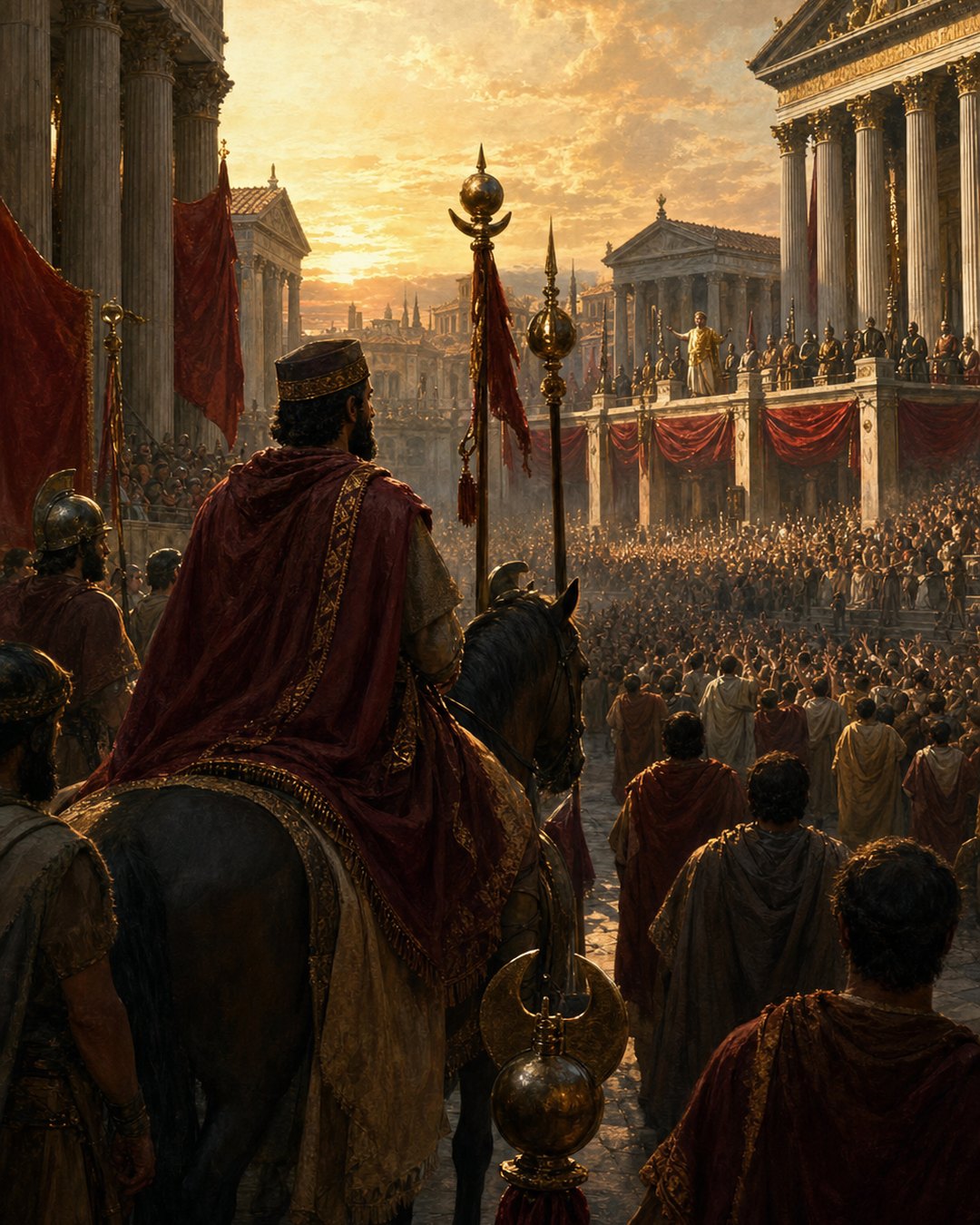
The man approaching Nero was already a king in every sense that mattered east of the Euphrates. Tiridates belonged to the Arsacid house, had the backing of his brother Vologases I of Parthia and had survived a contest in which Roman armies could destroy Armenian capitals but could not dictate a durable settlement. In Rome, however, he climbed a sloping platform and knelt.
Above him sat Nero in the dress of a triumphing general, framed by armed praetorians, standards and the temples of the Forum. Suetonius says the emperor removed Tiridates’s headgear and replaced it with a diadem while an official translated the king’s words for the crowd. The gesture took only moments. Its political preparation had consumed years.
The ceremony of 66 CE did not prove that Rome had conquered Parthia or annexed Armenia. It did something subtler. A compromise allowed Parthia’s candidate to rule while requiring Roman recognition. By turning that compromise into a kneeling body, a raised emperor and a crown bestowed before thousands, Nero made shared influence look like victory flowing from one hand.
Armenia Forced Two Empires to Bargain Through a King
Armenia stood between Roman and Parthian power, close enough to each that a change of ruler could alter roads, fortresses and alliances across the region. Vologases I placed his brother Tiridates on the Armenian throne after intervening in 52 CE. Rome could not treat that as an ordinary succession. An Arsacid king in Armenia appeared to move Parthian influence toward Rome’s eastern provinces.
Nero answered with Gnaeus Domitius Corbulo, an experienced commander who rebuilt discipline and carried war into Armenia. Roman forces took Artaxata and Tigranocerta, and Rome installed Tigranes V. Yet battlefield possession did not settle legitimacy. Parthian pressure returned, a later Roman army under Lucius Caesennius Paetus suffered humiliation near Rhandeia, and Corbulo again had to negotiate from a position created by both force and exhaustion.
The eventual arrangement divided what each empire valued. Tiridates, the Arsacid candidate, would reign in Armenia. Nero would confer the royal diadem. Parthia therefore secured the person on the throne, while Rome secured a ritual claim that the throne depended on imperial authorization. Neither side received the clean victory its public language preferred.
This was diplomacy built around a human hinge. Tiridates connected Armenia to the Parthian dynasty by blood, but his crown would be made publicly valid through Nero. The same Roman instinct that made military standards concentrate a legion’s identity made the diadem concentrate an untidy geopolitical settlement into one portable object.
The Long Journey Made Submission Visible Before Rome
Tiridates did not receive recognition by letter. He travelled west with a conspicuous entourage. The secondary synthesis in World History Encyclopedia describes a land journey accompanied by his wife, children, relatives and thousands of courtiers, nobles, priests and guards drawn from Armenia, Parthia and Rome. Travel itself became part of the settlement’s cost and theatre.
A journey overland allowed communities along the route to see the eastern king moving toward the emperor rather than the emperor moving toward him. Direction carried meaning. Tiridates crossed the empire’s spaces as an honoured guest, but every mile also reinforced the claim that Rome was the place from which final recognition came.
Nero spent extravagantly on the visit. Suetonius, writing with a sharp interest in imperial excess, gives the startling figure of eight hundred thousand sesterces a day and says Tiridates received more than one hundred million on departure. Ancient totals demand caution, especially in a biography organized around Nero’s vices. Even so, the tradition makes clear that economy was not the objective. Display was.
Lavish reception reduced the danger of humiliation for Tiridates. He could kneel in the Forum because he was treated everywhere else as a royal guest of extraordinary importance. Gifts, escorts and reserved places balanced the abasement of the central gesture. The settlement worked because each audience could select a different image: Rome saw a petitioner; Armenia and Parthia could see an Arsacid honoured at immense imperial expense.
The Forum Arranged a Political Sentence Without Writing It
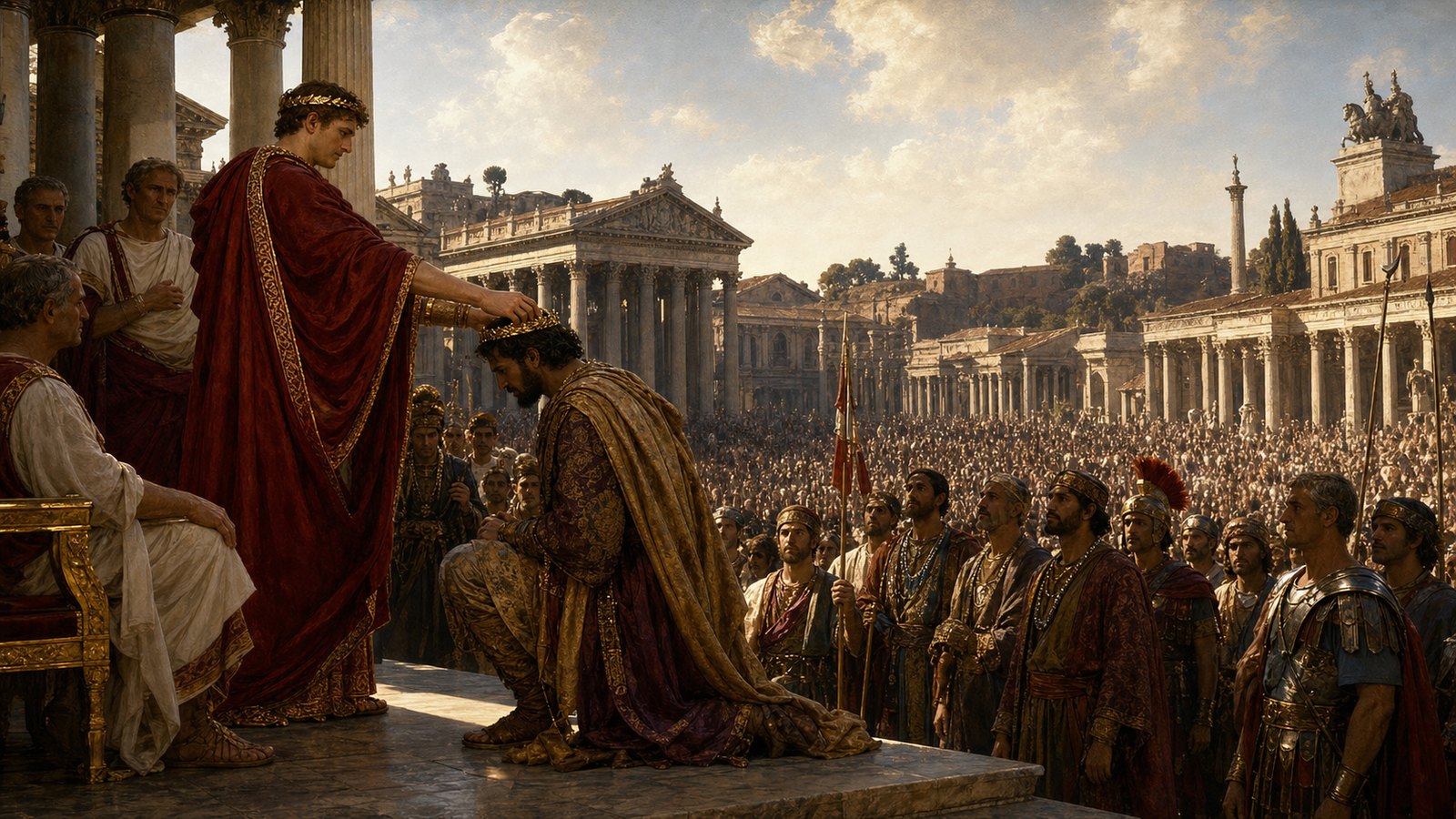
Bad weather delayed the advertised appearance, according to Suetonius, so Nero waited for a suitable day. When the ceremony finally began, praetorian cohorts stood fully armed around the Forum’s temples. Nero sat on the rostra in a curule chair, dressed like a commander celebrating triumph. Standards multiplied the military frame even though the event ratified negotiation rather than conquest.
Tiridates approached by a sloping platform and fell at Nero’s feet. The emperor then raised him with his right hand and kissed him. The sequence matters: lowering established hierarchy, raising transformed submission into favour, and the kiss admitted the king into a relationship rather than leaving him crushed. Ceremony could express dominance and partnership in consecutive movements.
The headgear exchange supplied the climax. Suetonius says Nero removed Tiridates’s turban and set on the diadem. A praetorian of suitable rank translated the supplication and proclaimed it to the crowd. Translation was not backstage assistance. It turned words spoken by an eastern king into a Roman public statement that spectators could understand as it happened.
Architecture completed the sentence. Tiridates below, Nero above, troops around, temples behind and citizens facing the platform gave every person a role. No treaty clause could match that immediate clarity. Rome had not chosen Tiridates, but the Forum made it appear that his kingship descended from Nero’s elevation, touch and gift.
The Theatre Extended One Coronation into a Day of Spectacle
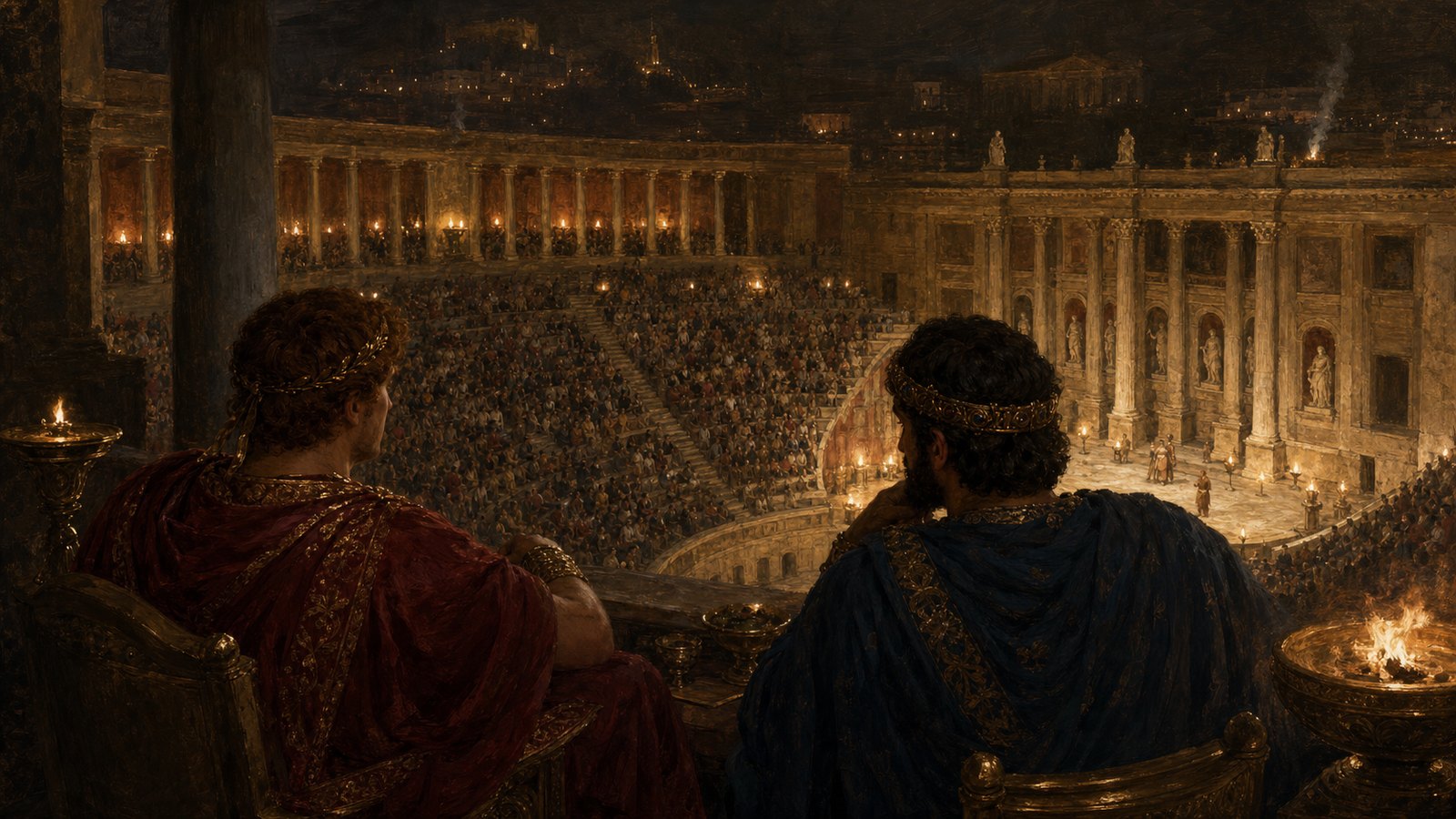
After the Forum, Tiridates went with Nero to the theatre. Suetonius says the king again made obeisance and then received a seat at the emperor’s right hand. The placement joined hierarchy with proximity. Tiridates acknowledged superiority once more, but then appeared beside Nero rather than among ordinary spectators.
The shift from rostra to theatre widened the event’s emotional range. Armed cohorts and standards had made the coronation resemble the conclusion of war. Entertainment made peace feel pleasurable, generous and complete. The crowd did not merely hear that the eastern crisis had ended; it spent the day inside a carefully staged version of that ending.
Public performance suited an emperor whose memory became entangled with acting, music and spectacle. The same theatrical instincts later helped hostile tradition turn him into the ideal villain of Rome’s Great Fire. In 66, those instincts served policy. Nero understood that a settlement seen only by diplomats was weaker at home than one witnessed, applauded and retold by a crowd.
Tiridates also understood performance. Kneeling did not erase the fact that his brother’s dynasty had placed him on the throne and that Roman campaigning had failed to replace him permanently. By completing the Roman script, he secured recognition, resources and a route home. Participation was not the opposite of agency; it was the price of converting military endurance into accepted rule.
Closing Janus Claimed More Peace Than the Border Could Promise
After the spectacle, Nero was hailed as imperator. Suetonius says he deposited a laurel wreath on the Capitol and closed the doors of the Temple of Janus as a sign that no war remained. The claim stretched beyond the Armenian agreement. A settlement on one frontier became material for declaring peace across the Roman world.
The closed doors did not freeze geopolitics. Armenia remained a contested kingdom, Arsacid in dynasty and exposed to Roman pressure. Tiridates’s reign is remembered as long and comparatively stable, but the balance depended on both great powers continuing to accept ambiguity. Rome could call him its crowned client; Parthia could call him the brother of its king.
That ambiguity is precisely what the Forum ceremony concealed so effectively. It substituted a clean vertical image for a horizontal bargain. The king knelt; the emperor sat. The king arrived bare of the Roman-recognized diadem; the emperor supplied it. The audience did not need to trace campaigns, reversals and clauses to know which figure the performance called superior.
Ancient narratives preserve the day partly because it was visually irresistible. A distant ruler crossed continents, armed men ringed temples, a translator carried his words, a diadem changed hands and theatre seats placed former enemies side by side. Each detail made politics concrete enough to remember.
Tiridates left Rome still Armenian, still Arsacid and still king. Nero remained unable to turn Armenia into a province. Yet for one crowded day, the difference between controlling a throne and controlling the image of a throne almost disappeared. The compromise belonged to two empires; the triumph, by design, looked like Nero’s alone.