
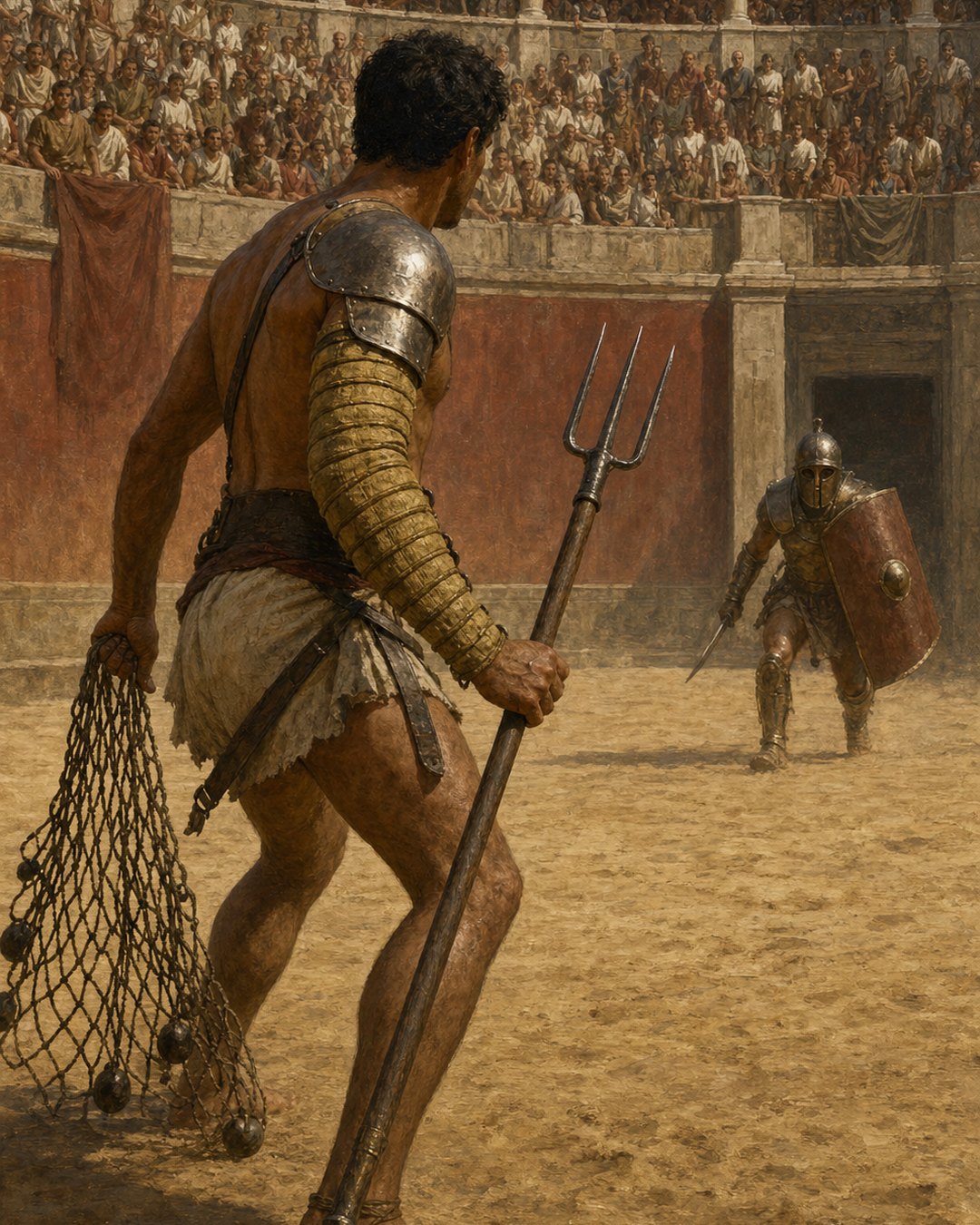
The first surprise was everything he did not carry. No helmet hid the retiarius’s face. No broad shield covered his chest. Heavy greaves did not close around both legs. In an arena where other fighters entered as moving surfaces of bronze, leather and painted wood, the net fighter looked exposed before anyone struck a blow.
His equipment answered that exposure. A weighted net could interrupt the opponent’s feet, arms or shield. A long trident threatened from beyond sword reach. A dagger remained for the dangerous moment when distance collapsed. Protection concentrated on one arm and shoulder rather than surrounding the whole body.
This was not a poorly equipped gladiator waiting to lose. It was a deliberately designed role. Matched against the armoured secutor, the retiarius turned every pace of sand into a decision: cast now or hold the net, stand behind the trident or circle away, recover a miss or abandon it before the pursuer arrived.
A Fishing Kit Became an Arena Identity
The name retiarius came from the net, rete in Latin. Spectators did not need an introduction to understand the association. The fighter carried implements that recalled capture at a distance: a casting net and a three-pronged spear resembling the tool used around water. The combination made his silhouette unique among gladiators.
World History Encyclopedia’s survey of gladiator types identifies the retiarius by net and trident, with a dagger as secondary weapon. Surviving objects reinforce how recognizable the figure became. The Metropolitan Museum preserves first- to third-century reliefs, terracotta figures and oil lamps whose small surfaces could still communicate a net fighter to viewers.
That repeatability mattered. Gladiatorial types were more than private choices by individual combatants. Equipment let a large crowd classify opponents across distance. A helmet crest, shield shape or long trident announced expectations before movement proved skill.
The same visual economy shaped status in amphitheatre seating. The building arranged viewers by rank; equipment arranged fighters by role. Both systems made a complex social event readable at a glance.
Less Armour Bought the Space a Net Fighter Needed
A cast net works only when its user can open it, direct it and release it without becoming trapped in his own gear. A large shield would obstruct that motion. A heavy helmet would add heat and limit awareness while the fighter watched the opponent, the net and the arena boundary. The retiarius’s missing armour was therefore part of the weapon system.
He was not entirely unprotected. A padded manica guarded the arm most exposed while handling weapons. A metal shoulder guard, the galerus, rose beside the neck and upper body. These pieces protected selected targets without taking away the free movement on which survival depended.
The trade remained severe. An uncovered head made a clean sword strike dangerous. Bare legs could be cut. Without a shield, the fighter could not simply absorb a rush. His defence was measured in reach, angle and timing rather than square centimetres of wood and metal.
That vulnerability created speed spectators could see. The retiarius could retreat, change direction and force his opponent to turn. Arena sand became usable space rather than the ground beneath a stationary exchange. Every missed cast threatened to convert freedom into a short, desperate pursuit.
The Secutor Was Built to Keep Coming Forward
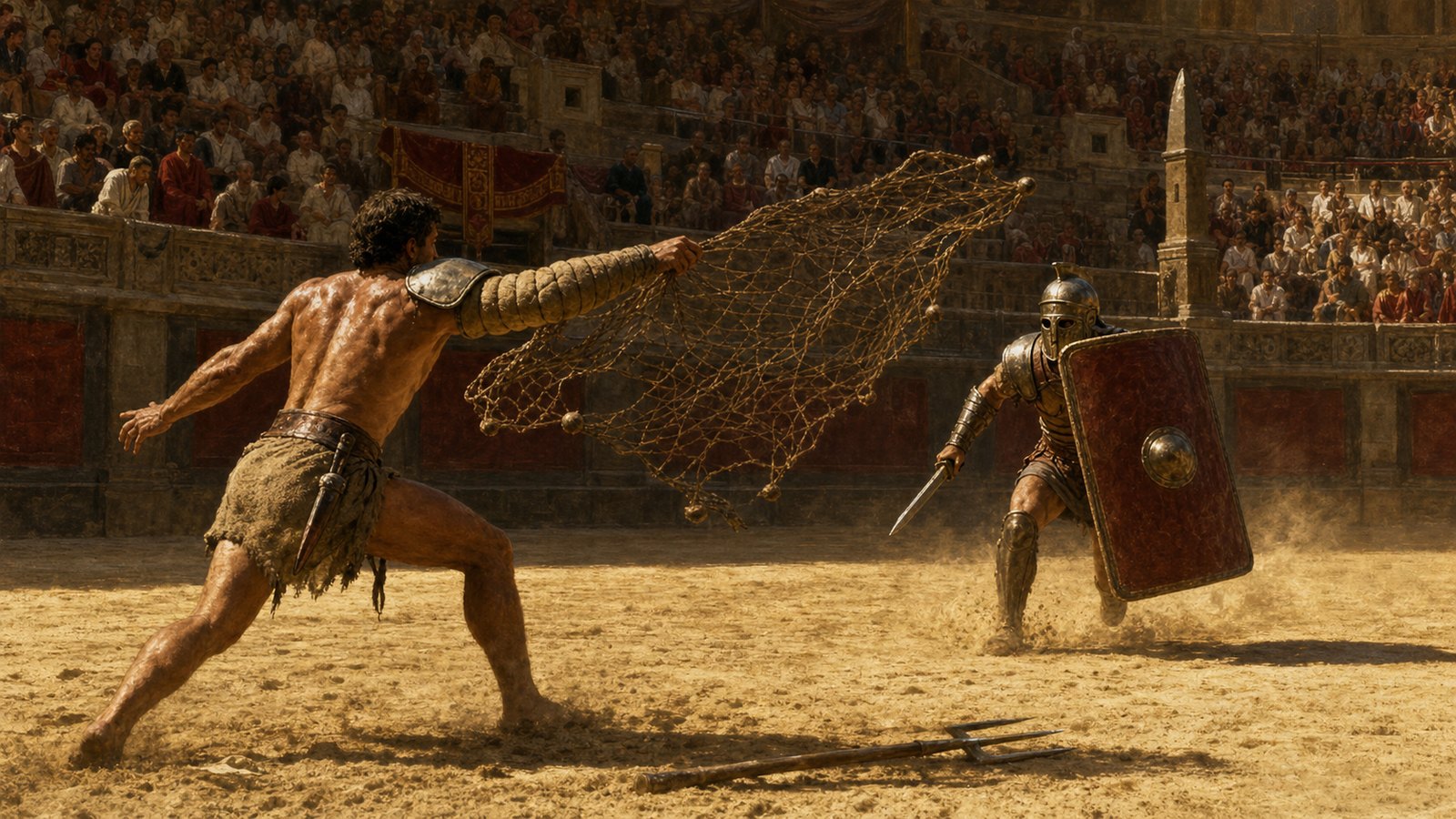
The classic opponent was the secutor, the pursuer. He carried a large shield and sword, protecting himself while closing the interval in which the trident was strongest. His smooth helmet offered few projections for the net to catch, and small eye openings protected the face at the cost of narrower vision and ventilation.
The pairing made mechanical sense. The retiarius wanted time, clear sight and several paces of separation. The secutor wanted pressure, shield contact and sword distance. One fighter’s advantage existed inside the other fighter’s problem. A long pursuit exhausted the enclosed man; a successful rush erased the open fighter’s reach.
This was more interesting than matching identical equipment. Spectators could anticipate choices because the asymmetry was obvious. If the net spread cleanly, the secutor had to shield, evade or cut through confusion. If it fell empty, the retiarius had to decide whether retrieving it was worth the lost seconds.
Roman spectacle repeatedly made equipment carry narrative. Gladiators embodied discipline, danger and social contradiction, but those large meanings arrived through concrete motions: a shield advancing, a net opening and a trident holding the line.
One Cast Could Rearrange the Whole Fight
A weighted edge helped the net spread and fall. The target did not need to be wrapped like a captured fish for the cast to matter. Mesh across a helmet could interrupt vision. Cord around an arm could disturb the sword. Weights against the shield or legs could force a pause long enough for the trident to threaten.
The trident offered multiple points and reach. Held crosswise, it could help maintain separation; directed forward, it forced the shielded opponent to respect a line beyond his sword. Yet length became awkward at close quarters. The weapon that controlled open sand could become difficult when bodies met.
That is where the dagger completed the set. It did not turn the retiarius into an ordinary swordsman, because he still lacked the other fighter’s shield and helmet. It gave him a final tool when net and reach no longer governed the exchange.
No fixed script guaranteed the outcome. A net could tangle its owner, a trident could be trapped by a shield, and an armoured pursuer could tire under sun and metal. The equipment created probabilities and dilemmas, not choreography. Skill appeared in how each fighter navigated the role he had been assigned.
The Bare Face Made Risk Impossible to Hide
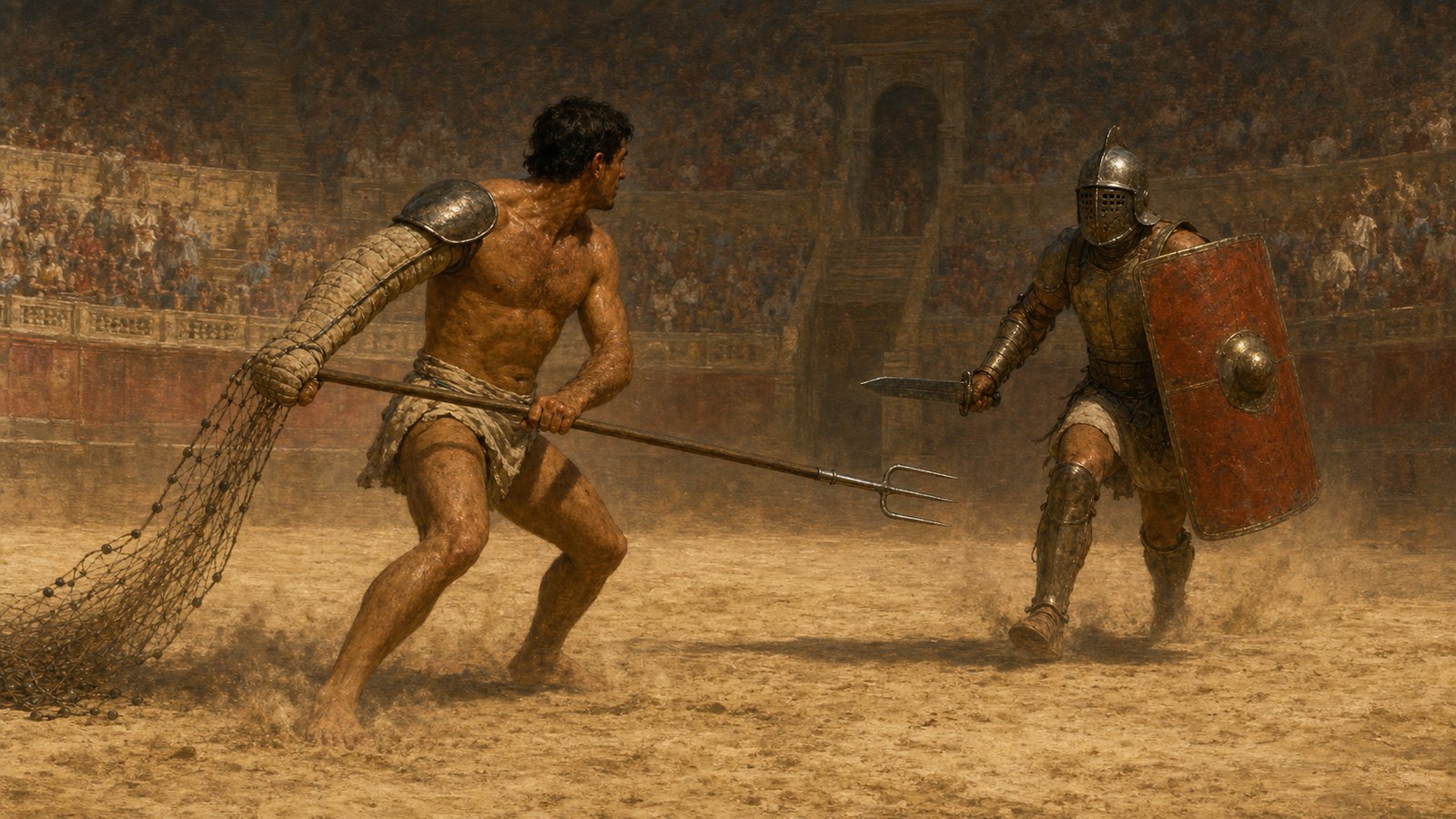
Most heavily armed gladiators appeared through a helmeted identity. The retiarius remained visibly human. The crowd could see strain, concentration and fear on an uncovered face. That exposure sharpened the contrast between his ordinary body and the specialized tools in his hands.
It also affected status. Roman writers could use the net fighter as a charged image because the role lacked the martial presentation of shield and helmet. The equipment evoked labour and fishing more readily than a citizen soldier’s battle line. Arena skill could be admired while the performer’s social position remained degraded.
The matchup made labour imagery collide with military imagery. Net and trident suggested a hunter working water, while sword, helmet and shield suggested the compact violence of an infantryman. Neither resemblance was exact, but the contrast gave spectators a story before they knew either man’s name. One figure trapped and kept away; the other endured and closed in.
That clarity did not make the contest safe or simple. A lightly protected fighter needed repeated correct decisions, whereas one successful rush might give the secutor the exchange he wanted. The crowd could watch the tactical balance change with every step, especially when the retiarius neared the arena wall and open space disappeared behind him.
Small manufactured images carried the type beyond a single match. A terracotta lamp or statuette did not preserve the entire sequence of a fight, but net, trident and bare head made the subject identifiable. Owners could bring arena imagery into dining rooms, shops or evening light, turning one tactical role into a durable visual motif.
The retiarius therefore survived in memory not despite his missing armour but because of it. His uncovered body made his choices legible. His net created one irreversible moment of suspense. His trident drew a boundary the secutor had to cross.
Before the cast, the lightly equipped fighter seemed at a disadvantage. After it, the entire arena understood the bargain. Protection had been exchanged for movement, certainty for opportunity, and a wall of armour for one chance to control the distance.