
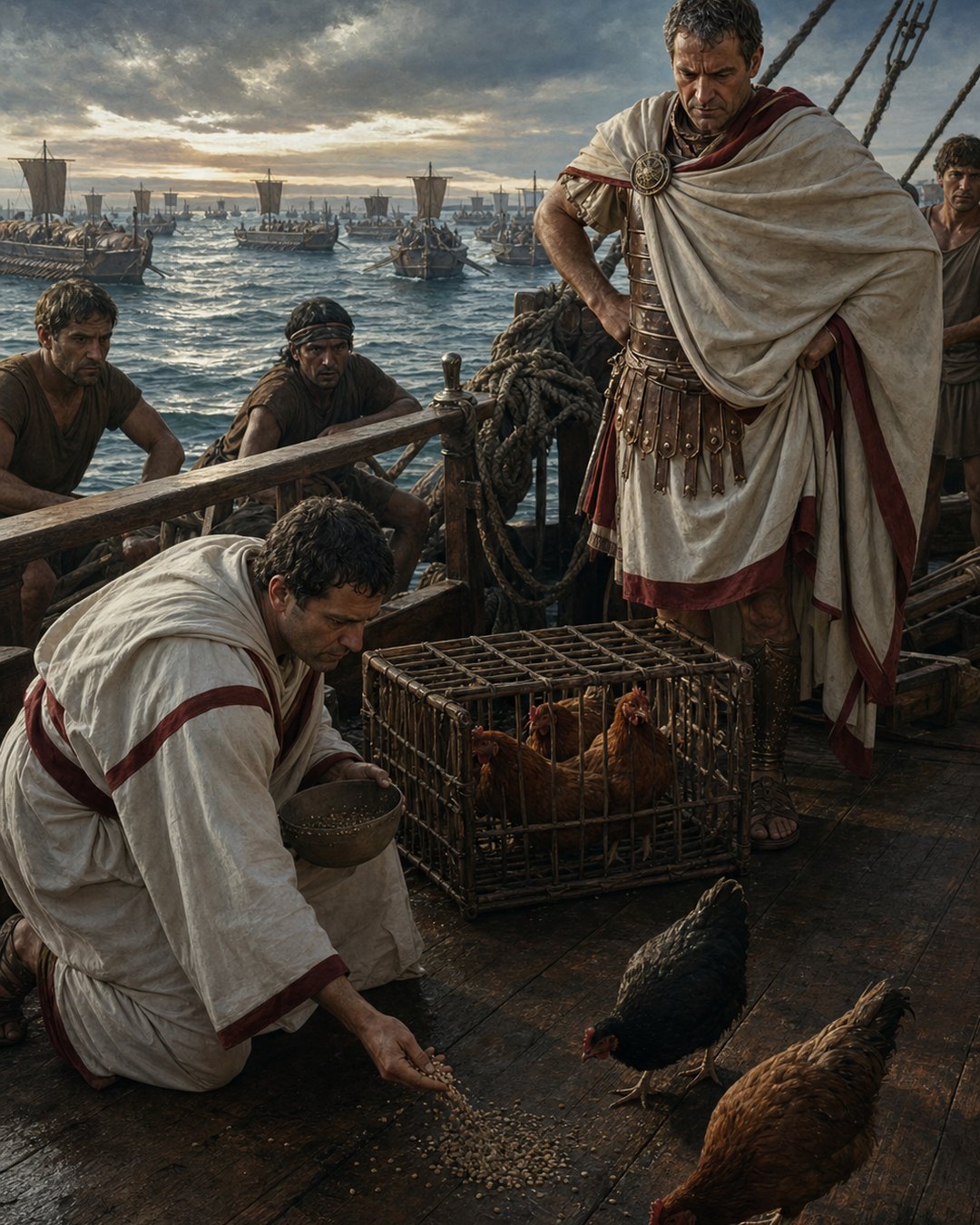
The grain landed on the deck, but the chickens would not eat. For a Roman commander preparing a fleet for battle, this was not a minor problem in animal handling. The birds had been brought aboard precisely because their appetite could be watched, interpreted and reported before thousands of men were committed to an irreversible manoeuvre.
Publius Claudius Pulcher wanted to attack the Carthaginian fleet at Drepana in 249 BCE. Later Roman tradition says that when the sacred chickens refused their food, he ordered them thrown into the sea with the bitter joke that, if they would not eat, they could drink. The fleet then suffered one of Rome’s worst naval defeats of the First Punic War.
The line is too perfect to treat as a deck-side transcript. Cicero preserves it generations later as an example of contempt for divination, while Polybius explains the defeat through surprise, formation and seamanship without mentioning the birds. Put together, the accounts show why the anecdote mattered: ritual gave Romans a way to turn a complicated failure into a judgment about the character of one commander.
A Cage of Birds Carried Rome’s Public Religion to Sea
Roman public action was surrounded by procedures for asking whether the gods favoured an undertaking. On campaign, chickens offered a practical form of auspicy. They could travel with an army or fleet, be released from their cage and offered grain while an attendant trained in the ritual watched the result. The system made a divine question portable.
The favourable sign was called the tripudium solistimum. Cicero describes grain falling from a bird’s mouth and striking the ground as the recognized indication. The detail is physical rather than mystical in appearance: cage door, food, movement, falling grain. Yet within Roman civic practice those ordinary motions carried constitutional and religious weight.
The attendant, the pullarius, mattered as much as the animals. He observed, interpreted and reported. A commander did not privately claim that he had felt encouraged; another person could state what happened. Ritual therefore created a chain of responsibility at the moment when speed, fear and ambition all pressed toward action.
This was not a substitute for reconnaissance or seamanship. It was a separate test of whether action should proceed under proper signs. Like the standards discussed in the legion’s concentrated symbols, the birds turned a large and abstract relationship—here between community, commander and gods—into something people could physically guard and witness.
Drepana Punished a Fleet That Lost Its Shape
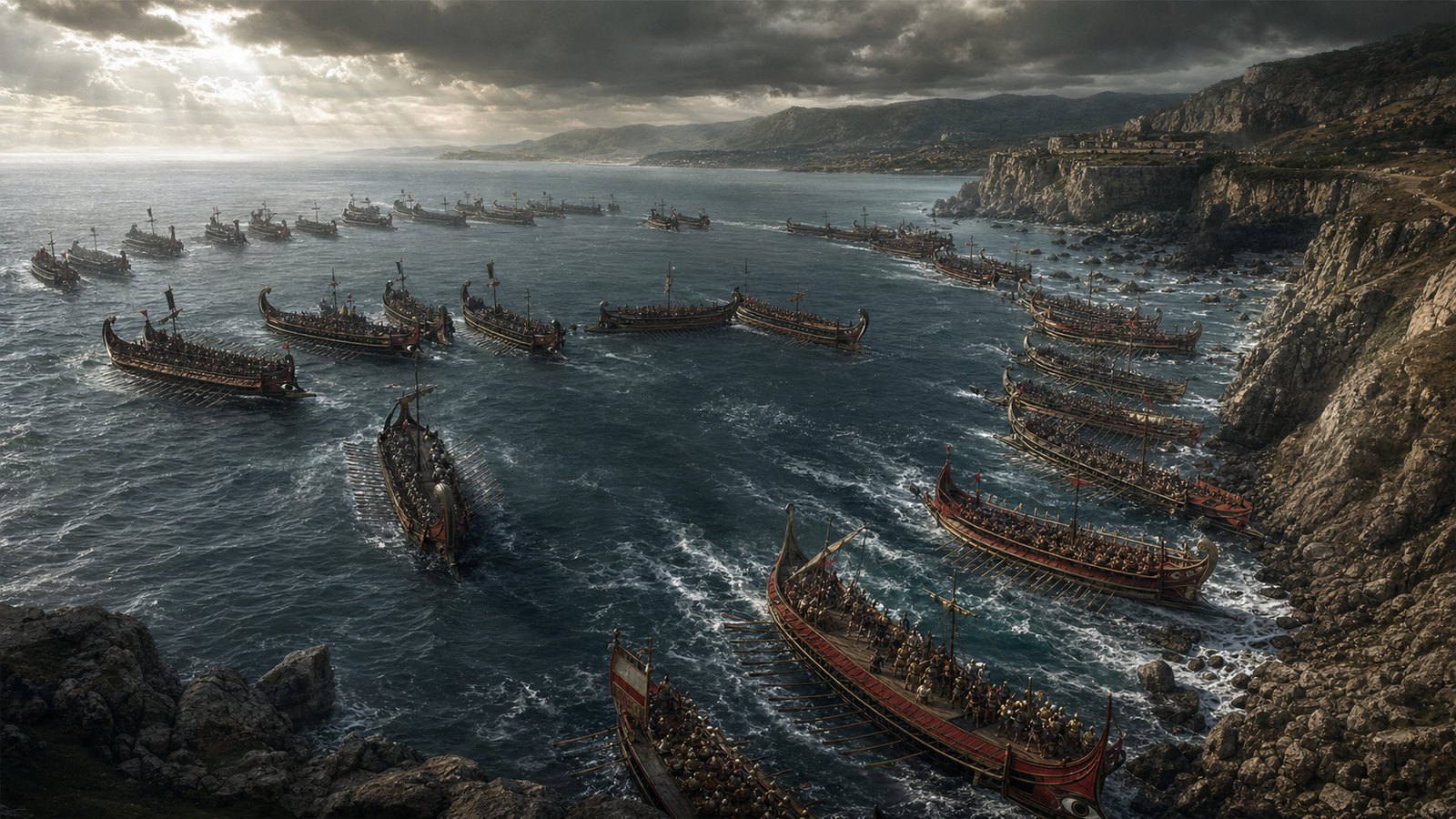
Polybius places the battle inside Rome’s prolonged attempt to break Carthaginian power in western Sicily. Pulcher sailed toward Drepana hoping to catch the enemy by surprise. Darkness and urgency helped conceal his approach, but the Roman fleet did not enter in a clean, compact order. Ships stretched out along the coast while the leading vessels were already nearing the harbour.
The Carthaginian commander Adherbal reacted quickly. Rather than wait to be trapped, he led his ships out by another route and formed in open water. This changed the geometry of the battle. Carthaginian crews had room to manoeuvre, while Roman ships fought with the Sicilian shore behind them and an uneven line beside them.
Polybius emphasizes differences in training and ship handling. The Carthaginians could retreat into open water, turn and renew attacks. Roman crews had less space and cohesion. When pressure mounted, some Roman ships were driven ashore while many others were captured. Pulcher escaped with only a fraction of the force.
That account supplies no need for supernatural causation. Surprise failed, deployment became tangled and a more agile enemy exploited open water. The mechanism resembles the constraint described in the Kızılburun wreck’s burden of maritime logistics: once ships, cargo or formations meet wind, coastline and limited room, intention is not enough.
The Famous Joke Made Impiety Audible
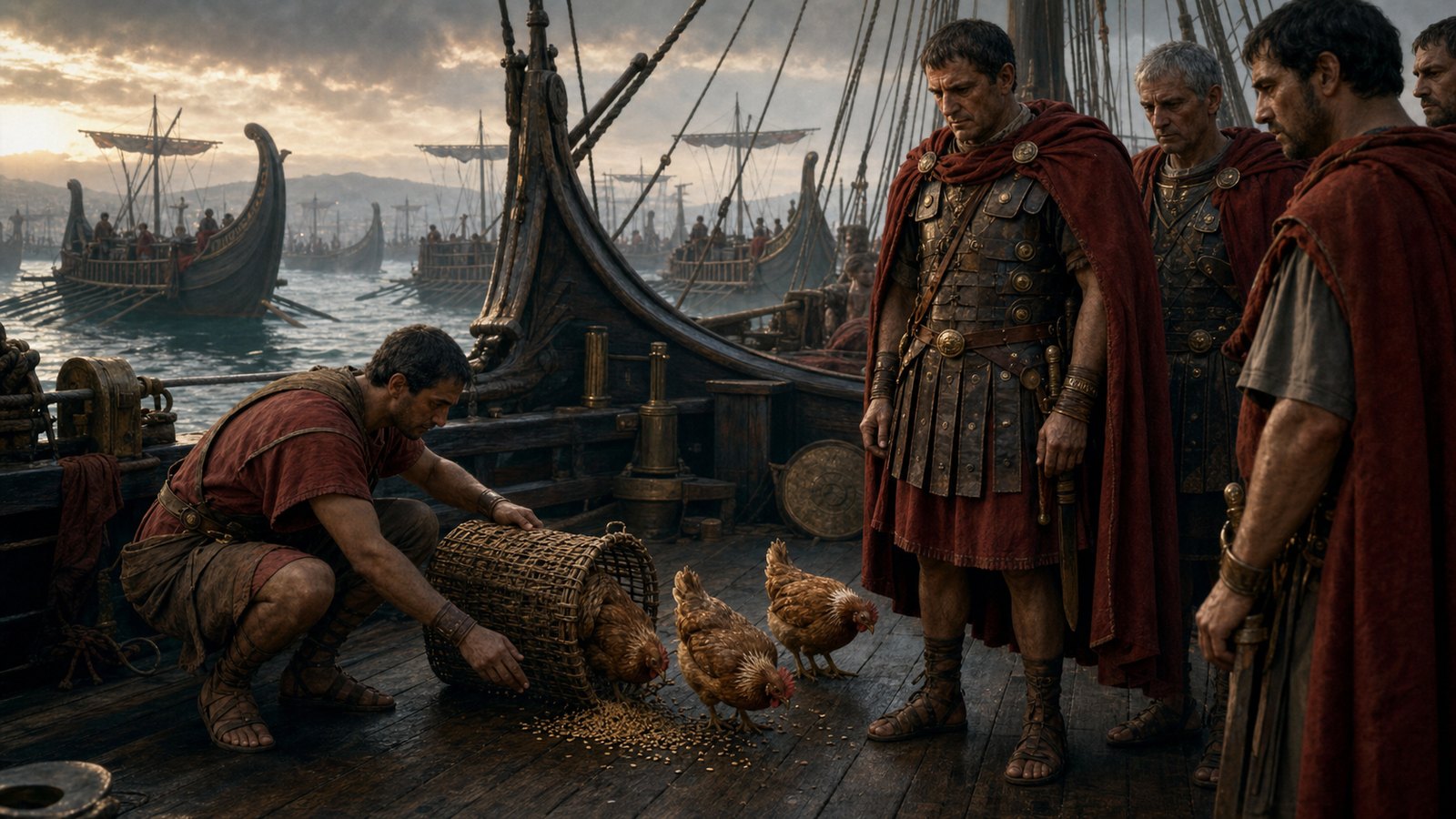
Cicero’s version gives the disaster a sentence. He says Pulcher mocked the gods when the chickens were released from their cage but would not eat. The consul ordered them submerged so that they might drink, since they refused food. The Latin wordplay converted impatience into a performance of contempt.
Its brilliance as an anecdote is also the reason for caution. No one preserved a contemporary logbook quoting the consul. Cicero wrote while debating the character and value of divination, and the story served his argument. It condensed an entire category of religious misconduct into words an audience could instantly remember.
The birds were not blamed for steering Roman ships badly. The joke blamed Pulcher for treating an established public procedure as an obstacle to be ridiculed. A commander might disagree with an interpretation or manipulate timing, but openly humiliating the sign attacked the shared rules by which action acquired legitimacy.
The sea completed the story’s cruel symmetry. The consul allegedly told the chickens to drink; soon Roman sailors and ships were in the water. That narrative balance is literary, not proof that every detail occurred exactly as repeated. It explains why the episode travelled so successfully through Roman memory.
Ritual Forced Ambition to Meet a Witness
Pulcher’s alleged reaction reveals a practical tension. An aggressive commander had assembled ships, crews and a surprise approach. An unfavourable report arrived at the point when delay could destroy the plan. The auspice forced him to choose between momentum and procedure in front of people who could later describe that choice.
This pause was one social function of ritual. It slowed an individual decision by requiring an observable condition beyond the commander’s own confidence. The gods could not be cross-examined, but the pullarius could report whether the birds ate. Soldiers and officers could know that the sign had been taken or ignored.
Such systems were vulnerable to management. Hungry birds, handling, timing and the attendant’s honesty could affect what appeared. Cicero himself discusses cases in which reporting and ritual discipline mattered. That did not make the procedure meaningless. It made control of the procedure part of political and military behaviour.
After victory, a commander could present favourable signs as evidence that action had aligned with divine order. After defeat, neglected signs became evidence that ambition had broken restraint. The chickens therefore participated in accountability even if they contributed nothing to naval tactics. They established what Pulcher had supposedly been warned against doing.
Defeat Needed More Than One Explanation
Roman memory did not have to choose between Polybius and Cicero. One account could explain how a fleet lost; the other could explain what the loss meant. Poor formation, difficult coastal space and Carthaginian skill belonged to military analysis. The submerged chickens belonged to moral and religious analysis.
The distinction matters because disasters create pressure for a legible culprit. Thousands of individual actions produced Drepana’s result, from rowing and signalling to the timing of Adherbal’s exit. A single arrogant sentence gave that complexity a face. Pulcher became the commander who did not merely miscalculate but mocked the warning placed before him.
Later proceedings and political hostility further fixed the association between his command and misconduct. Elite Roman families competed through reputation across generations; memorable failure could attach itself to a name as firmly as a triumph. The Claudian tendency toward pride was a favourite theme in hostile Roman storytelling, and the chickens fit it perfectly.
The episode survives because its objects are so small beside its consequences. A cage, a handful of grain and one report stood on the threshold of a fleet action. The commander crossed that threshold anyway. Whether or not every word of the joke is authentic, Romans used it to insist that authority was not the same thing as freedom from ritual restraint.
Drepana was decided by ships and crews, not by poultry. Yet the sacred chickens made the defeat discussable in another register. They asked whether a man entrusted with public force had respected the procedures that made his decision more than private appetite.
The birds refused their grain; the consul refused the pause. In Roman memory, those two refusals became inseparable. A naval formation broke against a more skilful enemy, while one sharp anecdote preserved the argument that command fails morally before its material consequences become visible.